BookBrief
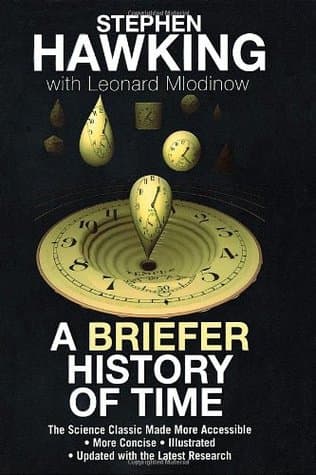
A Briefer History of Time cover
Archivist's Choice

A Briefer History of Time

Stephen Hawking (2005)

Genre

History / Science / Philosophy

Reading Time

240 min

Key Themes

See below

Track Your Reading

Sign in to track this book

Stephen Hawking explains the universe's biggest mysteries, from the Big Bang to black holes, in a way that makes sense, inviting everyone to understand space and time without complex math.

Core Idea

Stephen Hawking's "A Briefer History of Time" explains complex ideas about the universe and time simply. It suggests that how we understand the universe, from its start in the Big Bang to black holes and the search for a single theory, depends on how our idea of time changes. The book notes the importance of quantum mechanics, cosmic inflation, and the direction of time, arguing that a full physical theory should describe reality completely and consistently without needing a god. The main idea is that science, through looking and theorizing, can slowly solve the universe's deepest puzzles, changing common ideas about time and existence. Hawking thinks that by connecting general relativity and quantum mechanics, people can get closer to a 'theory of everything' that explains the universe's past, present, and future, showing a universe that is both understandable and self-contained.
Reading time
240 min
Difficulty
Medium
✓ Read this if...
You are curious about the fundamental questions of the universe, time, and space but want a more concise and updated introduction than the original 'A Brief History of Time'.
✗ Skip this if...
You are looking for an in-depth, mathematically rigorous treatment of cosmology or have already read and fully understood 'A Brief History of Time'.

Core idea

The central argument and framework that powers the entire book.

Stephen Hawking's "A Briefer History of Time" explains complex ideas about the universe and time simply. It suggests that how we understand the universe, from its start in the Big Bang to black holes and the search for a single theory, depends on how our idea of time changes. The book notes the importance of quantum mechanics, cosmic inflation, and the direction of time, arguing that a full physical theory should describe reality completely and consistently without needing a god.

The main idea is that science, through looking and theorizing, can slowly solve the universe's deepest puzzles, changing common ideas about time and existence. Hawking thinks that by connecting general relativity and quantum mechanics, people can get closer to a 'theory of everything' that explains the universe's past, present, and future, showing a universe that is both understandable and self-contained.

At a glance

Reading time

240 min

Difficulty

Medium

Read this if...

You are curious about the fundamental questions of the universe, time, and space but want a more concise and updated introduction than the original 'A Brief History of Time'.

Skip this if...

You are looking for an in-depth, mathematically rigorous treatment of cosmology or have already read and fully understood 'A Brief History of Time'.

Key Takeaways

1

The Elusive Nature of Time

Time is not an absolute, but a relative dimension shaped by gravity and motion.

Quote

Time is entirely a creation of the universe and had a beginning in the Big Bang.

Hawking clearly breaks down the common idea that time is always the same, showing instead that it is relative. He explains that time doesn't pass uniformly but is closely tied to space, forming a single 'spacetime.' This means people in different gravity or moving at different speeds will experience time differently. The book points out that time is not just a background but a part of the universe itself, starting with the Big Bang and possibly ending in a future cosmic event. This challenges the human idea of time as a steady, straig...

Supporting evidence

Einstein's theory of relativity, particularly the concept of time dilation where clocks run slower in stronger gravitational fields or at higher speeds.

Apply this

Recognize that our subjective experience of time is limited. When thinking about cosmic events or theoretical physics, abandon the everyday notion of time as a fixed, universal clock. Consider how even small differences in gravity (like between a mountain top and sea level) subtly affect time's passage, as demonstrated by atomic clocks.

spacetimerelativitytime-dilation
2

The Cosmic Beginning: Big Bang

The universe originated from an incredibly hot, dense state, expanding ever since.

Quote

The universe has not existed forever. Rather, it appears to have begun at a particular moment, the Big Bang.

Hawking presents the Big Bang as the accepted scientific model for how the universe began, describing it not as an explosion in space, but as space itself expanding. He explains how all matter and energy were squeezed into a super dense, hot point, from which the universe quickly grew and cooled, forming particles, then atoms, stars, and galaxies. This model gives a clear story for cosmic evolution, supported by much evidence. It suggests the universe had a clear beginning, challenging ideas of a static or eternal universe and raising...

Supporting evidence

The observation of cosmic microwave background radiation (CMB) – the afterglow of the Big Bang – and the redshift of distant galaxies, indicating an expanding universe.

Apply this

Appreciate the scale of cosmic history. When observing the night sky, understand that the light from distant galaxies carries a story of an expanding universe, originating from a single point. This understanding provides context for our place in the vastness of time and space.

big-bangcosmic-microwave-backgroundredshift
3

Black Holes: Cosmic Prisons

Regions of spacetime where gravity is so intense that nothing, not even light, can escape.

Quote

Black holes are not really 'holes' at all, but incredibly dense objects that warp spacetime so severely that escape is impossible.

Hawking focuses on black holes, describing them as collapsed stars or areas of huge density where gravity is incredibly strong. He introduces the 'event horizon' – the point of no return – past which light and information cannot escape, making direct viewing impossible. His work on 'Hawking radiation' suggests that black holes are not completely black but slowly disappear over long times by giving off particles, a new idea that connects general relativity with quantum mechanics. This idea means black holes are not forever cosmic priso...

Supporting evidence

The detection of X-rays from binary star systems where one component is a black hole, and the observation of gravitational waves from merging black holes.

Apply this

When considering the most extreme environments in the universe, understand black holes as the ultimate manifestation of gravity's power. Their existence forces us to confront the limits of our physical laws and the bizarre nature of spacetime. It also offers a glimpse into the interplay between quantum mechanics and general relativity.

black-holeevent-horizonhawking-radiation
4

The Arrow of Time

Why time flows in one direction, from past to future, and never in reverse.

Quote

The 'arrow of time' is the distinction between the past and the future, which gives time a direction.

Hawking explores the 'arrow of time,' the basic rule that time only moves forward. He names three arrows: the thermodynamic arrow (disorder increases), the psychological arrow (we remember the past, not the future), and the cosmological arrow (the universe expands, not shrinks). He argues these arrows are linked, especially the thermodynamic one. The rise of disorder in the universe gives a physical reason for time's direction. Without this difference, the universe would look the same in the past and future, and life as we know it cou...

Supporting evidence

The Second Law of Thermodynamics, which states that the total entropy of an isolated system can only increase over time, or remain constant in ideal cases.

Apply this

Observe how everything around you, from a breaking glass to the aging process, demonstrates the increase in entropy and the forward march of time. This concept explains why you can't unscramble an egg and offers a deep insight into the fundamental nature of reality and causality.

arrow-of-timeentropythermodynamics
5

Quantum Uncertainty

At the subatomic level, particles behave unpredictably, challenging classical determinism.

Quote

The more accurately you try to measure the position of a particle, the less accurately you can measure its speed, and vice versa.

Hawking goes into the puzzling world of quantum mechanics, showing how it differs from older physics. He introduces Heisenberg's Uncertainty Principle, which says that you can't know both the exact position and speed of a particle at the same time. This natural unpredictability at the quantum level means the universe isn't fully set; chance plays a role. This idea is important for understanding how matter and energy act at their most basic levels and is the basis for things like quantum changes, which are thought to have played a part...

Supporting evidence

Heisenberg's Uncertainty Principle, demonstrated through experiments involving subatomic particles like electrons.

Apply this

When considering the fundamental building blocks of reality, abandon the idea of perfectly predictable, miniature billiard balls. Embrace the inherent fuzziness and probabilistic nature of the quantum world. This understanding is vital for technologies like lasers and semiconductors and for appreciating the universe's foundational mysteries.

quantum-mechanicsuncertainty-principlequantum-fluctuations
6

The Quest for a Unified Theory

Physicists strive for a single theory to describe all forces and particles in the universe.

Quote

The ultimate aim of science is to provide a single theory that describes the whole universe.

Hawking clearly states the scientific goal: to find a 'Theory of Everything' (TOE) that combines general relativity (gravity) with quantum mechanics (the other basic forces – strong, weak, electromagnetic). He explains the current gap between these two main parts of modern physics, which describe different parts of reality (the very big vs. the very small). The book mentions ideas like string theory and M-theory, which suggest that basic particles are tiny vibrating strings. A successful TOE would not only fully explain the universe b...

Supporting evidence

The ongoing research in string theory, M-theory, and quantum gravity, attempting to reconcile general relativity and quantum mechanics.

Apply this

Appreciate that science is an ongoing quest, not a collection of final answers. Understand that the pursuit of a unified theory is not just an academic exercise but a search for the most fundamental truths about existence. This effort drives technological innovation and deepens our philosophical understanding.

theory-of-everythingstring-theoryquantum-gravity
7

Cosmic Inflation and Multiverse

The universe may have undergone rapid expansion, potentially leading to multiple universes.

Quote

Inflation provides a mechanism by which the universe could have started from almost nothing.

Hawking introduces the idea of cosmic inflation, a time of very fast expansion in the early universe, just moments after the Big Bang. This idea solves several problems with the standard Big Bang model, such as the flatness and horizon problems. He also looks at what inflation means, especially the idea of a multiverse – that our universe might be just one of many, each possibly with different physical rules. This mind-bending idea questions our unique place in the cosmos and opens new ways to understand why our universe seems so righ...

Supporting evidence

The observed flatness and homogeneity of the universe, which are explained by inflationary theory. Theoretical models that suggest inflation could lead to eternal inflation and the generation of multiple 'bubble universes'.

Apply this

Consider the profound implications of a multiverse. If our universe is one of many, it changes our perspective on the 'fine-tuning' argument for life. This concept encourages open-mindedness about realities beyond our direct perception and pushes the boundaries of scientific inquiry.

cosmic-inflationmultiversefine-tuning
8

The Role of God in Creation

Science offers a universe that can largely explain itself, reducing the need for divine intervention.

Quote

If the universe is entirely self-contained and has no boundaries or edge, it would have neither a beginning nor an end; it would simply be. What place, then, for a Creator?

Hawking directly discusses science and religion, especially God's role in making and running the universe. While not openly atheist, he argues that a full scientific theory, especially one that describes a self-contained universe without edges (like his 'no-boundary proposal'), leaves little need for a divine 'first cause.' He suggests that the laws of physics are enough to explain the universe's start and growth, making a creator unnecessary for its operation. This view encourages a natural understanding of existence, where the unive...

Supporting evidence

The 'no-boundary proposal' in cosmology, which suggests a universe that spontaneously arises from quantum fluctuations without a need for an initial singularity or external cause.

Apply this

Reflect on how scientific explanations can address questions traditionally reserved for theology. This doesn't necessarily negate spirituality but invites a deeper understanding of the universe's self-organizing principles. Consider that the 'why' questions might eventually be answered by sufficiently advanced 'how' explanations.

cosmologycreatorno-boundary-proposal
9

The Future of the Universe

The universe's ultimate fate depends on its overall density and expansion rate.

Quote

The universe's future is not set in stone; it depends on how much matter and energy it contains.

Hawking explores different ideas for the universe's final fate, mostly decided by the balance between its expansion and the gravity of its matter and energy. He talks about possibilities like the 'Big Crunch' (if gravity eventually stops expansion and pulls everything back together), the 'Big Freeze' or 'Heat Death' (if expansion continues forever, leading to a cold, empty universe), and the 'Big Rip' (if dark energy tears everything apart). While current evidence points to an accelerating expansion leading to a Big Freeze, Hawking no...

Supporting evidence

Observations of distant supernovae indicating an accelerating expansion of the universe, suggesting the presence of dark energy and favoring a 'Big Freeze' scenario.

Apply this

Consider the long-term implications of cosmic forces. Our existence is a fleeting moment in the grand cosmic timeline. This understanding can foster a sense of wonder and urgency regarding our impact on the planet, knowing that even the universe itself has a finite lifespan, albeit an unimaginably long one.

big-crunchbig-freezedark-energy
10

The Search for a Complete Understanding

Humanity's relentless pursuit of knowledge to comprehend the universe's fundamental laws.

Quote

The greatest triumph of human reason would be to understand the mind of God.

Beyond the scientific ideas, Hawking points out the human need to understand our place in the cosmos. He frames the search for a unified theory not just as a scientific task but as a deep philosophical one – to 'understand the mind of God,' not in a religious way, but in grasping the basic rules of reality. The book shows humanity's curiosity and our ability to create complex theories about the universe, even when those theories challenge what we commonly think. It highlights that science is a constant process of looking, guessing, an...

Supporting evidence

The historical progression of scientific thought, from ancient Greek philosophers to Galileo, Newton, and Einstein, each building upon previous knowledge to refine our understanding of the universe.

Apply this

Cultivate a sense of intellectual curiosity and an appreciation for scientific inquiry. Recognize that even complex concepts are accessible with clear explanation. Engage with scientific literature to expand your understanding of the universe and challenge your preconceptions. Support scientific research and education as a vital part of human progress.

scientific-methodcosmic-curiosityintellectual-pursuit

Critical analysis

Notable Quotes

Even if there is only one possible unified theory, it is just a set of rules and equations. What is it that breathes fire into the equations and makes a universe for them to describe?

Reflecting on the nature of a 'theory of everything' and the ultimate origin of existence.

The universe doesn't allow perfection.

Discussing the inherent irregularities and quantum fluctuations that prevent a perfectly smooth universe.

We are just an advanced breed of monkeys on a minor planet of a very average star. But we can understand the universe. That makes us something very special.

Emphasizing humanity's unique capacity for understanding the cosmos despite our humble origins.

If we do discover a complete theory, it should in time be understandable in broad principle by everyone, not just a few scientists.

Expressing hope for the accessibility of a final theory of everything.

The fact that we human beings, who are ourselves mere collections of fundamental particles of nature, have been able to come this close to an understanding of the laws governing us and our universe is a great triumph.

Celebrating the intellectual achievement of humanity in comprehending fundamental laws.

The universe is not indifferent to our existence - it's ignorant of it.

Highlighting the impersonal nature of the cosmos regarding human life.

There are grounds for cautious optimism that we may be near the end of the search for the ultimate laws of nature.

Discussing the progress in theoretical physics towards a unified theory.

The arrow of time is the direction in which disorder or entropy increases.

Explaining the concept of the arrow of time through the second law of thermodynamics.

What is it that breathes fire into the equations and makes a universe for them to describe?

Pondering the ultimate cause or mechanism that brings the universe into being, given the laws of physics.

It is a great achievement for humanity to have come to understand so much of the universe, and we should be proud of it.

Reflecting on the collective scientific progress and understanding of the cosmos.

The boundary condition of the universe is that it has no boundary.

Introducing the 'no-boundary proposal' for the universe's origin.

The universe has not always been in existence. It began about 15 billion years ago with the Big Bang.

Stating the widely accepted scientific view on the origin of the universe.

Science is not only a discipline of reason but also one of romance and passion.

Highlighting the emotional and inspiring aspects of scientific discovery.

We are all able to lead lives of purpose and meaning, even if we are not able to fully understand the universe.

Offering a philosophical perspective on human existence and purpose beyond scientific comprehension.

Quiz

Test Your Knowledge

Ready to see how well you understood this book? Take our interactive quiz with 10 questions.

10
Questions
~5
Minutes
?
Best Score

Key Questions (FAQ)

This book is an updated and more accessible version of Stephen Hawking's original 'A Brief History of Time'. It explores fundamental questions about the nature of space and time, the origins and future of the universe, and the role of God in creation, tailored for a general audience.

About the author