BookBrief
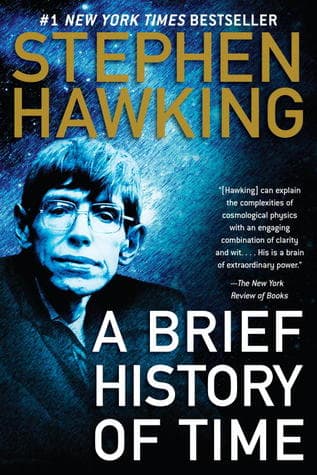
A Brief History of Time cover
Archivist's Choice

A Brief History of Time

Stephen Hawking (1988)

Genre

History / Science / Philosophy

Reading Time

240 min

Key Themes

See below

Track Your Reading

Sign in to track this book

Stephen Hawking explores the universe's greatest mysteries, from the Big Bang to black holes and the nature of space-time.

Core Idea

Stephen Hawking's "A Brief History of Time" gives a clear overview of cosmology, covering the Big Bang, black holes, and the search for a theory that explains everything. The book suggests that the universe follows basic physical laws. If we fully understand these laws, we could explain the universe's beginning, development, and end without needing a divine explanation. It explains ideas like spacetime, quantum mechanics, and time in a way that general readers can understand.
Reading time
240 min
Difficulty
Medium
✓ Read this if...
You are curious about the fundamental questions of the universe, its origins, and its ultimate fate, and want an accessible introduction to complex physics and cosmology without needing a science background.
✗ Skip this if...
You are looking for a deep dive into the mathematical underpinnings of physics, prefer philosophical rather than scientific explanations for existence, or are easily frustrated by abstract concepts.

Core idea

The central argument and framework that powers the entire book.

Stephen Hawking's "A Brief History of Time" gives a clear overview of cosmology, covering the Big Bang, black holes, and the search for a theory that explains everything. The book suggests that the universe follows basic physical laws. If we fully understand these laws, we could explain the universe's beginning, development, and end without needing a divine explanation. It explains ideas like spacetime, quantum mechanics, and time in a way that general readers can understand.

At a glance

Reading time

240 min

Difficulty

Medium

Read this if...

You are curious about the fundamental questions of the universe, its origins, and its ultimate fate, and want an accessible introduction to complex physics and cosmology without needing a science background.

Skip this if...

You are looking for a deep dive into the mathematical underpinnings of physics, prefer philosophical rather than scientific explanations for existence, or are easily frustrated by abstract concepts.

Key Takeaways

1

The Universe Had a Beginning

The Big Bang theory is the prevailing model for the universe's origin.

Quote

The discovery that the universe is expanding was one of the great intellectual revolutions of the twentieth century.

Hawking carefully presents the evidence for the Big Bang, questioning the old idea of a universe that is static and eternal. He explains how Edwin Hubble's observations of galaxies moving away from each other gave the first solid proof of an expanding cosmos. Looking back in time from this expansion leads to a point of extreme density and temperature, the Big Bang. This idea fundamentally changes how we understand existence, suggesting a definite start instead of an endless cycle, and raises questions about what, if anything, came bef...

Supporting evidence

Edwin Hubble's observations in the 1920s showed that galaxies are moving away from us, and the farther away they are, the faster they are receding. This 'redshift' is direct evidence of an expanding universe. Further support came from the discovery of the Cosmic Microwave Background (CMB) radiation in 1964, a faint glow uniformly distributed across the sky, interpreted as the afterglow of the Big Bang.

Apply this

When considering any complex system or problem, trace its origins. Understanding how something began often provides crucial insights into its current state and potential future, whether it's a business, a relationship, or a scientific theory.
big-bangcosmic-expansionredshift
2

Black Holes Are Not So Black

Black holes emit radiation and eventually evaporate, blurring the line between nothingness and existence.

Quote

Black holes ain't as black as they are painted. They are not the eternal prisons they were once thought.

Hawking's most famous contribution, 'Hawking Radiation,' changed our understanding of black holes. Before, black holes were thought to be gravitational traps from which nothing could escape. He theorized that quantum effects near the event horizon cause black holes to release particles and slowly lose mass, eventually disappearing. This idea connects general relativity and quantum mechanics, two main parts of modern physics that often seem to conflict. It suggests that information might not be completely lost inside black holes, which...

Supporting evidence

Hawking's theoretical derivation of 'Hawking Radiation' in 1974, which predicts that black holes should emit a thermal spectrum of particles due to quantum fluctuations near the event horizon. While not yet directly observed due to the faintness of the radiation from astrophysical black holes, it's a widely accepted theoretical prediction.

Apply this

Challenge seemingly absolute truths. Just as black holes were thought to be ultimate endpoints, many ideas or situations might have hidden mechanisms for change or decay. Look for the subtle interactions that can lead to unexpected outcomes.

black-holeshawking-radiationevent-horizonquantum-mechanics
3

The Arrow of Time

Time's direction is defined by increasing disorder, not just by psychological perception.

Quote

The arrow of time is the direction in which disorder or entropy increases.

Hawking examines why time seems to move in only one direction, from past to future. He talks about three 'arrows of time': the psychological (our memory of the past), the thermodynamic (increase of disorder or entropy), and the cosmological (expansion of the universe). He argues that the thermodynamic arrow, the irreversible increase in entropy according to the second law of thermodynamics, is key. This means time's direction is tied to the universe's change from an ordered state to one that is increasingly disordered. This gives a ph...

Supporting evidence

The Second Law of Thermodynamics, which states that the total entropy (disorder) of an isolated system can only increase over time. Hawking uses examples like a broken teacup (easy to break, impossible to spontaneously reassemble) to illustrate this irreversible increase in disorder.

Apply this

Recognize that progress often involves a trade-off with order. While we strive for efficiency and structure, the natural tendency of systems is towards disorder. Managing this 'entropy' is key to maintaining any complex system, be it a project, an organization, or even personal habits.

entropythermodynamicsarrow-of-timedisorder
4

The Universe Doesn't Need a Cause

The 'no-boundary proposal' suggests a self-contained, spontaneous origin.

Quote

So long as the universe had a beginning, we could suppose it had a creator. But if the universe is really completely self-contained, having no boundary or edge, it would have neither beginning nor end: it would simply be. What place, then, for a creator?

Hawking explores the deep philosophical questions about the universe's origin, especially his 'no-boundary proposal.' This theory, developed with James Hartle, suggests that the universe might not have had a clear starting point in time, much like the North Pole on Earth, which is at 90 degrees north latitude but has no 'north' of it. In this model, the universe's initial state is described by quantum mechanics, where space-time curves back on itself in imaginary time, removing the need for a single, 'caused' beginning. This idea chal...

Supporting evidence

The 'no-boundary proposal,' which describes the universe's initial state as a 'closed surface' in imaginary time, similar to the surface of a sphere. This removes the problem of a singularity and the need for a 'first cause' outside the universe's own laws.

Apply this

When faced with seemingly unanswerable 'why' questions, consider if the question itself assumes a framework that might not apply. Sometimes, the 'cause' is internal to the system, or the concept of 'beginning' is not what we intuitively understand.

no-boundary-proposalquantum-gravityimaginary-timecosmology
5

Unification is the Holy Grail

Physics seeks a single theory to explain all forces and particles.

Quote

The goal of science is to provide a single theory that describes the whole universe.

Hawking stresses the ongoing search in physics for a 'Theory of Everything' (TOE), a single, consistent framework that unites all basic forces (gravity, electromagnetism, strong nuclear, weak nuclear) and describes all particles. He discusses progress made with the Standard Model, which combines the electromagnetic and weak forces, but points out the major challenge of adding gravity. The conflict between general relativity (describing gravity and the large-scale universe) and quantum mechanics (describing the microscopic world) is th...

Supporting evidence

The historical progression from Newton's gravity to Maxwell's unification of electricity and magnetism, and then the electroweak unification within the Standard Model. The ongoing search for a theory of quantum gravity, such as string theory or loop quantum gravity, is the current frontier.

Apply this

Look for overarching principles or unifying themes in disparate areas of knowledge or work. Often, seemingly unrelated problems or concepts can be understood better when viewed through a common lens or a broader framework.

theory-of-everythingquantum-gravitystandard-modelunification
6

Wormholes and Time Travel: Possible, But Impractical

While theoretically plausible, time travel faces severe physical and paradox challenges.

Quote

It seems that if one wants to travel into the past, one has to go to a place where space-time is highly curved, such as a black hole.

In a later chapter, Hawking looks at the possibilities of wormholes and time travel, acknowledging their theoretical basis in general relativity. He explains that wormholes could act as shortcuts through space-time, connecting distant places or even different times. However, he quickly notes the huge practical difficulties: creating and keeping a wormhole open for travel would need 'exotic matter' with negative energy density, a substance not known to exist or be made in enough quantity. Also, the 'grandfather paradox' and other issue...

Supporting evidence

General relativity allows for solutions that describe wormholes (Einstein-Rosen bridges) and closed timelike curves (CTCs), which imply the possibility of time travel. However, the requirement for 'exotic matter' with negative energy density to keep wormholes open and the theoretical challenges of paradoxes (like the grandfather paradox) are key counterarguments.

Apply this

Distinguish between theoretical possibility and practical feasibility. Many things might be conceivable within the rules of a system, but the resources, energy, or collateral effects required make them impossible or undesirable in reality. This applies to technological innovation as much as to physics.

wormholestime-travelgeneral-relativitycausalitychronology-protection
7

The Nature of Scientific Theories

A theory's validity rests on its ability to make predictions and be disproven.

Quote

Any physical theory is always provisional, in the sense that it is only a hypothesis: you can never prove it.

Hawking provides a basic lesson in the philosophy of science: theories are not absolute truths but temporary models that explain observations and make predictions that can be tested. A good scientific theory must be able to be disproven, meaning there must be an experiment or observation that could show it wrong. If a theory consistently makes correct predictions and passes strict tests, it becomes more credible, but it is never 'proven' in a mathematical sense. This cycle of hypothesis, prediction, observation, and improvement drives...

Supporting evidence

Hawking frequently revisits the shift from the geocentric model to the heliocentric model, and later from Newton's gravity to Einstein's general relativity. Each successive theory offered better predictions or explained phenomena the previous one couldn't, without ever being 'proven' absolutely, but rather becoming the best available explanation until a better one emerged.

Apply this

Adopt a critical, evidence-based approach to knowledge. Be open to revising your beliefs when new evidence emerges, and always question the assumptions underlying any claim. Don't seek 'proof' but rather the most robust, predictive, and falsifiable explanations available.

falsifiabilityscientific-methodhypothesispredictiontheory
8

Cosmic Censorship Protects Reality

Singularities are hidden from view, preserving the predictability of physics.

Quote

The idea is that nature abhors a naked singularity just as much as a vacuum cleaner abhors a dirty carpet.

Hawking introduces 'cosmic censorship,' a theory that suggests all singularities (points of infinite density and curvature, like the center of a black hole or the Big Bang) are always hidden behind an event horizon. This means they are never 'naked' and thus cannot directly affect the predictable laws of physics in the observable universe. If naked singularities existed, they could be points where predictability breaks down, allowing anything to emerge from them, making the universe unpredictable. Cosmic censorship ensures that our un...

Supporting evidence

The mathematical properties of solutions to Einstein's equations suggest that singularities formed from gravitational collapse are always enclosed by an event horizon. While not a proven theorem, many physicists believe in some form of cosmic censorship to maintain the deterministic nature of physics.

Apply this

In complex systems, look for 'safety mechanisms' or 'error handling' that prevent catastrophic failures or maintain stability. Sometimes, the inability to observe a problem directly (like a hidden singularity) is what allows the rest of the system to function predictably.

cosmic-censorshipsingularityevent-horizongeneral-relativitypredictability
9

The Universe's Ultimate Fate

Expansion or collapse: the density of the universe determines its end.

Quote

The ultimate fate of the universe is still an open question.

Hawking explores the two main theoretical futures for the universe: continued expansion leading to a 'Big Freeze' or 'Big Rip,' or eventual gravitational collapse leading to a 'Big Crunch.' The average density of matter and energy in the universe determines which will happen. If the density is above a certain level, gravity will eventually stop the expansion and pull everything back together. If it is below, the expansion will continue forever, leading to a cold, dark, empty cosmos. He discusses how observations, especially of the cos...

Supporting evidence

The critical density concept, where the universe's average density relative to this critical value determines its curvature and ultimate fate. Observations of distant supernovae (Type Ia) in the late 1990s suggested that the universe's expansion is actually accelerating, implying the existence of 'dark energy' and favoring a Big Freeze/Rip scenario.

Apply this

Understand how initial conditions and critical thresholds dictate long-term outcomes. Whether in project management, personal finance, or strategic planning, identifying the key variables that tip the balance can help predict future states and inform decisions.

big-crunchbig-freezedark-energycosmic-densityuniverse-fate
10

The Role of Observation in Theory

New technologies constantly refine and challenge our cosmic understanding.

Quote

The greatest triumph of the human intellect is to understand how the universe works.

Hawking consistently stresses that scientific theories, no matter how elegant, must be confirmed or disproven by observation. He points out how advances in technology, from powerful telescopes to satellite missions like COBE, have given important data that either supported or challenged theoretical predictions, leading to better understanding. The book itself was updated to include new observational evidence, showing the dynamic interaction between theoretical physics and empirical data. This ongoing process shows that science is not ...

Supporting evidence

The COBE satellite's discovery of tiny temperature fluctuations in the cosmic microwave background in the early 1990s, which confirmed Hawking's theoretical predictions about the 'wrinkles' in space-time that would eventually form galaxies. This was a direct observational triumph supporting the Big Bang model and inflationary cosmology.

Apply this

Prioritize empirical feedback in any endeavor. No matter how well-conceived a plan or idea, real-world data and observation are essential for validation, refinement, and course correction. Be willing to adapt based on what the evidence tells you, rather than sticking rigidly to initial assumptions.

cosmic-background-explorerobservational-astronomyscientific-progressempirical-evidence

Critical analysis

Notable Quotes

The universe is not static; it is expanding.

Discussing Edwin Hubble's observations and the expanding universe theory.

We are just an advanced breed of monkeys on a minor planet of a very average star. But we can understand the Universe. That makes us something very special.

Reflecting on humanity's place in the cosmos and its capacity for understanding.

Even if there is only one possible unified theory, it is just a set of rules and equations. What is it that breathes fire into the equations and makes a universe for them to describe?

Pondering the ultimate origin and existence of the universe beyond scientific laws.

If we discover a complete theory, it should in time be understandable in broad principle by everyone, not just a few scientists.

Expressing hope for a universally comprehensible 'theory of everything'.

The arrow of time is the direction in which entropy increases.

Explaining the thermodynamic arrow of time and its relation to disorder.

Black holes ain't as black as they are painted. They are not the eternal prisons they were once perceived. Things can get out of a black hole both to the outside and to another universe.

Introducing the concept of Hawking radiation and the non-absolute nature of black holes.

One can make a case for the universe having been created at a certain time in the past, or for its having existed forever.

Discussing different cosmological models for the beginning of the universe.

The greatest enemy of knowledge is not ignorance, it is the illusion of knowledge.

A general reflection on intellectual humility and the pursuit of understanding.

Imaginary time is really another direction of space.

Explaining the concept of imaginary time in the context of quantum gravity and the no-boundary proposal.

So long as the universe has a beginning, we can suppose it had a creator. But if the universe is really completely self-contained, having no boundary or edge, it would have neither beginning nor end: it would simply be. What place, then, for a creator?

Exploring the implications of the no-boundary proposal for the role of a creator.

We shall not cease from exploration, and the end of all our exploring will be to arrive where we started and know the place for the first time.

A quote from T.S. Eliot used by Hawking to describe the journey of scientific discovery.

The boundary condition of the universe is that it has no boundary.

Introducing the 'no-boundary proposal' for the universe's origin.

The laws of science, as we know them at present, contain a number of fundamental numbers, like the size of the electric charge of the electron and the ratio of the masses of the proton and electron... The remarkable fact is that the values of these numbers seem to have been very finely adjusted to make possible the development of life.

Discussing the fine-tuning of the universe for life and the anthropic principle.

However, if one does not believe in a God who would have chosen the initial state of the universe, then it is necessary to ask how the universe began.

Setting up the fundamental question of the universe's origin in the absence of a divine creator.

Quiz

Test Your Knowledge

Ready to see how well you understood this book? Take our interactive quiz with 10 questions.

10
Questions
~5
Minutes
?
Best Score

Key Questions (FAQ)

Stephen Hawking's 'A Brief History of Time' explores fundamental questions about the universe, its origins, nature, and eventual fate. It delves into concepts like space-time, black holes, the Big Bang, and the search for a unified theory of everything.

About the author