BookBrief
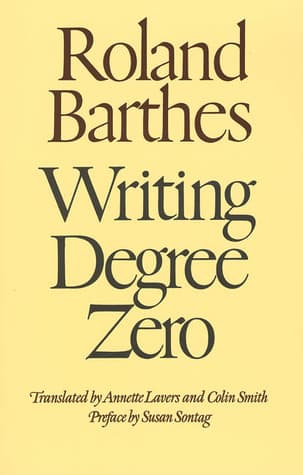
Writing Degree Zero cover
Archivist's Choice

Writing Degree Zero

Roland Barthes (1953)

Genre

Creativity / Philosophy

Reading Time

240 min

Key Themes

See below

Track Your Reading

Sign in to track this book

Roland Barthes examines how literature's revolutionary potential is often undermined by its historical forms and self-serving myths, questioning its inherent political commitment.

Core Idea

Barthes argues that writing is not a clear way to convey meaning. Instead, it is an act shaped by history, society, and ideology. He believes that the idea of literary commitment, common in post-war France, wrongly suggests writers can align their language with a political or moral stance without recognizing language's built-in limits and history. Barthes breaks down the idea of an 'innocent' or 'natural' style, stating that every writing style (classical, romantic, realist) is a deliberate, historically influenced choice, each with its own values and limitations. He introduces 'Writing Degree Zero' as an ideal, though impossible, state of neutrality where language would be free of historical and stylistic traits. This 'white writing' would escape the burden of old literary forms and bourgeois ideas of clarity, aiming for an objective, almost silent, expression. However, Barthes concludes that even this effort to be neutral becomes a style itself. This shows language's unavoidable 'prison' and the writer's inherent separation from a truly direct form of expression. Modern writing, then, is marked by its variety and self-focus, constantly struggling with its inability to be innocent.
Reading time
240 min
Difficulty
Hard
✓ Read this if...
You are interested in the philosophical underpinnings of literary criticism, the relationship between language and ideology, or the historical evolution of writing styles. Essential for students of literary theory, semiotics, or French philosophy.
✗ Skip this if...
You are looking for a practical guide to writing, a light introduction to literary studies, or a book that offers straightforward, unambiguous answers. This is dense, theoretical, and requires careful, reflective reading.

Core idea

The central argument and framework that powers the entire book.

Barthes argues that writing is not a clear way to convey meaning. Instead, it is an act shaped by history, society, and ideology. He believes that the idea of literary commitment, common in post-war France, wrongly suggests writers can align their language with a political or moral stance without recognizing language's built-in limits and history. Barthes breaks down the idea of an 'innocent' or 'natural' style, stating that every writing style (classical, romantic, realist) is a deliberate, historically influenced choice, each with its own values and limitations.

He introduces 'Writing Degree Zero' as an ideal, though impossible, state of neutrality where language would be free of historical and stylistic traits. This 'white writing' would escape the burden of old literary forms and bourgeois ideas of clarity, aiming for an objective, almost silent, expression. However, Barthes concludes that even this effort to be neutral becomes a style itself. This shows language's unavoidable 'prison' and the writer's inherent separation from a truly direct form of expression. Modern writing, then, is marked by its variety and self-focus, constantly struggling with its inability to be innocent.

At a glance

Reading time

240 min

Difficulty

Hard

Read this if...

You are interested in the philosophical underpinnings of literary criticism, the relationship between language and ideology, or the historical evolution of writing styles. Essential for students of literary theory, semiotics, or French philosophy.

Skip this if...

You are looking for a practical guide to writing, a light introduction to literary studies, or a book that offers straightforward, unambiguous answers. This is dense, theoretical, and requires careful, reflective reading.

Key Takeaways

1

The Myth of Literary Commitment

Literature's inherent inability to be truly 'committed' to a political cause.

Quote

Writing is in no way an instrument, it is a manner of being.

Barthes argues that writing, especially within the established forms of 'literature,' often strengthens existing power structures rather than truly challenging them. He sees 'committed literature' (littérature engagée) as a misleading idea. A writer may have political goals, but the formal limits and historical weight of literary language (langue) weaken or take over those intentions. The 'commitment' becomes an aesthetic choice, a style, rather than a radical act. Literature is tied to the bourgeois ideas it often claims to criticize...

Supporting evidence

Barthes traces the historical evolution of French literary styles, demonstrating how each 'écriture' (writing style) became an aesthetic choice rather than a direct political tool, eventually calcifying into a 'myth' of literature's social role.

Apply this

When evaluating any 'political' art, question whether its form and inherent structures genuinely challenge power, or merely aestheticize resistance within acceptable cultural boundaries. Look beyond explicit messages to the underlying semiotics of the medium itself.
littérature-engagéemyth-of-literature
2

Writing as a Moral Choice

Beyond style and form, the writer's ethical stance is embedded in their choice of language.

Quote

Language is a system of signs, but writing is a value.

For Barthes, 'writing' (écriture) is not just a skill or a neutral tool. It is a moral and political act, a 'moral choice' that comes before and supports the specific content. Every writer, knowingly or not, chooses a way of writing that carries historical and ideological weight. This choice of 'écriture' places the writer within a social structure, connecting them with certain class interests or historical movements, even if by accident. This 'writing' is different from 'language' (langue), which is a shared system, and 'style' (styl...

Supporting evidence

Barthes contrasts the 'bourgeois' writing of the 19th century, which aimed for a transparent, 'natural' language, with more self-conscious or experimental forms, each carrying its own moral implications and historical baggage.

Apply this

As a writer, be acutely aware of the historical and ideological implications of your chosen style and vocabulary. Recognize that your 'voice' is not neutral, but a historically situated choice that carries ethical weight. Analyze texts not just for 'what' they say, but 'how' they say it, and what that 'how' implies.

écrituremoral-choice-in-writingstyle-vs-écriture
3

Degree Zero: The Impossible Neutrality

The elusive quest for a 'transparent' or 'innocent' language free from historical baggage.

Quote

Degree Zero is a kind of ideal absence of all style, or at least a style that is so neutral that it becomes transparent.

Barthes introduces 'Writing Degree Zero' (écriture blanche) as a theoretical attempt to achieve language without historical, ideological, or stylistic additions. This 'blank' writing would ideally convey meaning without imposing a social or moral framework, aiming for pure, clear communication. However, Barthes suggests this state is mostly unreachable. Even trying to be neutral becomes a style itself, a conscious rejection of other styles, and thus carries its own historical and ethical meaning. The ideal of 'Degree Zero' highlights ...

Supporting evidence

Barthes discusses Albert Camus's writing as an example that approaches, but never fully achieves, 'Degree Zero.' Camus's 'white writing' attempts to be transparent, yet its very attempt defines it as a distinct 'écriture' with its own implications.

Apply this

When trying to communicate objectively or neutrally, recognize that true neutrality is an ideal, not a reality. Every word choice, every sentence structure, carries implicit biases. Strive for clarity, but be honest about the inherent 'color' of your language. Avoid the illusion that any communication can be entirely 'objective' or 'unfiltered.'

écriture-blancheneutral-languagetransparency-in-writing
4

The Writer's Alienation

How the act of writing distances the author from the world and their own intentions.

Quote

The writer is a kind of permanent institution, and his writing is a kind of permanent ceremony.

Barthes argues that writers, by engaging with 'literature' as an institution, become separated from direct political action and even from their own true voice. The act of writing turns the individual into a 'writer,' a social role with set expectations. The language they use is not a direct expression of their personal will but a historically burdened system. This separation means a writer's revolutionary intentions are often absorbed and neutralized by the form and institution of literature itself. Their 'commitment' becomes a perfor...

Supporting evidence

Barthes' analysis of the French Revolution's writers, who despite their radical aims, still relied on established literary forms that ultimately served to rationalize and aestheticize the revolution rather than truly driving it.

Apply this

If you are a writer or artist aiming for social change, be critically aware of how the institutional demands and historical baggage of your medium might dilute or reshape your message. Consider alternative forms of expression or direct action that bypass traditional artistic channels if your goal is immediate, unmediated impact.

writer-as-institutionalienation-of-the-writerliterature-as-ceremony
5

Language as a Prison

The inherent limitations and ideological constraints embedded within the very structure of language.

Quote

Language is a prison, a system of signs whose meaning is always already inscribed.

Barthes states that language itself (langue) is not a neutral tool but a system loaded with history and ideology. It is a shared institution inherited by the writer, shaping their thoughts before they even begin. Every word, every grammatical structure, carries a history of use and implied meanings that the writer cannot fully escape. This means that even before a writer expresses an idea, the very medium they use is already encoded with societal values and limits. Language, then, works like a prison, limiting expression and often sub...

Supporting evidence

Barthes references Saussure's linguistic theories, emphasizing the arbitrary yet historically fixed nature of the signifier-signified relationship, which dictates that language is a system rather than a transparent conduit.

Apply this

Be highly conscious of the ideological baggage carried by specific words and phrases. When crafting arguments or narratives, consider how the inherent biases of language might be subtly influencing your message or audience's interpretation. Seek to deconstruct and critically examine the 'naturalness' of everyday language.

langueideology-of-languagelinguistic-determinism
6

Style as Biological Destiny

The writer's 'style' is an involuntary, almost physiological emanation, distinct from conscious choice.

Quote

Style is a purely biological phenomenon, the writer's flesh, his voice.

Barthes distinguishes 'style' from 'écriture' (writing). While 'écriture' is a conscious, moral choice that places the writer historically, 'style' is presented as more instinctive and involuntary. It is the unique, almost biological rhythm and texture of a writer's expression, deeply rooted in their individual body and unconscious. Style, in this sense, comes before social and political aspects; it is what makes a writer's voice unique and recognizable, a personal signature that cannot be changed at will. Because it is an unconscious...

Supporting evidence

Barthes compares style to a 'secret,' an 'infra-language' that precedes social function, suggesting it's akin to a physical trait rather than a learned behavior or chosen ideology.

Apply this

Recognize that your 'natural' writing voice (style) is distinct from the deliberate choices you make about how to write (écriture). While your style may give your writing personality, it's your conscious 'écriture' that carries ethical and political weight. Don't confuse personal flair with political efficacy.

style-vs-écriturebiological-styleunconscious-writing
7

The Bourgeois Illusion of Transparency

The historical preference for 'natural' and 'transparent' language as a tool of ideological concealment.

Quote

Bourgeois writing is the writing of absence, of transparency, of the natural.

Barthes critically examines the dominant literary trend, especially in 19th-century French literature, which aimed for 'transparent' or 'natural' language. This style tried to make the medium invisible, creating the illusion that words were a direct window onto reality, rather than a constructed representation. Barthes argues that this 'transparency' is an ideological construct, a strategic move by bourgeois society. By presenting its language as neutral and universal, it hid its own class-specific values and power structures, making ...

Supporting evidence

Barthes points to the rise of realist novels and journalistic prose, which cultivated a detached, objective tone to present their narratives as mirrors of reality, thereby naturalizing bourgeois values.

Apply this

Be suspicious of any discourse that claims absolute neutrality or transparency, especially in media or political rhetoric. Always ask: whose 'reality' is being presented as universal? What ideological assumptions are being masked by a seemingly objective tone? Actively look for the 'hidden' choices in ostensibly 'natural' language.

bourgeois-writingtransparency-mythideological-concealment
8

The Heterogeneity of Modern Writing

The fragmentation of literary forms reflects the crisis of bourgeois society.

Quote

Modern writing has broken with the unity of classical writing.

Barthes observes that modern literature, unlike earlier classical works, has many diverse and often conflicting 'écritures.' This fragmentation is not just an aesthetic change but a symptom of a deeper societal crisis. The decline of a unified bourgeois ideology, which once supported a stable literary style, has led to a breakdown of shared language norms. Writers can no longer assume a universal audience or common values, resulting in many specialized, often unique, forms of writing. This variety reflects a loss of a central 'myth' o...

Supporting evidence

Barthes discusses the emergence of various experimental and fragmented literary forms in the post-war era, contrasting them with the more cohesive and 'natural' styles of the 18th and 19th centuries.

Apply this

When analyzing contemporary art or literature, recognize that stylistic diversity often signals underlying social and ideological fragmentation. Instead of searching for a singular meaning or universal message, appreciate the multiplicity of perspectives and the breakdown of traditional hierarchies. Embrace the inherent complexity and lack of easy answers in modern expression.

modern-écriturefragmentation-of-stylecrisis-of-literature
9

Literature as a Self-Referential System

Literature's primary commitment is to its own existence and perpetuation, not external reality.

Quote

Literature is committed to nothing but the myth of itself.

A main argument of Barthes is that literature, despite claiming to reflect or influence the world, is ultimately a self-focused system. Its primary 'commitment' is to keeping itself going as an institution, a set of forms, and a cultural myth. The 'myth of literature' suggests it holds a special place in society, capable of great insight or revolutionary change, but Barthes believes this is largely an illusion. Writers often engage with literary traditions and forms not to directly address outside reality, but to participate in litera...

Supporting evidence

Barthes' entire historical survey of French literature, where he consistently demonstrates how stylistic choices, even those appearing radical, ultimately become absorbed into the ongoing, self-perpetuating history of literary forms.

Apply this

Approach literature and art with a critical eye, questioning its claims of direct social impact. While art can be inspiring, recognize that its primary function often involves engaging with its own history and conventions. To truly understand its political dimension, analyze how it positions itself within, and potentially challenges, its own institutional boundaries, rather than just its explicit content.

self-referential-literaturemyth-of-literatureinstitutional-literature
10

The Impossibility of Innocent Language

All language is inherently 'guilty' due to its historical and ideological embeddedness.

Quote

The language that a writer chooses is never innocent.

Barthes concludes that 'innocent' language is impossible. There is no pure form of expression free from the influence of history, ideology, and social structures. Every word, every sentence, every 'écriture' is marked by its past uses and the power dynamics within the linguistic system. Even trying to achieve an 'écriture blanche' (Writing Degree Zero) becomes a historically placed choice, thus losing its innocence. This fundamental 'guilt' of language means writers must always consider the ethical and political implications of their ...

Supporting evidence

Barthes' overarching argument throughout the book, demonstrating how even attempts at 'revolutionary' or 'neutral' language inevitably acquire historical weight and ideological connotations.

Apply this

Cultivate a deep critical awareness of language in all its forms. Never assume that any communication is neutral or value-free. Always inquire into the historical context, ideological underpinnings, and power dynamics inherent in the words being used, both by others and by yourself. Embrace the responsibility that comes with using 'guilty' language.

innocent-language-mythguilt-of-languageideological-embeddedness

Critical analysis

Notable Quotes

Language is a plenitude, not a lack.

Barthes's foundational assertion about the inherent richness and completeness of language itself.

Writing is a blind act.

Referring to the writer's lack of full control over the ultimate interpretation of their work.

Writing Degree Zero is a neutral, an inert, a white state of writing.

Defining the concept of 'degree zero' as a stripped-down, style-less form of writing, free from ideological baggage.

Myth is a type of speech.

Introducing the idea that myth operates as a system of communication, transforming history into nature.

Every writer's style is a kind of vertical and mythological dimension of his thought.

Describing style as an almost biological or pre-linguistic force, deeply ingrained in the writer's being.

The language of literature is an asocial language.

Highlighting literature's detachment from the instrumental or functional aspects of everyday communication.

Writing is therefore a way of existing before history.

Suggesting that the act of writing transcends the immediate historical context, creating its own timeless space.

The classical writer uses an adjective as a logical accompaniment to the noun.

Analyzing the precise and functional relationship between words in classical writing, contrasting it with modern styles.

Modern poetry, since it must assume the burden of all the 'poetry' of the world, is always a murder of language.

Discussing how modern poetry, in its attempt to innovate, often deconstructs or 'murders' traditional linguistic structures.

Form is the very site of an alienation.

Arguing that the choice of a particular literary form can inherently alienate the writer or reader from pure expression.

Writing is a praxis.

Emphasizing writing as an active, practical engagement with language and the world, rather than a passive reflection.

The writer is not a prophet, nor a priest, nor a madman.

Rejecting romanticized or mystical notions of the writer, positioning them as a worker of language.

The function of writing is not to communicate, but to signify.

Distinguishing writing's purpose from mere information transfer, focusing instead on its capacity to create meaning.

Any style is a value.

Asserting that even the absence of overt style (like 'degree zero') carries its own specific value and meaning.

Quiz

Test Your Knowledge

Ready to see how well you understood this book? Take our interactive quiz with 10 questions.

10
Questions
~5
Minutes
?
Best Score

Key Questions (FAQ)

Roland Barthes's 'Writing Degree Zero' explores the inherent political nature of literature and the writer's ethical responsibilities. It challenges the prevailing idea that literature must be socially committed, arguing instead that literature often serves only the myth of its own existence.

About the author