BookBrief
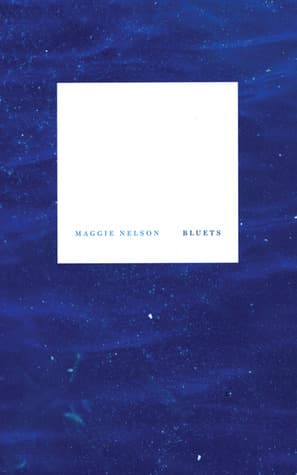
Bluets cover
Archivist's Choice

Bluets

Maggie Nelson (2009)

Genre

Biography / Memoir / Creativity / Philosophy

Reading Time

120 min

Key Themes

See below

Track Your Reading

Sign in to track this book

Maggie Nelson explores love, loss, and seeing through the color blue, turning it into a way to think about desire, suffering, and truth.

Core Idea

Maggie Nelson's "Bluets" is a poetic and philosophical book about the color blue. She uses blue to examine personal experiences of heartbreak, obsession, desire, and how we perceive things. Through numbered prose poems, Nelson combines memoir, art criticism, science, and philosophy. She argues that blue, found everywhere but hard to grasp, reflects how people experience both great suffering and beauty. She thinks that focusing on one idea can reveal complex truths about identity, loss, and finding meaning. The book suggests beauty and comfort can exist even in deep sadness.
Reading time
120 min
Difficulty
Medium
✓ Read this if...
You appreciate experimental non-fiction that blends memoir, philosophy, and poetry, are drawn to explorations of intense emotion (especially heartbreak and obsession), and enjoy books that encourage deep, contemplative reading.
✗ Skip this if...
You prefer traditional narrative structures, are looking for a straightforward story or self-help, or dislike highly abstract and fragmented prose.

Core idea

The central argument and framework that powers the entire book.

Maggie Nelson's "Bluets" is a poetic and philosophical book about the color blue. She uses blue to examine personal experiences of heartbreak, obsession, desire, and how we perceive things. Through numbered prose poems, Nelson combines memoir, art criticism, science, and philosophy. She argues that blue, found everywhere but hard to grasp, reflects how people experience both great suffering and beauty. She thinks that focusing on one idea can reveal complex truths about identity, loss, and finding meaning. The book suggests beauty and comfort can exist even in deep sadness.

At a glance

Reading time

120 min

Difficulty

Medium

Read this if...

You appreciate experimental non-fiction that blends memoir, philosophy, and poetry, are drawn to explorations of intense emotion (especially heartbreak and obsession), and enjoy books that encourage deep, contemplative reading.

Skip this if...

You prefer traditional narrative structures, are looking for a straightforward story or self-help, or dislike highly abstract and fragmented prose.

Key Takeaways

1

The All-Consuming Hue

Love, grief, and obsession are refracted through the singular lens of blue.

Quote

Suppose I were to begin by saying that I had fallen in love with a color.

Nelson's 'Bluets' is about the color blue, but it is also an exploration of how an outside obsession can help process deep inner states like grief, heartbreak, and the search for meaning. Her 'love' for blue acts as an intellectual and emotional anchor, letting her examine her personal suffering, specifically a painful breakup, by filtering it through blue's many associations and scientific properties. This is not escape, but a way of engaging, where the study of blue provides a way to understand subjective experience. It shows how th...

Supporting evidence

Nelson dedicates an entire book to the color blue, cataloging its history, philosophy, and personal significance. Her 'fall in love with a color' serves as the central conceit, through which she funnels all subsequent reflections on heartbreak and existence.

Apply this

When facing intense personal suffering, try to find an external, seemingly unrelated object or concept to channel your thoughts. Researching and collecting information about this 'thing' can provide a structured way to process unstructured emotions, offering both distraction and a new perspective on your internal landscape.

lyric-essayobject-fascinationblue-symbolism
2

The Erotics of Suffering

Pain, especially heartbreak, can be a strangely alluring and even generative force.

Quote

I was trying to write my way out of a heartbreak, and instead I was writing my way deeper into it.

'Bluets' addresses the often uncomfortable truth that suffering, especially the pain of a broken heart, can become a kind of fascination. Nelson describes a state where pain itself becomes a part of identity, a subject of study, and even a form of intimacy with the person lost. This is not simple masochism, but an acknowledgment of how the mind can hold onto the source of its pain, finding a strange comfort or meaning in it. She suggests that sometimes, the only way through pain is to fully experience it.

Supporting evidence

Nelson explicitly details her ongoing obsession with her ex-lover, even as she writes about blue, suggesting that the pain of their separation is a constant undercurrent, almost a companion. She admits to 'nursing' her wound, rather than seeking immediate healing.

Apply this

Instead of immediately trying to 'fix' or escape painful emotions, allow yourself to fully experience them for a defined period. Journaling or creating art during this time can help you understand the nuances of your suffering, potentially transforming it into a source of insight or creative output, rather than just something to be overcome.

heartbreak-as-musepain-processingmelancholy-exploration
3

The Limits of Vision

Perception is inherently subjective, and what we 'see' is often colored by our internal state.

Quote

Perhaps I am not telling you how I loved blue, but how I loved you.

Nelson skillfully blurs the line between objective observation and personal experience. Her examination of blue's scientific properties, history, and cultural meaning is always connected to her personal story of heartbreak and desire. She questions how reliable perception is, suggesting that our emotional state greatly affects what we notice, how we understand it, and what we think is 'true.' The color blue becomes a symbol for this selective vision – sometimes a comfort, sometimes a reminder of loss, always seen through one's own fil...

Supporting evidence

Nelson frequently pivots from an observation about blue (e.g., the specific wavelength of light, its use in religious art) to a personal reflection on her ex-lover or her own emotional state, demonstrating the seamless interplay between objective and subjective. The constant back-and-forth between 'blue' and 'you' is central.

Apply this

When you find yourself intensely focused on one aspect of a situation or person, take a step back and consider how your current emotional state might be influencing your perception. Try to actively seek out alternative perspectives or details you might be overlooking to gain a more holistic understanding.

subjective-perceptionemotional-lenscognitive-bias
4

The Fragmented Self

The lyric essay form mirrors the fractured nature of memory, identity, and grief.

Quote

A series of propositions, of attempts, of fragments.

Nelson's use of the lyric essay, presented as numbered statements, is not just a style choice but also a part of the theme. This broken structure reflects the confused state of mind that often comes with deep grief and heartbreak. Memories, observations, scientific facts, and philosophical thoughts are presented out of order, mirroring how the mind deals with trauma—jumping between ideas, returning to main themes, and never quite finding a clear answer. This form shows human experience more truly, acknowledging that life and emotion r...

Supporting evidence

The entire book is structured as 240 numbered propositions, each a short paragraph or sentence, without a conventional plot or chapter divisions. This deliberate fragmentation forces the reader to connect disparate ideas and experiences.

Apply this

If you're struggling to articulate a complex emotional experience, try writing in fragments or short, disconnected observations rather than a linear narrative. This can help you capture the raw, unfiltered essence of your feelings without the pressure of imposing a logical structure, potentially revealing new insights.

lyric-essay-formfragmented-narrativegrief-processing
5

The Solace of the Object

Objects, even colors, can become repositories for complex human emotions and memories.

Quote

What is blue? Is it a color? Is it a feeling? Is it a memory?

Nelson's deep dive into the color blue shows how objects or ideas can become strong carriers for intense personal and often painful emotions. By collecting blue objects, studying blue things, and thinking about the color's history, she fills it with her own grief, longing, and intellectual curiosity. The color blue stops being just something visual and becomes a complex symbol, a silent confidant, and a direct link to her inner world. This highlights how people often project their inner lives onto the outside world, finding meaning an...

Supporting evidence

Nelson's meticulous cataloging of blue objects (e.g., blue glass, blue birds, blue lights), historical anecdotes (e.g., the scarcity of blue in ancient texts, its use in Medieval art), and scientific facts demonstrates her active engagement with blue as more than just a color.

Apply this

When dealing with overwhelming emotions, find a specific object or concept that resonates with you. Research its history, collect related items, or simply meditate on its significance. This process can help externalize and contain your emotions, offering a sense of control and a unique way to process your experience.

object-relationssymbolic-meaningemotional-projection
6

The Elusiveness of Truth

Even in scientific and historical accounts, 'truth' is often constructed and contingent.

Quote

There are many blues, and even more ways of seeing them.

Beyond her personal story, Nelson questions the idea of objective truth, especially in science and history. She presents different accounts of blue's origins, how it is seen in different cultures, and its scientific properties. This shows that even factual information is often open to interpretation, cultural bias, and the limits of human understanding. This doubt extends to her own story, where she questions if her memories and feelings are true. 'Bluets' suggests that all stories, personal or academic, are ultimately made up, showin...

Supporting evidence

Nelson includes anecdotes about the varying perception of blue in different languages and historical periods (e.g., the absence of a word for blue in ancient Greek), and the subjective experience of blue by different individuals (e.g., colorblindness), undermining a singular 'truth' about the color.

Apply this

When encountering information, whether personal anecdotes or scientific claims, cultivate a critical mindset. Ask yourself: Whose perspective is this? What biases might be at play? What alternative interpretations or facts exist? This helps you move beyond accepting information at face value and encourages a deeper, more nuanced understanding.

epistemologysubjectivity-of-truthcultural-relativism
7

The Paradox of Intimacy

Even the deepest love involves inherent distances and the impossibility of full merger.

Quote

For to wish for another is to wish for a distance.

Nelson's thoughts on blue, especially its links to distance and endless horizons, become a reflection on the inherent separateness in human relationships, even the closest ones. The pain of her breakup is not just about loss, but about realizing the basic boundaries between people. She deals with the idea that true desire often requires recognizing the 'otherness' of the loved one, and that complete merging is an impossible, and perhaps unwanted, fantasy. This idea offers a mature, if sad, view of love, acknowledging its limits along ...

Supporting evidence

Nelson frequently links blue to concepts of distance, the horizon, and the unattainable, paralleling these with the ultimate unknowability of another person, even a beloved one. Her longing for her ex-lover is tinged with the understanding that they are fundamentally separate entities.

Apply this

In your relationships, acknowledge and respect the inherent individuality and 'otherness' of your loved ones. Instead of striving for complete merger or perfect understanding, embrace the beautiful tension of two separate beings connecting, allowing for space and mystery to coexist with intimacy.

relational-distanceintimacy-paradoxseparateness-in-love
8

Finding Beauty in the Abyss

Even in profound sorrow, there exists an aesthetic and intellectual richness.

Quote

And sometimes, all that is left is the beauty of the ruin.

'Bluets' shows how people can find beauty and intellectual stimulation even when suffering greatly. Nelson does not just dwell in her heartbreak; she thinks about it, puts it into history, and makes it beautiful through blue. This process turns raw pain into something artistic and meaningful. It suggests that grief, while terrible, can also open new ways of seeing and appreciating the world's complexities. The book itself is an act of transformation, turning personal pain into a work of literature, showing that even the darkest experi...

Supporting evidence

The entire book exemplifies this, as Nelson meticulously researches and writes about blue while clearly in a state of deep personal grief. The very act of creating such a beautiful, insightful book out of heartbreak is the primary evidence.

Apply this

When experiencing difficult emotions, try to channel them into a creative or intellectual pursuit. This doesn't mean ignoring the pain, but rather using it as fuel for exploration, creation, or learning. This process can help you discover unexpected beauty or meaning in your struggles.

aesthetic-of-griefsublimationcreative-processing
9

The Body as a Blue Canvas

The physical self is a site of both vulnerability and profound sensory experience.

Quote

Perhaps I am a blue body.

Nelson often connects her intellectual and emotional journey with references to the body. She shows its vulnerability, its ability to feel pleasure and pain, and its role in experiencing things. Her mentions of blue bruises, veins, and the body's internal chemistry connect the abstract philosophical thoughts to a real, physical reality. The body is not just a container but an active part of her suffering and understanding. This emphasis reminds us that our intellectual and emotional lives are deeply linked to our physical selves, and ...

Supporting evidence

Nelson references blue in the context of the body: 'the blue of a bruise,' 'the blue of veins,' and even the idea of being 'a blue body' herself, suggesting a profound, almost literal integration of the color into her physical being and suffering.

Apply this

Pay closer attention to your body's sensations and how they correlate with your emotional and intellectual states. Practice mindfulness techniques that connect your mind and body, recognizing that physical experiences often reflect and influence your internal world. This integration can lead to a more holistic self-awareness.

embodied-cognitionsomaticsbody-awareness

Critical analysis

Notable Quotes

Perhaps all the world is blue for her.

Reflecting on a woman who is blind but can perceive blue.

I will never be the kind of person who can just sit down and write.

Discussing the struggle and discipline of writing.

For what is a body but a censor?

Pondering the limitations and filters imposed by the physical body.

A color is a moment.

Considering the ephemeral nature of color and experience.

I have been trying to make myself a home in the world, and it has not been easy.

Reflecting on the challenges of finding belonging and stability.

Is it possible to be nostalgic for a color?

Exploring the emotional connection to the color blue.

The feeling of being sad, for instance, is not a thought.

Distinguishing between raw emotion and cognitive thought.

To be able to find pleasure in something so small, so simple, so common, is a great gift.

Appreciating the beauty and joy in ordinary things.

I wanted to know if I could give myself over to something completely.

Questioning the capacity for total immersion and surrender.

Each time I think I've reached the bottom of what there is to say about blue, I find another crack.

Describing the endless depth and complexity of a single subject.

Maybe love is a form of attention.

Proposing a definition of love based on focused awareness.

How many things are we missing because we're not looking for them?

Encouraging a more observant and curious approach to the world.

I am interested in how we come to know what we know.

Expressing a fundamental curiosity about epistemology and understanding.

There are things I can't say, and things I won't.

Acknowledging the boundaries and choices in self-expression.

Quiz

Test Your Knowledge

Ready to see how well you understood this book? Take our interactive quiz with 10 questions.

10
Questions
~5
Minutes
?
Best Score

Key Questions (FAQ)

'Bluets' is a lyrical and philosophical memoir by Maggie Nelson that explores themes of love, loss, suffering, and the limitations of human perception, all refracted through the author's intense fascination with the color blue. It delves into personal experiences and intellectual inquiries surrounding this specific hue.

About the author