BookBrief
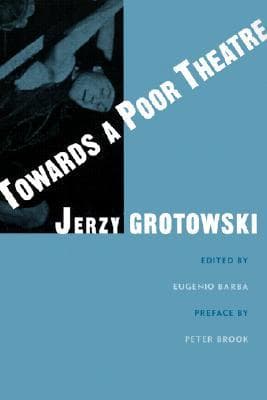
Towards a Poor Theatre cover
Archivist's Choice

Towards a Poor Theatre

Jerzy Grotowski (1968)

Genre

Reference / Creativity / Philosophy

Reading Time

264 min

Key Themes

See below

Track Your Reading

Sign in to track this book

Grotowski's work explores actor-audience connection, removing theatrical excess to show the raw truth of performance.

Core Idea

Jerzy Grotowski's "Towards a Poor Theatre" is a call for theatre without non-essential elements—like scenery, costumes, makeup, or conventional lighting and sound—to focus only on the actor-spectator relationship. Grotowski believed that by removing external theatrical devices, theatre could return to its core, revealing the actor's true self and creating a deep, almost ritualistic meeting with the audience. This 'negative path' aims to go beyond simple entertainment, pushing the actor to engage in self-exploration and public honesty, and the spectator to become an active witness rather than a passive observer. This transforms theatre into a non-religious ritual of shared vulnerability.
Reading time
264 min
Difficulty
Hard
✓ Read this if...
You are a theatre practitioner, director, actor, or scholar interested in experimental theatre, performance theory, or the philosophical underpinnings of actor training and audience engagement. This book is essential for understanding a pivotal movement in 20th-century theatre.
✗ Skip this if...
You are looking for a light read on conventional theatre history, practical playwriting tips, or a general introduction to mainstream theatrical production. This is a dense, philosophical, and intensely theoretical text.

Core idea

The central argument and framework that powers the entire book.

Jerzy Grotowski's "Towards a Poor Theatre" is a call for theatre without non-essential elements—like scenery, costumes, makeup, or conventional lighting and sound—to focus only on the actor-spectator relationship. Grotowski believed that by removing external theatrical devices, theatre could return to its core, revealing the actor's true self and creating a deep, almost ritualistic meeting with the audience. This 'negative path' aims to go beyond simple entertainment, pushing the actor to engage in self-exploration and public honesty, and the spectator to become an active witness rather than a passive observer. This transforms theatre into a non-religious ritual of shared vulnerability.

At a glance

Reading time

264 min

Difficulty

Hard

Read this if...

You are a theatre practitioner, director, actor, or scholar interested in experimental theatre, performance theory, or the philosophical underpinnings of actor training and audience engagement. This book is essential for understanding a pivotal movement in 20th-century theatre.

Skip this if...

You are looking for a light read on conventional theatre history, practical playwriting tips, or a general introduction to mainstream theatrical production. This is a dense, philosophical, and intensely theoretical text.

Key Takeaways

1

The Poor Theatre Imperative

Stripping away theatrical excess to reveal the essence of performance.

Quote

The rich theatre is one that uses a great number of technical tricks, a whole array of complicated machinery… We propose a poor theatre, which is a theatre without these things.

Grotowski's 'Poor Theatre' is not about saving money, but a deep philosophical rejection of lavish theatrical shows. He believed that many sets, costumes, lighting, and sound effects distract from the heart of theatre: the direct meeting between actor and spectator. By removing everything non-essential, Grotowski aimed to find the basic elements of live performance, pushing theatre to its most powerful and real form. This stripping down forces both actor and audience to face raw human experience, focusing on presence, vulnerability, a...

Supporting evidence

Grotowski's work with the Polish Laboratory Theatre, where they eschewed traditional stage design, elaborate costumes, and even conventional lighting, often performing in found spaces or with minimal, symbolic props.

Apply this

Artists and creators in any field can apply this principle by identifying and eliminating superfluous elements in their work. Focus on the core message, emotion, or experience you want to convey, and ruthlessly cut anything that doesn't directly serve that purpose. This forces a deeper engagement with the essential craft.

poor-theatretheatrical-minimalismessentialism
2

Actor-Spectator Relationship

Performance as an act of intimate confrontation and shared vulnerability.

Quote

The actor, by exposing himself, by sacrificing himself, challenges the spectator to self-analysis.

Grotowski changed the actor-spectator relationship, moving it from passive watching to an active, almost ritualistic confrontation. He insisted that the actor should not just 'show' a character but 'offer' themselves, going through self-exploration and public honesty. This extreme vulnerability from the actor is meant to break down normal performance barriers, inviting the spectator into a deep, often uncomfortable, self-reflection. The audience watches not just a story, but a human being in a state of honest, open existence, which in...

Supporting evidence

Grotowski's exercises for actors, focusing on the elimination of 'blocks' and the achievement of total organic response, leading to performances described as 'acts of transgression' or 'secular holiness' where the actor's inner life was laid bare.

Apply this

In any form of communication or presentation, strive for authenticity and vulnerability. Instead of merely presenting information, share a part of yourself or your genuine perspective. This creates a deeper connection and invites a more meaningful response from your audience, fostering empathy and trust.

actor-trainingvulnerabilityaudience-engagement
3

The Via Negativa

Achieving mastery not by adding, but by removing obstacles.

Quote

The process is not one of 'learning' something, but rather of 'unlearning' - removing the blocks that prevent the actor from being fully present and authentic.

Grotowski's training method, the 'via negativa' (negative path), differs greatly from traditional ways of learning skills. Instead of teaching actors new techniques, he focused on finding and removing the physical, vocal, and psychological blocks that stop an actor's natural impulses and true expression. These blocks include learned habits, self-consciousness, old clichés, and resistance to vulnerability. By systematically removing these layers of artifice and inhibition, Grotowski aimed to free the actor's natural ability, allowing f...

Supporting evidence

The rigorous physical and vocal exercises designed to break down habitual patterns and release tension, allowing the actor's body and voice to respond freely and expressively without intellectual interference.

Apply this

In personal and professional development, identify and address your limiting beliefs, bad habits, or inefficient processes. Instead of constantly seeking new tools or information, consider what you can remove or unlearn to unleash your existing capabilities. This applies to writing, problem-solving, or even daily routines.

via-negativaactor-trainingde-conditioningself-improvement
4

Theatre as a Secular Ritual

Creating a sacred space for collective transformation without religious dogma.

Quote

Theatre, when it is truly theatre, is a kind of ritual, a kind of confrontation, a kind of self-sacrifice.

Grotowski saw theatre as having the power for deep, almost spiritual, change, like old rituals, but completely separate from religious beliefs. For him, the theatrical event was a gathering where actor and spectator engaged in a 'non-religious ritual,' a shared experience that explores basic human questions of life, death, and existence. The actor, through their radical self-exposure, acts as a guide, leading the audience through an internal journey. This ritual quality comes not from copying religious rites, but from the intensity, f...

Supporting evidence

Performances like 'Akropolis' or 'The Constant Prince,' where the audience was placed in intimate proximity, sometimes even physically involved in the space, blurring the lines between observer and participant, creating an intense, almost claustrophobic shared experience.

Apply this

When creating experiences for others – whether it's a presentation, a workshop, or a creative project – consider how to elevate it beyond mere information transfer or entertainment. Design moments of heightened focus, shared vulnerability, or profound reflection to create a more impactful and memorable 'ritualistic' experience.

ritual-theatretransformative-artcollective-experience
5

Beyond Interpretation

The text as a springboard for creative exploration, not a sacred blueprint.

Quote

The text is a scalpel, not a bible. It is an instrument to operate on the actor and spectator, not an object to be revered.

Grotowski had a new approach to classic dramatic texts. Unlike traditional theatre, which often prioritizes sticking to the playwright's original meaning, Grotowski saw the text as raw material, a 'score' to be deeply explored and even changed for the actor's and director's current vision. He believed that simply repeating old interpretations made classics lifeless. Instead, the text served as a starting point, a framework for actors to find their own deep connections and personal 'transgressions.' This often led to bold adaptations t...

Supporting evidence

Grotowski's radical adaptations of works by great playwrights like Calderón or Wyspiański, where he often deconstructed narratives, reordered scenes, and focused on specific themes or character relationships that resonated with his own theatrical inquiry, rather than a literal staging.

Apply this

When approaching any established framework, brief, or historical precedent, don't be afraid to question its sacredness. Use it as a starting point for your own creative interpretation and exploration, bending or breaking conventions to find new meaning and relevance. This applies to design, writing, or problem-solving.

textual-deconstructiontheatrical-adaptationcreative-interpretation
6

The Actor-Spectator as Witness

The audience's role in actively completing the performance's meaning.

Quote

The spectator is not only a witness but also, in a certain sense, a co-creator of the event.

Grotowski's 'Poor Theatre' requires an active, involved spectator, moving beyond just watching. By removing distractions and showing raw, intense human experience, the audience is forced to fill in the gaps, to project their own inner world onto the performance. The meaning is not fully decided by the creators but comes from the unique interaction between the actor's offering and the spectator's reception. The audience becomes a 'witness,' not just to a story, but to an act of deep self-exposure, and in doing so, they become part of t...

Supporting evidence

The intimate seating arrangements and unconventional performance spaces used by the Laboratory Theatre, often placing spectators within the action or in extremely close proximity, making escape from the intensity virtually impossible.

Apply this

When presenting information or art, don't over-explain everything. Leave room for your audience to engage their imagination, draw their own conclusions, and connect with the material on a personal level. This fosters deeper understanding and ownership of the message.

active-audienceco-creationwitnessing
7

The Actor's Total Organism

Unifying body, voice, and psyche into a singular, responsive instrument.

Quote

The actor's organism must be trained to respond without resistance, to offer itself totally without interference from the intellect or self-consciousness.

For Grotowski, a truly effective actor is not just someone who can say lines or fake emotions, but a 'whole person' whose body, voice, and mind are connected and immediately responsive. His training aimed to break down the fake separation between these elements, which are often kept separate in normal acting. The goal was to reach a state where physical impulses, vocal expressions, and emotional states happen naturally and at the same time, without intellectual control or self-censorship. This needs great discipline, self-awareness, a...

Supporting evidence

Grotowski's 'Plastiques' and 'Resonances' exercises, which involved extreme physical contortions, vocalizations, and breath work designed to explore and expand the actor's physical and vocal range, connecting them directly to inner impulses.

Apply this

In any demanding creative or physical endeavor, strive for full integration of your faculties. Whether it's public speaking, playing an instrument, or engaging in a sport, practice harmonizing your physical actions, mental focus, and emotional state to achieve peak performance and authentic expression.

actor-trainingholistic-performanceorganic-actingmind-body-connection
8

The Actor as Human Being

Prioritizing the actor's internal journey over external character portrayal.

Quote

The actor who performs an 'act of transgression' reveals himself, not a role.

Grotowski's theatre changed the focus from 'playing a character' to the actor's deep personal journey and self-discovery. He believed that the most compelling theatre moments happen when the actor, through strict training and self-exploration, goes beyond just playing a role to show their own true humanity, weaknesses, and even 'unpleasant' truths. The character becomes a way for this self-exploration, rather than an external mask. This requires great courage and an almost strict dedication from the actor, who must be willing to 'sacr...

Supporting evidence

The emphasis on the actor's 'total response' and the creation of 'scores' of physical and vocal actions that were deeply personal to each actor, allowing their individual humanity to shine through the framework of the text.

Apply this

In leadership or interpersonal communication, strive to bring your authentic self to the interaction. Instead of trying to play a 'role,' share your genuine perspectives, struggles, and strengths. This builds trust and allows for more meaningful connections, fostering a culture of authenticity.

authentic-selfactor-identitypersonal-revelation
9

The Enduring Craft

Theatre's unique power lies in its live, unrepeatable human encounter.

Quote

We are not trying to create a new theatre, but to find out what theatre really is.

In a time increasingly dominated by film and television, Grotowski strongly defended theatre's unique and necessary value. He argued that theatre's essence is its live nature, its direct, immediate human meeting that can never be fully copied or saved. Unlike film, which is a fixed product, live theatre is a dynamic, temporary event, always being created and destroyed in the moment. This temporary nature is its strength, pushing both actor and spectator into a heightened state of presence and involvement. Grotowski's work was a consta...

Supporting evidence

Grotowski's conscious decision to avoid filming or extensively documenting his performances, believing that the true experience could only be had live, in the moment, and any recording would betray its essence.

Apply this

Identify the unique, irreplaceable qualities of your chosen craft or field that cannot be replicated by technology or other mediums. Double down on those intrinsic values. For writers, it might be the nuanced voice; for designers, the tactile experience; for educators, the interactive dialogue. Emphasize the human element.

livenesstheatre-essenceephemeral-arthuman-connection

Critical analysis

Notable Quotes

I am not interested in a theatre that would serve the purpose of entertaining me.

Grotowski's fundamental rejection of theatre as mere entertainment.

The actor's art is a matter of technique, not a matter of inspiration.

Emphasizing the rigorous training and craft required for the actor.

Poor Theatre is not a theatre of poverty, but a theatre that discovers its richness in what is essential.

Clarifying the core concept of 'Poor Theatre' as stripping away non-essentials.

The actor is a person who works with his body, not with his mind.

Highlighting the physical, corporeal aspect of the actor's work.

What is rich is not the abundance of means, but the abundance of possibilities.

Reframing richness in theatre as potential and exploration, not material resources.

To be an actor is to sacrifice oneself.

Describing the profound commitment and personal sacrifice demanded by the actor's craft.

The spectator must be confronted, not entertained.

Advocating for a challenging, active experience for the audience, rather than passive reception.

We do not deal with theatre as a synthesis of various creative disciplines, but as a specific art form.

Distinguishing theatre's unique identity from other arts and rejecting its role as a mere amalgamation.

The actor's work, if it is to be truly creative, must involve an act of transgression.

Suggesting that genuine artistic creation requires breaking boundaries and conventions.

The theatre must cease to be an imitation of life and become life itself.

A call for theatre to be a direct, vital experience rather than a representation.

We are not trying to create a 'new' theatre, but to rediscover the lost theatre.

Implying a return to fundamental, ancient roots and purposes of theatrical expression.

The elimination of elements not essential to the performance is not an act of impoverishment but of purification.

Further defining the 'Poor Theatre' approach as a process of refinement.

The actor is a human being who has given up his personal life to become a tool, an instrument.

Describing the dedication required to transform oneself into an effective artistic instrument.

The purpose of theatre is to meet, to confront, to provoke.

Summarizing the active and challenging role Grotowski envisioned for theatre.

Quiz

Test Your Knowledge

Ready to see how well you understood this book? Take our interactive quiz with 10 questions.

10
Questions
~5
Minutes
?
Best Score

Key Questions (FAQ)

'Poor Theatre' is Grotowski's radical approach to performance that strips away non-essential elements like elaborate sets, costumes, and lighting to focus solely on the actor-audience relationship and the actor's craft. It seeks to reveal the actor's inner self and create a direct, unmediated experience.

About the author