“The hardest part of saying goodbye is knowing that you'll never see them again. Even if you don't want to see them again, it's still hard to know that.”
— Cullen reflects on the disappearance of his brother, Gabriel.

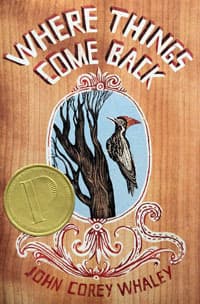
John Corey Whaley (2011)
Genre
Spirituality / Mystery / Young Adult
Reading Time
270 min
Key Themes
See below
Sign in to track this book
A small Arkansas town erupts in 'woodpecker-mania' over a rediscovered, supposedly extinct bird. A teenager grapples with his brother's disappearance, intertwining their search for meaning with a missionary's crisis of faith across continents.
Seventeen-year-old Cullen Witter lives a quiet life in Lily, Arkansas, a town he calls dull. His younger brother, Gabriel, is artistic and sensitive. Their ordinary summer is interrupted when John Barling, a local birdwatcher, claims to have sighted the Lazarus Woodpecker, a species thought extinct since the 1940s. This rediscovery throws Lily into a frenzy of media attention and 'woodpecker-mania.' Tourists flock to town, local businesses rebrand, and everyone talks about the bird. Cullen finds the sudden fame absurd and overwhelming, a stark contrast to his usual quiet life. This event sets the stage for dramatic changes that will soon engulf his family.
The 'Lazarus Woodpecker' craze continues to dominate Lily. Cullen's focus shifts dramatically when his fifteen-year-old brother, Gabriel, disappears. Gabriel, known for his introverted nature and artistic interests, leaves no note or explanation. The Witter family is in shock and despair. Local authorities, including Sheriff Berkley, start a search, but weeks pass with no leads. Cullen struggles to comprehend Gabriel's absence, feeling a deep void and an overwhelming sense of responsibility. His parents, especially his mother, are devastated. The once-stable family unit begins to fray under the immense stress and unanswered questions about Gabriel's fate.
As the search for Gabriel yields no results, Cullen feels increasingly isolated and burdened by his brother's disappearance. He begins to spend time with Cabot, a new girl in town who works at the local diner. Their relationship is complex. Cabot is quirky and perceptive, offering Cullen a temporary escape from his grief, but also challenging his perspectives. She introduces him to new ideas and experiences, providing a nascent sense of connection amidst his loneliness. Meanwhile, the town's fascination with the Lazarus Woodpecker begins to wane, replaced by a lingering melancholy and the unspoken question of Gabriel's whereabouts.
Interspersed with Cullen's story is a parallel narrative about Benton Sage, a young American missionary in Africa. Benton experiences a crisis of faith, questioning his mission's purpose and God's existence after witnessing immense suffering and a lack of tangible impact. He is haunted by personal tragedies and the overwhelming poverty and illness he encounters. Benton's search for meaning and renewed purpose mirrors Cullen's own quest for understanding and closure. This seemingly unrelated storyline, initially presented in brief, disconnected chapters, begins to hint at deeper thematic connections regarding faith, loss, and the search for what is lost.
Cullen's guilt over Gabriel's disappearance intensifies. He constantly replays their last interactions, searching for clues or missed opportunities to prevent his brother's vanishing. He feels immense pressure to be strong for his parents, who are visibly deteriorating under the strain. His mother becomes withdrawn and depressed, while his father struggles to maintain a semblance of normalcy. Cullen shoulders much of the emotional burden, trying to keep the family from falling apart. His relationship with Cabot provides some distraction, but the underlying grief and responsibility for his family's welfare remain constant, shaping his every decision and interaction.
As Cullen and Cabot grow closer, Cullen learns that Cabot is not just a new girl in town. She is the daughter of John Barling, the birdwatcher who claimed to have seen the Lazarus Woodpecker. This revelation recontextualizes much of Cabot's behavior and her presence in Lily. Cullen realizes that her initial interest in him might have been tied to the local celebrity status surrounding his missing brother and the woodpecker incident. The truth about Cabot's identity adds another layer of complexity to Cullen's already tumultuous emotional state, forcing him to question the authenticity of their connection and the motivations of those around him.
Driven by a need for answers and a growing suspicion, Cullen investigates John Barling's claim about the Lazarus Woodpecker. He discovers that the entire 'rediscovery' was a hoax orchestrated by Barling, who fabricated the sighting for personal gain and attention. The bird was never truly seen. It was a desperate act of deception. This revelation shatters the illusion of hope that the woodpecker brought to Lily and underscores themes of appearance versus reality. Cullen confronts Cabot about her father's lies, feeling a profound sense of betrayal, not just for himself, but for his town and the false hope it had embraced.
After uncovering Barling's deception, Cullen, with Cabot's conflicted assistance, devises a plan to expose the hoax. More importantly, he wants to pressure Barling into revealing any knowledge he might have about Gabriel's disappearance. Cullen suspects a connection between Barling's lies and Gabriel's vanishing, believing that Barling might be hiding something crucial. Their plan involves gathering evidence and confronting Barling publicly, hoping that the pressure will crack his composure and force him to confess. This desperate act is Cullen's last attempt to find answers and bring some form of justice or closure to his family.
Cullen and Cabot confront John Barling, cornering him with the evidence of his woodpecker hoax. Under intense pressure, Barling finally breaks down and confesses a horrifying truth: he was involved in Gabriel's disappearance. He reveals that Gabriel, disillusioned and seeking an escape, had intentionally sought him out, drawn by the idea of disappearing and starting anew, perhaps even faking his own death. Barling admits to helping Gabriel leave Lily, providing him with money and a means to escape, believing he was helping the boy find a new life. This confession is devastating for Cullen, confirming his worst fears while also offering a painful, albeit incomplete, answer to his brother's vanishing. Barling's role transforms from a mere deceiver to an accomplice in Gabriel's self-imposed exile.
In the parallel narrative, Benton Sage, utterly broken by his crisis of faith and personal losses in Africa, decides to return to America. He feels a compelling, almost inexplicable pull towards Lily, Arkansas, a town he's only heard about through news reports of the Lazarus Woodpecker and the subsequent disappearance of a local boy. Benton, now devoid of his religious convictions, is searching for any form of meaning or purpose, and the unresolved mystery of Lily seems to offer a strange, dark beacon. His journey back home is a pilgrimage of despair and a desperate search for something to believe in, even if it's just the truth behind a local tragedy.
Benton Sage finally arrives in Lily, drawn by the news surrounding Gabriel's disappearance. His arrival coincides with the revelation of Barling's involvement. Overwhelmed by his own despair and a twisted sense of justice, Benton confronts John Barling, holding him responsible for the pain and deception in the town. The confrontation escalates quickly, culminating in a violent act where Benton shoots and kills Barling. This shocking climax brings the two seemingly separate narratives crashing together, revealing the destructive power of lost faith, broken hope, and the desperate search for meaning. Cullen witnesses the aftermath, forever scarred by the tragic events that have consumed his town and family.
In the aftermath of Barling's murder and Benton's arrest, Lily is left to pick up the pieces. The truth about the woodpecker hoax and Gabriel's calculated disappearance is now public, but it brings little solace. Cullen is left with the profound grief of losing his brother, the betrayal of Barling, and the trauma of the violence. While Gabriel's physical whereabouts remain unknown, Barling's confession provides some closure, albeit a painful one, regarding his intentional departure. Cullen must now navigate a future forever altered by these events, finding a way to move forward, to piece together his own identity, and to reconcile with the lingering questions of faith, hope, and where things truly come back.
The Protagonist
Cullen transforms from a passive observer of his dull life to an active, determined investigator of his brother's disappearance and the town's deceptions, ultimately maturing through profound loss and the search for truth.
The Supporting/Central Mystery
Gabriel's arc is largely understood through his absence; he seeks to disappear and redefine himself, ultimately achieving a form of escape, though his future remains unknown.
The Supporting
Cabot moves from being an enigmatic love interest to a conflicted ally, revealing her own vulnerabilities and moral struggles.
The Antagonist
Barling's arc reveals him as a desperate deceiver whose lies unravel, culminating in his violent death.
The Supporting/Catalyst
Benton's arc is one of spiritual disillusionment and a descent into despair, culminating in a violent act that reflects his profound loss of faith.
The Supporting
Her arc is one of profound grief and deterioration in the face of her son's disappearance, eventually facing the painful truth.
The Supporting
His arc shows a father struggling to hold his family together while grappling with his own grief and the slow erosion of hope.
The Supporting
Sheriff Berkley's arc is limited to his official role, diligently but fruitlessly investigating Gabriel's vanishing until the truth is forced out.
The most pervasive theme in the novel is the impact of loss and the grieving process. Cullen experiences the loss of his brother, Gabriel, which permeates every aspect of his life and the lives of his parents. The family's disintegration due to Gabriel's absence shows the emotional and psychological toll of losing a loved one, especially without closure. This grief extends beyond the family, as the town of Lily loses its initial hope and excitement over the 'Lazarus Woodpecker,' replaced by a collective melancholy and the weight of the unsolved mystery. Benton Sage's storyline also explores loss, specifically the loss of faith and purpose in the face of suffering.
““I learned that there are two forms of hope: the hope that is something and the hope that is nothing. I don’t know why I’m telling you this, but I think it’s important. The hope that is something is a thing with feathers, I guess. The hope that is nothing is just that. Nothing.””
Both Cullen and Benton Sage search for meaning in a world that often seems absurd or cruel. Cullen searches for meaning in Gabriel's disappearance, in his relationships, and in the truth behind the town's deceptions. He grapples with the 'why' behind the tragedy. Benton, a missionary, searches for spiritual meaning and struggles with a crisis of faith, questioning God's existence and purpose in the face of human suffering. The novel explores how individuals cope when their established beliefs or understanding of the world are shattered, and what they might turn to in their desperate search for something to believe in.
““I guess I just want to know that when I’m gone, I won’t be completely forgotten. That someone will remember me. That I won’t just disappear into nothing.””
The novel is built around a central deception: the hoax of the Lazarus Woodpecker. This fabricated rediscovery brings false hope and a carnival-like atmosphere to Lily, masking the underlying reality of the town. John Barling's deception shows how easily people can be swayed by a compelling narrative, even when it's untrue. This theme extends to Gabriel's disappearance, which is initially perceived as a tragic vanishing but is ultimately revealed to be an intentional act of self-exile. The characters, especially Cullen, must learn to look beyond appearances and uncover the often painful truths hidden beneath the surface of events and people.
““There are some things you can’t make come back. Some things you can’t fix. And there are some things you just have to live with.””
Cullen's journey through the summer of Gabriel's disappearance is a coming-of-age story. He is forced to confront adult themes of loss, betrayal, responsibility, and the harsh realities of the world earlier than he might have otherwise. His relationship with Cabot, his efforts to hold his family together, and his pursuit of the truth all contribute to his maturation. He moves from a somewhat naive perception of his 'dull' town to a more complex understanding of human nature, grief, and the resilience required to navigate a world where things don't always come back.
““It’s about a lot more than what Cullen calls, 'that damn bird.' It’s about the dream of second chances.””
Two seemingly unrelated storylines that converge thematically and dramatically.
The novel employs a dual narrative structure, alternating between Cullen Witter's story in Lily, Arkansas, and Benton Sage's experiences as a missionary in Africa. Initially, these narratives appear disconnected, but they are thematically linked by shared explorations of loss, faith, and the search for meaning. The gradual weaving together of these threads builds suspense and foreshadowing, culminating in a dramatic and tragic convergence where Benton's despair directly impacts Cullen's world, creating a powerful and unexpected climax.
A plot element that initially drives the story but is ultimately revealed as a deception.
The Lazarus Woodpecker serves as a classic MacGuffin, a plot device that sets the story in motion and captures the attention of the characters and the reader. Its 'rediscovery' sparks the initial frenzy in Lily and provides a backdrop for Gabriel's disappearance. However, the bird itself is ultimately unimportant to the core mystery; it is a hoax. Its deceptive nature highlights themes of appearance versus reality and the false hopes that can be generated, making it a crucial, albeit ultimately fake, catalyst for the plot's true events.
Cullen's perspective, while honest, is limited by his age and lack of complete information.
While Cullen is a generally trustworthy narrator, his perspective is inherently limited by his age, emotional state, and the information available to him. He presents events as he experiences and interprets them, which means the full truth of Gabriel's disappearance and John Barling's motivations is gradually revealed to him (and thus to the reader). This subtle unreliability creates suspense and allows for twists, as Cullen's initial assumptions are challenged and overturned, forcing him to re-evaluate his understanding of his family, his town, and himself.
Hints and clues throughout the narrative that predict future events or revelations.
The novel uses various forms of foreshadowing to build suspense and thematic depth. Gabriel's melancholic nature and desire for escape hint at his intentional disappearance. The absurdity and eventual unraveling of the Lazarus Woodpecker hoax foreshadow the deeper deceptions and tragic events to come. Benton Sage's escalating crisis of faith and despair subtly foreshadow his violent actions, connecting his emotional state to the eventual climax in Lily. These subtle hints create a sense of impending doom and thematic resonance between the seemingly disparate plotlines.
“The hardest part of saying goodbye is knowing that you'll never see them again. Even if you don't want to see them again, it's still hard to know that.”
— Cullen reflects on the disappearance of his brother, Gabriel.
“Sometimes you have to be able to let things go, even if you don't want to. Even if it's the hardest thing you've ever had to do.”
— Cullen's internal struggle with the unknown fate of Gabriel.
“It's funny how the things you think will last forever are often the first to go.”
— Cullen observing the changes in his life and town.
“Maybe the whole point of life is just to find someone who gets you, and then hold on to them for dear life.”
— Cullen's thoughts on human connection and relationships.
“There are some things that, once you see them, you can never unsee. And those things change you.”
— Cullen grappling with disturbing discoveries related to the mystery.
“Sometimes the most important things are the ones you can't see.”
— A thematic idea related to faith, hope, and the unknown.
“You can't always control what happens to you, but you can control how you react to it.”
— Cullen considering his agency amidst difficult circumstances.
“The world keeps moving, even when you feel like your own world has stopped.”
— Cullen's realization as life continues despite his personal tragedy.
“Maybe not knowing is just another way of knowing. Maybe it's knowing that there's always something more.”
— Cullen's philosophical musings on the nature of mystery and the unknown.
“It's hard to believe in miracles when you've seen so much proof that they don't exist.”
— Cullen's skepticism in the face of suffering and unanswered prayers.
“Every time you think you know something, the world just turns around and proves you wrong.”
— Cullen's experience with the shifting truths and revelations in the story.
“Grief is a strange thing. It can make you feel like you're the only person in the world, even when you're surrounded by people.”
— Cullen's isolation in his sorrow.
“Sometimes the things we search for the hardest are right in front of us, we just don't know how to see them.”
— A reflection on the elusive nature of answers and understanding.
“There's a difference between being lost and being found. But sometimes, you have to be a little lost to find your way.”
— Cullen's journey of self-discovery amidst the search for his brother.
Ready to see how well you understood this book? Take our interactive quiz with 10 questions.

Biography coming soon.

Kay Lynn Mangum
4.3
Stormie Omartian
4.3
Jerry Bridges
4.3
Walter Brueggemann
4.3

Rhonda Byrne
4.3
Brother Lawrence
4.3

Joseph Campbell
4.3

Unknown
4.3