BookBrief
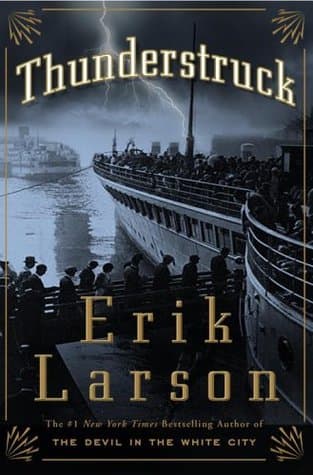
Thunderstruck cover
Archivist's Choice

Thunderstruck

Erik Larson (2006)

Genre

Biography / History / Mystery / Science

Reading Time

9-12 hours

Key Themes

See below

Track Your Reading

Sign in to track this book

In an era of scientific marvels and Edwardian opulence, a meek doctor's desperate attempt at the perfect murder collides with Marconi's revolutionary wireless, igniting the first global manhunt across the vast, once-silent Atlantic.

Core Idea

Thunderstruck connects two stories from the Edwardian era: Guglielmo Marconi's work on wireless telegraphy and the murder trial of Hawley Harvey Crippen, a doctor accused of poisoning his wife. The book shows how these stories, though different, are linked by new technologies, especially radio. Radio changed communication and global connection, and it also helped capture Crippen, changing how we view crime, justice, and news. The book explores how new technology, driven by obsession, both expands human ability and reveals human weakness and the unexpected results of progress.
Reading time
9-12 hours
Difficulty
Medium
✓ Read this if...
You enjoy meticulously researched historical narratives that blend biography, true crime, and the history of science, particularly those set in the Edwardian era with a focus on technological innovation and its societal impact.
✗ Skip this if...
You prefer a straightforward narrative without interwoven plotlines or are not interested in detailed accounts of early radio development or early 20th-century murder trials.

Core idea

The central argument and framework that powers the entire book.

Thunderstruck connects two stories from the Edwardian era: Guglielmo Marconi's work on wireless telegraphy and the murder trial of Hawley Harvey Crippen, a doctor accused of poisoning his wife. The book shows how these stories, though different, are linked by new technologies, especially radio. Radio changed communication and global connection, and it also helped capture Crippen, changing how we view crime, justice, and news. The book explores how new technology, driven by obsession, both expands human ability and reveals human weakness and the unexpected results of progress.

At a glance

Reading time

9-12 hours

Difficulty

Medium

Read this if...

You enjoy meticulously researched historical narratives that blend biography, true crime, and the history of science, particularly those set in the Edwardian era with a focus on technological innovation and its societal impact.

Skip this if...

You prefer a straightforward narrative without interwoven plotlines or are not interested in detailed accounts of early radio development or early 20th-century murder trials.

Key Takeaways

1

The End of the Great Hush

Marconi's wireless shattered centuries of communication silence, fundamentally altering human connection.

Quote

Before Marconi, a ship at sea was an island, isolated by an immensity of water and silence. After Marconi, the world began to shrink.

Marconi's work on wireless telegraphy changed communication from an era of silence to one of instant, global connection. For thousands of years, human interaction was limited by closeness or the speed of messengers and ships. The wireless, first seen as 'magic' or impractical, showed it could send messages across vast distances, through fog and over oceans, breaking down geographical barriers. This invention did more than improve communication; it redefined it, setting the stage for all future telecommunications and creating a world w...

Supporting evidence

Marconi's successful transatlantic signal transmission in 1901 from Cornwall to Newfoundland, initially just a faint 'S' signal, proved the viability of long-distance wireless communication despite scientific skepticism regarding signal curvature and atmospheric interference.

Apply this

Appreciate the silent infrastructure of modern communication. Reflect on how constant connectivity, a direct legacy of Marconi, impacts privacy, information dissemination, and the concept of 'distance' in our daily lives. Consider the ethical implications of omnipresent communication.

wireless-telegraphyglobal-communicationtechnological-disruption
2

The Unlikely Murderer

Hawley Crippen's mild demeanor masked a desperate capacity for extreme violence, defying typical criminal profiles.

Quote

Crippen was, by all accounts, 'the kindest of men,' a mild-mannered physician who seemed utterly incapable of violence, making his crime all the more shocking.

Dr. Hawley Crippen's case shows that appearances can be misleading. A quiet, almost shy homeopathic doctor, Crippen seemed unlike a hardened criminal. His calm, respectful nature and lack of aggression made his brutal murder and dismemberment of his wife, Cora, confusing to people at the time. This difference between his public image and his private actions shows how deeply hidden human desperation and dark abilities can be, challenging simple ideas of what a 'murderer' looks like. His ability to keep up such a facade shows the psycho...

Supporting evidence

Crippen's calm demeanor during initial police questioning, his efforts to deceive friends and neighbors about Cora's disappearance, and his subsequent flight with Ethel Le Neve, all while maintaining a quiet, almost ordinary front, deeply perplexed investigators like Inspector Dew.

Apply this

Be wary of judging character solely by superficial pleasantness. Understand that extreme circumstances or internal pressures can drive seemingly 'normal' individuals to desperate acts. Encourage critical thinking beyond initial impressions in personal and professional interactions.

criminal-psychologydeceptionedwardian-crime
3

Technology's Unintended Consequences

Marconi's wireless, intended for communication, became an unprecedented tool for law enforcement.

Quote

The wireless, born of commerce and science, found its first true celebrity moment not in trade, but in the capture of a killer.

Marconi saw his wireless mainly for commercial shipping, naval communication, and perhaps broadcast. However, its most dramatic early use came in a way he likely did not expect: criminal pursuit. The ability to send messages across the Atlantic to intercept a fleeing ship, the Montrose, changed law enforcement overnight. It closed the vast, silent ocean, which had been a safe place for fugitives, turning it into a trap. This shows a common theme in technology: inventions often find their most important or unexpected uses beyond thei...

Supporting evidence

The ship-to-shore wireless message sent from the *Montrose* by Captain Kendall, alerting Scotland Yard that Crippen and Le Neve were aboard, enabled Inspector Dew to take a faster ship, *Laurentic*, and intercept them before they reached Canada.

Apply this

When developing or adopting new technologies, consider the full spectrum of potential uses, both positive and negative, beyond the initial intended purpose. Engage in foresight planning for societal impacts of technological innovation.

technological-impactlaw-enforcement-innovationunintended-uses
4

The Allure of the Sea and Escape

Ocean liners represented both technological marvels and the last bastion of true escape from a rapidly shrinking world.

Quote

For Crippen, the sea offered a final, desperate hope for anonymity; for others, it was the ultimate expression of luxury and speed, a temporary return to a world without wires.

In the Edwardian era, ocean liners like the Montrose were symbols of human cleverness, luxury, and speed, but they also offered a brief sense of true detachment. Before widespread wireless, boarding a ship meant entering a 'great hush,' a time of real isolation from land-based communication and scrutiny. This made them ideal for those seeking escape, like Crippen and Le Neve. Larson contrasts the rich, self-contained world of these liners with the growing connectivity of the wireless, showing how the ships designed to conquer the oc...

Supporting evidence

Crippen's choice to flee on the *Montrose*, believing he could disappear into the anonymity of the transatlantic voyage, underscores the prevailing perception of ocean travel as a means of escape. His eventual capture on board shattered this illusion.

Apply this

Reflect on modern 'escape' mechanisms (e.g., disconnecting from digital life, remote travel) and how technology continues to erode true anonymity. Consider the psychological need for periods of 'unplugged' existence in an ever-connected world.

ocean-travelanonymitytechnological-erosion
5

Obsession as the Engine of Progress

Marconi's singular, almost monomaniacal focus was essential for his groundbreaking invention.

Quote

Marconi was a man possessed by a single idea, driven by an inner fire that burned away all doubt and distraction.

Guglielmo Marconi's success came not just from intelligence, but from an intense, almost fanatical obsession. He faced much doubt from scientists who thought long-distance wireless was impossible because of the Earth's curve. His early experiments were often rough, his methods sometimes unusual, and his funding uncertain. Yet, his single focus, his willingness to ignore critics, and his tireless experiments, often in harsh conditions, were the real reasons for his breakthroughs. This shows that revolutionary progress often needs more ...

Supporting evidence

Marconi's persistent efforts to transmit signals across the English Channel and later the Atlantic, despite mathematical proofs suggesting it was impossible, exemplify his obsessive drive. He personally oversaw many experiments, enduring long hours and physical discomfort.

Apply this

Identify areas in your own life or work where a deeper, more focused commitment could lead to significant breakthroughs. Learn to discern between healthy passion and unproductive obsession, but recognize the power of intense focus in achieving ambitious goals.

innovationperseverancescientific-discovery
6

The Edwardian Era's Contradictions

A period of scientific marvels and social rigidity, where progress coexisted with deep-seated prejudices.

Quote

Edwardian London was a city of gaslight and electric innovation, of rigid social codes and burgeoning scientific freedom, a place where séances shared the stage with wireless demonstrations.

Larson shows the Edwardian era as a paradox. It was a time of scientific and technological advancement, with wireless, automobiles, and large ocean liners promising a changed future. Yet, it was also rooted in Victorian social rules, class systems, and common superstitions, including a fascination with spiritualism and seances. This mix of scientific inquiry and irrational beliefs, and technological optimism with social conservatism, created a unique culture. The Crippen case, with its sensationalism and focus on morality, and Marconi...

Supporting evidence

The public's simultaneous fascination with Marconi's 'magic' wireless and the popular appeal of spiritualism, as well as the strict social expectations that pressured figures like Crippen and his wife, illustrate the era's conflicting values.

Apply this

Recognize that periods of rapid change often involve simultaneous adherence to old traditions and embrace of new ideas. Analyze contemporary society for similar contradictions between technological progress and social norms.

edwardian-societycultural-dichotomyscientific-superstition
7

The Human Element in Justice

Inspector Dew's empathy for Crippen adds a nuanced layer to the pursuit of justice.

Quote

Even as he pursued Crippen across the Atlantic, Inspector Dew found himself feeling a strange, almost reluctant sympathy for the doctor and his lover.

Larson adds the human element to law enforcement through Inspector Dew. Despite his duty to catch Crippen, Dew develops a nuanced view, acknowledging the doctor's quiet desperation and the tragic nature of his affair with Ethel Le Neve. This is not about excusing the crime, but about understanding the complex reasons and emotional trouble that can lead people down such paths. It reminds us that even in the pursuit of justice, there is room for empathy and a recognition of shared human experience, preventing a purely punitive or dehuma...

Supporting evidence

Dew's observations of Crippen and Le Neve's behavior on the *Montrose*, noting their quiet affection and Crippen's apparent gentleness, contributed to his conflicted feelings, despite his unwavering commitment to the arrest.

Apply this

Cultivate empathy even when dealing with difficult situations or individuals. Understand that complex motivations often underlie actions, and a more holistic view can lead to more effective and humane outcomes in personal and professional conflict resolution.

empathy-in-justicehuman-motivationpolice-procedure
8

The Power of Narrative and Sensationalism

The Crippen case became a global sensation, fueled by the nascent power of mass media and new communication technologies.

Quote

The Crippen case was more than a murder; it was a global drama, played out on the front pages of newspapers, amplified by the very wires Marconi had stretched across the world.

The Crippen murder trial and the transatlantic chase captivated the world, becoming a media spectacle. This was partly due to the sensational crime and the unlikely culprit, but it was also amplified by the growing power of mass media, including newspapers, and the wireless technology that helped catch Crippen. The ability to send news and updates quickly across continents meant the public could follow the story almost in real-time, creating a shared, global narrative. This was an early example of how communication technology could tu...

Supporting evidence

Newspapers worldwide, from London to New York, dedicated extensive coverage to the Crippen case, often with daily updates transmitted via telegraph and, increasingly, wireless. The public followed the 'Crippen chase' with intense interest, making it a household topic.

Apply this

Analyze how contemporary media shapes public perception of events, particularly sensational ones. Be critical of information presented through mass media, recognizing its potential for both informing and sensationalizing. Understand the historical roots of modern media's influence.

mass-mediasensationalismpublic-opinion
9

The Fragility of Love and Deception

Crippen's desperate acts were rooted in a tragic, illicit love affair and the pressure to maintain a facade.

Quote

At its heart, the Crippen saga was a sad and tragic love affair, born of desperation and culminating in murder, all to protect a fragile, forbidden bond.

Beneath the sensational headlines and technological wonders, the Crippen story is a human tragedy driven by a desperate, forbidden love. Crippen's affair with Ethel Le Neve, and his desire to escape his unhappy marriage with Cora, led him to murder. This shows the immense pressure people can feel to keep up social appearances and the destructive lengths they might go to pursue forbidden desires or protect a secret life. The story is a reminder of the fragility of human relationships, the destructive power of deceit, and the tragic res...

Supporting evidence

Crippen's unwavering loyalty to Ethel Le Neve, even after his arrest, and the profound unhappiness of his marriage to Cora, as detailed in their strained interactions and public quarrels, underscore the emotional drivers behind his actions.

Apply this

Reflect on the importance of honesty and communication in relationships to avoid the corrosive effects of deceit. Consider the psychological toll of living a double life and the societal pressures that can contribute to such desperation.

illicit-lovedeception-consequencesmarital-strife

Critical analysis

Notable Quotes

There is a tide in the affairs of men, Which taken at the flood, leads on to fortune; Omitted, all the voyage of their life Is bound in shallows and in miseries. On such a full sea are we now afloat, And we must take the current when it serves, Or lose our ventures.

Marconi's ambition and the opportune moment for his wireless telegraphy.

The secret to happiness, of course, is not getting what you want; it is wanting what you get.

A reflection on the often unfulfilled desires and the nature of contentment.

He understood that the future belonged to those who could control the flow of information.

Marconi's vision for wireless communication and its strategic importance.

For the first time, distance was not an insurmountable barrier to communication.

The revolutionary impact of Marconi's successful transatlantic wireless transmission.

He was a man who saw the world not as it was, but as it could be.

Describing Marconi's inventive and forward-thinking mindset.

The line between genius and madness, he often reflected, was a fine one indeed.

Considering the intense focus and sometimes eccentric behavior of brilliant minds.

History, he had come to believe, was not a linear progression but a series of overlapping waves, each one building on the last, sometimes crashing, sometimes surging forward.

A broader perspective on historical events, particularly the intertwined narratives of Marconi and Crippen.

There was a certain poetry in the idea that the very air around them was alive with unseen messages.

The wonder and mystery surrounding the early days of wireless technology.

The greatest discoveries often emerge from the most unlikely of places, and the most unexpected of minds.

Reflecting on the unpredictable nature of scientific breakthroughs.

He understood that sometimes, to achieve the extraordinary, one must be willing to risk everything.

Marconi's dedication and the inherent risks in his pioneering experiments.

The world, he realized, was shrinking, not in size, but in the time it took to traverse it with news.

The profound impact of wireless communication on the perception of global distance.

Every secret, he mused, eventually finds its way to the surface, given enough time and the right catalyst.

The eventual unraveling of Crippen's crime, aided by new technologies.

The true measure of a man's life, he often thought, was not in the wealth he accumulated, but in the dreams he pursued and the lives he touched.

A reflective thought on legacy and purpose, applicable to both Marconi and the broader human experience.

The air, once silent and empty, now hummed with the whispers of a new age.

The transformative effect of wireless communication on the world.

Quiz

Test Your Knowledge

Ready to see how well you understood this book? Take our interactive quiz with 10 questions.

10
Questions
~5
Minutes
?
Best Score

Key Questions (FAQ)

Thunderstruck interweaves the true stories of two remarkable men: Dr. Hawley Crippen, an unlikely murderer, and Guglielmo Marconi, the pioneering inventor of wireless communication. Their lives dramatically converge during one of history's most gripping criminal chases across the Atlantic.

About the author