“They shared that sense of wild, and of being at the edge of the world, that children have in their games.”
— Describing the children playing in a rural setting.

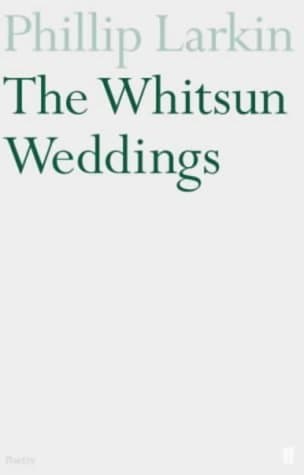
Philip Larkin (1964)
Genre
Non-Fiction
Reading Time
30-45 min
Key Themes
See below
Sign in to track this book
Philip Larkin's 'The Whitsun Weddings' takes readers on a journey through post-war England, capturing everyday life with tender observation and melancholic wit.
The poem begins with the narrator boarding a train on a Whitsun Saturday afternoon. As the train leaves, he observes the ordinary, unglamorous scenery of industrial and suburban England. He notes the 'dingy' backs of houses, allotments, and 'half-built' estates, typical of Larkin's post-war British landscape. The train moves steadily, 'quickening' and 'gathering speed,' creating a sense of distance and allowing the narrator to observe. This first part of the journey sets a slightly melancholic, detached mood; the narrator is alone amidst the holiday weekend's activity, preparing for the unexpected encounters ahead.
As the train stops at various stations, the narrator starts to notice a pattern: at each stop, groups of people, clearly wedding parties, board the train. These are not just individual couples, but entire entourages, with 'parents and children still on the platform' waving goodbye. The first few groups are described with a sense of novelty and mild interest. He notes their 'loud' and 'fresh' appearance, contrasting with the drabness of the train's interior and the outside landscape. This repeated boarding of wedding parties gradually shifts the narrator's attention from the scenery to the human drama inside the train.
The narrator's observations become more specific and detailed as he describes the brides and grooms. He notes their 'new-bought, specially-ready clothes' and their physical appearance, often with a slightly detached, almost clinical eye. He describes 'nylon gloves' and 'lemon-coloured' dresses, 'brassy' hair and 'cheap' perfume. There is a hint of social commentary, as he sees these weddings as typical of a certain social group, perhaps lower-middle class, and a bit unrefined. His descriptions are sharp, capturing both the excitement and the slightly awkward, unpolished nature of these celebrations, highlighting the contrast between their hopeful joy and the narrator's cynical view.
As more wedding parties board, the train's atmosphere changes. It becomes a small world of festive, if somewhat noisy, celebration. The narrator hears 'laughter' and 'talk,' and sees the 'flushed' faces of the participants. The air smells of 'fish and chips' and 'cheap scent.' This accumulation of parties creates a combined effect, where initial separate observations merge into a collective experience. The train, usually a place of quiet travel, is now lively with the energy of new beginnings, though seen through the narrator's often critical and ironic lens. The large number of weddings emphasizes how common the experience is.
The repeated sight of these weddings leads the narrator to reflect on marriage itself, especially in this social context. He considers why these unions happen, seeing them as a predictable, almost unavoidable step for these young couples. He notes the 'innocence' and 'ignorance' of the brides, suggesting they do not fully understand what they are starting. His thoughts are tinged with Larkin's usual mix of cynicism and a reluctant acknowledgment of human patterns. He sees these weddings as a mass phenomenon, a 'mass-produced' ritual, rather than unique, deeply personal events, which subtly critiques societal norms.
A key realization for the narrator is that all these different wedding parties, along with himself, are heading to a common destination: London. This shared direction creates an unexpected sense of unity among the passengers. For the newlyweds, London represents the start of their new lives, perhaps honeymoons or new homes, while for the narrator, it is just another destination. This convergence highlights the different purposes and expectations people bring to the same journey. The train becomes a vessel carrying many hopes, dreams, and everyday realities towards the bustling city, emphasizing the anonymity and collective experience of modern life.
As the train continues, the day begins to end, and the light outside changes. The 'sunlight' that first lit the landscape gives way to 'evening' light, casting longer shadows and changing the mood. This shift in lighting mirrors the narrator's changing perspective. His initial bright, almost harsh observations soften as dusk approaches, giving his reflections a more thoughtful tone. The fading light also symbolizes the passing of the wedding day itself, and perhaps, the fleeting nature of the initial joy and excitement felt by the couples. It adds a touch of wistfulness to the overall story.
Despite his earlier detachment and critical observations, the narrator feels an unexpected moment of empathy for the newlyweds. He acknowledges their 'fresh-raddled' faces and 'awkward' gestures, but also senses the deep meaning of their decision. He notes their 'innocence' and the 'serious business' they have undertaken. This shift suggests a softening of his cynical view, a recognition of the universal human desire for connection and new beginnings. It is a subtle but important change, moving beyond mere observation to a brief, shared understanding of their collective human experience, even if he remains an outsider.
The poem ends with a strong and vivid metaphor as the train nears London. The narrator imagines the collective future of these couples as a 'great shout' or an 'arrow-shower' of lives, all starting at once into the unknown. This imagery captures the huge potential and the vast, undifferentiated future waiting for these young people. The 'arrow-shower' suggests both a collective path and the individual, yet connected, paths their lives will take. It is a moment of deep poetic insight, turning the ordinary observations of a train journey into a reflection on fate, destiny, and the shared human condition, leaving the reader with a sense of wonder and a hint of sadness.
The Protagonist/Observer
Starts detached and critical, gradually moves towards a moment of shared human understanding and poetic insight.
The Collective Supporting
Represent the beginning of a new life stage, observed in their moment of transition.
The Collective Supporting
Represent the beginning of a new life stage, observed in their moment of transition.
The Collective Supporting
Serve as a static element, embodying the social context and support surrounding the weddings.
Larkin places the ordinary setting of a train journey through industrial England next to the important ritual of marriage. The poem shows how significant life events, like weddings, are often part of the everyday, sometimes unglamorous, reality. The repeated boarding of wedding parties highlights the common and almost 'mass-produced' nature of these rites, yet the narrator's final metaphor makes them grand and universal, suggesting that even ordinary rituals hold great collective weight and future potential.
“And none thought worth more than any one / Of all the others they would never meet.”
The narrator is clearly an observer, separate from the celebrations around him. He examines the wedding parties, noting their appearances, behaviors, and implied social class, without directly interacting with them. This theme explores what it is like to be an outsider looking in, offering a critical yet ultimately empathetic view of human activity. His journey is one of internal reflection rather than external involvement, allowing him to find universal truths from specific things he observes. The train itself is a perfect means for this detached observation.
“The women shared / The secret like a happy funeral.”
Despite the narrator's initial cynicism, the poem ultimately explores the strong human desire for hope and new beginnings, shown by the young couples. Each wedding represents a leap of faith, a decision to start a shared future. The collective 'arrow-shower' at the poem's end powerfully symbolizes the start of these new lives, full of unknown potential and shared destiny. Even if the narrator sees some 'ignorance' in their choices, the sheer number of these unions shows a lasting, universal human optimism in the face of an uncertain future, emphasizing the enduring power of starting anew.
“All down the line / Fresh-raddled faces, short floral dresses, / And nervous laughter, all gone up in a yell / Of welcome, as the train drew out again.”
Larkin subtly includes social class commentary through his precise descriptions of the wedding parties. Details like 'nylon gloves,' 'lemon-coloured' dresses, 'brassy' hair, and the 'smell of fish and chips' suggest a specific post-war, working-to-lower-middle-class British group. The train journey through industrial and suburban areas further places the poem in a particular view of Britain. The poem captures a part of contemporary British life, highlighting the commonality of certain experiences and rituals across different social levels, but always filtered through Larkin's usual mix of affection and critical distance.
“I thought of London, with its crowds / And the way they'd all be waiting.”
The train journey symbolizes life's passage and the collective human experience.
The literal train journey from the countryside towards London serves as a powerful metaphor for the journey of life, particularly the journey into marriage and the future. The sequential boarding of wedding parties at various stations reinforces the idea of life's stages and the continuous stream of people embarking on similar paths. The shared destination of London further emphasizes the collective human condition, where individuals, despite their unique circumstances, are all moving towards a common, albeit unknown, future. The train becomes a microcosm of society in motion.
The recurring sight of wedding parties builds a sense of collective experience.
The poem heavily relies on the repetition of the event: at each station, another wedding party boards the train. This cumulative effect is crucial. It transforms what might have been an isolated observation into a widespread social phenomenon. The repetition allows the narrator, and the reader, to move beyond individual details to grasp the larger pattern and significance of these unions. It builds a sense of overwhelming evidence for a particular social ritual, highlighting its commonality and almost inevitable nature in post-war Britain.
Vivid descriptions of sights, sounds, and smells immerse the reader in the scene.
Larkin employs rich and specific sensory details to bring the train journey and its passengers to life. He notes the 'dingy' houses, the 'half-built' estates, the 'nylon gloves,' 'lemon-coloured' dresses, the 'brassy' hair, and the 'smell of fish and chips' and 'cheap scent.' These precise observations ground the poem in a tangible reality, allowing the reader to visualize and almost experience the scene. This meticulous detailing is key to Larkin's realism and his ability to evoke a particular time and place, making the abstract themes feel concrete.
The narrator's viewpoint evolves from detached cynicism to subtle empathy.
The poem demonstrates a subtle but significant shift in the narrator's perspective. Initially, he is a purely analytical and somewhat critical observer, dissecting the appearances and implied social standing of the wedding parties. However, as the journey progresses and dusk falls, his observations soften, leading to a moment of unexpected empathy and a profound, poetic reflection on the collective fate of these couples. This evolution in perspective allows for a more nuanced and ultimately more humanistic conclusion to the poem, moving beyond mere social commentary.
“They shared that sense of wild, and of being at the edge of the world, that children have in their games.”
— Describing the children playing in a rural setting.
“The wind was a steady, invisible hand, pushing and pulling at the train, making it sway like a drunken man.”
— Observing the train journey through the countryside.
“He felt the quiet desperation of those who try to make sense of a world that offers none.”
— Reflecting on a character's internal struggle.
“The light, when it came, was not a sudden burst but a slow, hesitant unfolding, like a flower opening in time-lapse.”
— Describing dawn breaking over a landscape.
“There was a kind of beauty in their plainness, a sturdy, unpretentious grace that spoke of endurance.”
— Commenting on the architecture of an old building.
“The silence was not empty, but full of the unspoken things, the histories and the futures that hung in the air.”
— Pondering the atmosphere of a quiet, historic place.
“He carried the weight of his own expectations, heavier than any physical burden.”
— Exploring a character's internal pressure and self-imposed demands.
“The past, he realized, was not a fixed thing, but a constantly shifting landscape, reinterpreted with every new memory.”
— Meditating on the nature of memory and history.
“They built their lives on small rituals, the comforting repetitions that kept chaos at bay.”
— Observing the daily routines of ordinary people.
“The world, he thought, was a vast collection of unfinished stories, each waiting for an ending that might never come.”
— Contemplating the open-ended nature of life and human experience.
“It was the kind of day that made you feel both insignificant and profoundly connected to everything.”
— Experiencing a powerful moment in nature.
“The laughter, when it finally broke, was like a dam bursting, releasing a flood of pent-up emotion.”
— Describing a moment of sudden joy or relief.
“He understood then that true freedom was not the absence of chains, but the ability to choose which chains to wear.”
— A character's realization about the nature of freedom and commitment.
“The quiet dignity of their lives, unheralded and unremarked, was a testament to human resilience.”
— Reflecting on the lives of ordinary, hardworking individuals.
Ready to see how well you understood this book? Take our interactive quiz with 10 questions.