“Odi et amo. quare id faciam, fortasse requiris. nescio, sed fieri sentio et excrucior.”
— A famous declaration of contradictory feelings towards Lesbia.

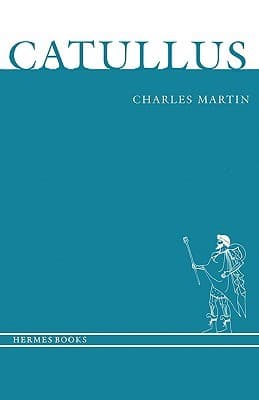
Sign in to track this book
This book explores Catullus, the Roman poet. His witty and erotic verses, once seen as spontaneous, are shown to be sophisticated and artfully constructed. He was a modernist ahead of his time.
Charles Martin starts by describing Catullus's popular image as a witty and erotic love poet, often seen as spontaneous and direct. However, Martin immediately says he will go beyond this surface understanding. He argues that Catullus was a sophisticated poetic innovator and a 'modernist' of his time. Martin aims to show the deliberate art and intelligence in Catullus's seemingly effortless verse, suggesting that a deeper reading uncovers complex structures and ironic subjectivity. This introduction sets the stage for a comprehensive re-evaluation, promising to look at Catullus's life, writing habits, and the literary context of his age, connecting his innovations to modern poetic styles.
Martin places Catullus within the Roman literary movement called the *Novi Poetae*, or 'New Poets.' He describes this group as intellectual innovators who broke from traditional epic and grand historical poetry, preferring shorter, more personal, and carefully crafted verses. This movement valued *lepos* (charm), *urbanitas* (sophistication), and Hellenistic influence, especially from Alexandrian poets like Callimachus. Catullus, as a key member, adopted this style, focusing on themes of love, friendship, and daily life, often with an ironic or self-aware tone. Martin shows how their rejection of epic themes and their pursuit of technical perfection and emotional immediacy made them 'modernists' in their own era, preparing the way for Catullus's unique contributions.
This section examines the known biographical details of Gaius Valerius Catullus, showing how his life experiences likely influenced his poetry. Martin discusses Catullus's origins in Verona, his move to Rome, and his involvement in the city's social and political circles. He explores Catullus's relationships with important figures, including Julius Caesar, and his passionate, difficult affair with 'Lesbia,' widely believed to be Clodia Metelli, the sister of Publius Clodius Pulcher. Martin does more than list facts; he interprets how these personal and political entanglements fueled the intense emotions, sharp wit, and occasional anger in Catullus's verse, arguing that his life was linked to his art, giving his poems an autobiographical feel.
A main point of Martin's analysis is his reinterpretation of the poems addressed to 'Lesbia' (likely Clodia Metelli). He sees them not as isolated lyrical outbursts, but as a unified, artfully arranged poetic sequence. He argues against the common idea that these poems are simply spontaneous expressions of love and heartbreak. Instead, Martin shows how Catullus carefully crafted this series to depict the course of a passionate, ultimately destructive relationship, moving from initial infatuation and joy to disillusionment, betrayal, and bitter resentment. He points to recurring motifs, thematic developments, and structural echoes that connect these poems into a coherent narrative, showing Catullus's deliberate artistic control over his most famous work.
Martin examines the mystery around 'Lesbia's' identity, largely accepting the scholarly view that she was Clodia Metelli, a prominent and controversial Roman matron. He discusses what this identification means for understanding the social dynamics and scandalous nature of their affair in Roman society. Beyond Lesbia, Martin also analyzes Catullus's creation of his own poetic persona in these poems. He argues that Catullus is not just documenting his feelings but is consciously creating a 'lover' persona — one that is vulnerable, obsessive, often self-pitying, yet also capable of sharp wit and biting satire. This self-awareness, Martin argues, is a sign of Catullan modernity, blurring the lines between the poet's life and his artistic creation.
Challenging typical dismissals of Catullus's shorter, non-Lesbia poems as less important, Martin argues for their artistic merit and innovative nature. These poems, often known for their irreverence, obscenity, and sharp social commentary, are presented as the work of a sophisticated poetic mind. Martin highlights Catullus's experimental use of various meters, his playful use of language, and his ability to combine personal attacks with broader social critique. He shows how these 'minor' works reveal Catullus's versatility, his engagement with Roman daily life, and his willingness to push poetic boundaries, confirming his status as a 'modernist' who found artistic value in subjects previously thought unworthy of serious verse.
Martin explores Catullus's use of comic invention, self-awareness, and irony throughout his collected works. He argues that Catullus's humor is not just for entertainment but often serves deeper critical or emotional purposes. This includes his playful mockery of social conventions, his use of hyperbole in both love and hate, and his frequent use of irony to expose hypocrisy or express complex feelings. Martin points out Catullus's meta-poetic moments, where he comments on his own writing process or the nature of poetry itself, showing remarkable self-awareness for an ancient poet. This intellectual playfulness and ability to step outside his own narrative contribute to his 'modern' sensibility.
This section focuses on Catullus's elaborate experiments with poetic form and meter. Martin analyzes Catullus's mastery of many metrical schemes, from the hendecasyllabic (his signature meter) to the elegiac couplet, the choliambic, and even rarer forms. He argues that Catullus did not just adopt these meters but innovated within them, adapting them to suit his unique thematic and emotional needs. Martin shows how Catullus's careful attention to sound, rhythm, and word placement contributes significantly to the impact and meaning of his poems, revealing a poet who was emotionally expressive and a highly skilled, conscious craftsman.
A key argument of Martin's book is the connection between Catullus and modernists. He suggests that Catullus's subjective poetry, his ironic detachment, his focus on individual experience, and his formal experimentation resonate with poets of the 19th and 20th centuries, who also sought to break from traditional forms and explore new ways of expression. Martin highlights how Catullus's directness, his psychological depth, and his willingness to explore uncomfortable truths speak to a modern sensibility. This chapter connects the historical gap, presenting Catullus not as a relic of the past but as a timeless innovator whose work continues to influence and inspire contemporary literary thought.
Martin traces the unique path of Catullus's literary reception and legacy. Unlike contemporaries like Horace, Virgil, and Ovid, whose influence was immediate and sustained throughout literary history, Catullus remained largely unappreciated or even suppressed due to the perceived obscenity of his work. Martin argues that it was only with the modern era, particularly from the 19th century onward, that Catullus's unique qualities began to be fully recognized and celebrated. His directness, his psychological realism, and his formal innovations found an appreciative audience among poets and scholars seeking new forms of expression. Martin concludes that Catullus now speaks to our age with a unique directness, having finally claimed his rightful place in Western literature.
The Protagonist/Poet
Catullus is presented not as having a personal arc within the book, but his poetic legacy undergoes an arc from historical obscurity to modern appreciation.
The Author/Analyst
Martin's arc is in successfully articulating and defending his re-evaluation of Catullus's poetic genius.
The Supporting/Love Interest/Antagonist
Lesbia's 'arc' within Catullus's poems moves from idealized beloved to reviled betrayer.
The Supporting/Literary Movement
The movement itself represents a shift in Roman literary taste and practice.
The Mentioned/Contrast
No personal arc; serves as a benchmark for literary influence.
The Mentioned/Contrast
No personal arc; serves as a benchmark for literary influence.
The Mentioned/Contrast
No personal arc; serves as a benchmark for literary influence.
The Supporting/Comparative
Represents a shift in literary taste that allowed for Catullus's re-evaluation.
This central theme argues that Catullus, though living in the 1st century BCE, showed characteristics and innovations that connect with modern poetic styles. Martin calls Catullus a 'modernist of his age,' pointing out his subjective poetry, ironic detachment, and focus on individual experience over grand narratives. For example, Catullus's psychological depth in the Lesbia cycle, where he explores complex, often contradictory emotions of love and hate, feels very contemporary. His self-awareness and meta-commentary on his own poetic process also align with later modernist practices, making him a poet who speaks directly to our present age.
“He is now regarded as a poet who speaks to our age with a singular directness.”
Martin consistently shows how Catullus's personal experiences, especially his difficult affair with Lesbia, are woven into his poetry. The 'Lesbia cycle' is a prime example, where raw emotion and biographical detail are transformed through careful artistry into a unified poetic sequence. This theme explores how Catullus used his life as material, not just to document events, but to craft a complex poetic persona and explore universal human emotions. The specifics of Roman social life and politics also appear in his shorter, often satirical, poems, blurring the lines between the poet's lived reality and his artistic creations.
“Martin considers Catullus's life, habits of composition, and the circumstances in which he worked.”
A core theme is Catullus's role as a poetic innovator who, with the *Novi Poetae*, broke from established Roman literary traditions. Instead of epic poetry or grand historical narratives, Catullus embraced shorter, more personal, and aesthetically refined verses. This rejection showed in his choice of subject matter (love, friendship, daily life, obscenity), his ironic and subjective tone, and his elaborate experiments in poetic form and meter. Martin highlights Catullus's willingness to challenge conventions and find artistic value in the 'unworthy,' seeing him as a revolutionary figure who reshaped Roman poetry and influenced future generations, though with a significant delay.
“He places him among the modernists of his age, who created a new ironic and subjective poetics...”
The Lesbia poems clearly explore the theme of love in all its complexity and destructive potential. Catullus's portrayal moves from the excitement of initial infatuation to the agony of betrayal, jealousy, and deep disillusionment. Martin emphasizes how Catullus captures the obsessive, irrational, and often contradictory nature of love, where intense affection can turn into bitter hatred. This theme is not romanticized but presented with a raw, psychological realism, clear in poems like *carmen* 8, where the speaker struggles to move on, or *carmen* 85, 'Odi et amo,' which captures the painful duality of his feelings. The theme shows love as a force that can both elevate and devastate.
“Odi et amo. Quare id faciam, fortasse requiris. Nescio, sed fieri sentio et excrucior.”
Martin consistently points to the theme of Catullus's careful artistry and sophisticated craftsmanship, arguing against the idea of his verse as merely spontaneous. This theme highlights Catullus's deliberate choices in meter, wordplay, structure, and thematic arrangement. For instance, Martin's analysis of the Lesbia poems as a unified sequence shows a conscious artistic design. Similarly, the detailed examination of Catullus's diverse metrical experiments and his ability to adapt them to different emotional and thematic needs shows a poet deeply engaged with the technical aspects of his craft. The book aims to show the 'art and intelligence behind the seemingly spontaneous verse,' revealing a poet who was emotionally expressive and formally brilliant.
“Martin offers original interpretations of Catullus's poems, viewing the love poems to 'Lesbia' as a unified, artfully arranged poetic sequence...”
The constructed voice or character adopted by Catullus in his poems.
Catullus frequently employs a poetic persona, a carefully constructed 'self' that may or may not directly reflect his actual biographical identity. This device allows him to explore various emotional states and social roles, from the vulnerable, obsessive lover in the Lesbia poems to the sharp-tongued satirist in his invectives. Martin highlights that this persona is not merely Catullus 'being himself,' but a deliberate artistic choice, enabling a degree of detachment and irony. The use of persona contributes to his 'modernist' quality, as it blurs the line between author and speaker and allows for complex, often contradictory, expressions of feeling without necessarily committing the historical Catullus to every sentiment.
The arrangement of individual poems into a unified, narrative-driven series.
Martin argues that the Lesbia poems, traditionally viewed as separate lyrics, function as a deliberate poetic cycle or sequence. This device involves arranging individual poems in a way that creates a narrative arc, thematic development, or emotional progression. By treating the Lesbia poems as a sequence, Martin reveals Catullus's sophisticated structural planning, demonstrating how the poems collectively tell the story of a relationship's rise and fall, moving from initial joy to despair and bitter resentment. This device elevates the poems from mere lyrical outbursts to a carefully crafted, overarching artistic statement, showcasing Catullus's long-form compositional intelligence even within short lyrical forms.
Harsh, often personal, verbal attack or denunciation in verse.
Catullus frequently utilizes invective, a device characterized by its sharp, often obscene, and highly personal attacks against individuals or groups. This is seen in his poems directed at rivals, unfaithful lovers, or those he deemed morally corrupt. Far from being mere childish outbursts, Martin argues that Catullus's use of invective is a sophisticated rhetorical and poetic tool. It allows him to express intense emotion, engage in social commentary, and showcase his wit, even while employing vulgarity. This device highlights his 'irreverent' and innovative spirit, as he fearlessly wields language to wound and satirize, pushing the boundaries of acceptable poetic subject matter.
References or connections to other literary works, particularly Greek and Roman models.
Catullus frequently employs intertextuality and allusion, subtly (and sometimes overtly) referencing earlier Greek and Roman literary works, especially those of the Alexandrian poets like Callimachus. This device demonstrates Catullus's erudition and his participation in a learned poetic tradition. By alluding to established myths, literary conventions, or specific poetic lines, Catullus engages in a dialogue with his predecessors, either to honor them, subtly subvert their themes, or to signal his own poetic lineage. Martin highlights this as a mark of his sophistication and his connection to the *Novi Poetae*'s emphasis on Hellenistic influences, adding layers of meaning for the educated Roman reader.
“Odi et amo. quare id faciam, fortasse requiris. nescio, sed fieri sentio et excrucior.”
— A famous declaration of contradictory feelings towards Lesbia.
“Vivamus, mea Lesbia, atque amemus, rumoresque senum severiorum omnes unius aestimemus assis!”
— An invitation to Lesbia to live and love, disregarding the criticisms of older, stricter men.
“Ille mi par esse deo videtur, ille, si fas est, superare divos, qui sedens adversus identidem te spectat et audit dulce ridentem.”
— Expressing intense envy and admiration for the man who can sit calmly with Lesbia, hearing her laugh.
“Passer, deliciae meae puellae, quicum ludere, quem in sinu tenere, cui primum digitum dare adpetenti et acris solet incitare morsus.”
— Describing Lesbia's pet sparrow, highlighting its playful interactions with her.
“Multas per gentes et multa per aequora vectus advenio has miseras, frater, ad inferias, ut te postremo donarem munere mortis et mutam nequiquam adloquerer cinerem.”
— A poignant lament for his deceased brother, traveling to offer final funeral rites.
“Nulli se dicit mulier mea nubere malle quam mihi, non si Iuppiter ipse petat.”
— Catullus' initial delight and belief in Lesbia's unwavering devotion to him.
“Dicebas quondam solum te nosse Catullum, Lesbia, nec prae me velle tenere Iovem.”
— Recalling Lesbia's past declarations of exclusive love for him.
“Quem tu, dea, tempore in omni omnia per saecla mihi perfice laetus amor.”
— A prayer to Venus to grant him a happy love for all time.
“At tu, Catulle, destinatus obdura, et te hoc velle negato.”
— Catullus' internal struggle, urging himself to be firm and deny his lingering desire for Lesbia.
“Si qua recordanti benefacta priora voluptas est homini, cum se pervidit esse pium, nec sanctam violasse fidem, nec foedere nullo divum ad fallendos numine abusum homines.”
— Reflecting on the comfort of a clear conscience when one has been faithful and not betrayed trust.
“Verum id non impune feres.”
— A warning to Lesbia that her actions will not go unpunished, implying emotional or reputational consequences.
“Nulla potest mulier tantum se dicere amatam vere, quantum a me Lesbia amata mea est.”
— Catullus' assertion that no woman has ever been loved as truly as he loved Lesbia.
“Vale, puella. Iam Catullus obdurat, nec te requiret nec rogabit invitam.”
— A farewell to Lesbia, stating Catullus' resolve to be strong and no longer pursue her against her will.
“Non est iam dicere, ut antea, 'mea'; sed toto te colere in corde, 'mea' non est.”
— Lamenting that he can no longer truly call Lesbia 'mine' in his heart, despite still loving her.
Ready to see how well you understood this book? Take our interactive quiz with 10 questions.

Gaius Valerius Catullus was a Latin poet of the late Roman Republic. He was known for his lyric poetry and epigrams, particularly his often erotic and satirical works. His surviving poems, collected as 'Catullus', offer a vibrant glimpse into Roman social life and personal relationships.