“The prudent mariner does not rely solely on the visibility of other vessels; he assumes their presence and plans accordingly.”
— Emphasizing proactive navigation and risk assessment.

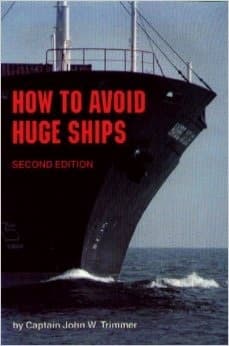
John W. Trimmer (1992)
Genre
Non-Fiction
Reading Time
120 min
Key Themes
See below
Sign in to track this book
Navigate your pleasure craft safely through shipping lanes by understanding the immense forces and key blind spots of large containerships, ensuring your family's evening on the water doesn't become a disaster.
John W. Trimmer begins by describing a small recreational vessel meeting a large commercial ship, immediately showing the dangers involved. He explains that the smaller vessel often has more responsibility for avoiding collisions due to the size, momentum, and operational limits of huge ships. The introduction sets a serious, practical tone, urging small boat operators to learn and use the rules of the road and best practices for safe navigation, rather than assuming larger vessels will always see and move around them. This first part emphasizes that not knowing the rules is no excuse when lives are at risk on the water.
This section discusses the physical characteristics and operational limits of huge ships, such as containerships, tankers, and bulk carriers. Trimmer explains their large size, deep drafts, and the long time and distance they need to change course or speed. He details the limited visibility from their bridges, especially for small boats near the bow, and the 'pivot point' that affects how a large ship turns. Understanding these factors, such as a large ship's inability to stop quickly or its blind spots, is important for small boat operators to make good decisions and avoid dangerous situations.
Trimmer spends a large part of the book explaining the International Regulations for Preventing Collisions at Sea (COLREGs). He breaks down key rules for small craft, including rules about 'stand-on' and 'give-way' vessels, and responsibilities in crossing, overtaking, and head-on situations. The book clarifies the need for a proper lookout, safe speed, and taking early, clear action to avoid collision. Special attention is given to understanding navigation lights and sound signals, which are crucial for night navigation and poor visibility. The author stresses that these rules are legal requirements, not suggestions, and following them is essential for safety.
This chapter examines the common idea that large ship radar will always detect small recreational boats. Trimmer explains how factors like sea state, rain, radar cross-section, and clutter can make small vessels invisible to ship's radar, especially if they do not have radar reflectors. He also discusses the Automatic Identification System (AIS), explaining that while it is a strong tool, not all small boats have it, meaning they will not show up on a ship's AIS display. The author emphasizes that small boat operators should never rely only on being detected by a large ship's electronic systems, reinforcing the need for active avoidance strategies.
Trimmer gives a look at the bridge of a large commercial vessel, detailing the duties of the watch officer, helmsman, and pilot (if needed). He describes the various instruments and displays, the lookout procedures, and the communication protocols. The chapter highlights the constant demands on bridge personnel, from monitoring multiple systems to communicating with Vessel Traffic Services (VTS) and other ships. Understanding the limited staff, possible distractions, and the amount of information processed on a ship's bridge helps small boat operators see why their small craft might not always be the main focus.
Knowing the limits of radar and AIS, Trimmer provides practical advice on how small boat operators can be more easily detected. This includes using radar reflectors, making sure navigation lights are bright and correct, and carrying a strong spotlight for night identification. He also discusses the importance of sound signals, like fog horns, in poor visibility. The focus is on active steps a small boat can take to 'stand out' and alert larger vessels to their presence, rather than just hoping to be seen. This section gives small craft owners practical tools for staying safe.
This important chapter gives specific tactical advice for small boat operators encountering large ships. Trimmer advises understanding the 'danger zone' around a ship, the importance of early and firm action, and avoiding crossing in front of a large vessel too closely. He explains the concept of target angle and how to tell if a collision risk exists. The book stresses that when in doubt, the safest action is to slow down, change course to pass behind, or stop and let the ship pass. The goal is to provide clear guidance for safe maneuvers that prioritize avoiding close encounters.
While the main focus is on prevention, Trimmer also addresses the possibility of a collision. This section covers emergency procedures, such as making distress calls (Mayday), deploying life rafts, and having emergency equipment ready. It also gives advice on actions after a collision, including checking damage, helping others, and working with rescue services. The author highlights the importance of preparation, including having a 'ditch bag' and knowing how to use all safety equipment. This chapter serves as a clear reminder of the possible outcomes and the need for full safety planning.
Trimmer explains how Vessel Traffic Services (VTS) work in busy waterways, acting like air traffic control for ships. He advises small boat operators to monitor relevant VHF channels, especially in VTS areas, to understand the situation and hear advisories. The chapter also gives practical tips on using VHF radio effectively for communication, including correct call signs, channels, and etiquette. While small boats usually do not need to report to VTS, understanding their operations and being able to communicate with large ships or VTS can be a key safety advantage, especially in complex navigation situations.
Beyond rules and equipment, Trimmer stresses the importance of human judgment. He discusses the need for constant situational awareness, avoiding being too relaxed, and understanding the pressures on both small boat operators and large ship bridge teams. The chapter encourages a proactive, cautious approach, urging operators to expect dangers rather than just reacting to them. It highlights that even with all the rules and technology, human judgment, watchfulness, and a healthy respect for the power of the sea and the size of commercial vessels are the ultimate keys to safe navigation and avoiding huge ships.
The Protagonist (implied)
Transforms from potentially uninformed or complacent to knowledgeable and proactive in maritime collision avoidance.
The Antagonist (implied by potential threat) / Supporting (by their operational reality)
Remains constant in their professional duties; their perspective is revealed to the reader to foster understanding.
The Antagonist (implied by potential threat)
Its physical properties and operational constraints are revealed, demystifying its perceived invincibility and highlighting its limitations.
The Supporting (as motivation)
Remain static; their vulnerability drives the central 'protagonist's' learning.
A main theme is that the small boat operator is responsible for avoiding collisions with huge ships. The book consistently states that assuming a large ship will see and move for a small craft is dangerous. It promotes a proactive approach, urging readers to understand the limits of large vessels and their own role in ensuring safety. This theme appears in every chapter, from understanding COLREGs to becoming visible and taking early, clear action, shifting the responsibility from hopeful reactions to informed, preventive measures.
“Have you ever wondered what action you must take to keep clear of that fast-approaching ship? This book will tell you how to do so quickly.”
The book repeatedly points out the limits in maritime navigation for both small recreational boats and large commercial vessels. For small boats, this includes their potential to be invisible to radar, lack of AIS, and sometimes, operator inexperience. For huge ships, limits include their long stopping distances, turning circles, blind spots, and the human element on the bridge. By explaining these constraints, the book creates a full picture of why certain collision avoidance strategies are needed, building understanding for large ship crews while clearly placing the burden of awareness on the small vessel.
“Conscientious skippers are wise to read this book and discover if a ship's radar will pick up a small boat at night.”
A main message is that knowledge is the best tool for staying safe at sea. The book teaches the reader about COLREGs, ship characteristics, bridge operations, and electronic aids, giving them the information needed to make safe decisions. Not knowing the rules is presented as the biggest threat. By explaining how large ships operate and clarifying maritime law, the book states that a well-informed operator is a safe operator, able to predict dangers and perform correct maneuvers to avoid hazardous situations.
“It is fascinating to learn what is taking place on the bridge or down in the engine room of one of these leviathans as it heads your way. Can it be stopped before it hits you? Learn how to protect yourself and your loved ones by reading this book written for the private boat owner/captain.”
Despite modern technology like radar, AIS, and GPS on vessels, the book consistently emphasizes that human judgment, watchfulness, and following established rules are still most important. It details how human factors on both small and large vessels (e.g., being too relaxed, distracted, misinterpreting information) can cause accidents, even with advanced equipment. The text highlights that technology helps human decision-making, but does not replace basic seamanship and constant situational awareness, especially when near vessels whose size makes quick human-driven maneuvers difficult.
“Have you ever wondered what action you must take to keep clear of that fast-approaching ship?”
Practical examples illustrate potential dangers and correct responses.
The book frequently uses hypothetical scenarios, such as the initial example of a luxury trawler encountering a containership, to frame its lessons. These scenarios immerse the reader in realistic situations, making the technical information immediately relevant and understandable. By presenting a problem (e.g., 'a ship is approaching, what do you do?') and then providing the solution through detailed explanations of rules and best practices, the book effectively guides the reader through complex decision-making processes in a practical, memorable way, reinforcing the direct applicability of the knowledge.
Explains the complex workings of large ships and maritime regulations.
A key device is the systematic demystification of large ship operations and maritime law. The author takes the reader 'inside' the bridge of a commercial vessel, explains the physics of their movement, and breaks down the often-intimidating COLREGs into understandable principles. This approach removes the aura of invincibility or unknowability surrounding huge ships, allowing small boat operators to understand their limitations and capabilities, thus fostering a more informed and less fearful approach to collision avoidance. It transforms complex concepts into actionable insights for the average boater.
Direct, instructional style to impart critical safety information.
The book adopts a clear, authoritative, and didactic tone throughout. It directly instructs the reader on what they 'must' do, what they 'should' know, and what actions are 'wise.' This instructional voice reinforces the gravity of the subject matter and ensures that the critical safety information is conveyed without ambiguity. The direct address to the 'private boat owner/captain' creates a personal connection and underscores the book's purpose as an essential guide for preventing potentially catastrophic maritime incidents through clear, unambiguous advice.
Explains the rationale behind rules and procedures, not just the rules themselves.
Beyond simply stating the rules of the road or recommended procedures, the book consistently explains the underlying 'why.' For example, it doesn't just say 'pass astern of large ships,' but explains *why* this is safer by detailing their turning radius, pivot point, and inability to stop quickly. This emphasis on rationale helps the reader deeply understand the principles rather than just memorizing rules, enabling them to apply the knowledge effectively even in novel or ambiguous situations, thereby fostering true seamanship and better decision-making.
“The prudent mariner does not rely solely on the visibility of other vessels; he assumes their presence and plans accordingly.”
— Emphasizing proactive navigation and risk assessment.
“Even in clear weather, a small craft operator should always consider the potential for a large ship to appear unexpectedly.”
— Highlighting the constant vigilance required, regardless of conditions.
“Understanding the turning radius and stopping distance of a supertanker is paramount to maintaining a safe distance.”
— Discussing the physical limitations of large vessels and their implications for avoidance.
“The sound of a ship's horn, though often startling, is a vital communication tool that must be heeded without delay.”
— Stressing the importance of auditory signals in collision avoidance.
“Never assume a large vessel has seen you; always act as if you are invisible until positive confirmation is made.”
— A crucial piece of advice for small craft operators regarding visibility.
“A well-maintained radar reflector can be the difference between being a blip and being invisible to a ship's radar.”
— Discussing the practical equipment for increasing detectability.
“The rules of the road are not merely suggestions; they are the framework for safe passage and must be followed meticulously.”
— Emphasizing the legal and practical importance of COLREGs.
“When in doubt, alter course early and significantly. Hesitation is the enemy of avoidance.”
— Providing actionable advice on maneuverability and decisiveness.
“The wake of a large ship can be deceptively powerful; maintain a safe distance even after it has passed.”
— Warning about secondary hazards from large vessels.
“Understanding the traffic patterns of major shipping lanes is as important as knowing your own local waters.”
— Highlighting the need for broader navigational awareness.
“A good pair of binoculars is an essential tool, allowing for early identification of vessel type and direction.”
— Recommending basic but effective observational tools.
“Never attempt to cross ahead of a large ship if there is any doubt about your ability to clear its path with ample room.”
— A critical warning against risky maneuvers.
“The sea is unforgiving of complacency. Constant vigilance and respect for its power are non-negotiable.”
— A general philosophical statement about maritime safety.
“Proper lookout is not just about seeing, but about understanding what you see and anticipating potential conflicts.”
— Defining the comprehensive nature of effective lookout.
Ready to see how well you understood this book? Take our interactive quiz with 10 questions.