BookBrief
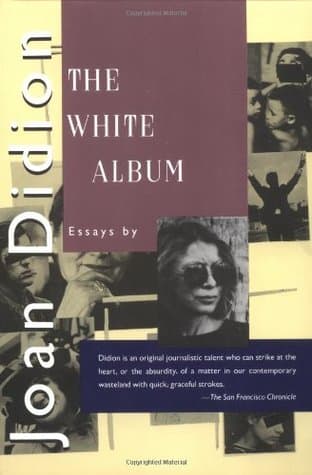
The White Album cover
Archivist's Choice

The White Album

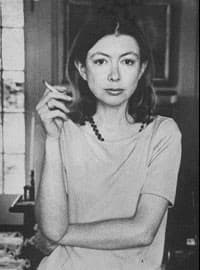
Joan Didion (1979)

Genre

Biography / Memoir / History

Reading Time

240 min

Key Themes

See below

Track Your Reading

Sign in to track this book

Joan Didion's "The White Album" looks at America's fractured mood in the late 1960s and 70s. It uses sharp, often unsettling stories to capture the era's mix of hope, fear, and cultural change, all set against California's bright but shadowed landscape.

Core Idea

Joan Didion's "The White Album" examines California's cultural and political climate in the late 1960s and early 1970s. It shows the deep worries, social divisions, and unclear morals beneath the American dream. Through a series of clear essays, Didion argues that this time was marked by a shared illusion, where seeking individuality and the appeal of disorder hid a deeper loss of meaning and structure. She carefully records the gap between public stories and private experiences, showing how unstable truth was in a time of changing values, celebrity obsession, and a general feeling of coming disaster. The book's main idea is that seemingly separate events—from the Manson murders to the Black Panthers, from building dams to Hollywood parties—are connected signs of a society dealing with its own collapse. Didion, a distant but affected observer, navigates this broken reality, pointing out the ironic link between everyday life and catastrophe, and how the past keeps haunting the present. In the end, "The White Album" reflects on how easily order can break down, how appealing disorder can be, and how hard it is to find sense in a world that has lost its way.
Reading time
240 min
Difficulty
Medium
✓ Read this if...
You are fascinated by the cultural and political tumult of late 1960s/early 1970s California, appreciate incisive literary journalism, and enjoy exploring themes of societal fragmentation, truth's elusiveness, and the American psyche's darker corners.
✗ Skip this if...
You prefer straightforward narrative non-fiction, dislike fragmented structures and highly subjective authorial voices, or are looking for an optimistic or definitive account of the era.

Core idea

The central argument and framework that powers the entire book.

Joan Didion's "The White Album" examines California's cultural and political climate in the late 1960s and early 1970s. It shows the deep worries, social divisions, and unclear morals beneath the American dream. Through a series of clear essays, Didion argues that this time was marked by a shared illusion, where seeking individuality and the appeal of disorder hid a deeper loss of meaning and structure. She carefully records the gap between public stories and private experiences, showing how unstable truth was in a time of changing values, celebrity obsession, and a general feeling of coming disaster.

The book's main idea is that seemingly separate events—from the Manson murders to the Black Panthers, from building dams to Hollywood parties—are connected signs of a society dealing with its own collapse. Didion, a distant but affected observer, navigates this broken reality, pointing out the ironic link between everyday life and catastrophe, and how the past keeps haunting the present. In the end, "The White Album" reflects on how easily order can break down, how appealing disorder can be, and how hard it is to find sense in a world that has lost its way.

At a glance

Reading time

240 min

Difficulty

Medium

Read this if...

You are fascinated by the cultural and political tumult of late 1960s/early 1970s California, appreciate incisive literary journalism, and enjoy exploring themes of societal fragmentation, truth's elusiveness, and the American psyche's darker corners.

Skip this if...

You prefer straightforward narrative non-fiction, dislike fragmented structures and highly subjective authorial voices, or are looking for an optimistic or definitive account of the era.

Key Takeaways

1

The Cracks in the California Dream

Beneath the golden veneer, Didion reveals the unraveling of the American West's utopian promise.

Quote

We were seeing the storm gather even then, and the storm was not going to break.

Didion skillfully dissects the idea of California as a place for self-creation and endless chances. Through her broken narratives, she shows how fragile and ultimately broken this dream became during the chaotic late 1960s and 70s. The Manson murders, the Watts riots, and the general feeling of unease she describes are not just separate events. They are signs of a deeper societal breakdown. California, often seen as a promised land, becomes a place where the nation's fears, radical ideas, and disappointments are made stronger. Her wri...

Supporting evidence

Didion's chilling reportage on the Manson Family, particularly the casual brutality and the unmoored nature of their followers, serves as a stark emblem of this unraveling. She notes the 'moral relativism' that allowed such horrors to fester in the sun-drenched landscape.

Apply this

When examining cultural phenomena or societal shifts, look beyond the surface narrative or idealized image to identify the underlying tensions, contradictions, and potential for collapse. Consider how foundational myths can become distorted or weaponized.
california-mythcultural-disintegrationamerican-dream-decline
2

The Banality of Evil and the Glamour of Chaos

Didion's unflinching gaze reveals how ordinary people can be drawn into extraordinary acts of violence and ideological fervor.

Quote

The center was not holding. It was a country of children, and the children were playing with fire.

One of Didion's most unsettling observations is how she portrays the Manson Family. She sees them not as evil outsiders, but as products of the era's cultural drift. She removes the sensationalism, showing them as surprisingly ordinary people caught in a swirl of drugs, charismatic manipulation, and a deep lack of social connection. Similarly, her meeting with the Black Panthers highlights the showy parts of radicalism, where ideology can become a stage for power struggles and personal complaints. Didion understands that chaos, though...

Supporting evidence

Her detailed account of the Manson trial, focusing on the mundane details of the defendants' lives and their chillingly detached demeanor, rather than just the horror of their crimes. Also, her observation of the Black Panther press conference, noting the 'careful staging' and the 'almost theatrical' quality of their presentation.

Apply this

When analyzing social movements or acts of extremism, look for the human elements and the underlying motivations – psychological, social, economic – rather than simply labeling participants as 'evil.' Understand how circumstances and charisma can influence individual agency.

manson-familyblack-panther-partysocietal-breakdowncharismatic-leadership
3

The Disorientation of the Observer

Didion's personal struggles with anxiety and a sense of unreality mirror the broader societal confusion she documents.

Quote

I was paralyzed by the conviction that I would never be able to tell the story.

A key part of 'The White Album' is Didion's inclusion of herself, not as an all-knowing narrator, but as a vulnerable observer dealing with her own mental and physical health. Her struggles with anxiety, migraines, and a deep sense of being out of place are not just personal details; they are central to her analysis of the era. This personal unease mirrors the collective unease of the late 60s and 70s, when traditional stories and ways of understanding the world seemed to disappear. By openly admitting her own confusion, Didion gives ...

Supporting evidence

Didion's detailed descriptions of her own mental breakdowns, particularly her diagnosis with multiple sclerosis and the accompanying anxiety attacks that left her unable to distinguish reality from hallucination. She explicitly states her belief that 'the world was breaking apart' and that she 'could not make the pieces fit'.

Apply this

Recognize that personal experience and emotional states can profoundly influence perception and analysis, especially when observing complex or traumatic events. Embrace vulnerability as a pathway to deeper understanding and connection in storytelling or analysis.

subjectivity-in-journalismanxiety-and-societypersonal-disorientation
4

The Elusive Nature of Truth in a Fractured Era

Didion questions the possibility of definitive understanding when reality itself seems to be disintegrating.

Quote

We tell ourselves stories in order to live.

Didion's fragmented, mosaic-like structure in 'The White Album' is more than just a style choice; it is a statement of its theme. She argues that in a time when social agreement has broken down, when traditional institutions are failing, and when 'truth' is increasingly personal, a straight, clear narrative is impossible, perhaps even dishonest. Her essays often present different facts, observations, and personal thoughts without explicitly connecting them. This forces the reader to face the uncertainty and make their own sense of the...

Supporting evidence

The very structure of the book, moving from Manson to the Black Panthers, to personal reflections, to celebrity profiles, without explicit transitions, exemplifies this. Her opening essay, 'The White Album,' explicitly states her inability to construct a coherent narrative from the events.

Apply this

When faced with complex, multi-faceted problems, resist the urge for oversimplification or a single 'correct' answer. Embrace ambiguity and consider how different perspectives and fragments of information contribute to a more nuanced, if less tidy, understanding.

postmodern-journalismnarrative-truthepistemological-crisis
5

The Irony of Individualism and Collective Delusion

The era's focus on self-discovery often led to a collective embrace of unexamined ideologies and dangerous groupthink.

Quote

The women's movement was a series of bad ideas, one after another.

While the 60s and 70s celebrated individual freedom and self-expression, Didion critically observes how this often led to new kinds of conformity and shared delusion. Her essay on the Women's Movement, for example, does not dismiss its goals but sharply criticizes its intellectual flaws, its tendency towards rigid beliefs, and its often-unexamined assumptions. She sees how the pursuit of individual authenticity could turn into a strict adherence to group ideas, whether in radical politics or counter-cultural communes. This highlights ...

Supporting evidence

Her pointed critique of the intellectual underpinnings of the Women's Movement in 'The Women's Movement,' where she found the arguments 'riddled with bad logic' and 'unexamined assumptions.' She highlights the group-think and rhetorical posturing over genuine intellectual inquiry.

Apply this

Skeptically examine movements or ideologies that promise absolute liberation or truth. Be wary of groupthink, even within seemingly progressive or individualistic contexts, and always question the underlying assumptions and potential for new forms of conformity.

counterculture-critiquefeminist-critiqueindividualism-vs-conformity
6

Water as a Metaphor for Control and Desire

In arid California, the control of water symbolizes humanity's struggle to impose order on nature and destiny.

Quote

To perceive California as a place in which a miracle of considerable proportions has been achieved by human will and ingenuity is to perceive it accurately.

Didion's essay 'Holy Water' is a deep reflection on how artificial and fragile life is in California. The state is made livable by huge engineering projects and constant manipulation of its natural environment. Water, here, is not just a resource; it symbolizes human ambition, control, and the constant tension between nature and civilization. The elaborate aqueducts and dams represent a huge effort to defy natural limits, to create an oasis where one should not naturally exist. This control over water, however, is never complete, and ...

Supporting evidence

Her detailed description of the California water system, particularly the aqueducts and reservoirs, and the immense political and engineering effort required to bring water to Los Angeles. She notes that 'water is the only California commodity that is truly scarce, and the only one that is truly vital.'

Apply this

Look for symbolic elements in landscapes or infrastructure that reveal deeper truths about human values, societal priorities, and the relationship between humanity and nature. Consider how our attempts to control our environment often reflect our attempts to control our lives.

environmental-symbolismcalifornia-water-warshuman-control-nature
7

The Enduring Power of the Mundane

Didion finds profound significance in the seemingly ordinary, revealing how everyday life reflects larger societal shifts.

Quote

I lost the sense that the world was explicable, and began to see that it was not.

Though the book covers dramatic events, much of Didion's strength comes from her careful attention to everyday things: the design of a suburban mall, the routine of a dinner party, the details of a medical diagnosis, or the specific feel of a landscape. These seemingly ordinary observations are not just filler; they are the threads from which she weaves her larger picture of cultural analysis. She understands that big historical changes are often most deeply felt and understood in the small, personal details of daily life. The decline...

Supporting evidence

Her essays 'On the Mall,' detailing the consumerist landscape, or 'Many Mansions,' describing the peculiar architecture of the Getty Museum, or 'In Bed,' recounting her experiences with migraines, all elevate personal and everyday observations to significant cultural commentary.

Apply this

Practice observational journalism or analysis by paying close attention to the details of everyday life, environments, and routines. Recognize that significant insights into culture and society can often be found in the seemingly insignificant.

everyday-life-analysisobservational-journalismcultural-details
8

The Unsettling Persistence of the Past

Didion demonstrates how historical traumas and unresolved issues continue to haunt the present, shaping the American psyche.

Quote

The past is never dead. It's not even past.

Even though the book covers events from the late 60s and 70s, Didion's essays are deeply filled with a sense of history. She often refers to the founding stories and historical paths that brought California, and America, to its current state. The pioneering spirit, the search for a new beginning, the use of resources—these historical forces are not just background; they actively shape the present chaos. The unresolved racial tensions that fueled the Watts riots, the lingering worries from previous wars, and the very building of the st...

Supporting evidence

Her discussions of the historical context of California's development, such as the water wars and the legacy of the Spanish missions, in essays like 'Holy Water' and 'Many Mansions,' show how past struggles for control and identity continue to shape the present.

Apply this

When analyzing current events or social conditions, always consider the historical context and how past decisions, traumas, or foundational myths continue to influence the present. Recognize that societal problems rarely emerge in a vacuum.

historical-memoryamerican-historylegacy-of-trauma
9

The Allure and Emptiness of Celebrity

Didion critiques the commodification of personality and the superficiality of fame in American culture.

Quote

The most striking thing about the movie business is the way it manages to absorb and neutralize everything that comes near it.

Didion, herself a well-known figure, often returns to the theme of celebrity and its damaging effects. Whether writing about Hollywood, political figures, or even the fame of people like the Manson Family, she consistently exposes the constructed, often empty nature of public images. She observes how the media machine can both create and consume individuals, turning complex lives into marketable stories. The appeal of fame, for Didion, often hides a deep emptiness or a dangerous separation from reality. Her analysis of figures in 'In ...

Supporting evidence

Her essay 'In Hollywood' delves into the lives of Hollywood figures, revealing the often-absurd and superficial nature of the industry and its inhabitants, who are 'always leaving, always arriving, always just about to be discovered.'

Apply this

Critically analyze the role of celebrity and media in shaping public perception and cultural values. Look beyond the manufactured image to understand the underlying realities and potential for superficiality or manipulation.

celebrity-culturemedia-critiqueamerican-superficiality
10

The Precariousness of Order and the Imminence of Chaos

Didion's writing consistently reveals the thin veneer of order that separates society from its inherent, underlying chaos.

Quote

Quite often I have felt myself a stranger in a strange land, but never more so than in this place.

A constant theme throughout 'The White Album' is how fragile social order is and the ever-present threat of chaos. From the mental instability she experiences to the societal breakdowns she documents, Didion suggests that civilization is a delicate structure, easily broken. The carefully designed landscapes of California, the elaborate rituals of politics, and even the personal stories we create to make sense of our lives are all vulnerable to collapse. The Manson murders are not an unusual event but a stark reminder of the basic forc...

Supporting evidence

The entire collection, particularly the title essay, builds this sense of impending doom and the dissolution of order. Her personal experiences with illness and anxiety directly parallel her observations of societal breakdown, reinforcing the idea that chaos is both internal and external.

Apply this

Recognize that societal stability is not guaranteed and requires constant vigilance and maintenance. Be aware of the signs of fragility in social, political, or personal systems, and consider the potential for rapid disintegration.

social-order-fragilitychaos-theory-societyexistential-precariousness

Critical analysis

Notable Quotes

We tell ourselves stories in order to live.

Opening line of the essay 'The White Album,' reflecting on the human need for narrative.

I was seeing what I had come to see, and it was not a pretty sight.

Didion's observation during her visit to a Doors recording session, capturing the chaotic energy.

The center was not holding. It was a country of children, and the children were screaming.

Reflecting on the social and political turmoil of the late 1960s in America.

Character — the willingness to accept responsibility for one's own life — is the source from which self-respect springs.

From the essay 'On Self-Respect,' defining the core of personal integrity.

To have that sense of one's past in one's bones, and to be able to make a narrative of it, is not a given.

Discussing the difficulty and importance of understanding and constructing personal history.

Hawaii is a set of social and economic arrangements, of which the landscape is a kind of expressive diagram.

Analyzing the relationship between environment, culture, and power structures in Hawaii.

Quite often, in fact, the one thing that most people do not want to hear is the truth.

A cynical observation on human nature and the reception of uncomfortable realities.

One of the things I like to do is to go to the supermarket and just stand there and look at the people.

A simple, yet profound, act of observation that reveals much about society.

The future always looks good in the rear-view mirror.

A reflection on nostalgia and the way we perceive past hopes and futures.

Writers are always selling somebody out.

From 'Slouching Towards Bethlehem,' acknowledging the inherent ethical dilemmas of writing about real people.

The very act of writing is an act of hope.

Despite the often bleak subject matter, Didion finds hope in the creative process itself.

I was not meant to know what it meant. I was only meant to write it down.

Didion's detached, observational approach to documenting events, even when their meaning is elusive.

It was not a question of 'getting in touch with my feelings.' It was a question of being in touch with the fact that I was going crazy.

Describing a personal mental health crisis, rejecting therapeutic clichés.

Marriage is the only adventure open to the cowardly.

A provocative and cynical view on marriage, highlighting its perceived safety and constraint.

Quiz

Test Your Knowledge

Ready to see how well you understood this book? Take our interactive quiz with 10 questions.

10
Questions
~5
Minutes
?
Best Score

Key Questions (FAQ)

'The White Album' is a collection of essays by Joan Didion, offering a journalistic mosaic of American life in the late 1960s and 1970s. It explores the cultural and political turmoil of the era, focusing heavily on California as its spiritual center.

About the author

Joan Didion

Joan Didion was an American writer. She is considered one of the pioneers of New Journalism along with Gay Talese, Hunter S. Thompson, and Tom Wolfe.