BookBrief
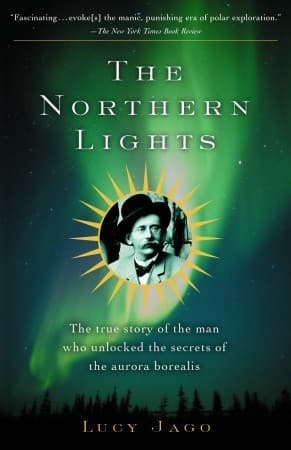
The Northern Lights cover
Archivist's Choice

The Northern Lights

Lucy Jago (2001)

Genre

Biography / History / Science

Reading Time

8 hours

Key Themes

See below

Track Your Reading

Sign in to track this book

Troubled genius Kristian Birkeland braved arctic wilderness, scientific doubt, and his own struggles to explain the aurora borealis, changing our understanding of the cosmos even as his brilliance went unrecognized.

Core Idea

Kristian Birkeland, a Norwegian physicist, was a visionary whose theories and experiments in the Arctic changed our understanding of the aurora borealis and cosmic electricity. Despite doubt, rivalry, and isolation, his pursuit of scientific truth led to the 'terrella' experiment and the first model of the Northern Lights. This work set the stage for modern space physics, though he did not receive full recognition, including the Nobel Prize, during his lifetime.
Reading time
8 hours
Difficulty
Medium
✓ Read this if...
You are fascinated by the history of science, particularly early 20th-century physics, the challenges faced by unconventional thinkers, and the dramatic interplay between scientific discovery and personal ambition amidst the backdrop of the Arctic.
✗ Skip this if...
You prefer broad surveys of scientific topics over detailed biographical accounts of individual scientists, or if you are looking for a purely contemporary scientific explanation of the Northern Lights without historical context.

Core idea

The central argument and framework that powers the entire book.

Kristian Birkeland, a Norwegian physicist, was a visionary whose theories and experiments in the Arctic changed our understanding of the aurora borealis and cosmic electricity. Despite doubt, rivalry, and isolation, his pursuit of scientific truth led to the 'terrella' experiment and the first model of the Northern Lights. This work set the stage for modern space physics, though he did not receive full recognition, including the Nobel Prize, during his lifetime.

At a glance

Reading time

8 hours

Difficulty

Medium

Read this if...

You are fascinated by the history of science, particularly early 20th-century physics, the challenges faced by unconventional thinkers, and the dramatic interplay between scientific discovery and personal ambition amidst the backdrop of the Arctic.

Skip this if...

You prefer broad surveys of scientific topics over detailed biographical accounts of individual scientists, or if you are looking for a purely contemporary scientific explanation of the Northern Lights without historical context.

Key Takeaways

1

The Maverick's Vision

Birkeland's radical theories challenged established scientific dogma.

Quote

Birkeland's audacious theories, often dismissed as 'fantastical' by his peers, were ultimately vindicated, demonstrating the power of independent thought against prevailing orthodoxy.

Kristian Birkeland was a scientific outsider, driven by curiosity about the aurora borealis. When others thought the Northern Lights were caused by atmospheric events, Birkeland proposed a new idea: charged particles from the sun, guided by Earth's magnetic field, hit the atmosphere. This was a major step in understanding, forming the basis for modern space physics. His work anticipated concepts like the solar wind and magnetospheric substorms decades before they were accepted, showing the courage needed to pursue unconventional ideas...

Supporting evidence

Birkeland's 'terrella' experiments, where he simulated Earth's magnetic field with a magnetized sphere in a vacuum chamber, demonstrating how electron beams were guided towards the poles, mimicking the aurora.

Apply this

Embrace intellectual curiosity and challenge conventional wisdom. Don't be afraid to pursue theories that seem outlandish if supported by rigorous experimentation and observation, as breakthroughs often come from paradigm shifts.
scientific-orthodoxyparadigm-shiftsolar-wind
2

Arctic Laboratories

Extreme environments were crucial for Birkeland's ground-breaking observations.

Quote

The unforgiving landscapes of the Arctic were not merely backdrops for Birkeland's quest, but integral components of his scientific methodology, providing the raw data essential for his theories.

Birkeland knew that to understand the aurora, he had to study it where it happened. He went on dangerous expeditions to the remote mountains of Norway, setting up some of the first Arctic observatories. These were not easy academic pursuits but difficult tasks, full of extreme weather, logistical problems, and personal risk. The data from these isolated outposts, often gathered in brutal conditions, provided key evidence for his theories about the aurora's electromagnetic nature. This shows a deep commitment to observational science o...

Supporting evidence

The establishment of observatories on remote Norwegian peaks like Haldde and Kaafjord, where Birkeland and his team conducted synchronized measurements of magnetic disturbances and auroral activity.

Apply this

Recognize that profound understanding often requires direct engagement with the subject matter, even if it means venturing into challenging or uncomfortable 'environments.' Fieldwork and direct observation can be irreplaceable.

arctic-explorationobservational-scienceempirical-evidence
3

The Price of Genius

Birkeland's brilliance was intertwined with profound personal struggles.

Quote

The same intensity that fueled Birkeland's scientific breakthroughs also fed his inner demons, a stark reminder that genius often walks hand-in-hand with vulnerability.

Kristian Birkeland's life showed the often-difficult link between great intellect and mental health. His search for scientific truth was shadowed by depression and paranoia, conditions likely made worse by scientific criticism and rivalries. While his scientific work was immense, his personal life was marked by isolation and, eventually, a suspicious death. This story reminds us that even the most brilliant minds are human, and their struggles are as much a part of their story as their successes. It highlights the importance of unders...

Supporting evidence

Descriptions of Birkeland's increasingly erratic behavior, his periods of intense depression, and the circumstances surrounding his death in a Tokyo hotel room, which some speculate was suicide or related to his mental state.

Apply this

Cultivate empathy and understanding for individuals, especially those pushing boundaries. Recognize that mental health is as critical as intellectual capacity, and support systems are vital for sustained well-being and productivity.

mental-healthscientific-biographygenius-vulnerability
4

The Rival's Shadow

Scientific progress can be hampered by professional jealousy and sabotage.

Quote

Even in the hallowed halls of science, human frailties like jealousy and ambition can cast long, destructive shadows, hindering progress and undermining reputations.

Birkeland's scientific journey involved not just nature's mysteries but also human adversaries. His work met strong opposition, not only because it was new, but also due to sabotage and professional jealousy from rivals, especially Vilhelm Bjerknes. Bjerknes, a leading meteorologist, worked to discredit Birkeland's theories and hinder his career, even trying to claim credit for some of his ideas. This shows a darker side of science, where ambition and rivalry can slow knowledge and cause immense personal harm to innovators.

Supporting evidence

Detailed accounts of the professional rivalry between Birkeland and Vilhelm Bjerknes, including Bjerknes's efforts to undermine Birkeland's funding, publications, and Nobel Prize nominations.

Apply this

Be aware of the human element in any collaborative or competitive field. While striving for excellence, guard against destructive rivalries and understand that external validation doesn't always reflect intrinsic worth.

scientific-rivalryacademic-politicsintellectual-property
5

The Nobel Snub

Posthumous recognition is a poor substitute for timely acclaim.

Quote

The tragic irony of Birkeland's life was that the very scientific establishment that denied him the Nobel Prize during his lifetime would posthumously embrace his theories as foundational.

Despite his contributions to understanding the aurora and Earth's magnetic field, Kristian Birkeland was repeatedly passed over for the Nobel Prize. His theories, first seen as too radical, became widely accepted decades after his death, when space technology provided clear proof. This failure to recognize his genius during his lifetime shows how scientific conservatism and personal biases can delay recognition of important work. It highlights the often-unfair nature of scientific awards and the impact of timely recognition on a perso...

Supporting evidence

The historical context of Nobel Prize nominations and the eventual confirmation of Birkeland's 'field-aligned currents' (Birkeland currents) by satellite observations in the 1960s, decades after his death.

Apply this

Champion new ideas and challenge the status quo. Don't let the lack of immediate recognition deter you, but also strive to create systems that are more open to unconventional, yet rigorously supported, theories.

nobel-prizeposthumous-recognitionscientific-conservatism
6

From Laboratory to Cosmos

Birkeland's 'terrella' experiments provided crucial insights into cosmic phenomena.

Quote

Birkeland's miniature Earth in a vacuum chamber was a visionary leap, demonstrating how terrestrial experiments could unlock secrets of the cosmos.

One of Birkeland's most clever contributions was his 'terrella' experiment. By putting a magnetized sphere (representing Earth) in a vacuum chamber and hitting it with cathode rays (simulating solar particles), he could show how these particles were guided by the magnetic field towards the poles, creating light rings like the aurora. This was an early example of using lab simulations to understand large astrophysical events, a method still important in science today. It showed his ability to turn complex theories into observable exper...

Supporting evidence

Detailed descriptions of the 'terrella' apparatus and the experiments conducted, which visually replicated the auroral oval and the deflection of charged particles by a magnetic field.

Apply this

Embrace interdisciplinary thinking and innovative experimental design. Look for ways to model complex systems on a smaller, controllable scale to gain insights into broader phenomena.

terrella-experimentlaboratory-simulationastrophysics
7

The Unified Field

Birkeland's work connected terrestrial and cosmic electromagnetism.

Quote

Birkeland intuitively grasped the interconnectedness of seemingly disparate phenomena, seeing the aurora not as an isolated spectacle, but as a manifestation of universal electromagnetic laws.

Before Birkeland, understanding Earth's magnetism and atmospheric events was largely disconnected. His theories, especially the idea of currents flowing along magnetic field lines (now Birkeland currents), provided a link between processes in the sun, space, and Earth's atmosphere. He proposed a unified electromagnetic system that explained how solar activity directly affected Earth's phenomena. This complete view was new, showing a deep understanding of the basic forces governing the universe and setting the stage for modern space we...

Supporting evidence

Birkeland's theoretical models and experimental results that demonstrated the existence of electrical currents flowing from space into Earth's polar regions, connecting solar emissions to auroral displays.

Apply this

Seek to understand the underlying principles that connect seemingly disparate fields. A 'unified field' perspective can lead to profound breakthroughs and a more complete understanding of complex systems.

electromagnetismspace-weathermagnetospheric-physics
8

Beyond the Aurora

Birkeland's innovations extended beyond pure science to practical applications.

Quote

Birkeland was not just a theoretician; his ingenious mind sought practical applications, transforming abstract scientific principles into tangible, world-changing technologies.

While known for his aurora research, Birkeland's inventive mind led him to develop many practical technologies. His scientific curiosity was matched by an engineering skill that sought to use natural phenomena for human benefit. From designing an electromagnetic cannon (the 'Birkeland cannon') to developing an industrial process for fixing atmospheric nitrogen to make fertilizer (the Birkeland-Eyde process), his work had real-world impact. This multi-faceted genius shows how basic scientific discovery and technological innovation work...

Supporting evidence

The invention of the Birkeland-Eyde process for nitrogen fixation, which was vital for agricultural production, and his work on the electromagnetic cannon, a precursor to modern railguns.

Apply this

Encourage and pursue both fundamental research and its practical applications. Recognize that true innovation often bridges the gap between theoretical understanding and tangible solutions to real-world problems.

technological-innovationapplied-sciencenitrogen-fixation
9

The Cost of Isolation

Birkeland's singular focus contributed to both his brilliance and his downfall.

Quote

While his intense focus allowed him to see what others missed, it also isolated Birkeland, leaving him vulnerable to the very human frailties he struggled to overcome.

Birkeland's dedication to solving the aurora mystery was both his greatest strength and a source of his personal struggles. His intense focus, while leading to major scientific breakthroughs, often came at the cost of social connection and professional collaboration. This isolation made him more vulnerable to the psychological tolls of his work, including depression and paranoia, and left him with fewer allies against his critics. It highlights the importance of a balanced life, even for geniuses, and the role of community and support...

Supporting evidence

Descriptions of Birkeland's solitary nature, his strained relationships, and how his single-minded pursuit of his theories contributed to his social and professional isolation.

Apply this

Cultivate a strong support network and maintain social connections, even when deeply engaged in a passion project. Balance intense focus with well-being to sustain long-term creativity and resilience.

isolationwork-life-balancescientific-dedication
10

The Legacy Unveiled

Birkeland's theories gained full validation decades after his death.

Quote

The ultimate vindication of Birkeland's work arrived not through peer review or awards, but through the irrefutable evidence provided by a new era of space exploration.

Kristian Birkeland's scientific legacy shows the long path of scientific truth. While his theories were mostly rejected during his lifetime, the space age brought the proof he never saw. Satellite observations from the 1960s onward confirmed 'Birkeland currents' and the solar wind, validating his ideas about the aurora's extraterrestrial origins. This delayed but ultimate proof shows that scientific progress is not always linear or immediately recognized. It highlights the lasting power of foundational theories, even when they are ahe...

Supporting evidence

The launch of satellites like the OGO-4 and Triad in the 1960s and 70s, which directly measured the field-aligned currents predicted by Birkeland, unequivocally confirming his theories.

Apply this

Persist in advocating for well-supported, innovative ideas, even if they lack immediate acceptance. Trust that verifiable evidence will eventually prevail, and contribute to the long-term pursuit of truth in your field.

scientific-validationspace-agebirkeland-currents

Critical analysis

Notable Quotes

The aurora was a dance of spirits, a celestial ballet that stirred the soul and ignited the imagination.

Describing the profound emotional impact of the Northern Lights on early observers.

Science sought to tame the mystery, to dissect the spectacle into its constituent parts, yet the wonder remained undiminished.

Reflecting on the balance between scientific understanding and the inherent awe inspired by the aurora.

For centuries, the lights were omens, portents of war or famine, whispered warnings from the gods.

Discussing ancient beliefs and superstitions surrounding the aurora.

It was a canvas upon which the universe painted its most vibrant, ephemeral dreams.

A poetic description of the visual beauty and transient nature of the aurora.

The scientific quest for understanding the aurora was not merely about data points and magnetic fields; it was a human endeavor to comprehend our place in the cosmos.

Highlighting the deeper philosophical motivations behind aurora research.

To witness the aurora borealis is to feel both infinitesimally small and profoundly connected to something vast and eternal.

Capturing the dual sense of humility and belonging experienced by those who see the lights.

The colours shifted and flowed, a silent symphony playing out across the polar night.

Describing the dynamic and quiet visual spectacle of the aurora.

Each flicker and pulse was a testament to the sun's power, a cosmic echo reaching Earth across millions of miles.

Explaining the solar origin of the aurora in an evocative way.

The early explorers, braving unforgiving landscapes, often found solace and terror in equal measure beneath the dancing sky.

Illustrating the mixed emotions of historical explorers encountering the aurora in harsh environments.

From ancient myths to modern physics, the aurora has always challenged our perceptions of reality.

Emphasizing the aurora's consistent role in pushing the boundaries of human understanding.

It was a phenomenon that defied easy categorization, a bridge between the tangible world and the realm of the ethereal.

Reflecting on the aurora's unique position between scientific explanation and mystical interpretation.

The silent language of the lights spoke volumes to those who dared to listen, revealing secrets of the solar wind and Earth's magnetic shield.

Connecting the visual spectacle to the scientific principles it represents.

To truly appreciate the aurora, one must surrender to its grandeur, allowing the scientific facts to enhance rather than diminish the magic.

Suggesting an approach to experiencing the aurora that integrates both wonder and knowledge.

Quiz

Test Your Knowledge

Ready to see how well you understood this book? Take our interactive quiz with 10 questions.

10
Questions
~5
Minutes
?
Best Score

Key Questions (FAQ)

Kristian Birkeland was a pioneering Norwegian scientist whose lifelong quest was to understand the aurora borealis. He is considered the first person to explain how the Northern Lights are created, despite facing significant challenges and skepticism from the scientific community of his time.

About the author