BookBrief
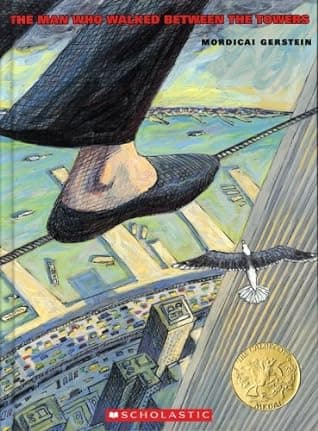
The Man Who Walked Between the Towers cover
Archivist's Choice

The Man Who Walked Between the Towers

Mordicai Gerstein (2003)

Genre

Biography / History / Children's

Reading Time

10 min

Key Themes

See below

Track Your Reading

Sign in to track this book

Philippe Petit walks a tightrope between the new Twin Towers, turning an impossible act into a poetic dance against the New York City sky.

Core Idea

Mordicai Gerstein's "The Man Who Walked Between the Towers" tells the story of Philippe Petit's high-wire walk between the World Trade Center's Twin Towers in 1974. The book shows how extraordinary vision, skill, and a willingness to go beyond normal limits can make everyday life feel magical, creating beautiful, free moments. It describes Petit's intense focus, careful planning, and the teamwork needed to achieve his dream. The book presents his act as a piece of performance art that captured a city's attention and became part of history.
Reading time
10 min
Difficulty
Easy
✓ Read this if...
You are fascinated by true stories of audacious human achievement, the intersection of art and civil disobedience, or the history of the Twin Towers. It's also excellent for children learning about courage, determination, and the pursuit of dreams.
✗ Skip this if...
You prefer detailed psychological analyses or extensive historical context over a focused, poetic narrative of a single event. If you are looking for a deep dive into the ethics of illegal acts, this brief, celebratory account may not suffice.

Core idea

The central argument and framework that powers the entire book.

Mordicai Gerstein's "The Man Who Walked Between the Towers" tells the story of Philippe Petit's high-wire walk between the World Trade Center's Twin Towers in 1974. The book shows how extraordinary vision, skill, and a willingness to go beyond normal limits can make everyday life feel magical, creating beautiful, free moments. It describes Petit's intense focus, careful planning, and the teamwork needed to achieve his dream. The book presents his act as a piece of performance art that captured a city's attention and became part of history.

At a glance

Reading time

10 min

Difficulty

Easy

Read this if...

You are fascinated by true stories of audacious human achievement, the intersection of art and civil disobedience, or the history of the Twin Towers. It's also excellent for children learning about courage, determination, and the pursuit of dreams.

Skip this if...

You prefer detailed psychological analyses or extensive historical context over a focused, poetic narrative of a single event. If you are looking for a deep dive into the ethics of illegal acts, this brief, celebratory account may not suffice.

Key Takeaways

1

The Audacity of Vision

Petit's dream transcended the physical, envisioning art where others saw only architecture.

Quote

He looked at the towers, and in his mind, he saw a wire stretched between them, high in the sky. He saw himself walking on that wire.

Philippe Petit's story shows the human ability for bold vision. Before the World Trade Center towers were finished, Petit, a street performer, saw them as a stage for an artistic act. This was not about seeking thrills, but about an artistic drive so strong that he spent years planning and executing it. His vision was not just to walk, but to turn a city space into a canvas for a brief, beautiful performance, changing how people saw public space and what was possible in it. It shows how a single, focused pursuit of an extraordinary dr...

Supporting evidence

The book details Petit's long-term planning, including studying blueprints, making sketches, and practicing for years, all before the towers were even finished, demonstrating a pre-existing, deeply ingrained vision.

Apply this

Cultivate a 'vision board' for long-term, ambitious goals. Regularly revisit and refine it, allowing your initial audacious idea to guide your persistent efforts, even when the path seems unclear or impossible to others.
audacious-visionartistic-expressionunwavering-focus
2

Mastery Through Obsession

Years of relentless practice and meticulous planning underpinned Petit's seemingly spontaneous act.

Quote

He practiced on a wire stretched between two trees. He practiced on a wire stretched between two buildings. He practiced, and practiced, and practiced.

The book shows that Petit's 'walk' was not a spur-of-the-moment stunt; it was the result of intense, focused practice and careful preparation. His commitment to mastering the tightrope, clear from his early street performances and constant training, shows that true skill comes from consistent repetition and refinement. This involved not only physical training but also studying the towers, understanding wind patterns, and finding clever ways to string the cable. His 'performance' shows that extraordinary feats are often the visible par...

Supporting evidence

Gerstein describes Petit's extensive practice, first between trees, then between buildings, as well as the detailed planning involving his accomplices to sneak equipment into the towers.

Apply this

Identify a skill you want to master. Dedicate a specific, consistent block of time each day or week for deliberate practice, focusing on incremental improvements and identifying specific weaknesses to address. Document your progress.

masterydeliberate-practicemeticulous-planning
3

The Power of Collaboration (and Deception)

Petit's solo performance was an intricate orchestration of a dedicated, albeit illicit, team.

Quote

He gathered a band of conspirators: friends who would help him carry the heavy cable and equipment, friends who would stand guard, friends who would distract the guards.

While the famous image is of Petit alone on the wire, the book clearly shows that his feat was a complex, shared effort. He gathered a team who played important roles in the elaborate, almost heist-like, operation. Each team member's help was vital, from sneaking in heavy equipment to distracting security guards and stringing the cable across the huge gap. This shows that even the most individual acts of genius often depend on a network of support, trust, and shared goals. The illegal nature of their collaboration adds daring and clev...

Supporting evidence

The narrative explicitly details the roles of Petit's friends in aiding the 'coup,' including carrying equipment, posing as construction workers, and using a bow and arrow to string the pilot line.

Apply this

For your next ambitious project, identify key areas where you need support. Actively recruit and clearly delegate tasks to a small, trusted team, fostering a sense of shared purpose and celebrating collective achievements.

collaborationteamworklogistical-planning
4

Transcending the Mundane

Petit's walk transformed ordinary architecture into a stage for profound, ephemeral art.

Quote

The people on the streets below stopped and stared. They pointed. They gasped. They couldn't believe their eyes.

Petit's tightrope walk was more than a physical achievement; it was an act of artistic change. He took two huge, practical buildings—symbols of business and city power—and, for a short, amazing hour, turned them into the ends of a sky stage. The act itself was brief, existing only in that moment, but its effect on thousands of onlookers was deeply spiritual. It made people look up, pause their daily routines, and see something unexpected and beautiful, changing their ideas of what cities are for and what art can be. This brief spectac...

Supporting evidence

The book describes the reactions of the crowd below – stopping, staring, gasping – and the awe generated by the sight of Petit high above.

Apply this

Seek out or create moments of 'awe' in your daily life. This could be actively observing nature, attending live performances, or engaging in creative acts that challenge your routine and invite wonder.

ephemeral-arturban-transformationawe-and-wonder
5

The Dance with Danger

The inherent peril of the walk was not a deterrent, but an integral element of its artistic power.

Quote

A tiny figure, dancing in the sky, between two giants of steel and glass. The wind blew. The towers swayed slightly. He swayed with them.

The danger in Petit's walk was not a mistake; it was a key part of its artistic and emotional effect. The book shows the terrifying height and the fragility of his position, highlighting the great risk. This dance with death, performed with grace, made the act more than just a stunt—it made it art. It spoke to the human interest in pushing limits, facing fear, and finding beauty in instability. The danger made the wonder and preciousness of the moment greater, making the performance unforgettable. It showed that sometimes, true art ex...

Supporting evidence

Gerstein emphasizes the height, the wind, and Petit's swaying, explicitly detailing the perilous conditions and the physical demands of the walk.

Apply this

When pursuing a significant goal, acknowledge and embrace the inherent risks. Understand that overcoming challenges and facing fears can amplify the reward and personal growth associated with the achievement, rather than viewing danger as a reason to avoid it.

risk-takingcouragehuman-vulnerability
6

Living in the Moment

For Petit, the walk was an immersive, timeless experience, detached from external consequences.

Quote

He was dancing with the wind. He was one with the sky. He was free.

One of the most striking parts of Petit's performance, as shown by Gerstein, is his deep focus on the moment. Despite the threat of arrest, the incredible height, and global attention, Petit seemed completely unaffected by outside consequences, fully present in his 'dance.' He spent over 45 minutes on the wire, not rushing, but performing, lying down, kneeling, and greeting a seagull. This shows a deep state of flow, where the act itself becomes the only reality, beyond time and outside pressures. It is a strong lesson in mindfulness ...

Supporting evidence

The book details Petit's extended time on the wire, his various poses (lying down, kneeling), and his interaction with the seagull, indicating a state of profound presence rather than hurried execution.

Apply this

Practice mindfulness during a challenging task. Focus entirely on the immediate actions and sensations, rather than worrying about outcomes or external judgments. Aim for a 'flow state' where your attention is fully absorbed.

mindfulnessflow-statepresence
7

The Impermanence of Grandeur

The story, written before 9/11, offers a poignant reflection on monuments and their legacy.

Quote

And the towers are gone now, but the memory of the man who walked between them remains.

Though published in 2003, after the events of 9/11, Gerstein's book carries a deep message about how even the grandest human creations are temporary. The towers, once symbols of ambition and engineering, are shown as magnificent backgrounds for Petit's brief art. The afterword acknowledging their absence adds a sad, almost mournful tone to the story. It shows that while physical structures may fall, the human spirit, acts of beauty, and the stories of those who dared to dream can last. The book turns the World Trade Center from just b...

Supporting evidence

The book's dedication and postscript, written after the towers' destruction, directly address their absence, imbuing the story with a deeper sense of historical poignancy.

Apply this

Reflect on the temporary nature of material possessions and even grand achievements. Prioritize creating meaningful experiences and fostering human connection, as these intangible legacies often outlast physical structures.

impermanencelegacyhuman-spirit
8

Art as Civil Disobedience

Petit's act was a beautiful defiance, a challenge to authority and conventional norms.

Quote

He was arrested, of course. But the judge, perhaps touched by the beauty of the act, sentenced him to perform for children in the park.

Petit's tightrope walk was an illegal act of civil disobedience. He broke many laws to achieve his artistic vision. However, the unique outcome—his sentence to perform for children—shows society's complex view of such acts. It suggests that when art is truly extraordinary, it can sometimes go beyond or even redefine legal limits, appealing to a deeper human appreciation for beauty, courage, and freedom. His defiance was not destructive; it was creative, challenging the ordinary and the restrictive. This takeaway explores how some acts...

Supporting evidence

The book explicitly states his arrest and the unusual, lenient sentence, demonstrating the legal consequences and the public's unique reaction.

Apply this

When faced with creative or ethical boundaries, consider how 'disrupting' the norm (within ethical reason) might lead to a more impactful or meaningful outcome. Challenge assumptions about what is 'allowed' in pursuit of a greater good or artistic expression.

civil-disobedienceartistic-freedomchallenging-norms
9

The Everyday Magic of Extraordinary Feats

The book reminds us that magic isn't supernatural, but often found in human dedication and daring.

Quote

It was as if he had conjured a dream into reality.

Gerstein's lyrical writing gives Petit's story a sense of magic, suggesting that the extraordinary is not just in fantasy, but can be brought into reality through human will and skill. The 'magic' here is not supernatural; it is the deep impact of seeing someone achieve the seemingly impossible through years of dedication and a strong belief in their vision. The book reminds us that true wonder often comes from pushing human limits, turning daring acts into moments of shared awe. It encourages readers, especially children, to believe ...

Supporting evidence

The evocative language used throughout the book, describing Petit's actions as 'dancing' and 'conjuring a dream,' creates a magical tone around a very real event.

Apply this

Identify a personal 'impossible dream' that you've dismissed. Break it down into small, actionable steps. Dedicate consistent effort, believing that sustained dedication can transform the seemingly magical into a tangible reality.

human-potentialimaginationdedication
10

Finding Freedom in Constraint

The narrow confines of the wire became Petit's expansive stage for ultimate freedom.

Quote

He stretched out his arms like a bird, and flew.

Paradoxically, the ultimate freedom Petit felt was found within the tightest limits: a thin wire hundreds of feet in the air. This narrow, dangerous path, which would be terrifying and limiting for most, became his space for endless expression. He was not just walking; he was dancing, lying down, kneeling, and performing, showing complete skill and freedom within a very confined and dangerous space. This idea challenges the usual concept of freedom, suggesting that true liberation is not always found in an absence of boundaries, but s...

Supporting evidence

The detailed descriptions of Petit's various movements on the wire (lying down, kneeling, dancing) illustrate how he found expansive expression within the severe physical constraint.

Apply this

Identify a current constraint in your life or work (e.g., limited resources, time). Instead of viewing it as a barrier, brainstorm ways to innovate and create within those specific boundaries, finding unexpected opportunities for creativity and freedom.

creative-constraintmastery-and-freedomdiscipline-as-liberation

Critical analysis

Notable Quotes

The year was 1974, and on a wire, high above the city, a young man was about to begin a walk.

Opening sentence, setting the scene for Philippe Petit's high-wire walk.

He loved to juggle. He loved to ride his unicycle. But most of all, Philippe loved to walk on a wire.

Describing Philippe Petit's passions and his primary obsession.

He practiced and practiced, on a wire he strung between two trees in his yard, on a wire he strung across a stream.

Illustrating Philippe's dedication and rigorous training.

When Philippe Petit first saw a picture of the Twin Towers, not yet finished, he knew just what he must do.

Philippe's immediate inspiration upon seeing the World Trade Center towers.

He would string a wire between the two towers and walk on it.

Philippe's audacious plan, the central act of the story.

It was against the law. But Philippe was a street performer, a rebel, a poet of the air.

Acknowledging the illegality of his act and defining Philippe's character.

Secretly, he planned his fantastic crime.

Highlighting the clandestine and daring nature of his preparations.

He dressed as a construction worker, and with his friends, snuck into the towers.

Describing the ingenious method used to gain access to the towers.

They shot a fishing line across the void, then a stronger rope, then a cable.

Detailing the complex process of stringing the wire between the buildings.

And then, at dawn, on August 7, 1974, Philippe stepped out onto the wire.

The pivotal moment when Philippe begins his walk.

He was an angel. He was a phantom. He was a bird.

Describing the awe-inspiring sight of Philippe on the wire, from the perspective of the onlookers.

For almost an hour, he walked, danced, knelt, and even lay down on the wire.

Illustrating the duration and variety of Philippe's performance.

When he finally stepped off the wire, he was arrested. But he was also a hero.

The immediate aftermath of his walk, capturing the mixed reaction.

He gave them a free show, a gift, a dream.

Reflecting on the impact and meaning of Philippe's unauthorized performance.

And for a while, the people of New York looked up, and remembered the man who walked between the towers.

The lasting legacy and memory of Philippe Petit's extraordinary feat.

Quiz

Test Your Knowledge

Ready to see how well you understood this book? Take our interactive quiz with 10 questions.

10
Questions
~5
Minutes
?
Best Score

Key Questions (FAQ)

'The Man Who Walked Between the Towers' by Mordicai Gerstein tells the true story of Philippe Petit, a French aerialist who, in 1974, secretly strung a tightrope between the tops of the World Trade Center's Twin Towers and walked across it multiple times. It captures the daring, beauty, and impact of this unauthorized high-wire act.

About the author