BookBrief
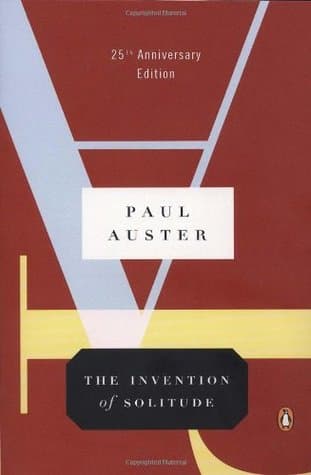
The Invention of Solitude cover
Archivist's Choice

The Invention of Solitude

Paul Auster (1982)

Genre

Biography / Memoir / Philosophy

Reading Time

240 min

Key Themes

See below

Track Your Reading

Sign in to track this book

After his emotionally distant father's sudden death uncovers a sixty-year-old murder mystery, Paul Auster confronts inherited silences and the challenge of defining himself as a father and a writer.

Core Idea

Paul Auster's "The Invention of Solitude" is a two-part reflection on absence, memory, and how identity forms. It explores these ideas through the author's largely unknown, deceased father and Auster's own new experience with fatherhood. The book suggests that identity is a shifting story, shaped by the empty spaces others leave, the unavoidable patterns across generations, and the conscious act of writing. Writing becomes a way to face, understand, and create one's own truth in a solitary life. The book argues that the stories we tell, or don't tell, about our past greatly influence our present and future, especially regarding inherited traits and experiences, and the search for meaning in life and death's arbitrary nature.
Reading time
240 min
Difficulty
Medium
✓ Read this if...
You are interested in deeply introspective memoirs, philosophical explorations of identity, father-son relationships, and the role of writing in processing grief and self-discovery. Ideal for those who appreciate literary, fragmented narratives.
✗ Skip this if...
You prefer straightforward, chronological biographies, or are looking for a light, plot-driven read. If you dislike abstract prose and a strong focus on internal monologue, this might not be for you.

Core idea

The central argument and framework that powers the entire book.

Paul Auster's "The Invention of Solitude" is a two-part reflection on absence, memory, and how identity forms. It explores these ideas through the author's largely unknown, deceased father and Auster's own new experience with fatherhood. The book suggests that identity is a shifting story, shaped by the empty spaces others leave, the unavoidable patterns across generations, and the conscious act of writing. Writing becomes a way to face, understand, and create one's own truth in a solitary life. The book argues that the stories we tell, or don't tell, about our past greatly influence our present and future, especially regarding inherited traits and experiences, and the search for meaning in life and death's arbitrary nature.

At a glance

Reading time

240 min

Difficulty

Medium

Read this if...

You are interested in deeply introspective memoirs, philosophical explorations of identity, father-son relationships, and the role of writing in processing grief and self-discovery. Ideal for those who appreciate literary, fragmented narratives.

Skip this if...

You prefer straightforward, chronological biographies, or are looking for a light, plot-driven read. If you dislike abstract prose and a strong focus on internal monologue, this might not be for you.

Key Takeaways

1

The Absent Father's Legacy

Unpacking a father's silence reveals a lifetime of unspoken truths and their profound impact.

Quote

He was a man who left no mark, who was content to live his life as if he had never been born.

Auster's initial look at his father is not about warm memories but about a deep absence. His father, a distant and emotionally unavailable person, creates a void that shapes Auster's early life and later thoughts. The book suggests that this 'emptiness' is not just a lack of presence but an active force, a silence that reveals much about a life lived without real connection or clear affection. This void pushes Auster to explore his father's past, not out of longing, but out of a need to understand why there was such emotional distance...

Supporting evidence

Auster's discovery of his father's belongings, particularly the unopened boxes and the lack of personal effects, serves as physical evidence of his father's 'unlived' life and emotional detachment. The sparse details and memories Auster recounts emphasize this absence.

Apply this

Reflect on the 'silences' or unspoken narratives within your own family history. What do these absences communicate? How do they shape your understanding of your identity and relationships? Consider how you might fill these voids with your own intentional presence and communication.

paternal-absenceemotional-distancefamily-legacy
2

The Shadow of Violence

A historical murder reveals the traumatic origins of a family's emotional repression.

Quote

The past is never dead. It's not even past.

The most striking discovery in the book is the sixty-year-old murder mystery involving Auster's paternal grandfather. This violent event, a domestic murder-suicide, casts a long, chilling shadow over the family, especially Auster's father. The book suggests that this traumatic event, mostly unspoken, caused the father's emotional shutdown and his later inability to connect. The murder becomes a symbol for the deeper violence of silence and repression, showing how unacknowledged trauma can affect generations, shaping personalities and ...

Supporting evidence

The detailed recounting of the murder of Auster's paternal grandmother by his grandfather, and the subsequent suicide of the grandfather, is the central historical event that Auster uncovers.

Apply this

Investigate significant, potentially traumatic, events in your family history. How might these events have influenced subsequent generations? Consider the importance of acknowledging and processing historical trauma to break cycles of emotional repression.

generational-traumafamily-secretshistorical-impact
3

The Act of Self-Invention

Writing becomes a desperate attempt to construct meaning and identity from the fragments of memory.

Quote

He was a man who left no mark, who was content to live his life as if he had never been born. But I, his son, am condemned to remember him.

Auster's memoir is not just about his father; it is also about writing as a way to discover and create oneself. Faced with the emptiness of his father's life, Auster uses language to fill the silence, to put together a story that makes sense of an otherwise unclear past. The act of writing becomes a form of 'solitude' – a necessary retreat to face and build meaning. By trying to understand his father, Auster simultaneously creates his own identity as a son, a father, and a writer. This self-aware approach highlights how memory and aut...

Supporting evidence

The book's structure itself, moving from a direct memoir of his father to a more philosophical, third-person reflection ('A.'), demonstrates Auster's engagement with the process of writing and self-creation.

Apply this

Consider journaling or creative writing as a tool for self-reflection and understanding. How can narrating your own experiences help you to process emotions, uncover patterns, and construct a stronger sense of self?

autobiographycreative-processself-discovery
4

Fatherhood: A Mirror and a Maze

Becoming a father forces Auster to confront his own paternal legacy and forge a new path.

Quote

For a long time, I could not imagine myself as a father. It was as if that part of my life had been erased before it had begun.

The second part of the book, where Auster uses the third-person 'A,' explores his own experience with fatherhood. This change in perspective is important; it lets him reflect on the worries and duties of being a father, especially given his own father's emotional absence. He fears repeating the same patterns of detachment, recognizing the deep effect his own presence will have on his son. Fatherhood becomes a mirror, showing his past, and a maze, requiring him to navigate new emotional areas while trying to break inherited patterns. T...

Supporting evidence

The narrative's shift to 'A' contemplating his own son and the separation from him directly illustrates this theme. The internal struggle to be a different kind of father is central to this section.

Apply this

If you are a parent, reflect on the aspects of your own upbringing that you consciously choose to emulate or reject in your parenting style. How does your past inform your present relationships with your children?

parentingfather-son-relationshipbreaking-cycles
5

The Solitude of the Self

Solitude is not merely loneliness, but a necessary condition for profound self-reflection and creation.

Quote

Solitude. It is not a question of being alone, but of being with oneself.

The title, 'The Invention of Solitude,' is a main theme. Auster does not present solitude as a negative state of isolation, but as an active, deliberate choice – a space for inner exploration and identity formation. For Auster, solitude is where memory, reflection, and creation happen. In this inner space, he can face the ghosts of his past, deal with his present complexities, and create a future self. The book suggests that true self-awareness often requires this withdrawal, this deliberate turning inward, to construct meaning from t...

Supporting evidence

The very act of writing this memoir, a deeply personal and introspective endeavor, occurs within a space of solitude, both literal and metaphorical, as Auster sifts through memories and thoughts.

Apply this

Schedule dedicated time for solitude and self-reflection in your routine. This could be through journaling, meditation, or simply quiet contemplation. What insights emerge when you intentionally disconnect from external distractions?

introspectionself-reflectionpersonal-growth
6

Coincidence and the Fabric of Reality

Seemingly random events can reveal hidden connections and influence life's trajectory.

Quote

Nothing is ever accidental. Everything is connected, even if we cannot see the connection at the time.

Auster is interested in how coincidence shapes lives. Throughout the book, he points out seemingly random events, encounters, and discoveries that, in hindsight, prove to be significant. The murder mystery itself is uncovered through a series of coincidences, and his thoughts on his own life are marked by these 'chance' events. This suggests a philosophical view where life is not entirely linear or predictable, but a fabric woven with threads of accident and synchronicity. Auster implies that by noticing these coincidences, one can ga...

Supporting evidence

The discovery of the newspaper clipping detailing his grandfather's murder, which was not actively sought but stumbled upon, serves as a prime example of a pivotal coincidence.

Apply this

Pay closer attention to 'coincidences' in your own life. Instead of dismissing them, reflect on what connections they might suggest or what they might be trying to tell you about your path or relationships.

synchronicitydestinymeaning-making
7

The Elusiveness of Truth

Memory is unreliable, and the 'truth' of a life is always a constructed narrative.

Quote

Memory is not a museum, but a battlefield.

Auster's effort to understand his father is complicated by the difficulties of memory and the subjective nature of truth. He admits that he is piecing together fragments, relying on few memories, and interpreting silence. The book suggests that a definite, objective 'truth' about a person, especially one as elusive as his father, is impossible to reach. Instead, what emerges is a constructed story, an 'invention' based on available evidence and the writer's own view. This self-awareness about memory's limits and narrative's power make...

Supporting evidence

Auster repeatedly emphasizes the scarcity of his own memories of his father and the reliance on second-hand accounts or interpretations of objects, highlighting the constructed nature of his narrative.

Apply this

When reflecting on your own past or the lives of others, acknowledge the subjectivity and fallibility of memory. Instead of seeking one definitive truth, consider the multiple perspectives and interpretations that can exist.

memorysubjectivitynarrative-truth
8

The Weight of Unspoken Words

Silence, particularly within families, can be more destructive than spoken conflict.

Quote

The language of silence is the one he spoke best.

Auster's father's deep silence is not presented as harmless, but as a heavy, stifling presence that defined their relationship. The book clearly shows how a lack of communication, emotional expression, and shared vulnerability can create vast gaps between people, even within a family. This 'language of silence' leads to misunderstanding, promotes detachment, and leaves a legacy of emotional emptiness. Auster's exploration warns about the destructive power of unaddressed issues and the importance of open, honest communication, even whe...

Supporting evidence

The lack of meaningful conversations or emotional exchanges between Auster and his father, as described throughout the first section, is the core evidence of this theme.

Apply this

Identify areas of silence or unaddressed issues in your own relationships. Consider initiating difficult conversations, even if uncomfortable, to prevent the build-up of unspoken resentment or misunderstanding.

communication-breakdownemotional-repressionfamily-dynamics
9

Writing as a Response to Loss

The act of creation can be a powerful antidote to grief and the search for meaning in absence.

Quote

And so, in the end, I wrote this book. Not to understand him, perhaps, but to invent him.

The entire memoir can be seen as Auster's artistic response to the deep loss and unanswered questions about his father's life and death. Writing becomes a way to process grief, to give shape to the shapeless, and to turn absence into presence. By 'inventing' his father through words, Auster finds a way to engage with a relationship that was largely unfulfilled in life. This highlights the healing and restorative power of creative expression, especially when facing significant personal loss. It shows how art can be a means of both reme...

Supporting evidence

The book itself is the ultimate evidence – Auster's decision to write this memoir, delving into his father's life and his own, is a direct response to the void left by his father's death.

Apply this

If you are experiencing grief or struggling with unresolved feelings, consider engaging in a creative pursuit (writing, art, music) as a way to process emotions and find meaning in your experiences.

grief-processingcreative-therapymeaning-making
10

The Self as a Mosaic

Identity is not monolithic, but a complex tapestry woven from memories, coincidences, and narratives.

Quote

I am not one man, but many men. I am a multitude.

Auster's use of different narrative voices and his fragmented approach to memory suggest that the self is not a single, fixed thing, but a constantly changing collection. His identity as 'Paul Auster' the son, and 'A.' the father/writer, shows this multiplicity. He is shaped by his father's absence, his family's historical trauma, his own experiences as a parent, and the act of writing and reflecting. The book invites readers to see their own identities not as a simple biography, but as a rich, complex interplay of internal and extern...

Supporting evidence

The stylistic shift between the two sections, and the adoption of the third-person 'A,' directly demonstrates Auster's exploration of fragmented and multiple identities within one individual.

Apply this

Reflect on the different 'roles' or 'selves' you embody in various contexts (e.g., parent, professional, friend). How do these different facets contribute to your overall identity? Consider how your identity has evolved over time.

identity-formationmultiplicity-of-selfexistentialism

Critical analysis

Notable Quotes

It seems to me that the only way to make a book is to write the one you are writing, and the only way to make a life is to live the one you are living.

Reflecting on the nature of creation and existence.

I discovered that solitude was the one thing I needed to live. It was the only thing that made me feel alive.

Describing his realization about the importance of being alone.

The past is a foreign country; they do things differently there.

A meditation on memory and the irrecoverable nature of the past.

A book is a world, a world in itself, and I am in it, and it is in me.

Expressing the immersive and reciprocal relationship with literature.

Every man is a book, and every man is a book that has been written, but never read.

Pondering the unread stories and hidden depths within individuals.

We are all strangers to ourselves, and we are all strangers to each other.

A reflection on the inherent unknowability of self and others.

The world is in my head. My body is a world. The world is a body.

Exploring the interconnectedness of mind, body, and external reality.

To be alone is to be free, to be free is to be alone.

Linking the concepts of solitude and personal liberation.

The story is never over. It goes on and on, even after you're gone.

Considering the enduring nature of narratives and their impact beyond a lifetime.

We live in a world of words. We are surrounded by words. We are made of words.

Emphasizing the pervasive and fundamental role of language.

The dead are not gone. They are just in another room.

A comforting thought about the continuing presence of those who have passed.

Writing is a solitary act, but it is also an act of communion.

Paradoxically describing the dual nature of writing as both isolated and connected.

There are no answers, only questions. And the questions are endless.

Reflecting on the unending nature of inquiry and the absence of definitive solutions.

Memory is a kind of writing. It is a way of inscribing the past onto the present.

Connecting the act of remembering to the creative and interpretive process of writing.

The greatest journeys are the ones we take inside ourselves.

Highlighting the importance of introspection and inner exploration.

Quiz

Test Your Knowledge

Ready to see how well you understood this book? Take our interactive quiz with 10 questions.

10
Questions
~5
Minutes
?
Best Score

Key Questions (FAQ)

Paul Auster's 'The Invention of Solitude' is a two-part memoir exploring themes of fatherhood, memory, and writing. The first section delves into his distant relationship with his recently deceased father and uncovers a family murder mystery, while the second reflects on his own role as a father and the act of storytelling.

About the author

Paul Auster

Paul Benjamin Auster is an American writer and film director. His notable works include The New York Trilogy (1987), Moon Palace (1989), The Music of Chance (1990), The Book of Illusions (2002), The Brooklyn Follies (2005), Invisible (2009), Sunset Park (2010), Winter Journal (2012), and 4 3 2 1 (2017). His books have been translated into more than forty languages.