BookBrief
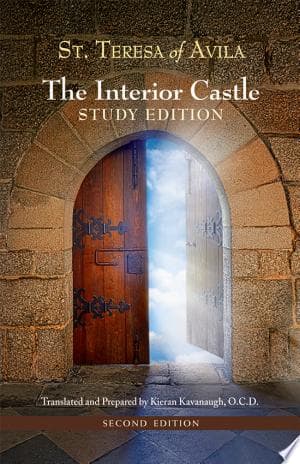
The Interior Castle cover
Archivist's Choice

The Interior Castle

Teresa of Ávila (2013)

Genre

Spirituality

Reading Time

9-12 hours (given 284 pages and dense content)

Key Themes

See below

Track Your Reading

Sign in to track this book

Explore the soul's seven crystal mansions with Teresa of Ávila to find divine union in its deepest part.

Core Idea

Teresa of Ávila's "The Interior Castle" describes the soul's journey to mystical union with God as a castle with seven rooms. The main idea is that through self-knowledge, prayer, letting go of worldly desires, and accepting difficulties, one can move through these inner rooms. Each room means a deeper stage of spiritual cleansing and closeness with God, ending in the seventh room where the soul unites with God. This transforms it into an instrument of active love and service. The book stresses that this spiritual change is for everyone, and God lives within us.
Reading time
9-12 hours (given 284 pages and dense content)
Difficulty
Hard
✓ Read this if...
You are seeking a detailed, experiential guide to Christian mystical spirituality, desire to understand the stages of inner prayer and spiritual growth, or are interested in the classical works of Catholic mysticism.
✗ Skip this if...
You prefer secular self-help, are looking for a quick spiritual fix, or are averse to dense, allegorical religious texts written from a 16th-century Catholic perspective.

Core idea

The central argument and framework that powers the entire book.

Teresa of Ávila's "The Interior Castle" describes the soul's journey to mystical union with God as a castle with seven rooms. The main idea is that through self-knowledge, prayer, letting go of worldly desires, and accepting difficulties, one can move through these inner rooms. Each room means a deeper stage of spiritual cleansing and closeness with God, ending in the seventh room where the soul unites with God. This transforms it into an instrument of active love and service. The book stresses that this spiritual change is for everyone, and God lives within us.

At a glance

Reading time

9-12 hours (given 284 pages and dense content)

Difficulty

Hard

Read this if...

You are seeking a detailed, experiential guide to Christian mystical spirituality, desire to understand the stages of inner prayer and spiritual growth, or are interested in the classical works of Catholic mysticism.

Skip this if...

You prefer secular self-help, are looking for a quick spiritual fix, or are averse to dense, allegorical religious texts written from a 16th-century Catholic perspective.

Key Takeaways

1

The Soul as a Seven-Mansion Castle

Spiritual growth is an ordered journey through distinct inner chambers.

Quote

I began to think of the soul as if it were a castle made of a single diamond or of very clear crystal, in which there are many rooms, just as in heaven there are many mansions.

Teresa's idea of the soul as an 'Interior Castle' is more than poetic; it provides a way to understand spiritual growth. Each of the seven rooms shows a stage of the spiritual journey, moving from outward, worldly concerns to God's innermost dwelling. This is not a straight path up, but a deeper inward movement, needing effort and grace. The first rooms involve self-knowledge, prayer, and freedom from sin. The later rooms include deep mystical experiences and a closer union with God. This castle image makes an otherwise abstract spiri...

Supporting evidence

Teresa's initial vision of the soul as a crystal globe, detailed at the beginning of the book, which she then systematically elaborates into the seven mansions, each with its own spiritual challenges and graces.

Apply this

Regularly reflect on your current spiritual state, identifying which 'mansion' you most resonate with. Use this framework to understand the challenges you face and the next steps required for deeper inward movement, rather than getting discouraged by perceived stagnation.

spiritual-journeysoul-metaphorinner-life
2

The Necessity of Self-Knowledge

Before divine union, one must first understand and humble oneself.

Quote

We shall never succeed in knowing ourselves unless we seek to know God: let us look at His greatness, and then we shall see our own baseness; by looking at His purity, we shall see our own filth; by looking at His humility, we shall see how far we are from being humble.

Teresa states that the journey into the Interior Castle must begin with deep self-knowledge. This is not a quick self-check but a clear understanding of one's limits, sinfulness, and reliance on God. Without this humility, the soul cannot move past the outer rooms. She warns against thinking one is spiritually advanced without first facing one's flaws. True self-knowledge, strangely, comes not from looking inward only, but from thinking about God's perfection. This shows our own weaknesses and inspires real humility and a wish for cha...

Supporting evidence

Teresa's detailed description of the first three mansions, where the primary focus is on detachment from worldly pleasures, examination of conscience, and the practice of vocal and mental prayer to combat sin and cultivate virtues.

Apply this

Engage in daily examen or reflective prayer, not to condemn yourself, but to honestly assess your motivations, actions, and areas needing growth. Pair this with contemplative prayer, focusing on God's attributes, to foster humility and a longing for divine grace.

humilityself-reflectionspiritual-discipline
3

The Power of Prayer as a Lifeline

Prayer is the essential dialogue that sustains the soul's journey.

Quote

Prayer is nothing else than being on terms of friendship with God, frequently conversing in secret with Him Who we know loves us.

For Teresa, prayer is not just a religious duty but the soul's very breath, how it talks to God and gets closer to Him. She separates different kinds of prayer, from spoken and mental prayer in the early rooms to the prayer of quiet and union in the later stages. What stays the same is the idea that prayer is a direct, personal bond—a friendship with the divine. Through steady prayer, the soul cleanses itself, receives grace, and gets ready for deeper mystical experiences. Neglecting prayer is like cutting off the castle's life suppor...

Supporting evidence

Teresa's extensive discussion of different types of prayer throughout the book, particularly her advice on mental prayer in the early mansions and her description of the 'prayer of quiet' and 'prayer of union' in the later mansions as states of profound interior peace and divine presence.

Apply this

Commit to a consistent daily prayer practice, starting with simple vocal prayers and gradually moving towards periods of silent, contemplative prayer where you simply rest in God's presence, cultivating a sense of intimate friendship.

contemplative-prayermystical-experiencedivine-communication
4

Detachment from Worldly Pleasures

True freedom for the soul comes from severing ties to earthly attachments.

Quote

The devil has no power over a soul that is detached.

Teresa stresses that moving into the Interior Castle requires letting go of worldly pleasures, honors, and even spiritual comforts themselves. This is not about being ascetic for its own sake, but recognizing that attachments create 'cobwebs' and 'snakes' (sins) that stop the soul from freely moving toward God. The more the soul holds onto earthly comforts, status, or even the wish for pleasant spiritual feelings, the less room it has for divine grace. True detachment frees the soul, making it flexible in God's hands and immune to tem...

Supporting evidence

Teresa's warnings in the early mansions about the 'venomous creatures' (sins) and 'serpents' (devils) that inhabit the outer chambers and can only be overcome by diligent prayer, self-knowledge, and detachment from worldly distractions.

Apply this

Identify one significant worldly attachment (e.g., excessive screen time, material possession, need for approval) and intentionally practice detachment from it through sacrifice or mindful moderation. Observe how this creates more interior space and freedom.

asceticismspiritual-freedomnon-attachment
5

The Role of Suffering and Trials

Spiritual purification often involves periods of profound desolation and trial.

Quote

The Lord tries those He loves, and the more He loves them, the more He tries them.

Teresa directly discusses spiritual suffering, especially in the middle rooms. She says that trials, periods of emptiness, and dryness are not signs God has left us but tools for cleansing. These 'dark nights' remove illusions, self-reliance, and attachments, making the soul depend entirely on God's grace. Though painful, these experiences are key to deepening faith and preparing the soul for higher states of union. She normalizes these hard times, assuring the reader they are part of God's teaching, purifying the soul like gold in a ...

Supporting evidence

Teresa's descriptions of the 'dryness' and 'spiritual trials' experienced in the third and fourth mansions, where prayer becomes difficult and consolations are withdrawn, serving to purify the soul's intentions and deepen its faith.

Apply this

When facing spiritual dryness or personal trials, reframe them not as punishment but as opportunities for deeper purification and surrender to God's will. Practice patience and perseverance, trusting that these experiences are forging a stronger, more resilient faith.

dark-night-of-the-soulspiritual-purificationperseverance
6

Mystical Union as a Divine Marriage

The culmination of the journey is an intimate, transformative union with God.

Quote

For the soul to be made one with God, it must lose its own life and live in God.

The final goal of the Interior Castle is the seventh room, where the soul experiences a deep, transforming union with God, often called a 'spiritual marriage.' This is not losing oneself but a joining of wills, where the soul's desires perfectly match God's. Teresa describes this as an almost indescribable state of peace, joy, and constant awareness of God's presence, where doubt and fear disappear. This union is a gift, not something earned, given by divine grace after much cleansing and preparation. It's a state of deep closeness wh...

Supporting evidence

Teresa's detailed, almost ecstatic descriptions of the seventh mansion, where the soul experiences a 'spiritual marriage' and 'transformation in God,' characterized by profound peace, constant awareness of the Divine Presence, and an inability to doubt God's love.

Apply this

Cultivate a longing for deeper union with God, understanding that while it is a gift, our purification and openness prepare us for it. Practice surrendering your will to God in daily decisions, seeing this as a step towards greater alignment.

spiritual-marriagedivine-unionmysticism
7

The Fruits of Union: Active Love and Service

True mystical experience leads not to quietism but to fervent action.

Quote

The true test of whether we are living in God is not in our raptures or consolations, but in how we love our neighbor.

Importantly, Teresa corrects the idea that mystical union leads to passive quietism or leaving the world. Instead, the soul that has united with God is filled with an intense, active love that makes it serve others. The spiritual marriage is not for personal gain but for God's kingdom. The soul, now perfectly aligned with divine will, becomes an instrument of God's love in the world, showing virtues like humility, charity, and endurance. This active love for one's neighbor becomes the clear proof and outward sign of the inner change, ...

Supporting evidence

Teresa's emphasis in the later mansions that the 'fruits' of spiritual union are not just inner peace but outward acts of charity, service to others, and a burning desire for the salvation of souls, demonstrating that true mystical experience is never sterile.

Apply this

After periods of prayer or spiritual reflection, intentionally seek out opportunities for service or acts of charity, no matter how small. Use your spiritual energy to actively contribute to the well-being of your community and the world.

charityactive-contemplationsocial-justice
8

The Role of Humility and Obedience

Submission to God's will and spiritual guidance is paramount for progress.

Quote

Humility is the foundation and cornerstone of all virtues.

Throughout the journey, Teresa always highlights the essential virtues of humility and obedience. Humility is not self-abasement but a true understanding of one's place before God, admitting complete reliance on divine grace. Obedience, especially to spiritual guides, is shown as a protection against error and a way to align one's will with God's. In a world full of spiritual dangers and self-deception, humility keeps the soul grounded, while obedience provides a needed outside check, ensuring that extraordinary experiences are truly ...

Supporting evidence

Teresa's frequent admonitions about the dangers of pride and self-will, and her insistence on seeking guidance from a wise spiritual director, especially when experiencing unusual spiritual phenomena, to discern their true origin.

Apply this

Regularly practice acts of humility, such as admitting mistakes or seeking advice from trusted spiritual mentors. Cultivate an attitude of obedience to divine promptings and legitimate spiritual authority, even when it challenges your preferences.

spiritual-guidancevirtuediscernment
9

The Interiority of God's Presence

God is found not externally, but within the deepest recesses of the soul.

Quote

God dwells in the soul, and if we are to find Him, we must seek Him within ourselves.

The main insight of the Interior Castle is that God is not far away or outside us but lives within the soul itself, in its innermost room. The whole journey is a discovery, a realization of this inner divine presence. This deep inwardness makes Teresa's mysticism unique and shows that spiritual seeking is not about reaching out but going inward. The castle image perfectly illustrates that the 'kingdom of God is within you,' and the rooms are just layers of self-deception and worldly distraction that hide this inherent divine indwellin...

Supporting evidence

The entire premise of the book, where the 'King' (God) resides in the innermost dwelling of the soul. Teresa consistently directs the reader inward, away from external observances as the sole path to God, towards profound internal contemplation.

Apply this

Shift your spiritual focus from seeking God primarily in external rituals or places to cultivating an awareness of His presence within your own being. Practice moments of silent interiority, recognizing the divine spark within.

immanencecontemplationdivine-indwelling

Critical analysis

Notable Quotes

The soul is like a castle, all of one piece, and made of a single diamond or very clear crystal, in which there are many rooms, just as in Heaven there are many mansions.

Introducing the central metaphor of the castle, representing the soul's journey to God.

It is a great pity, and a cause for shame, that we do not understand ourselves, or know who we are.

Lamenting the lack of self-knowledge among Christians.

God grant that I may have the strength to write about these things, for I know that I shall need it.

Expressing humility and dependence on God for the task of writing about spiritual experiences.

The door of this castle is prayer.

Emphasizing prayer as the essential entry point to the spiritual journey within the soul.

The important thing is not to think much but to love much.

Highlighting the primacy of love over intellectual contemplation in spiritual progress.

For true perfection consists in the love of God and neighbor.

Defining spiritual perfection through the dual commandment of love.

For the Lord does not look so much at the greatness of our works as at the love with which they are done.

Stresssing that the intention and love behind actions are more important than the actions themselves.

There are no certainties in this life, other than that we are born to die, and that we must serve God.

Reflecting on the fundamental truths of human existence and spiritual purpose.

The soul must strive to be like a clean mirror, so that the Sun of Justice may shine upon it.

Illustrating the need for purity and openness to receive divine grace.

God does not constrain our will; He takes what we give Him.

Explaining the concept of free will and God's respect for human choice in the spiritual journey.

Let us endeavor to be so closely united with God that He may live in us and we in Him.

Describing the ultimate goal of spiritual union with God.

The more we advance, the greater the trials we must expect.

Warning that spiritual progress often comes with increased difficulties and temptations.

Humility is the virtue by which we walk in truth.

Defining humility as essential for spiritual authenticity and progress.

For the love of God consists not in shedding tears, but in serving with justice and fortitude and humility.

Distinguishing true love for God from mere emotional display, emphasizing practical virtues.

It is not a matter of thinking a great deal, but of loving a great deal; so, do whatever most arouses you to love.

Reiterating the core message about the supremacy of love over intellectual effort in prayer and contemplation.

Quiz

Test Your Knowledge

Ready to see how well you understood this book? Take our interactive quiz with 10 questions.

10
Questions
~5
Minutes
?
Best Score

Key Questions (FAQ)

'The Interior Castle' by Teresa of Ávila is a classic guide to spiritual development, depicting the soul as a castle with seven mansions. It outlines a journey of faith through these stages, leading to profound union with God through prayer and service.

About the author