BookBrief
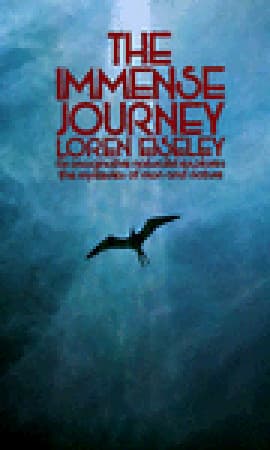
The Immense Journey cover
Archivist's Choice

The Immense Journey

Loren Eiseley (1958)

Genre

Science / Philosophy

Reading Time

240 min

Key Themes

See below

Track Your Reading

Sign in to track this book

Loren Eiseley, a writer with a scientist's mind and a poet's heart, turns his encounters with nature into deep thoughts about humanity's ancient past and uncertain present.

Core Idea

Loren Eiseley's "The Immense Journey" argues that people poorly understand their place in the universe because of their limited time perspective and human-centered views. Through vivid writing, Eiseley shows that life's beginning and changes are not simple, predictable steps but a series of unlikely, often harsh transformations. These changes are driven by the cosmic movement of elements, especially water, over vast periods of 'ghost continent' time. He questions the idea of human progress and control, seeing humanity as a 'double exposure' – a being both tied to its primitive past and reaching, often blindly, toward an unknown future. We are forever linked to the lasting mystery of ourselves and life's delicate, connected web.
Reading time
240 min
Difficulty
Medium
✓ Read this if...
You appreciate poetic, philosophical reflections on evolution, time, and humanity's place in the natural world, blending scientific observation with profound existential inquiry.
✗ Skip this if...
You prefer straightforward scientific explanations, linear narratives, or a focus on practical applications over speculative, often melancholic, contemplation.

Core idea

The central argument and framework that powers the entire book.

Loren Eiseley's "The Immense Journey" argues that people poorly understand their place in the universe because of their limited time perspective and human-centered views. Through vivid writing, Eiseley shows that life's beginning and changes are not simple, predictable steps but a series of unlikely, often harsh transformations. These changes are driven by the cosmic movement of elements, especially water, over vast periods of 'ghost continent' time. He questions the idea of human progress and control, seeing humanity as a 'double exposure' – a being both tied to its primitive past and reaching, often blindly, toward an unknown future. We are forever linked to the lasting mystery of ourselves and life's delicate, connected web.

At a glance

Reading time

240 min

Difficulty

Medium

Read this if...

You appreciate poetic, philosophical reflections on evolution, time, and humanity's place in the natural world, blending scientific observation with profound existential inquiry.

Skip this if...

You prefer straightforward scientific explanations, linear narratives, or a focus on practical applications over speculative, often melancholic, contemplation.

Key Takeaways

1

The Cosmic Dance of Water

All life, including humanity, is a transient manifestation of Earth's ancient water cycle.

Quote

I have come to think of myself as a kind of human river—a creature that flows, that has flowed, and that will flow.

Eiseley clearly shows that our individual lives are not fixed but are constantly changing and deeply connected to the planet's water cycle. He sees the human body as a temporary container for water that has been through countless forms and ages—from early oceans to ice, from rain to tree sap. This view removes the idea of a separate self, showing us as part of a large, old circulation. Our very being, our thoughts, and our bodies are temporary arrangements of molecules that have been, and will be, part of the wider Earth. This underst...

Supporting evidence

Eiseley frequently recounts personal experiences by rivers or springs, meditating on the water's journey and its presence within him. He speaks of 'the long journey' that water takes through geological time and biological forms, culminating in the momentary 'fountain' of an individual life.

Apply this

Cultivate a 'water consciousness' by observing natural water bodies and reflecting on the water within your own body. Recognize the shared molecular heritage with all living things and the Earth, fostering environmental stewardship and a profound sense of belonging. Hydrate mindfully, acknowledging the ancient journey of each drop.

hydrological-cycleecological-identitydeep-time
2

The Ghost Continent of Time

Human consciousness is a brief flicker against the backdrop of immense, ungraspable geological time.

Quote

We are a dream that has come out of the past, and it is a past that has no end.

Eiseley skillfully conveys the immense scale of geological and evolutionary time, often calling it a 'ghost continent' or 'immense journey' where the past is not truly gone but remains in echoes and traces. He questions the human-centered idea that puts humanity at the top or end of evolution. Instead, he places us as a brief, recent event, a 'momentary dream' coming from eons of blind, uncaring processes. This view is humbling, making us face the short-lived nature of our species and our individual lives. It suggests that our attempt...

Supporting evidence

His vivid descriptions of fossil hunting, particularly his encounters with ancient bone beds in the American West, trigger profound meditations on the creatures that lived and died millions of years ago, highlighting the insignificance of human time scales.

Apply this

Practice 'deep time' meditation: spend time in nature, contemplating the age of rocks, trees, and the land itself. Read about geological epochs and evolutionary history to recalibrate your sense of personal and species-level importance. Embrace humility in the face of cosmic scale.

geological-timeevolutionary-perspectiveanthropocentrism
3

The Unpredictable Genesis

Life's origins and evolutionary path are far more contingent and miraculous than deterministic.

Quote

The emergence of man from the primeval slime was not an inevitable process, but a series of improbable accidents.

Eiseley breaks down the idea of smooth, linear progress in evolution, especially regarding humanity's rise. He highlights the role of chance, environmental changes, and unlikely events—the 'blind accidents'—that pushed life down specific, often irreversible, paths. He sees the start of consciousness and complex life forms not as a destined outcome but as a series of amazing, almost miraculous, combinations of circumstances. This view creates a deep sense of wonder at how unlikely our existence is. It challenges fixed ideas of evolutio...

Supporting evidence

He often refers to the 'great ice rivers' and 'continental shifts' that dramatically altered environments, forcing evolutionary adaptations. His reflections on the evolution of the hand or the brain emphasize their 'unforeseen' and 'improbable' development, rather than a clear, directed trajectory.

Apply this

Recognize and appreciate the improbable nature of your own existence and the life around you. Cultivate a sense of wonder at the complexity of biological systems, rather than taking them for granted. Embrace serendipity and unexpected turns in your own life, viewing them as potential catalysts for growth.

contingency-evolutionrandomness-lifeprimordial-origins
4

The Human as a 'Double Exposure'

We are simultaneously embedded in the natural world and alienated by our unique consciousness.

Quote

Man is a double exposure, a film that registers the outer world and at the same time the inner, the world of his own unique and private shadow.

Eiseley captures the basic contradiction of human existence: we are products of nature, tied by its rules and cycles, yet our self-awareness, imagination, and ability for abstract thought create a deep separation. This 'double exposure' means we see the world both as animals reacting by instinct and as conscious beings reflecting on it, often with a feeling of isolation or sadness. This unique position gives us the ability to appreciate beauty and think about meaning, but also to feel deeply alone in a universe that mostly ignores our...

Supporting evidence

His solitary wanderings in nature often lead to moments of profound connection with animals or landscapes, immediately followed by introspective reflections on human uniqueness and the burden of consciousness, creating a juxtaposition within the narrative.

Apply this

Embrace both aspects of your 'double exposure': spend time in nature to reconnect with your animal self, and dedicate time to contemplation, art, or philosophy to explore your unique human consciousness. Understand that this tension is not a flaw, but a defining characteristic of being human.

human-consciousnessnature-alienationexistential-paradox
5

The Persistence of the Primitive

Ancient instincts and primeval memories continue to shape modern human behavior and perception.

Quote

There is a ghost of the primordial forest that still haunts the human mind.

Eiseley argues that despite our technology and complex culture, humanity is still greatly shaped by its long evolutionary past. He sees hints of ancient fears, hunting instincts, and basic connections to nature within our minds. These 'ghosts' of the past appear in our dreams, our automatic reactions, and our lasting interest in wildness. This idea questions the view of humanity as purely rational and modern, suggesting that a large part of us remains connected to an older, more basic existence. Understanding this helps us explain see...

Supporting evidence

He describes encounters with animals—like a fox or a hawk—that evoke a sudden, profound sense of shared ancient lineage or a primal fear/recognition. He also muses on human dreams and superstitions as residual 'forest' or 'cave' memories.

Apply this

Pay attention to your primal instincts and unconscious reactions. Explore your dreams for insights into your deeper, ancient self. Seek opportunities to connect with wilderness, recognizing it as a way to engage with a fundamental part of your being that civilization often suppresses.

collective-unconsciousprimordial-instinctsevolutionary-psychology
6

The Illusion of Progress

Technological advancement does not equate to a deeper understanding or mastery of nature.

Quote

We have made a technological wilderness, but we are no closer to understanding the true wilderness, or ourselves.

Eiseley criticizes the modern human tendency to mistake scientific and technological 'progress' for true wisdom or control over nature. He suggests that while we can change our environment, we often do so without truly understanding how it works or our place within it. This creates a 'technological wilderness' – a human-made environment that, oddly, distances us further from the deep mysteries and natural rhythms of real wilderness. Our inventions often add new layers of complexity and separation, hiding rather than showing our basic ...

Supporting evidence

He contrasts the 'mechanized mind' of modern science with the patient, reverent observation of early naturalists or indigenous peoples, suggesting that the former often misses the deeper, interconnected truths of life.

Apply this

Question the uncritical acceptance of technological solutions. Seek out experiences that foster direct, unmediated connection with nature. Prioritize understanding and respect for ecological systems over purely utilitarian or exploitative approaches. Recognize the limits of human knowledge.

technological-hubrisecological-wisdomnature-connection
7

The Enduring Mystery of the Self

Despite scientific inquiry, the essence of individual consciousness remains an unfathomable enigma.

Quote

The self is a kind of ghost that inhabits the machine, and no amount of dissection can reveal its hiding place.

Eiseley, despite his science background, humbly admits the limits of science in fully explaining consciousness and the 'self.' He sees the individual 'I' not as just a product of biological processes that can be fully taken apart, but as an elusive, almost ghostly presence. This 'ghost' within the body's machine resists full explanation, keeping a deep, unyielding mystery. His view suggests that the personal experience of being alive, of having thoughts and feelings, goes beyond purely physical explanations. This is not a rejection of...

Supporting evidence

He often reflects on his own thoughts and dreams, finding that they defy simple categorization or origin. His inability to find a 'soul' in the dissected brains of animals or humans leads him to conclude that the essence of self is not physically localized.

Apply this

Cultivate introspection and self-reflection, recognizing that your inner world holds depths beyond simple explanation. Be wary of overly simplistic explanations of consciousness. Embrace the mystery of your own being, fostering a sense of awe for your subjective experience.

consciousness-mysteryreductionism-limitssubjective-experience
8

The Fragility of the Moment

Each living moment is a precious, fleeting manifestation against an backdrop of vast emptiness.

Quote

We live in a brief, precarious moment, a flicker of light in an immense, unremembering darkness.

Eiseley often reminds us of how uncertain and temporary life is, both for individuals and for our species. Against the 'immense, unremembering darkness' of cosmic time and space, our existence is a fragile, brief success. This view is not negative, but rather a strong call to value the present. It highlights the wonder that anything exists at all, given the vastness of non-existence. Each breath, each flower, each conscious thought is a rare event. This understanding encourages us to live with more awareness, to value connections, and...

Supporting evidence

His observations of ephemeral natural phenomena, like a dying leaf or a migrating bird, often lead to meditations on the transience of life. He also frequently refers to the 'lost cities' and 'forgotten empires' of past species, emphasizing the impermanence of all things.

Apply this

Practice mindfulness and presence, savoring each moment as a unique and unrepeatable event. Cultivate gratitude for your existence and the life around you. Embrace impermanence as a natural part of being, rather than fearing it. Live with intention.

impermanencemindfulnessexistential-gratitude
9

The Unseen Web of Life

All living things are profoundly interconnected, often in ways invisible to the casual observer.

Quote

There are no solitary lives. We are all bound together by invisible threads.

Eiseley consistently stresses the deep connection of all life forms, from the smallest microbe to the largest mammal. He argues that what seems like individual existence is, in reality, a complex knot in an 'unseen web' of ecological relationships, shared evolutionary history, and the constant exchange of matter and energy. This view challenges human-centered isolation, showing humanity as just one thread in a vast, complex fabric. It creates a deep sense of responsibility and kinship with the non-human world, emphasizing that harm to...

Supporting evidence

He often describes intricate ecological relationships, such as the dependence of plants on ancient soil bacteria or the cyclical nature of predator-prey dynamics. His reflections on the shared ancestry of all vertebrates also highlight this deep connection.

Apply this

Observe ecological systems in your local environment, noticing how different species interact. Reflect on your own dependencies on the natural world (food, water, air). Practice conscious consumption, recognizing the impact of your choices on the broader web of life.

ecological-interdependencebiospherekinship-nature
10

The Poet-Scientist's Vision

True understanding requires both rigorous scientific observation and imaginative, poetic interpretation.

Quote

The true nature of things is not to be found in the mere accumulation of facts, but in the imaginative leap that connects them.

Eiseley himself shows what it means to be a 'poet-scientist,' arguing that a complete understanding of the world cannot be achieved by science alone. While facts and data are important, it is the imaginative, intuitive, and poetic interpretation that truly reveals the deeper meaning and connections of things. He bridges the perceived gap between objective scientific study and subjective artistic expression, showing that both are essential tools for grasping life's 'immense journey.' This approach encourages us to move beyond narrow th...

Supporting evidence

Eiseley's entire writing style is evidence of this, blending precise scientific details about fossils or geology with lyrical, metaphorical language and personal, philosophical reflections. He often transitions seamlessly from a dry scientific observation to a profound, almost spiritual, meditation.

Apply this

Cultivate both your analytical and creative faculties. Don't be afraid to use metaphor and imagination to understand complex concepts. Seek out interdisciplinary perspectives and allow wonder to guide your inquiries, recognizing that some truths are best accessed through intuition and feeling, not just cold logic.

interdisciplinary-thoughtscientific-humanismpoetic-inquiry

Critical analysis

Notable Quotes

The most awe-inspiring thing about the universe is not that it is so vast, but that it is so old. To look across those eons is to be humbled.

Reflecting on the vastness of geological time and the age of the Earth.

There is a time in every man's education when he arrives at the conviction that envy is ignorance; that imitation is suicide; that he must take himself for better for worse as his portion.

Considering the individual's unique journey and self-acceptance.

Man, I suspect, is not a finished animal but a chrysalis.

Pondering the ongoing evolution and potential of humanity.

It is a commonplace that the great discoveries of science are made by men who were not looking for them.

Discussing the serendipitous nature of scientific discovery.

We are all of us, in the end, but particles of dust dancing in the immensity of space.

Emphasizing the transient and small nature of human existence in the cosmic scale.

The world of the past is contained in the present, just as the future is contained in the present.

Reflecting on the interconnectedness of time and the echoes of history.

The universe that we inhabit is not a fixed and static place, but a constantly changing and evolving one.

Describing the dynamic nature of the natural world and the cosmos.

The past is a foreign country; they do things differently there.

A common phrase, used by Eiseley to highlight the profound differences in past eras.

There is no more melancholy spectacle than a man who has lost his way and is wandering in the dark.

Musing on the human condition and moments of confusion or despair.

Every man has a right to his own universe.

Asserting the individual's unique perception and experience of reality.

The eye is not merely a camera, but a window on the soul.

Discussing the deeper meaning and expressiveness of human sight.

We are the living past, the future in embryo.

Connecting humanity to the flow of time, carrying history forward.

The greatest journey is the journey inward.

Emphasizing the importance of introspection and self-discovery.

The world is full of magic things, patiently waiting for our senses to grow sharper.

Encouraging a deeper engagement with the natural world and its hidden wonders.

The true art of memory is the art of attention.

Highlighting the role of focused observation in understanding and remembering.

Quiz

Test Your Knowledge

Ready to see how well you understood this book? Take our interactive quiz with 10 questions.

10
Questions
~5
Minutes
?
Best Score

Key Questions (FAQ)

'The Immense Journey' explores humanity's deep past and our intricate connection to the natural world and evolutionary history. Eiseley weaves together personal anecdotes, scientific insights, and philosophical reflections to illustrate the vastness of time and the mysteries of life's origins.

About the author