BookBrief
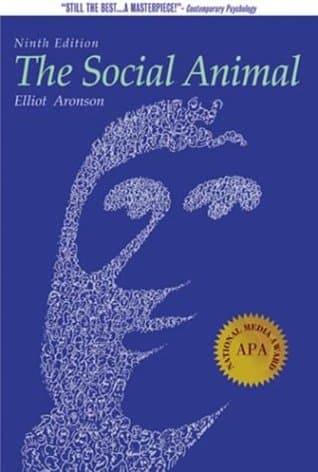
The Social Animal cover
Archivist's Choice

The Social Animal

Elliot Aronson (1972)

Genre

Psychology / Science / Philosophy

Reading Time

12-16 hours

Key Themes

See below

Track Your Reading

Sign in to track this book

Aronson explores the social forces—from conformity to cults—that shape our choices and destiny.

Core Idea

Elliot Aronson's "The Social Animal" states that people are social creatures whose thoughts, feelings, and actions are shaped by their social environment and the need for a good self-image. The book looks at social psychology experiments to show how biases, the need for self-justification, and influences like conformity and obedience often lead people to act in ways that seem irrational but make sense in a social context. It argues that understanding these social mechanics helps explain human nature, from prejudice and aggression to attraction and altruism.
Reading time
12-16 hours
Difficulty
Medium
✓ Read this if...
You want a comprehensive, accessible, and engaging introduction to the core concepts and seminal experiments of social psychology, and how they explain everyday human behavior and societal phenomena.
✗ Skip this if...
You are looking for a highly specialized or advanced academic text on a niche area of social psychology, or prefer books with a primary focus on neuroscience or clinical psychology.

Core idea

The central argument and framework that powers the entire book.

Elliot Aronson's "The Social Animal" states that people are social creatures whose thoughts, feelings, and actions are shaped by their social environment and the need for a good self-image. The book looks at social psychology experiments to show how biases, the need for self-justification, and influences like conformity and obedience often lead people to act in ways that seem irrational but make sense in a social context. It argues that understanding these social mechanics helps explain human nature, from prejudice and aggression to attraction and altruism.

At a glance

Reading time

12-16 hours

Difficulty

Medium

Read this if...

You want a comprehensive, accessible, and engaging introduction to the core concepts and seminal experiments of social psychology, and how they explain everyday human behavior and societal phenomena.

Skip this if...

You are looking for a highly specialized or advanced academic text on a niche area of social psychology, or prefer books with a primary focus on neuroscience or clinical psychology.

Key Takeaways

1

The Power of Self-Justification

Humans rationalize their actions to maintain a positive self-image, often leading to irrational behavior.

Quote

When people are induced to do something that is inconsistent with their beliefs, they will change their beliefs to reduce the discomfort caused by the inconsistency.

Cognitive dissonance is a strong force that makes people change their attitudes or beliefs to match their past actions, especially when those actions are voluntary and have big effects. This is not just about small inconsistencies; it is a basic way to maintain self-esteem. When we put time, effort, or suffer for something, we tend to value it more, even if facts suggest it is not worth it. This self-justification can lead to a 'slippery slope' where small initial decisions are explained away, opening the door for more extreme behavio...

Supporting evidence

Aronson details classic experiments, such as the 'initiation' studies, where participants who underwent a severe initiation to join a group rated the group as more attractive than those who underwent a mild or no initiation, even when the group was objectively boring. This demonstrated their justification for the effort and discomfort.

Apply this

When making significant decisions, especially those involving effort or sacrifice, pause and critically evaluate the objective value of the outcome, rather than just justifying the effort. Be wary of situations where you're asked to make small, seemingly innocuous commitments that could lead to larger, less desirable ones through self-justification.


cognitive-dissonanceself-esteemrationalization
2

The Allure of Conformity

The pressure to fit in can override individual judgment, even when the group is demonstrably wrong.

Quote

Most of us are not as independent as we think we are. The desire to be liked and accepted can lead us to conform to group norms, even when those norms contradict our own perceptions.

Humans are social animals, and the need to belong is very strong. This often shows up as conformity, where people adjust their behavior, attitudes, or beliefs to fit group standards. Aronson points out that conformity is not always bad; it is necessary for social unity. However, it becomes a problem when it stops critical thinking or leads to harmful results. Two main reasons drive conformity: informational influence (believing the group has better information) and normative influence (wanting to be liked and to avoid rejection). The ...

Supporting evidence

The classic Asch conformity experiments, where participants were asked to judge the length of lines. Despite obvious visual evidence, many conformed to the incorrect answers given by confederates, demonstrating the powerful pull of normative influence.

Apply this

Cultivate environments where dissenting opinions are not only tolerated but encouraged. Before making a decision based on group consensus, independently verify information and consider the potential for groupthink. Actively seek out diverse perspectives to challenge your own assumptions.

groupthinksocial-influencenormative-influence
3

Obedience to Authority: A Dangerous Default

Individuals are disturbingly willing to follow orders from authority figures, even when those orders conflict with their conscience.

Quote

The most frightening aspect of the obedience experiments is not that people are inherently evil, but that ordinary people, simply doing their jobs, and without any particular hostility on their part, can become agents in a terrible destructive process.

The Milgram experiments clearly show how people can be destructively obedient. Aronson explains how situations, not bad intentions, can make ordinary people cause harm when given orders. Key factors include the authority figure's perceived legitimacy, the gradual increase of commands, and the spreading of responsibility. People tend to enter an 'agentic state,' where they see themselves as tools carrying out someone else's will, giving up personal moral responsibility. This phenomenon helps explain historical atrocities, from genocide...

Supporting evidence

The Milgram obedience experiments, where participants administered what they believed were increasingly painful electric shocks to a 'learner' on the instruction of an experimenter, despite the learner's protests.

Apply this

Develop a strong internal moral compass and be prepared to question authority, especially when asked to do something that feels ethically wrong. Understand that 'just following orders' is not a valid excuse for unethical behavior. Foster a culture in organizations where subordinates are empowered to speak up against questionable directives.

milgram-experimentagentic-statediffusion-of-responsibility
4

The Fundamental Attribution Error

We overemphasize dispositional factors and underestimate situational ones when explaining others' behavior.

Quote

When we observe others, we are prone to explain their behavior in terms of their personality traits, even when powerful situational forces are at play. We tend to see the person, not the situation, as the primary cause.

The fundamental attribution error (FAE) is a common bias where we explain others' actions mainly by their personal traits (personality, intelligence, moral character) while ignoring the strong influence of outside, situational factors. For example, if someone cuts us off in traffic, we quickly call them a 'jerk,' instead of thinking they might be rushing to an emergency. On the other hand, when explaining our own behavior, we tend to credit our successes to ourselves and our failures to outside factors (the actor-observer bias). This ...

Supporting evidence

Studies where participants read essays advocating for or against a particular viewpoint. Even when told the essay writer was assigned the position, participants still inferred the writer's true beliefs aligned with the essay, demonstrating a failure to account for the situational constraint.

Apply this

Before judging someone's behavior, consciously consider the external circumstances they might be facing. Practice 'putting yourself in their shoes' to empathize with their situation. When evaluating others, look for patterns across various situations rather than making snap judgments based on single incidents.

attribution-biasactor-observer-biasempathy
5

The Psychology of Prejudice

Prejudice is a complex interplay of cognitive biases, social learning, and motivational factors, not just individual malice.

Quote

Prejudice is a hostile or negative attitude toward a distinguishable group of people, based solely on their membership in that group.

Aronson sees prejudice as more than just individual bigotry; it is a deeply rooted social phenomenon. He explains how stereotypes (mental shortcuts), emotional parts (hostility, fear), and behavioral discrimination combine to form prejudice. Key factors include ingroup/outgroup dynamics (favoring one's own group), economic and political competition, and the scapegoat theory. The book shows how conforming to social norms, even without openly agreeing, can continue prejudice. Understanding the psychological roots, such as 'blaming the v...

Supporting evidence

The 'jigsaw classroom' technique, developed by Aronson, where students from diverse backgrounds must cooperate to learn material, significantly reduced prejudice and improved academic performance in desegregated schools by fostering interdependence and empathy.

Apply this

Actively challenge your own stereotypes and biases. Seek out diverse perspectives and engage in cooperative activities with people from different backgrounds. Advocate for policies and practices that promote intergroup contact and reduce competition between groups. Be aware of the 'just-world hypothesis' and resist the urge to blame victims of systemic injustice.

stereotypesdiscriminationingroup-outgroupjigsaw-classroom
6

Interpersonal Attraction: The Lure of Similarity and Proximity

We are drawn to those who are similar to us and those we frequently encounter.

Quote

The single best predictor of whether two people will become friends or lovers is physical proximity. The closer people live or work, the more likely they are to interact, and the more likely they are to become attracted to each other.

Aronson looks at what brings people together, stressing that attraction is not purely mysterious but often follows predictable psychological patterns. Proximity, or simply being exposed to someone, greatly increases the chance of attraction—we tend to like what is familiar. Similarity, whether in attitudes, values, interests, or even looks, also plays a key role; we seek agreement for our own beliefs and feel more comfortable with those who are like us. While physical attractiveness is a factor, its importance is often shaped by the '...

Supporting evidence

The Westgate housing project study, where residents were most likely to form friendships with those living physically closest to them, even if their interests differed. Also, studies showing that people rate faces they've seen multiple times (mere exposure) as more attractive.

Apply this

If you want to build relationships, actively seek out opportunities for frequent, positive interaction with others. Engage in activities that genuinely reflect your interests, as this increases the chance of meeting similar-minded individuals. Be open to meeting people outside your immediate social circle, but understand the natural pull towards familiarity.

mere-exposure-effectmatching-hypothesispropinquity-effect
7

The Empathy-Altruism Hypothesis

True altruism exists, driven by genuine empathy for another's distress.

Quote

When we feel empathy for a person, we will attempt to help that person for purely altruistic reasons, regardless of what we have to gain.

While many theories of helping behavior focus on selfish reasons (reducing one's own distress, gaining social rewards), Aronson presents strong evidence for the empathy-altruism hypothesis. This theory states that when we truly feel empathy—the ability to understand another's feelings—we are motivated to help purely for the other person's benefit, without expecting personal gain. This challenges a purely cynical view of human nature and suggests a capacity for true selflessness. Understanding this difference is vital for creating a mo...

Supporting evidence

Studies where participants were given the option to escape a distressing situation (e.g., watching someone suffer). When empathy was high, participants helped even when they could easily escape, suggesting they weren't just trying to alleviate their own discomfort.

Apply this

Actively practice empathy by trying to understand others' perspectives and feelings. When you encounter someone in need, consciously focus on their distress rather than your own potential discomfort. Support initiatives and education that foster empathy and compassion in individuals and communities.

altruismprosocial-behaviorempathy
8

The Bystander Effect: Silence in Numbers

The more people present during an emergency, the less likely any individual is to help.

Quote

The greater the number of bystanders who witness an emergency, the less likely any one of them is to help.

The bystander effect clearly shows how social situations can stop helping behavior. Aronson explains that this happens mainly because of three psychological processes: diffusion of responsibility (each person feels less responsible when others are present), pluralistic ignorance (looking to others for clues and wrongly thinking their inaction means no emergency exists), and evaluation apprehension (fear of looking foolish). This effect highlights the critical role of perception and social influence in emergencies. It is a powerful, su...

Supporting evidence

The tragic case of Kitty Genovese, who was murdered while 38 witnesses reportedly did nothing. Subsequent laboratory experiments confirmed the effect, showing that participants were less likely to report smoke entering a room when others were present and inactive.

Apply this

If you are in an emergency, or witness one, do not assume others will act. Take direct action. If you need help, single out one person ('You in the red shirt, please call 911!') to counteract diffusion of responsibility. If you witness a potential emergency, break the pluralistic ignorance by explicitly stating your concern or asking if help is needed.

diffusion-of-responsibilitypluralistic-ignorancebystander-intervention
9

Propaganda and Persuasion: The Art of Influence

Persuasion is a nuanced process influenced by the source, message, and audience characteristics.

Quote

When it comes to persuasion, it is not simply what is said, but who says it, to whom, and under what circumstances.

Aronson discusses the psychology of persuasion, separating it from outright manipulation but acknowledging the fine line. He outlines key factors that affect how well persuasive communication works: the source's credibility and attractiveness, the message's nature (e.g., one-sided vs. two-sided arguments, fear appeals), and the audience's characteristics (e.g., intelligence, self-esteem, prior commitment). He stresses the importance of the peripheral versus central routes to persuasion; the first relies on surface cues, while the seco...

Supporting evidence

Studies demonstrating that highly credible sources (e.g., experts) are more persuasive, especially when the audience is not highly involved. Also, the effectiveness of fear appeals is shown to be curvilinear: too little fear doesn't motivate, too much can paralyze or lead to denial.

Apply this

When evaluating information, always consider the source's credibility and potential biases. Don't be swayed by superficial cues like attractiveness or popularity. For important decisions, engage in central route processing: critically evaluate the logical arguments and evidence presented, rather than relying on emotional appeals or endorsements.

persuasioncredibilityelaboration-likelihood-modelfear-appeals
10

The Social Animal's Imperfect Logic

Human behavior is often driven by irrational needs and biases, despite our capacity for reason.

Quote

We are not always rational animals. We are rationalizing animals.

Throughout the book, Aronson consistently returns to the idea that humans, while capable of deep reason, are often swayed by emotional needs, social pressures, and mental shortcuts that lead to irrational, biased, and sometimes self-destructive behaviors. From self-justification to conformity, from prejudice to the bystander effect, our decisions are rarely purely logical. Instead, they are deeply influenced by the desire to maintain a good self-image, to belong, to obey authority, and to simplify a complex world using mental shortcut...

Supporting evidence

The synthesis of all preceding takeaways – cognitive dissonance, conformity, obedience, attribution errors, and prejudice – collectively demonstrate the pervasive influence of non-rational factors in human decision-making and behavior.

Apply this

Cultivate self-awareness to recognize your own biases and irrational tendencies. Approach societal problems with an understanding of human psychological limitations, designing solutions that account for these rather than assuming ideal behavior. Practice critical thinking and actively seek out information that challenges your preconceived notions.

cognitive-biasirrationalityhuman-natureheuristics

Critical analysis

Notable Quotes

Human beings are not, for the most part, cool, rational information-processing machines.

Early in the book, challenging the view of humans as purely logical beings.

People who do crazy things are not necessarily crazy.

Explaining the fundamental attribution error and the power of situational factors.

The greater the price we pay for something, the more we tend to like it.

Discussing the psychology of justification and effort justification.

If you want someone to do a favor for you, ask them to do a small one first.

Illustrating the 'foot-in-the-door' technique and compliance.

We tend to like people who like us.

A fundamental principle of interpersonal attraction, reciprocity of liking.

One of the most powerful determinants of whether we like another person is whether we perceive them as similar to us.

Explaining the role of similarity in attraction and relationship formation.

Prejudice is a hostile or negative attitude toward a distinguishable group of people, based solely on their membership in that group.

Defining prejudice and its core components.

The best way to reduce prejudice is to get members of different groups to work together on common goals.

Proposing solutions to prejudice, particularly the jigsaw classroom and contact hypothesis.

We often make inferences about the causes of people's behavior.

Introducing attribution theory and how we explain actions.

People are far more easily influenced than they think they are.

Highlighting the pervasive nature of social influence, often underestimated by individuals.

People tend to like things that are familiar to them.

Discussing the mere exposure effect and its impact on preferences.

The less justification there is for an act, the greater the dissonance.

Explaining the core mechanism of cognitive dissonance and insufficient justification.

Aggression is intentional behavior aimed at causing either physical or psychological pain.

Defining aggression in the context of social behavior.

People will alter their attitudes to conform to the attitudes of people they like.

Describing the influence of liking on attitude change and persuasion.

Quiz

Test Your Knowledge

Ready to see how well you understood this book? Take our interactive quiz with 10 questions.

10
Questions
~5
Minutes
?
Best Score

Key Questions (FAQ)

'The Social Animal' introduces social psychology as the scientific study of how people's thoughts, feelings, and behaviors are influenced by the actual, imagined, or implied presence of others. It explores the powerful impact of social situations on individual behavior and perception.

About the author