BookBrief
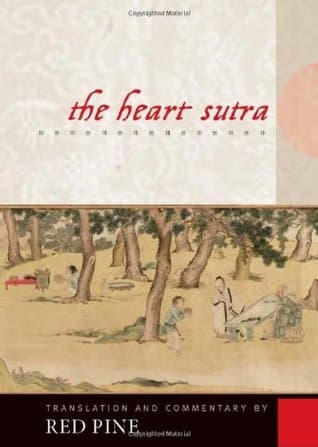
The Heart Sutra cover
Archivist's Choice

The Heart Sutra

Red Pine (2004)

Genre

Spirituality / Philosophy

Reading Time

240 min

Key Themes

See below

Track Your Reading

Sign in to track this book

Red Pine's clear translation and notes explain the complex idea that 'form is emptiness, emptiness is form,' making the Heart Sutra's core Buddhist teaching on enlightenment understandable.

Core Idea

Red Pine's "The Heart Sutra" explores the main Buddhist idea of emptiness (śūnyatā), explaining that all things, including ourselves and what we think is real, do not exist on their own. Through his careful translation and detailed notes, the book shows how this idea frees the mind from suffering. It does this by revealing that everything depends on other things and does not last forever. The book suggests that true wisdom comes not from learning facts, but from directly seeing that form and emptiness are not separate, which then removes all fixed ideas and leads to an enlightened mind.
Reading time
240 min
Difficulty
Hard
✓ Read this if...
You are interested in a deep, scholarly, yet accessible dive into one of Buddhism's most pivotal texts, seeking to understand the concept of emptiness and its implications for spiritual liberation.
✗ Skip this if...
You prefer a purely introductory text to Buddhism or are not prepared for philosophical density and a detailed verse-by-verse analysis of a foundational sutra.

Core idea

The central argument and framework that powers the entire book.

Red Pine's "The Heart Sutra" explores the main Buddhist idea of emptiness (śūnyatā), explaining that all things, including ourselves and what we think is real, do not exist on their own. Through his careful translation and detailed notes, the book shows how this idea frees the mind from suffering. It does this by revealing that everything depends on other things and does not last forever. The book suggests that true wisdom comes not from learning facts, but from directly seeing that form and emptiness are not separate, which then removes all fixed ideas and leads to an enlightened mind.

At a glance

Reading time

240 min

Difficulty

Hard

Read this if...

You are interested in a deep, scholarly, yet accessible dive into one of Buddhism's most pivotal texts, seeking to understand the concept of emptiness and its implications for spiritual liberation.

Skip this if...

You prefer a purely introductory text to Buddhism or are not prepared for philosophical density and a detailed verse-by-verse analysis of a foundational sutra.

Key Takeaways

1

Form is Emptiness, Emptiness is Form

The ultimate non-duality of phenomena and their inherent lack of self-existence.

Quote

Form is no other than emptiness; emptiness is no other than form.

The core of Mahayana Buddhism and the main idea of the Heart Sutra is the paradox: 'form is emptiness, emptiness is form.' This does not mean things do not exist, but that they lack a fixed, independent nature. 'Form' refers to all things, all sensory experiences. 'Emptiness' (śūnyatā) is not nothingness, but the understanding that these forms have no lasting essence. They depend on other things, do not last forever, and arise from other events. To understand this is to see past the idea of separate, solid things, recognizing that rea...

Supporting evidence

Red Pine meticulously breaks down the Sanskrit and Chinese characters for 'rūpa' (form) and 'śūnyatā' (emptiness), showing how ancient commentators grappled with this precise phrasing, emphasizing that 'is no other than' implies an identity, not a transformation. He cites Xuanzang's translation, which solidifies this direct equation.

Apply this

When facing a challenging situation or a strong emotion, instead of viewing it as a solid, overwhelming 'thing,' recognize its empty nature. Ask: What are its components? How did it arise? How will it change? This deconstruction helps to loosen its grip and reveal its impermanence, fostering a more detached and adaptable response.

sunyatainterdependenceimpermanencenon-duality
2

The Five Skandhas: Illusory Aggregates

Our sense of 'self' is a temporary compilation, not a fixed entity.

Quote

Avalokiteshvara Bodhisattva, coursing deep in prajnaparamita, saw that the five skandhas were all empty of self-existence.

The Heart Sutra systematically breaks down the idea of a permanent self by looking at the five skandhas (aggregates): form, feeling, perception, intentions, and consciousness. These are the parts that make up what we wrongly think of as 'me.' Red Pine's notes show how the Sutra states that each of these parts, alone and together, lacks independent existence. 'Form' is our body and the physical world. 'Feeling' is sensations (pleasant, unpleasant, neutral). 'Perception' is how we recognize and sort things. 'Intentions' are our mental a...

Supporting evidence

The Sutra explicitly lists all five skandhas – rūpa, vedanā, saṃjñā, saṃskāra, vijñāna – and declares them 'empty.' Red Pine elaborates on the historical Buddhist context of these terms, drawing from early Buddhist teachings that predate the Heart Sutra but are here given a Mahayana 'emptiness' interpretation.

Apply this

Next time you experience a strong emotion or a persistent thought, identify which skandha it primarily falls under. Observe it as a transient phenomenon, not an intrinsic part of 'you.' For example, 'This is a feeling of anger' rather than 'I am angry.' This creates a crucial space between you and the experience, reducing identification and suffering.

skandhasanattaself-illusionimpermanence
3

No Eyes, Ears, Nose, Tongue, Body, Mind

Sensory faculties and their objects are also empty of inherent existence.

Quote

There are no eyes, no ears, no nose, no tongue, no body, no mind; no forms, no sounds, no smells, no tastes, no touch, no dharmas...

The Heart Sutra extends the idea of emptiness beyond the five skandhas to all sensory experience. It states that not only are the sense organs (eyes, ears, etc.) empty of a fixed nature, but so are their objects (forms, sounds, etc.), and even the awareness that comes from their contact. This does not mean we do not see or hear, but that seeing, the eye, and the seen object all depend on each other and lack independent, fixed essences. There is no separate 'eye' that sees a separate 'form'; instead, seeing is an event that relies on c...

Supporting evidence

The Sutra's direct enumeration of the 'eighteen dhātus' (six sense organs, six sense objects, six consciousnesses) and declaring 'no' to each is a profound rhetorical device. Red Pine explains the 'no' as 'not having inherent existence,' rather than literal absence, drawing on commentaries that clarify this crucial distinction.

Apply this

During a moment of strong sensory input (e.g., a beautiful sunset, an irritating noise), try to observe the 'no-ness' of the experience. Instead of 'I see a sunset,' just acknowledge 'seeing-of-sunset' as a process. Notice the lack of a solid 'seer' or a solid 'seen.' This can shift perception from clinging or aversion to simple awareness.

sense-basesdharmassubject-object dualityemptiness-of-experience
4

No Ignorance, No End of Ignorance

The chain of dependent origination is also empty of inherent reality.

Quote

There is no ignorance, and no end of ignorance; no aging and death, and no end of aging and death...

This seemingly contradictory statement applies emptiness to the very roots of suffering: the twelve links of dependent origination. These links explain how not knowing leads to suffering, birth, aging, and death. The Sutra states 'no ignorance, no end of ignorance,' and so on, through the whole chain. This is not a denial of the experience of not knowing or suffering, but a statement that even these basic processes of conditioned existence are empty of a fixed nature. They arise dependently and are not ultimately real. By seeing the...

Supporting evidence

Red Pine explains that this section directly references the 'Twelve Nidanas' or 'Twelve Links of Dependent Origination,' a core teaching in all Buddhist schools. The Heart Sutra applies the principle of emptiness to each link, from ignorance (avidyā) to aging and death (jarāmaraṇa), asserting their lack of inherent self-existence, thereby transcending the cycle of samsara.

Apply this

When caught in a cycle of habitual suffering (e.g., procrastination, anxiety), instead of feeling trapped by 'my ignorance' or 'my suffering,' observe these states as empty phenomena. Recognize their impermanence and conditioned nature. This detachment can create a space for new responses, rather than reinforcing the cycle by solidifying its components.

dependent-originationnidanassamsaraliberation
5

No Suffering, No Cause, No Extinction, No Path

The Four Noble Truths are also empty, transcending conventional understanding.

Quote

There is no suffering, no cause, no extinction, no path...

This is perhaps the boldest statement, as it directly denies the Four Noble Truths—the very foundation of all Buddhist teaching. The Sutra states 'no suffering, no cause, no extinction, no path.' This is not a rejection of the Buddha's basic teaching but a deep statement that even these ultimate truths, when seen from perfect wisdom, are empty of their own existence. They are useful tools, frameworks meant to guide beings to freedom, but they are not ultimate realities themselves. To hold onto the Four Noble Truths as absolute, fixed ...

Supporting evidence

Red Pine emphasizes that this section is a direct Mahayana critique and transcendence of the foundational teachings of earlier Buddhist schools. He highlights how the 'no' here signifies the ultimate emptiness of even the most sacred doctrines when viewed from the highest wisdom, serving as a warning against dogmatic adherence.

Apply this

When feeling stuck in a spiritual practice or clinging to a particular teaching, remember that even the 'path' is empty. Be open to transcending fixed ideas about what enlightenment 'should' look like or how it 'should' be achieved. Allow for fluidity and direct experience, rather than rigid adherence to concepts.

four-noble-truthsskillful-meansdogmatranscendence
6

No Wisdom, No Attainment

Ultimate realization transcends the concepts of 'wisdom' and 'gaining' anything.

Quote

There is no wisdom, and no attainment. With nothing to attain...

This is the final denial, reaching even into the goal of Buddhist practice: wisdom and attainment. If everything is empty, what is there to 'gain' or 'attain'? And who is the 'gainer'? The Sutra's statement 'no wisdom, no attainment' means that ultimate freedom is not about getting something new, but about realizing what has always been there—the empty nature of reality. It is about letting go of the illusion of an independent self trying to reach a separate goal. True wisdom is seeing emptiness, which means there is nothing to hold o...

Supporting evidence

Red Pine explains that 'attainment' (prāpti) implies gaining something from the outside, which is impossible if all phenomena are empty. The 'no wisdom' refers to wisdom as a conceptual entity, not the living experience of prajnaparamita itself. He highlights how this section is crucial for preventing practitioners from developing new attachments to spiritual achievements.

Apply this

When engaged in spiritual practice, be mindful of the subtle desire to 'get somewhere' or 'achieve enlightenment.' Recognize that these are conceptual goals. Instead, focus on the present moment, on the act of practice itself, without attachment to a future outcome or the idea of 'gaining' something. The realization is in the letting go.

non-attainmentprajnaenlightenmentletting-go
7

The Bodhisattva's Unhindered Mind

Emptiness leads to fearless compassion and freedom from delusion.

Quote

Because there is nothing to attain, the Bodhisattva, relying on prajnaparamita, has no hindrances in his mind. Because there are no hindrances, he has no fear...

The Heart Sutra ends by showing the practical result of understanding emptiness: the Bodhisattva's free mind. When there is 'nothing to attain' because everything is empty, there is no fear, no worry, no attachment, and no confusion. This is perfect freedom. The Bodhisattva, having seen through the illusions of self and things, acts with great kindness not out of duty, but naturally from a place of deep connection. There are no barriers to their wisdom or their helpful actions because they no longer cling to any fixed ideas, including...

Supporting evidence

Red Pine emphasizes the transition from the negations to the positive outcome: the Bodhisattva's state. He highlights the connection between 'no attainment' and 'no hindrances' (āvaraṇa), and subsequently 'no fear' (bhaya), which are direct results of realizing emptiness. This is the practical, liberating aspect of the Sutra's teaching.

Apply this

When facing a situation that normally triggers fear or hesitation, pause and reflect on the empty nature of the perceived threat and your own 'self' that feels threatened. This can help to dissolve the mental hindrances, allowing for a more clear, compassionate, and courageous response, free from attachment to outcomes.

bodhisattvakarunafearlessnesshindrances
8

The Great Mantra: Beyond All Suffering

The ultimate sound of awakening transcends words and concepts.

Quote

Therefore know the prajnaparamita mantra, the mantra of great wisdom, the unsurpassed mantra, the unequaled mantra, able to allay all suffering, true and not false.

The Heart Sutra finishes with the powerful Prajnaparamita Mantra: 'Gate Gate Pāragate Pārasaṃgate Bodhi Svāhā.' This mantra is not just words but a sound that represents the Sutra's entire teaching—the journey beyond suffering by understanding emptiness. It means 'Gone, Gone, Gone Beyond, Gone Completely Beyond, Enlightenment, So Be It!' Red Pine explains that the mantra works as a direct, non-conceptual way to pass on wisdom, bypassing intellectual understanding. It is a call to direct experience, a conclusion that goes beyond all th...

Supporting evidence

Red Pine provides a detailed etymological breakdown of each word in the mantra, tracing its Sanskrit roots and explaining its layers of meaning, drawing on ancient commentaries that interpret 'Gate' as 'gone' (to the other shore of enlightenment) and 'Svāhā' as 'so be it' or 'hail.'

Apply this

Regularly chant the Prajnaparamita Mantra, focusing on its meaning and the feeling of 'going beyond.' Allow the sound and rhythm to bypass intellectual analysis and resonate with the deeper understanding of emptiness and liberation. Use it as a tool to cut through mental chatter and reconnect with the core teaching.

mantraprajnaparamitaenlightenmenttranscendence

Critical analysis

Notable Quotes

Form is emptiness, emptiness is form.

The central paradox of the Heart Sutra, expressing the non-duality of phenomena and ultimate reality.

Emptiness is not other than form; form is not other than emptiness.

Clarifying the relationship between form and emptiness, emphasizing their inseparability.

In emptiness there is no form, no feeling, no perception, no volition, no consciousness.

Listing the five skandhas (aggregates of existence) and stating their absence in the state of emptiness.

No eye, ear, nose, tongue, body, mind; no form, sound, smell, taste, touch, mental object.

Denying the existence of the six sense organs and their corresponding objects within emptiness, pointing beyond sensory experience.

No ignorance and also no end of ignorance, up to no old age and death and also no end of old age and death.

Refuting the twelve links of dependent origination within emptiness, implying freedom from the cycle of suffering.

No suffering, no origin of suffering, no cessation of suffering, no path.

Rejecting the Four Noble Truths within emptiness, suggesting that in ultimate reality, even these fundamental truths are transcended.

No wisdom and also no attainment.

Stating that in emptiness, even the concepts of wisdom and spiritual attainment are dissolved, as there is nothing to attain.

Because there is nothing to attain, the Bodhisattva, relying on Prajnaparamita, is without hindrance.

Explaining the freedom and fearlessness of a Bodhisattva who understands emptiness and is free from grasping.

Because there is no hindrance, he is without fear.

A direct consequence of being without hindrance, highlighting the liberation from fear that comes with understanding emptiness.

Far removed from all perverted views, he dwells in Nirvana.

Describing the ultimate state of a Bodhisattva who has transcended all dualistic and deluded perspectives.

The Prajnaparamita is the great mantra, the great wisdom mantra, the unsurpassed mantra, the unequaled mantra.

Glorifying the Prajnaparamita (Perfection of Wisdom) as the ultimate spiritual tool or teaching.

It removes all suffering. This is true and not false.

Asserting the efficacy of Prajnaparamita in alleviating all forms of suffering, confirming its truth.

Therefore, proclaim the Prajnaparamita mantra, proclaim this mantra: Gate Gate Paragate Parasumgate Bodhi Svaha.

The concluding mantra of the Heart Sutra, a call to go beyond, to the other shore of enlightenment.

Even the Buddha himself, in his own experience, had to confront the reality of suffering and find a way out.

From Red Pine's commentary, emphasizing the universal experience of suffering and the active search for liberation, even for the enlightened.

The Heart Sutra is not a denial of existence but a denial of the way we perceive existence.

From Red Pine's commentary, clarifying that emptiness does not mean nothingness but a liberation from deluded perceptions of reality.

Quiz

Test Your Knowledge

Ready to see how well you understood this book? Take our interactive quiz with 10 questions.

10
Questions
~5
Minutes
?
Best Score

Key Questions (FAQ)

The Heart Sutra, or Prajna Paramita Hrdaya Sutra, is a concise Buddhist text that encapsulates the core teachings of perfect enlightenment. It is renowned for its declaration that 'form is emptiness, emptiness is form,' and has profoundly influenced Buddhist thought across various traditions.

About the author