“If he was a swami, he could not stay in the house, but must go and live on the river bank, or in a temple, or under a tree, and he must not have any possessions.”
— Rosie's initial understanding of Raju's spiritual role, which he initially fakes.

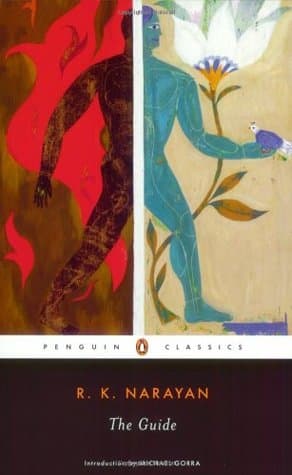
Genre
Literary Fiction / Spirituality
Reading Time
240 min
Key Themes
See below
Sign in to track this book
A charmingly corrupt ex-tour guide, mistaken for a spiritual guru, finds his manufactured piety divinely tested when a drought-stricken village demands a miracle.
The novel begins with Raju, recently out of prison for forgery, arriving in the village of Mangal. He seeks anonymity and rest, finding an old, rundown temple on the village edge. He decides to stay there for a while, enjoying the quiet. Soon, a villager named Velan finds Raju in the temple. Velan, seeing Raju's calm look and the temple setting, mistakes him for a holy man. He starts bringing Raju food and asking for advice. Raju, at first amused, decides to play along, enjoying the respect and free meals, which are a stark contrast to his recent past.
News of the 'Swami' in the temple quickly spreads through Mangal. Villagers, facing problems from family disputes to crop failures, begin to come to Raju for blessings and advice. Raju, despite his past as a practical and often cynical tourist guide, finds himself giving out common-sense advice, which the villagers see as deep wisdom. He enjoys the attention and power this new role brings, slowly becoming comfortable with the pretense. He starts to believe in his own performance, or at least in its benefits, and the villagers' strong faith secures his position as a respected spiritual leader.
The story often switches between Raju's present life as a swami and his past. One important flashback details his life as a successful and somewhat dishonest tourist guide in Malgudi. He tells of meeting Rosie, the beautiful and talented wife of Marco, an academic focused on ancient art. Rosie, a dancer from a low-caste family, feels stifled by her husband's intellectual interests and lack of care for her passion. Raju is immediately drawn to her beauty and her sad spirit. He sees a chance to not only guide her but also to help her achieve her artistic dreams, which Marco dismisses as unimportant.
Raju becomes Rosie's confidant and supporter. He encourages her dancing, arranges performances, and eventually, their relationship becomes romantic. Marco discovers their affair, leading to a dramatic confrontation and Rosie's decision to leave her husband. Raju, now fully committed to Rosie, takes her under his wing, becoming her manager and promoter. He puts all his energy into making her a famous dancer, neglecting other duties and becoming more controlling. Rosie's career thrives, and she becomes widely known as 'Nalini,' a celebrated classical dancer, fulfilling her lifelong dream.
As Rosie's fame grows, Raju's ego and need for control also increase. He becomes obsessed with her career and the money it brings, managing all her finances and publicity. He starts forging Rosie's signature on documents, driven by a misguided desire to protect her earnings and maintain control. When a legal document requires Rosie's signature for her jewelry, Raju forges it, leading to his arrest and trial. Rosie, though initially supportive, becomes more aware of Raju's manipulative nature and his deceit. The incident shatters her trust and their relationship, leading to his imprisonment and her eventual departure from his life.
Returning to Raju's present life as the swami, a severe drought hits Mangal, threatening the villagers' livelihoods. Desperate, the villagers ask Raju for a solution. An old man, inspired by a local story, suggests that a true holy man can bring rain by fasting for twelve days, standing in water. Velan and the other villagers beg Raju to do this penance. Raju, at first horrified, tries to explain he is not a real holy man, but his protests are met with strong faith and a complete misunderstanding of his true nature. Trapped by their expectations, Raju reluctantly agrees to fast.
With the entire village watching, Raju begins his twelve-day fast. A small platform is built in the riverbed, and Raju stands in the shallow water, enduring hunger and the elements. Villagers constantly watch him, bringing offerings and showing devotion. Inside, Raju is tormented by his past, his deceit, and the absurdity of his situation. He questions his identity and the meaning of his life. He tries to escape, but the villagers' intense belief and constant watch make it impossible. He feels trapped by the role he created, a role that now demands a great sacrifice.
As the fast continues, news of the 'fasting saint' of Mangal spreads beyond the village. Journalists, photographers, and curious people from all over India, and even abroad, come to Mangal. The event becomes a media spectacle, with reporters wanting interviews and photographers documenting Raju's every move. Raju, weak from lack of food, becomes a symbol of spiritual devotion for the outside world, further cementing his unwilling sainthood. He has moments of clarity and despair, thinking about his life and the ironic path that led him here, while the villagers remain firm in their faith.
By the eleventh day, Raju is very weak, almost collapsing. He has vivid hallucinations and drifts in and out of consciousness. During these moments of delirium, he has a deep spiritual experience. The line between his past self and his current role blurs, and he begins to genuinely feel a sense of purpose and selflessness. He no longer feels like an impostor but a vessel for the villagers' hopes. He realizes that the fast is no longer just a performance but a true act of penance and sacrifice, going beyond his former selfish desires.
On the morning of the twelfth day, Raju, barely able to stand, feels a change in the air. He gives a final, weak message to Velan, hoping for rain. As he collapses into the water, a few drops of rain begin to fall, quickly turning into a downpour. The villagers celebrate, convinced that Raju's sacrifice brought them salvation. Raju's fate after his collapse is unclear, but the story suggests he has achieved a form of spiritual redemption and peace, fulfilling the role he was forced into, but ultimately embraced. The rain marks the end of his journey from a fraudulent guide to a genuine, if reluctant, holy man.
The Protagonist
Raju transforms from a self-serving charlatan into a genuinely selfless figure, finding redemption through an accidental act of sacrifice.
The Supporting
Rosie evolves from a suppressed wife to a confident, independent artist, ultimately choosing her artistic integrity over romantic entanglement.
The Supporting
Marco remains largely static, representing the unyielding intellectual who cannot connect with emotional or artistic expression.
The Supporting
Velan's faith remains steadfast, acting as a constant mirror to Raju's evolving spiritual state.
The Supporting
Her character remains consistent, embodying traditional values and expressing disappointment in Raju's actions.
The Supporting
Gaffur remains a steadfast, supportive friend, witnessing Raju's journey without undergoing significant personal change.
The Mentioned
Not applicable, as he is primarily a background figure establishing Raju's origins.
The Supporting
No significant arc, serves to support the villagers' collective belief.
The main theme follows Raju's journey from a selfish, materialistic person to a figure of spiritual sacrifice. At first, he acts as a holy man for convenience and to avoid responsibility. However, as the fast continues, outside pressure and the villagers' strong faith cause an internal change. He starts to truly accept the role, finding a deeper purpose and connection to humanity. This is clear when he thinks about his past and feels a genuine desire to bring rain, moving beyond his former selfish nature. The unclear ending suggests that true redemption comes through selfless action, regardless of initial intention.
“For the first time in his life, he was making an earnest effort, for the first time he was doing something in which he was not personally interested.”
This theme runs through the novel, showing the difference between how Raju presents himself and his true character. As a tourist guide, he creates an image of knowledgeable charm; as a swami, he projects an aura of spirituality he initially lacks. The villagers of Mangal see him as a saint simply because he is in the temple and makes initial pronouncements, ignoring his protests. Even Rosie at first sees Raju as her artistic savior, unaware of his manipulative tendencies. The novel explores how easily people can be fooled by appearances and how a role, once taken on, can develop its own life, eventually shaping the person's reality.
“He often wondered what would happen if he suddenly announced, 'I am not a swami. I am a fraud.'”
The novel explores the villagers' strong, often blind, faith in Mangal. Their belief in Raju's spiritual powers is absolute, even when he tries to deny it. This faith is powerful enough to make Raju undertake a life-threatening fast, changing him in the process. It questions whether the object of faith needs to be truly holy for faith itself to be transformative. The villagers' shared belief creates a reality, showing the power of community and shared conviction in shaping events and individuals. Their faith, though naive, ultimately leads to a deep spiritual experience for Raju and a real outcome (rain).
“A man who fasts for the public good acquires the power to control the elements.”
This theme is seen in Rosie, who wants to express herself through dance but is held back by her husband Marco's intellectual snobbery and lack of interest. Her dance represents her true identity, her passion, and her search for freedom from societal and marital limits. Raju initially helps her achieve this freedom, becoming her manager and enabling her career. However, his possessiveness and control eventually threaten her artistic independence, showing that even seemingly freeing relationships can become restrictive. Rosie's final decision to pursue her art independently shows the triumph of artistic integrity and personal freedom.
“I am a dancer. I must dance. I cannot rest.”
The conflict between materialism and spirituality is central to Raju's character. In his past life, he is driven by money, fame, and control, especially in managing Rosie's career, which leads to his downfall. His time in prison and later role as a swami force him to confront the emptiness of his materialistic pursuits. The villagers' simple, spiritual needs contrast sharply with his past ambitions. The fast, a deeply spiritual act, strips him of all material comforts and makes him embrace selflessness, ultimately leading to a spiritual awakening that goes beyond his former greed.
“He was an expert in squeezing money out of the most unpromising situations.”
Alternating chapters between Raju's present as a swami and his past life.
Narayan skillfully employs a non-linear narrative, frequently switching between Raju's present life in Mangal as a revered holy man and his past life as a charismatic but ultimately corrupt tourist guide in Malgudi. This device serves to slowly reveal Raju's true character and the events that led to his imprisonment. It creates dramatic irony, as the reader is aware of Raju's fraudulent past while the villagers remain ignorant, intensifying the tension of his impending 'sacrifice.' The flashbacks provide essential context for understanding Raju's internal conflict and his journey towards potential redemption.
The audience knows Raju's true identity, while the villagers remain oblivious.
Dramatic irony is a key element, as the reader is privy to Raju's criminal past and his initial reluctance and cynicism about being a holy man, while the villagers of Mangal hold him in unquestioning reverence. This creates a constant tension and a sense of impending discovery, making Raju's internal struggle more poignant. It also highlights the theme of appearance versus reality, as the villagers' faith is based on an illusion, yet it drives the entire plot and Raju's eventual transformation. The irony deepens as Raju himself begins to believe in the role he is forced to play.
Rain as a symbol of purification, redemption, and life-giving power.
The impending rain, and its eventual arrival, serves as a powerful symbol throughout the novel. The drought represents the spiritual and physical barrenness that afflicts both the land and, metaphorically, Raju's soul. The fast undertaken for rain symbolizes a purification process and an act of ultimate sacrifice. When the rain finally falls, it signifies not only the end of the drought for the villagers but also Raju's spiritual redemption and the cleansing of his past sins. It is a life-giving force that brings hope and renewal, both for the community and for Raju's transformed self.
An abandoned temple as a catalyst for Raju's new identity.
The dilapidated temple where Raju takes refuge is more than just a physical location; it is a significant plot device. Its abandoned state allows Raju to initially hide, but its inherent sacredness immediately casts him in the role of a holy man. The villagers' reverence for the temple extends to its inhabitant, regardless of his true nature. The temple becomes a stage for Raju's performance and, eventually, the site of his spiritual awakening. It symbolizes the ancient traditions and spiritual expectations that inadvertently trap Raju but also provide the framework for his unexpected transformation.
“If he was a swami, he could not stay in the house, but must go and live on the river bank, or in a temple, or under a tree, and he must not have any possessions.”
— Rosie's initial understanding of Raju's spiritual role, which he initially fakes.
“The only thing for me was to keep my mouth shut and look profound.”
— Raju's internal monologue while people consult him as a holy man, despite his lack of knowledge.
“A man who performs a miracle is a man who can perform a miracle.”
— Raju's cynical view of how people perceive and attribute power to him.
“You are like a man who has lost his way in a jungle and is asking others for directions, when they themselves are lost.”
— Raju's mother scolding him for his lifestyle and choices.
“I was not a swami, but a railway guide, and that was all.”
— Raju reflecting on his past identity and the irony of his current predicament.
“The trouble with me is that I am always trying to please people.”
— Raju's self-awareness of his people-pleasing tendencies, which lead him into trouble.
“A genuine holy man would not bother about food, but would live on air and sunshine.”
— Villagers' expectations of a true holy man, contrasting with Raju's human needs.
“My life had been a series of surprises and unexpected turns, and I wondered what new turn it would take now.”
— Raju's reflection on his unpredictable life journey.
“I felt a great peace descend on me, a peace I had never known before.”
— Raju experiencing genuine spiritual peace as he commits to the fast.
“It was not a question of my believing or not believing; it was a question of their faith.”
— Raju understanding the power of the villagers' belief, regardless of his own.
“The greatest joy of life was to be able to help someone, to be of service.”
— Raju's realization of true fulfillment during his spiritual transformation.
“I was not acting any more. I was simply doing what I had to do.”
— Raju's internal shift from pretense to genuine commitment during the fast.
“The rain, which had held off for so long, seemed to come down with a new vigor.”
— The final moments of the novel, suggesting the breaking of the drought and the culmination of Raju's sacrifice.
“A man's character is his destiny.”
— A philosophical reflection on the consequences of one's actions and nature.
“People wanted to be cheated, and if you didn't cheat them, they felt disappointed.”
— Raju's cynical observation about human nature and gullibility.
Ready to see how well you understood this book? Take our interactive quiz with 10 questions.

Biography coming soon.
Stormie Omartian
4.3

Walter Brueggemann
4.3
Jerry Bridges
4.3
Brother Lawrence
4.3
Joseph Campbell
4.3

Unknown
4.3

Pat Conroy
4.2

Dante Alighieri
4.2