“Perhaps this is what it means to be a man, to be tied to a woman, to be forever connected to her, to be unable to live without her.”
— Tess and her husband, Sully, reflect on their relationship and the nature of love.

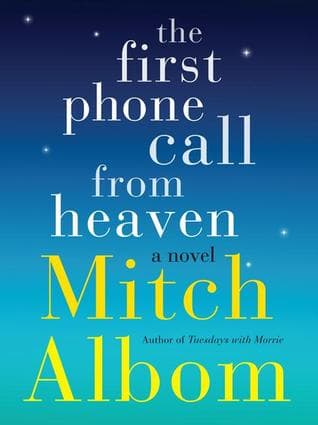
Mitch Albom (2013)
Genre
Spirituality / Mystery
Reading Time
320 min
Key Themes
See below
Sign in to track this book
When residents of a small town receive calls from deceased loved ones, a skeptical father investigates whether it's a miracle or a trick, making everyone consider what belief really means.
The quiet town of Coldwater, Michigan, gains international attention when residents report phone calls from the afterlife. Tess Rafferty, a local homemaker, gets the first call from her recently deceased mother. Soon after, other townspeople, including the skeptical Dr. Lyle Penn, a former NASA scientist, and Father Rob, the local priest, also claim to hear from the dead. The calls are short but feature recognizable voices and specific, personal details, making them very convincing. The event quickly draws international media, with reporters and believers coming to Coldwater to see this possible miracle.
During the growing excitement, Sully Harding, a former pilot recently released from prison after a tragic accident, arrives in Coldwater. He carries grief and guilt, having lost his wife, Giselle, and their daughter, Amy, in the plane crash he was piloting. Deeply skeptical of the miraculous phone calls, Sully believes them to be a trick and wants to expose the truth. He observes the town's reaction, the media frenzy, and the residents' growing faith, all while dealing with his own deep loss and the unlikelihood of receiving such a call himself.
Coldwater becomes a global phenomenon, attracting pilgrims, opportunists, and skeptics. News channels broadcast live from the town square, and books about the calls become bestsellers. While many accept the calls as proof of an afterlife, Sully, along with the initially skeptical Dr. Penn, looks for a more rational explanation. Dr. Penn, at first dismissive, becomes interested in the technical details and the sheer number of calls. They both observe patterns, timing, and specific details shared, trying to find inconsistencies or common threads that might point to a human origin.
Sully's reason for being in Coldwater also includes his wish to reconnect with his estranged young son, Charlie, who lives with his maternal grandparents nearby. The calls, however, become a source of disagreement and a painful reminder of Sully's own inability to hear from Giselle or Amy. He meets Katherine Yellin, a local journalist covering the story, who is initially interested in the human aspect but gradually becomes more involved in Sully's search for answers. Their relationship is careful, built on shared observation and a growing unease with the unquestioning belief gripping the town.
Mayor Alex Thexton, an ambitious politician, fully embraces the 'miracle' to help Coldwater's struggling economy. He organizes events, encourages tourism, and becomes the public face of the town's extraordinary story. Under his leadership, Coldwater changes from a quiet lakeside community into a busy center, complete with 'heavenly' merchandise and tours. The mayor's enthusiasm, while helping the town financially, also raises questions about making faith a business and the potential for exploitation, which Sully and Katherine start to notice.
A key moment occurs when a man named Elias, thought to have died, is seen alive in another city. This discovery casts significant doubt on the calls' authenticity, as Elias was one of the people whose voice a Coldwater resident heard. This finding strengthens Sully's belief that the calls are a clever trick. He intensifies his efforts, now having tangible proof that at least one 'heavenly' caller is, in fact, still alive, confirming his initial skepticism and providing a new lead in his investigation.
Sully's investigation leads him to the local radio station, where he uncovers the elaborate setup behind the calls. He discovers that a skilled sound engineer and impersonator named Dale, working under the direction of Mayor Thexton and a few others, has been planning the entire scheme. Dale, with his remarkable ability to mimic voices and access to personal information, created the illusion of calls from the deceased, using recording and broadcasting technology. The main reason was economic, aimed at boosting Coldwater's profile and tourism, a plan conceived by the mayor.
With clear evidence, Sully exposes the trick to Katherine and then to the world. The revelation that the calls were fake sends shockwaves through Coldwater and globally. The initial reaction is a mix of anger, betrayal, and deep disappointment from those who had found comfort and renewed faith in the calls. Mayor Thexton and his accomplices are arrested, and Dale confesses his role. The exposure forces the town and its visitors to consider the nature of belief, the desire for an afterlife, and how easily hope can be manipulated.
After the truth comes out, Sully, though proven right in his skepticism, finds a different kind of peace. Exposing the trick, while painful for many, allows him to face his own grief and guilt more directly. He finally starts to truly connect with his son, Charlie, explaining the situation and beginning to rebuild their relationship. Sully's journey shifts from proving a negative to finding a way to live with his loss, understanding that real connection and hope do not need miraculous phone calls but rather genuine human interaction and personal acceptance.
Even after the trick is exposed, the book explores the lasting power of belief. For some residents, the experience, though a deception, prompted a deeper look into their own faith and the comfort they found in the idea of an afterlife. While the literal calls were fake, the emotional impact and the sense of community they created were real. The story ends by suggesting that while the calls themselves were a lie, the human need for connection, hope, and belief in something beyond death remains a deep and important part of human experience, going beyond the specific circumstances of the Coldwater 'miracle'.
The Protagonist
Sully transforms from a cynical, grief-stricken man obsessed with debunking a hoax to someone who finds a path towards healing and reconciliation with his son, understanding that belief can exist even without literal proof.
The Supporting
Katherine moves from being a detached observer to an active participant in uncovering the truth, challenging her own journalistic objectivity and personal beliefs along the way.
The Antagonist
Mayor Thexton's arc is one of escalating deception and eventual downfall, as his ambition leads to the exposure of his elaborate hoax.
The Supporting
Dr. Penn's arc shows a shift from staunch scientific skepticism to a personal desire for belief, even as he continues to observe the phenomenon with a scientific eye.
The Supporting
Tess's arc remains largely consistent as a symbol of pure, initial belief, though she is affected by the ultimate revelation of the hoax.
The Supporting
Father Rob's arc reflects the challenge of integrating an extraordinary event into established religious doctrine, ultimately reaffirming the importance of core faith beyond superficial phenomena.
The Antagonist
Dale's arc is one of complicity in a grand deception, leading to his eventual confession and the exposure of the hoax.
The Supporting
Charlie's arc is tied to Sully's, as their relationship slowly begins to mend and heal after the resolution of the story.
The novel explores what people believe and why, especially when faced with the unexplainable. It asks if belief needs solid proof or if it can exist as an inner, comforting feeling. The townspeople's quick acceptance of the calls highlights humanity's deep desire for an afterlife and connection with lost loved ones. Even after the trick is exposed, some characters find that the *feeling* of hope and community created by the calls were real, suggesting that belief can matter more than the truth of what is believed. Sully's journey, in contrast, shows a skeptic's struggle to find meaning without such external validation.
“What if the greatest miracle isn't what we think it is, but what we want it to be?”
At its heart, the book is a look at grief and the difficult path to healing. Sully Harding's overwhelming guilt and sorrow over losing his wife and daughter drive his skepticism and his search for truth. The phone calls, whether real or fake, connect to the universal human experience of wanting one more moment, one more word, with those we have lost. The story suggests that real healing comes not from a miraculous return or a debunked trick, but from facing one's pain, accepting loss, and finding a way to live with it, as Sully eventually does through his connection with his son.
“Grief is a ghost. It's an echo of what was, and it never truly leaves.”
The novel criticizes the media's role and the commercialization of personal experiences. The global media frenzy around Coldwater turns a possible miracle into a show, making grief and hope into products. Mayor Thexton's use of the calls for money shows how easily deep human desires can be manipulated for profit and fame. The constant news cycles and the rush to publish books and create merchandise highlight a society eager to consume 'miracles,' often without critical thought, and the ethical issues involved in profiting from such a vulnerable human need.
“A miracle, it turned out, was excellent for tourism.”
A main tension in the story is the conflict between relentlessly seeking truth and the comfort found in a pleasing illusion. Sully represents a strong commitment to truth, even if it shatters cherished beliefs. On the other hand, many Coldwater residents, like Tess Rafferty and even Dr. Penn at first, find deep comfort and renewed faith in the calls, choosing to believe despite a lack of concrete evidence. The book asks if some truths are too painful to bear, and if an illusion, however false, can provide real emotional and spiritual comfort. Ultimately, it suggests that while truth is important, the human need for hope and meaning is just as powerful.
“Sometimes, the truth isn't what you want to hear, but what you need to know.”
The central mystery driving the plot and character motivations.
The phone calls from heaven serve as the primary inciting incident and the central mystery of the novel. They are the catalyst that brings Sully to Coldwater, sparks global media attention, and forces characters to confront their beliefs about life, death, and the afterlife. The calls function as a classic MacGuffin, initially appearing as a supernatural phenomenon, but ultimately revealed to be a meticulously crafted hoax. Their ambiguous nature allows for both profound spiritual exploration and a compelling detective story.
A character whose disbelief drives the investigative plotline.
Sully Harding embodies the archetype of the skeptical protagonist. His deep personal grief and prior experiences make him inherently distrustful of the 'miracle.' This skepticism is crucial for the plot, as it provides the motivation for the investigative storyline, contrasting sharply with the widespread belief in Coldwater. Sully's rational approach and determination to uncover the truth propel the narrative forward, ensuring that the miraculous claims are thoroughly examined rather than simply accepted.
A microcosm for examining universal human reactions to extraordinary events.
Coldwater, Michigan, serves as a microcosm for universal human reactions to an extraordinary event. Its initial quietness and close-knit community amplify the impact of the phone calls, transforming it into a global focal point. The small town setting allows for a concentrated examination of how a community grapples with faith, doubt, media intrusion, and opportunism. It creates a contained environment where the personal stories of its residents can be deeply explored against the backdrop of a world-changing phenomenon.
The technical explanation for the hoax, providing a rational solution to the mystery.
The extraordinary talent of Dale, the impersonator and sound engineer, is the key plot device that provides the rational explanation for the seemingly miraculous phone calls. His ability to perfectly mimic voices and recreate personal details is what makes the hoax so convincing and difficult to detect. This device allows the author to maintain the mystery for much of the novel, building suspense, before offering a plausible, albeit shocking, human-orchestrated solution that brings the 'miracle' back down to earth.
“Perhaps this is what it means to be a man, to be tied to a woman, to be forever connected to her, to be unable to live without her.”
— Tess and her husband, Sully, reflect on their relationship and the nature of love.
“When you're looking for answers, you don't look to the living. You look to the dead.”
— The mysterious phone calls from the deceased begin, prompting people to seek meaning.
“The greatest gift you can give someone is your time. Because when you give your time, you are giving a portion of your life that you will never get back.”
— A character reflects on the value of presence and connection in human relationships.
“We're all looking for something to believe in. Something to make sense of the chaos.”
— The townspeople of Coldwater grapple with the unprecedented events and their faith.
“Sometimes the greatest miracles are the ones we don't even notice.”
— A subtle observation about the everyday wonders that often go unacknowledged.
“Heaven is not a place, it's a state of mind.”
— A character offers a different perspective on the afterlife, challenging traditional views.
“The past is never dead. It's not even past. It's just waiting for you to find it again.”
— Characters are confronted with unresolved issues and memories from their past.
“Fear is a powerful motivator. But so is hope.”
— As the world reacts to the calls, both fear and hope spread among the populace.
“You can't live your life waiting for the next phone call.”
— One of the characters realizes the importance of living in the present, despite the extraordinary circumstances.
“Every secret has a cost.”
— A character grapples with the burden of keeping a significant secret.
“We are all connected, living and dead. It's just a different line.”
— The underlying theme of connection and the continuity of existence is highlighted.
“Perhaps the greatest trick of the devil was to convince us he didn't exist, and the greatest trick of God was to convince us we didn't matter.”
— A cynical yet thought-provoking observation on faith and human significance.
“Love is not a feeling, it's a commitment.”
— A character reflects on the enduring nature of true love beyond fleeting emotions.
“The world is full of questions, and sometimes the only answer is to keep living.”
— Amidst the profound mystery, the simple act of continuing to live becomes an answer in itself.
Ready to see how well you understood this book? Take our interactive quiz with 10 questions.

Biography coming soon.

Kay Lynn Mangum
4.3

Stormie Omartian
4.3

Jerry Bridges
4.3

Walter Brueggemann
4.3

Rhonda Byrne
4.3
Brother Lawrence
4.3

Joseph Campbell
4.3

Unknown
4.3