BookBrief
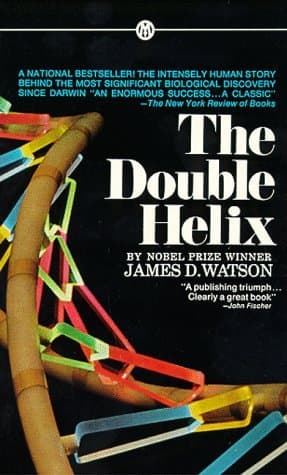
The Double Helix cover
Archivist's Choice

The Double Helix

James D. Watson (1968)

Genre

Biography / Memoir / History / Science

Reading Time

120 min

Key Themes

See below

Track Your Reading

Sign in to track this book

James Watson's personal account describes the intense race to discover the double helix, revealing the ambition, intellect, and rivalries behind one of the 20th century's greatest scientific finds.

Core Idea

James Watson's "The Double Helix" is a highly personal, often informal, and biased first-person story of the race to find DNA's structure. It shows scientific discovery not as a neat, rational process, but as a messy, competitive, and human effort driven by ambition, rivalry, intuition, and strategic use of ideas. The book shows how important collaboration is, even with personal conflicts, and the elegance of the simple double helix model, which many smart people missed until the right data, insight, and persistence came together.
Reading time
120 min
Difficulty
Easy
✓ Read this if...
You are interested in a raw, unvarnished, and opinionated look into the human side of a monumental scientific discovery, or if you want to understand the dynamics, personalities, and sheer excitement behind the race for the double helix.
✗ Skip this if...
You prefer a purely objective, comprehensive historical account of DNA's discovery, or if you are put off by a narrative that is openly sexist and takes significant liberties with historical accuracy and attribution.

Core idea

The central argument and framework that powers the entire book.

James Watson's "The Double Helix" is a highly personal, often informal, and biased first-person story of the race to find DNA's structure. It shows scientific discovery not as a neat, rational process, but as a messy, competitive, and human effort driven by ambition, rivalry, intuition, and strategic use of ideas. The book shows how important collaboration is, even with personal conflicts, and the elegance of the simple double helix model, which many smart people missed until the right data, insight, and persistence came together.

At a glance

Reading time

120 min

Difficulty

Easy

Read this if...

You are interested in a raw, unvarnished, and opinionated look into the human side of a monumental scientific discovery, or if you want to understand the dynamics, personalities, and sheer excitement behind the race for the double helix.

Skip this if...

You prefer a purely objective, comprehensive historical account of DNA's discovery, or if you are put off by a narrative that is openly sexist and takes significant liberties with historical accuracy and attribution.

Key Takeaways

1

Science as a Human Endeavor

Scientific discovery is driven by ambition, ego, and competition as much as pure intellect.

Quote

Science seldom proceeds in the straightforward logical manner imagined by outsiders. Instead, its advances are often due to a combination of lucky accidents and shrewd guesses.

Watson's memoir challenges the idea that scientific discovery is purely objective, rational, or done alone. He clearly shows the intense competition, personal rivalries, and strategic moves that marked the race to find DNA's structure. Scientists, even brilliant ones like Linus Pauling, Rosalind Franklin, and Maurice Wilkins, are shown to be very human, driven by ambition, ego, and the wish for recognition. This honest portrayal reveals that collaboration often has tension, and 'gentlemanly science' is often just a front. The book rem...

Supporting evidence

The constant tension and 'cold war' between Wilkins and Franklin at King's College, and Watson and Crick's relentless pursuit to beat Pauling to the structure, even resorting to interpreting Pauling's published (and incorrect) triple helix model.

Apply this

When working in competitive fields, acknowledge the human element of ambition and ego. Understand that collaboration isn't always harmonious, and strategic thinking, beyond pure technical skill, is crucial for success.

scientific-competitionhuman-element-sciencescientific-ego
2

The Power of Collaboration (and its Discontents)

Effective scientific collaboration often involves an unlikely pairing of complementary (and sometimes clashing) personalities.

Quote

Francis Crick and I were united by a common goal: to find the structure of DNA, no matter what.

The partnership between Watson and Crick is a main theme, showing how two very different people—Watson's youthful impatience and quick insights, combined with Crick's sharp mind, endless energy, and theoretical strictness—could come together to make a huge discovery. Their collaboration had its problems, but their combined strengths, especially Crick's ability to explain and test ideas, and Watson's strong drive, worked well together. The book suggests that while individual genius is important, the right collaborative dynamic can spee...

Supporting evidence

Watson's description of Crick's constant theorizing and 'loud' personality, contrasted with his own more visual and impatient approach. Their shared office and constant discussions, often bordering on arguments, were essential to refining their model.

Apply this

Seek out collaborators whose strengths complement your weaknesses, even if their working style differs significantly from your own. Embrace constructive intellectual friction as a catalyst for better ideas.

scientific-collaborationcomplementary-skillsdynamic-partnerships
3

Serendipity and Strategic 'Borrowing'

Major scientific breakthroughs often rely on opportune timing, access to others' data, and a bit of luck.

Quote

Molecular biology was not yet a recognized discipline. Its adherents were a motley collection of physicists, chemists, and biologists, all of whom shared a common ambition: to understand the secret of life.

Watson's story makes it clear that finding the double helix was not one moment of genius alone, but a mix of existing knowledge, careful observations, and a key bit of luck. Access to Rosalind Franklin's 'Photo 51' (through Wilkins, without her clear permission) and her unpublished data (from a Medical Research Council report, also without her knowledge) was certainly important. This brings up ethical questions, but Watson presents it as a practical need in a high-stakes race. It shows that scientific progress often builds on the unac...

Supporting evidence

Maurice Wilkins showing Watson Franklin's 'Photo 51' X-ray diffraction image, which provided crucial visual evidence of the helical structure. Also, the use of Franklin's data on DNA's symmetry and water content from the MRC report, which helped Crick deduce key parameters.

Apply this

Be aware of the ethical implications of data sharing and access in your field. Recognize that breakthroughs often come from synthesizing disparate pieces of information, not just generating new ones, and actively seek out relevant, even if indirectly obtained, insights.

scientific-ethicsdata-sharingserendipity-sciencescientific-discovery
4

The Importance of Visualizing the Invisible

Building physical models is a powerful, intuitive tool for understanding complex molecular structures.

Quote

The most important feature of the model was that it was a double helix, with the two chains running in opposite directions.

Watson stresses how important physical model-building was in their discovery process. While others relied heavily on X-ray crystallography and mathematical analysis, Watson and Crick's breakthrough came from moving physical models of nucleotides, trying to fit them together in a way that met both chemical rules and the existing X-ray data. This hands-on, three-dimensional approach allowed them to visualize and test ideas in a way that pure abstract thinking could not. It shows that sometimes, the most complex problems are solved not j...

Supporting evidence

Their continuous construction and reconstruction of models using metal plates and clamps, trying out different base pairings (A-T, G-C) and backbone configurations, which ultimately led to the discovery of the complementary base pairing and the antiparallel strands.

Apply this

When grappling with complex, multi-dimensional problems, don't shy away from physical modeling, drawing, or other tangible representations. Visualizing and manipulating components can unlock insights that purely abstract thought might miss.

scientific-modelingvisual-thinkingspatial-reasoningproblem-solving
5

The Pitfalls of Premature Publication (and Pauling's Lesson)

Rushing to publish an unverified theory can lead to embarrassment and missed opportunities.

Quote

Pauling's proposed structure for DNA was a triple helix with the phosphate groups in the center. This was a blunder of the first magnitude.

Linus Pauling, a famous scientist, famously published an incorrect triple helix model for DNA. Watson uses this event to show the dangers of intellectual arrogance and the pressure to be first. Pauling's mistake, which put the phosphate backbone in the center, was chemically wrong and ignored basic acidity rules. This error, according to Watson, pushed him and Crick to work harder, realizing that even the best minds could make mistakes, and that the race was truly open. It serves as a warning: while speed is important in scientific di...

Supporting evidence

Pauling's publication of the triple helix model in 1953, which Watson and Crick quickly identified as chemically impossible due to the unshielded phosphate groups. This error was a major motivator for them to accelerate their own work.

Apply this

Before presenting or publishing your work, rigorously test your assumptions and seek critical feedback, especially from those who might challenge your conclusions. Don't let the pressure to be first compromise the integrity of your findings.

scientific-rigorpremature-publicationintellectual-humilitypeer-review
6

The Unsung Heroes (and Heroines)

Scientific breakthroughs often depend on the foundational work and overlooked contributions of others.

Quote

Rosalind Franklin, though sometimes difficult, was undeniably brilliant and her X-ray photographs were superb.

While Watson and Crick received the Nobel Prize, the book subtly points out the essential, yet often unacknowledged, contributions of others, especially Rosalind Franklin and Maurice Wilkins. Franklin's careful X-ray diffraction images (especially Photo 51) and her precise measurements were key for figuring out the helical structure and its size. Wilkins's early work and his indirect sharing of Franklin's data were also important. Watson's frank, though sometimes critical, portrayal of Franklin shows her scientific skill, even as it r...

Supporting evidence

The critical role of Rosalind Franklin's 'Photo 51' and her detailed analysis of DNA's A and B forms, which provided the quantitative data Watson and Crick needed to validate their model. Maurice Wilkins's initial X-ray work and his role in facilitating access to Franklin's data.

Apply this

Actively acknowledge and credit the foundational work and indirect contributions of others, even those whose methods or personalities you find challenging. Strive to create inclusive environments where all contributions are valued and recognized.

scientific-recognitiongender-bias-sciencefoundational-researchintellectual-debt
7

The Thrill of the Chase

The pursuit of a major scientific discovery is an exhilarating, all-consuming intellectual adventure.

Quote

There was no time to be anything but excited.

Watson's story captures the intense excitement and emotional highs and lows of being close to a huge discovery. His writing conveys the thrill of the race against Pauling, the frustration of dead ends, and the pure joy when things finally fit together. The book is not just a historical account but a vivid description of the passion that drives scientists. It illustrates how the intellectual challenge, the competitive spirit, and the chance for a major contribution to human knowledge can create an all-consuming focus, making the journe...

Supporting evidence

Watson's almost feverish descriptions of their daily discussions, their urgent trips to London to see Wilkins, and the relief and excitement upon realizing the complementary base pairing and the double helix structure.

Apply this

Cultivate a deep curiosity and passion for the problems you are trying to solve. Embrace the challenges and setbacks as part of the exciting journey of discovery, allowing that intrinsic motivation to drive your work.

scientific-passionintellectual-curiositydiscovery-processmotivation
8

Youthful Audacity and Unconventional Paths

Sometimes, a fresh perspective and a disregard for convention are key to groundbreaking insights.

Quote

I was only twenty-four, and I knew nothing about X-ray diffraction. But I was determined to learn.

Watson was quite young (24) when he started the DNA search, and his background was in phage genetics, not crystallography. His 'outsider' viewpoint, combined with his youthful boldness and lack of respect for established figures, allowed him and Crick to approach the problem with fewer fixed ideas than more experienced crystallographers. This suggests that sometimes, a fresh, even naive, perspective can be an advantage, allowing one to question assumptions and explore unusual paths that seasoned experts might miss. It supports the ide...

Supporting evidence

Watson's admitted lack of deep knowledge in X-ray crystallography, yet his quick grasp of the essential data. His willingness to collaborate with Crick, a physicist, to tackle a biological problem, bypassing traditional disciplinary boundaries.

Apply this

Don't be afraid to tackle problems outside your immediate area of expertise if you have a strong interest. Embrace a beginner's mindset and challenge established norms; sometimes, fresh eyes see what others miss.

fresh-perspectiveinterdisciplinary-researchbeginner-mindsetdisruptive-thinking
9

The Role of Mentorship and Institutional Support

Even independent-minded scientists benefit immensely from supportive environments and key mentors.

Quote

Cavendish Laboratory, under the leadership of Sir Lawrence Bragg, provided an ideal intellectual atmosphere for our work.

Despite the strong competition, Watson and Crick worked within a supportive structure at the Cavendish Laboratory, led by Sir Lawrence Bragg. Bragg, himself a Nobel laureate, provided the space, resources, and intellectual freedom needed for their unusual pursuits, even when their first efforts were criticized. The ability to freely discuss ideas, access equipment, and be part of an active scientific community was essential. This shows that while individual genius is celebrated, it often does best within a system that encourages intel...

Supporting evidence

The Cavendish Laboratory's environment, where Crick was allowed to pursue 'off-topic' research with Watson, and the eventual support and encouragement from Bragg after their initial, incorrect model. The existence of the Medical Research Council funding and reports.

Apply this

Seek out environments and mentors that foster intellectual freedom and provide necessary resources, even if their direct involvement is minimal. Appreciate the institutional support that often underpins groundbreaking individual work.

scientific-mentorshipinstitutional-supportresearch-environmentintellectual-freedom
10

The Elegance of Simplicity

The most profound scientific truths often possess an inherent beauty and simplicity once revealed.

Quote

The structure was too pretty not to be true.

Once the double helix model was finished, Watson and Crick were struck by its natural elegance and simplicity. The complementary base pairing (A-T, G-C) and the self-replicating nature of the structure immediately suggested how genetic information could be copied, meeting the basic need for a heredity molecule. This 'prettiness' or aesthetic appeal often comes with major scientific breakthroughs, showing a deep underlying truth. It suggests that while the path to discovery can be complex and messy, the final solution often reveals a b...

Supporting evidence

The immediate realization, upon establishing the complementary base pairing, of how the DNA molecule could replicate itself, providing a direct answer to a fundamental biological question. This elegant solution felt intuitively correct.

Apply this

When evaluating solutions or theories, consider their elegance and simplicity. Often, the most profound answers are not overly complicated but reveal a beautiful, underlying order that explains much with little.

scientific-elegancesimplicity-in-sciencefundamental-truthsaesthetic-science

Critical analysis

Notable Quotes

It is not often that a scientist gets the chance to participate in the discovery of a really new natural phenomenon.

Watson reflecting on the rarity and significance of their discovery.

A good many people thought that Rosalind Franklin should have been awarded a Nobel Prize for her work, but it was too late.

Watson discussing the contributions of Rosalind Franklin and the Nobel Prize rules.

The first order of business was to find a place to live. It was not a trivial task, for Cambridge was not exactly a boom town.

Watson's initial experiences upon arriving in Cambridge.

I was very surprised when I learned that Linus Pauling was also working on the structure of DNA.

Watson's reaction to finding out about Pauling's competing research.

The feeling was that, if we did not hurry, Pauling might get the answer first.

The sense of urgency felt by Watson and Crick due to Pauling's competition.

Our first attempts to build a model of DNA were disastrous.

Watson describing their early, unsuccessful attempts at model building.

It was obvious that a double helix was the only possible structure.

Watson's realization after seeing the crucial X-ray diffraction image.

We were, of course, quite aware that we were playing with dynamite.

Watson's acknowledgement of the potential scientific and ethical implications of their work.

I could not be bothered by the fact that I was not a chemist.

Watson's focus on the problem despite his lack of formal training in chemistry.

Francis, in contrast, knew that the purine and pyrimidine bases had to be held together by hydrogen bonds.

Highlighting Francis Crick's crucial chemical insight.

The structure was so pretty and so simple that it had to be right.

Watson's aesthetic judgment of the DNA structure after its discovery.

We had, of course, no idea that we were on the verge of a revolution.

Watson reflecting on their ignorance of the future impact of their discovery.

The race was on, and we were determined to win it.

Watson's competitive spirit driving their research efforts.

Thus, the race was still very much on, and we were still very much in it.

Watson reiterating the ongoing competitive pressure.

It was obvious that the structure of DNA was the most beautiful of all molecules.

Watson's personal appreciation for the elegance of the DNA structure.

Quiz

Test Your Knowledge

Ready to see how well you understood this book? Take our interactive quiz with 10 questions.

10
Questions
~5
Minutes
?
Best Score

Key Questions (FAQ)

'The Double Helix' is James D. Watson's personal account of the scientific discovery of the structure of DNA. It details the intense competition, collaborative efforts, and personal rivalries among scientists racing to solve one of biology's greatest mysteries in the mid-20th century.

About the author