BookBrief
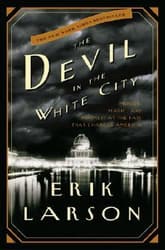
The Devil in the White City: Murder, Magic, and Madness at the Fair That Changed America cover
Archivist's Choice

The Devil in the White City: Murder, Magic, and Madness at the Fair That Changed America

Erik Larson (2003)

Genre

Biography / History / Mystery

Reading Time

9-12 hours

Key Themes

See below

Track Your Reading

Sign in to track this book

At the 1893 Chicago World's Fair, an architect's triumph is overshadowed by a serial killer who preys on visitors.

Core Idea

Erik Larson tells two stories: the creation of the 1893 Chicago World's Columbian Exposition and the crimes of Dr. H. H. Holmes, a serial killer who targeted fair visitors. The book shows how a time of great progress and innovation also allowed for profound darkness. It demonstrates how the forces that enabled an architectural marvel and a grand illusion of societal advancement also gave anonymity and opportunity for unimaginable evil. Readers consider the duality of human nature and the connection between progress and depravity, all set during an important moment in American history.
Reading time
9-12 hours
Difficulty
Medium
✓ Read this if...
You enjoy narrative non-fiction that blends historical events with true crime, appreciate detailed historical accounts of significant cultural moments, or are fascinated by the Gilded Age and the darker side of human nature.
✗ Skip this if...
You prefer pure historical analysis without a strong narrative element, are sensitive to detailed descriptions of violence and serial murder, or dislike books that juggle multiple storylines.

Core idea

The central argument and framework that powers the entire book.

Erik Larson tells two stories: the creation of the 1893 Chicago World's Columbian Exposition and the crimes of Dr. H. H. Holmes, a serial killer who targeted fair visitors. The book shows how a time of great progress and innovation also allowed for profound darkness. It demonstrates how the forces that enabled an architectural marvel and a grand illusion of societal advancement also gave anonymity and opportunity for unimaginable evil. Readers consider the duality of human nature and the connection between progress and depravity, all set during an important moment in American history.

At a glance

Reading time

9-12 hours

Difficulty

Medium

Read this if...

You enjoy narrative non-fiction that blends historical events with true crime, appreciate detailed historical accounts of significant cultural moments, or are fascinated by the Gilded Age and the darker side of human nature.

Skip this if...

You prefer pure historical analysis without a strong narrative element, are sensitive to detailed descriptions of violence and serial murder, or dislike books that juggle multiple storylines.

Key Takeaways

1

The Grand Illusion

The 1893 World's Fair was a breathtaking spectacle masking a city's dark underbelly.

Quote

The fair was an oasis, a bubble of civility and beauty in a city otherwise characterized by grit and grime. But even within its illuminated boundaries, shadows lurked.

The World's Columbian Exposition, known as the White City, was an achievement in urban planning, architecture, and engineering. It showed America's rise on the global stage. Its white buildings, electric lights, and planned grounds sharply contrasted with the chaotic, crime-ridden, and often dirty reality of Chicago in the late 19th century. This duality is central to the book, showing how great human aspiration and progress can exist with the darkest human impulses. The fair was a symbol of hope and what was possible, yet it also gav...

Supporting evidence

The detailed descriptions of the White City's grandeur and its temporary nature, contrasted with the grimy, dangerous streets of Chicago where Holmes operated, illustrate this theme.

Apply this

Recognize that even in times of great collective achievement or public spectacle, individual vulnerabilities and societal dangers persist. Be critical of surface appearances and understand the underlying realities.

urban-planninggilded-agesocial-contrast
2

Architectural Triumph Against All Odds

Daniel Burnham's relentless vision brought the White City to life despite immense challenges.

Quote

Make no little plans; they have no magic to stir men's blood and probably themselves will not be realized.

Daniel H. Burnham, the Director of Works for the fair, faced a huge task: design and build an entire city in just over two years. His challenges included the death of his partner, John Root, political disagreements, labor disputes, financial problems, and the logistical difficulty of coordinating thousands of workers and materials. Burnham's leadership, his ability to inspire and manage a team of the era's greatest architects and engineers, and his belief in the project's grand vision were important. His story shows the power of ambit...

Supporting evidence

Larson details Burnham's constant battles with committees, the rushed timelines, and the personal tragedy of Root's death, all while maintaining the project's ambitious scope.

Apply this

Embrace audacious goals and understand that significant achievements often require immense perseverance, strong leadership, and the ability to adapt to unforeseen obstacles. Don't be afraid to 'make no little plans.'

project-managementleadershipresilienceurban-design
3

The Allure of the Predator

H.H. Holmes exploited trust and anonymity to commit unspeakable acts.

Quote

He was a man who lived by his wits, a charmer with a dark secret, preying on the naive and the vulnerable.

H.H. Holmes, born Herman Webster Mudgett, was a master manipulator who took advantage of Chicago's transient population during the fair. He presented himself as respectable and charming, using his medical background and business skills to gain trust. His 'Murder Castle,' a hotel with secret passages, soundproof rooms, a gas chamber, and a crematorium, is a monument to his depravity. Holmes's ability to blend into society while committing horrific crimes shows how appearances can deceive and the danger of unchecked narcissism and psych...

Supporting evidence

Larson's meticulous reconstruction of Holmes's life, from his acquisition of the drugstore to the construction and interior design of his hotel, and the detailed accounts of his victims' disappearances.

Apply this

Be wary of individuals who exhibit an excessive charm offensive or who seem too good to be true. Trust your instincts and be cautious in unfamiliar environments, especially when dealing with new acquaintances. Understand that evil often wears a mask of normalcy.

psychopathymanipulationserial-killerhuman-darkness
4

The Double-Edged Sword of Progress

Technological advancements at the fair facilitated both wonder and destruction.

Quote

The fair was a laboratory of the future, where new technologies promised a brighter tomorrow, yet some of these same advancements could be twisted for malevolent ends.

The 1893 World's Fair displayed new technology: electric lights by Westinghouse, the Ferris Wheel, new building materials, and communication methods. These marvels captivated visitors, symbolizing humanity's potential. Larson shows how these advancements could be corrupted. Holmes, for example, used architectural knowledge to design his deadly hotel, and the anonymity of a large, busy city (a result of industrial growth) allowed him to operate undetected for years. The ease of travel by railroads, celebrated at the fair, also brought ...

Supporting evidence

The contrast between the dazzling electric lights of the White City (a marvel) and Holmes's use of gas pipes in his hotel for murder (a perversion of technology). The overall ease of movement and anonymity in a booming city.

Apply this

Critically evaluate new technologies and societal changes, considering not only their intended benefits but also their potential for unintended negative consequences or misuse. Advocate for ethical oversight and responsible innovation.

technological-ethicsindustrial-revolutionunintended-consequences
5

The Fragility of Justice

Law enforcement struggled to comprehend and combat a new breed of criminal.

Quote

The police were accustomed to ordinary criminals, not a man who built a murder factory disguised as a hotel. They were outmatched by his cunning.

The story of H.H. Holmes shows the limits of 19th-century law enforcement. Detectives and police were unprepared for a serial killer like Holmes, whose crimes were carefully planned, often had no clear motive beyond personal gratification, and used the growing anonymity of urban life. The lack of standard forensic techniques, interstate cooperation, and comprehensive missing persons databases allowed Holmes to avoid capture for a long time. His eventual arrest was often due to chance and the efforts of a few dedicated individuals rath...

Supporting evidence

The numerous instances where Holmes narrowly escaped detection, the difficulty in tracing his victims, and the eventual role of insurance fraud in his downfall, rather than direct murder investigations.

Apply this

Understand that justice systems are constantly evolving and have inherent limitations. Support advancements in forensic science, inter-agency cooperation, and victim advocacy to better address complex criminal threats. Don't assume justice is inevitable.

criminologyforensicslaw-enforcement-historyjustice-system-gaps
6

The Human Cost of Grandeur

The fair's triumph was built on immense personal sacrifice and danger.

Quote

Beneath the gleaming facades of the White City lay the untold stories of those who toiled and sometimes died to bring it to life.

While the White City was a marvel, its construction had a significant human cost. Thousands of laborers worked in dangerous conditions, often for low wages, facing risks from falls, machinery, and diseases. The scale and speed of the project meant safety was often overlooked, leading to many accidents and deaths. Burnham himself faced great personal stress and exhaustion, pushing himself and his team to their limits. This part of the story reminds us that behind every great achievement, there are often unseen sacrifices and struggles....

Supporting evidence

Larson details the harsh working conditions, the long hours, and the specific accounts of accidents and deaths among the construction workers at the fairgrounds.

Apply this

When celebrating large-scale achievements, remember to acknowledge the labor and sacrifices that made them possible. Advocate for ethical labor practices, worker safety, and fair compensation in all industries.

labor-historyworker-safetyethics-of-progresssocial-responsibility
7

The Power of a Visionary

Burnham's single-minded focus transformed an impossible dream into reality.

Quote

A great leader is one who can articulate a vision so compelling that others are willing to sacrifice their own comfort to achieve it.

Daniel Burnham's commitment to his vision for the White City was important for its success. Despite setbacks, political maneuvering, and skepticism, Burnham kept a clear picture of what the fair could be. He inspired his team of architects, engineers, and artists to push boundaries, to work with speed and scale, and to overcome difficult obstacles. His ability to delegate, mediate disputes, and maintain morale under pressure shows the power of visionary leadership. He didn't just manage a project; he made a dream real, showing that a ...

Supporting evidence

Burnham's famous quote, 'Make no little plans,' and his relentless pursuit of classical grandeur despite initial resistance from some architects.

Apply this

Cultivate a clear, compelling vision for your goals, whether personal or professional. Learn to inspire and empower others by communicating that vision effectively, fostering collaboration, and maintaining resilience in the face of adversity. Don't let practicalities immediately dampen ambitious ideas.

visionary-leadershipinspirationgoal-settingperseverance
8

The Shadow of the Metropolis

The anonymity and chaos of a rapidly growing city provided fertile ground for evil.

Quote

Chicago itself was a monster, growing at an alarming rate, a place where one could easily disappear, or make others disappear.

Chicago's rapid growth in the late 19th century created an environment that helped Holmes's crimes. The city attracted people seeking new opportunities, making it easy for individuals to arrive without many social ties and disappear without immediate alarm. The large number of people, along with basic communication and record-keeping systems, meant a serial killer could operate with terrifying freedom. Larson portrays Chicago as a character itself – an ambitious, but also dangerous and chaotic city, where the bright lights of progress...

Supporting evidence

The constant influx of visitors to Chicago for the Fair, and the difficulty the police had in tracking missing persons or connecting Holmes's various aliases and activities.

Apply this

Be mindful of the balance between privacy and safety in urban environments. Understand how rapid societal changes can create new vulnerabilities. Support community building and robust public safety initiatives to mitigate the risks associated with urban anonymity.

urbanizationanonymitysocial-dislocationcity-life-dangers
9

The Enduring Fascination with Evil

The macabre story of Holmes continues to captivate, reflecting a dark human curiosity.

Quote

Holmes possessed a darkness so profound that it continues to haunt the imagination, a reminder of the abyss within human nature.

Larson's choice to connect the story of the White City's construction with H.H. Holmes's crimes is not just a narrative choice; it taps into a human interest in the macabre. The contrast between beauty and horror, creation and destruction, is compelling. The lasting interest in figures like Holmes, even over a century later, shows our attempts to understand the origins of evil, the psychology of a predator, and the vulnerabilities that allow such individuals to operate. It makes us confront uncomfortable truths about human nature and ...

Supporting evidence

The lasting cultural impact of Holmes's story, evident in books, documentaries, and the continued public interest in his crimes, as well as the initial sensationalism of his trial.

Apply this

Engage with true crime and historical accounts critically, seeking to understand the underlying societal, psychological, and systemic factors rather than merely sensationalizing the horror. Use such stories as a lens to examine human nature and societal safeguards.

true-crimehuman-psychologyevil-naturecultural-fascination

Critical analysis

Notable Quotes

Quiz

Test Your Knowledge

Ready to see how well you understood this book? Take our interactive quiz with 10 questions.

10
Questions
~5
Minutes
?
Best Score

Key Questions (FAQ)

The book intertwines two parallel stories set during the 1893 Chicago World's Fair: architect Daniel H. Burnham's monumental effort to build the fair's 'White City,' and serial killer H.H. Holmes' use of the fair to lure victims to his 'Murder Castle.' It explores the juxtaposition of American progress and dark criminality in Gilded Age Chicago.

About the author