BookBrief
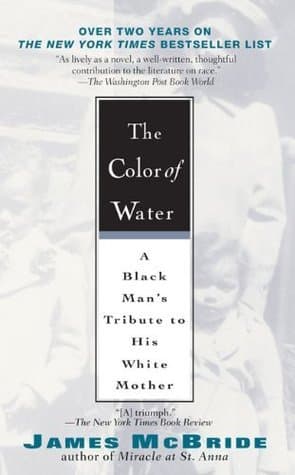
The Color of Water: A Black Man's Tribute to His White Mother cover
Archivist's Choice

The Color of Water: A Black Man's Tribute to His White Mother

James McBride (1995)

Genre

Biography / Memoir

Reading Time

12 Minutes

Key Themes

See below

Track Your Reading

Sign in to track this book

A journalist discovers the remarkable life of his white mother, who survived the Holocaust and became a respected figure in a Black community, showing how love crosses racial lines and how identity is complex.

Core Idea

James McBride's "The Color of Water" is a powerful memoir that explores the complex interplay of race, identity, faith, and family through the lens of his mother, Ruth McBride Jordan. The central argument is that identity is fluid and shaped by individual experiences, choices, and the love within a family, rather than being rigidly defined by race or societal expectations. McBride weaves together his own journey of self-discovery with his mother's harrowing yet ultimately triumphant story of growing up as a white Jewish girl in the Jim Crow South, converting to Christianity, and raising twelve biracial children in Brooklyn. The book ultimately celebrates the enduring strength of a mother's love and the resilience of the human spirit in overcoming adversity and prejudice.
Difficulty
Easy

Core idea

The central argument and framework that powers the entire book.

James McBride's "The Color of Water" is a powerful memoir that explores the complex interplay of race, identity, faith, and family through the lens of his mother, Ruth McBride Jordan. The central argument is that identity is fluid and shaped by individual experiences, choices, and the love within a family, rather than being rigidly defined by race or societal expectations. McBride weaves together his own journey of self-discovery with his mother's harrowing yet ultimately triumphant story of growing up as a white Jewish girl in the Jim Crow South, converting to Christianity, and raising twelve biracial children in Brooklyn. The book ultimately celebrates the enduring strength of a mother's love and the resilience of the human spirit in overcoming adversity and prejudice.

At a glance

Difficulty

Easy

Key Takeaways

1

Identity as a Fluid Construct

Race and belonging are less about rigid categories and more about lived experience and self-definition.

Quote

God is the color of water.

Ruth McBride's statement that 'God is the color of water' is the book's main idea. It shows her belief that faith and human worth matter more than race. Her own life, changing from Rachel Shilsky, a white Jewish girl, to Ruth McBride Jordan, a Black woman by marriage and choice, shows how identity can shift. She chose to leave her difficult past and build a new life and community, raising twelve Black children in a mostly Black neighborhood. This was more than just fitting in; it was a complete reshaping of herself, based on a strong ...

Supporting evidence

Ruth's entire life story, from her abandonment of her Jewish family in Virginia to her marriage to a Black minister and her unwavering commitment to her Black children and community.

Apply this

Reflect on how your own identity is shaped by choice and experience, not just birthright. Challenge preconceived notions of identity in others, recognizing the complex interplay of heritage, belief, and personal journey.


2

The Power of a Mother's Unwavering Love and Discipline

Ruth McBride's fierce dedication and strict rules were the bedrock for her children's success.

Quote

She was a dark-skinned, light-skinned, and sometimes no-skinned woman, a woman who knew what she wanted and how to get it, and what she wanted most was for her children to be educated.

Ruth McBride's twelve children grew up poor in Red Hook, Brooklyn, but all earned higher education, with most getting graduate degrees. This remarkable result came from Ruth's strict discipline, her focus on education, and her steady love. She managed a busy household but taught important values: respect, hard work, and faith. She took her children to Jewish schools for better learning, expected good grades, and exposed them to culture. She did all this while dealing with racism and personal struggles. Her drive to end the cycle of po...

Supporting evidence

The fact that all twelve McBride children became successful professionals, including doctors, educators, and artists, despite their impoverished upbringing.

Apply this

Parents should prioritize education and instill discipline and strong values, understanding that consistent effort and high expectations can overcome significant obstacles. Society should support single mothers and families in poverty with resources that enable them to foster their children's educational success.

3

Navigating Dual Heritages

James McBride's journey highlights the complexities and sometimes contradictory experiences of mixed-race identity.

Quote

I was confused, and when I was confused I was angry.

James McBride's story explores what it was like to grow up as a mixed-race child in a Black family with a white mother who first hid her past. His confusion came from his mother not talking about her background and his own struggle to connect his Black identity with her unknown white heritage. This inner conflict led to times of anger, rebellion, and a search for belonging, especially in his teen years when he experimented with drugs and violence. His journey to understand his mother's past helped him understand himself. It let him br...

Supporting evidence

McBride's personal accounts of his adolescent struggles, his questioning of his mother's race, and his eventual investigation into her past.

Apply this

Foster open dialogue about racial and cultural heritage within families, especially for mixed-race individuals. Encourage self-exploration and understanding of one's roots as a path to personal integration and peace.

4

The Scars of Intergenerational Trauma

Ruth's traumatic past, though hidden, profoundly shaped her and her children's lives.

Quote

Her past was a mystery, a riddle, a locked room.

Ruth McBride's early life in Suffolk, Virginia, included great hardship: a cruel, abusive father, a fragile mother, and widespread anti-Semitism and racism. Her choice to run from this past and erase her Jewish identity was a way to survive. She rarely spoke of it, but these deep pains surely shaped her strong independence, her focus on faith, and her protectiveness toward her children. Her past, unknown to her children for years, still influenced her parenting and her children's understanding of where they came from. This shows how u...

Supporting evidence

Ruth's detailed recollections of her father's abuse, her mother's frailty, and the pervasive racism and anti-Semitism in Suffolk, Virginia.

Apply this

Recognize the potential for intergenerational trauma within families and communities. Encourage open communication about family histories, even difficult ones, to foster healing and understanding across generations.

5

Faith as a Cornerstone of Resilience

Spiritual belief provided strength and guidance through immense hardship for both Ruth and her children.

Quote

God is not a White man. God is not a Black man. God is the color of water. God is a spirit.

Ruth McBride's deep and unusual faith was a constant in her difficult life. Her belief that 'God is the color of water' went beyond race and church lines, offering a universal spiritual truth that supported her and her family. After converting to Christianity, she helped start a church in her living room, which became a spiritual and community center. This faith helped her endure prejudice and poverty. It also gave her children a moral guide, teaching them love, forgiveness, and perseverance. It showed them to look past surface differ...

Supporting evidence

Ruth's founding of the New Brown Memorial Baptist Church, her constant teaching of spiritual values to her children, and her personal testimonies of relying on God through adversity.

Apply this

Explore the role of personal faith or spiritual practices as a source of strength and meaning in navigating life's challenges. Encourage open-mindedness regarding diverse spiritual perspectives.

6

The Unseen Labor of Motherhood

The memoir subtly reveals the immense, often unacknowledged work involved in raising a large family in poverty.

Quote

She was a master of organization, a general without an army, a conductor without an orchestra.

Beyond the stories of race and identity, the book quietly celebrates the hard work of motherhood, especially for a single parent of twelve children in poverty. Ruth McBride's life was a constant act of being resourceful, sacrificing, and planning. She worked multiple jobs, dealt with bureaucracy for housing and education, cooked for a large family, and kept some order and discipline in a busy home. The memoir shows the physical and emotional cost of this, highlighting the often-unseen work that supports children's success, particularl...

Supporting evidence

McBride's descriptions of his mother's multiple jobs, her strict budgeting, her logistical feats in getting children to different schools, and her constant presence in their lives.

Apply this

Acknowledge and value the immense labor of caregivers, particularly mothers, in society. Advocate for policies that support families and provide resources for single parents to manage their responsibilities effectively.

7

Challenging Racial Stereotypes Through Lived Experience

The McBride family's story directly refutes monolithic views of race and family.

Quote

Race is like a button on a coat. You can take it off or put it on. It doesn't mean anything.

The McBride family itself—a white Jewish mother raising twelve Black children in a Black community—challenges racial stereotypes and common ideas of family. Ruth refused to be defined by her race, and she insisted on seeing people as individuals. This went against the strict racial divisions common in society, especially in the mid-20th century. Her children, growing up with a white mother who identified with the Black community, learned early on to question racial lines. The book shows that love, family, and shared values can overcom...

Supporting evidence

The diverse racial makeup of the McBride family itself, their upbringing in a Black community, and their mother's consistent teaching that race is insignificant.

Apply this

Actively challenge racial stereotypes and promote inclusive understandings of family and community. Seek out and amplify stories that demonstrate the fluidity and complexity of racial identity.

8

The Search for Roots and Reconciliation

James's quest for his mother's past was essential for his own personal and familial healing.

Quote

Her silence was a wall, and I was determined to knock it down.

James McBride's journey to find his mother's hidden past is a main part of the story, driven by his need to understand himself and his family. For years, Ruth's past was a mystery, leaving a gap in James's understanding of his own background. His journalism skills helped him discover his personal history. Interviewing his mother and tracing her steps back to Suffolk, Virginia, was a deep process of healing—for James with his mother, and for Ruth with her own painful past. This search for roots, though at first difficult and uncovering...

Supporting evidence

James's interviews with his mother, his travels to Suffolk, Virginia, and his meetings with his mother's estranged family members.

Apply this

Encourage individuals to explore their family histories, even if they contain difficult truths, as a means of personal growth and familial understanding. Support efforts to document and preserve diverse family stories.

9

Education as a Gateway to Freedom

Ruth saw education not just as knowledge, but as liberation from poverty and prejudice.

Quote

Education, she would say, is the only way out. That's the only way you'll get ahead.

For Ruth McBride, education was very important, a necessary path to a better life and freedom. Having faced extreme poverty and prejudice, she knew that knowledge and skills were the most powerful tools her children could have. She made huge sacrifices to ensure her children went to the best schools, even if it meant busing them far from their neighborhood or sending them to mostly white, Jewish schools. Her own return to college at age 65, earning a degree in social work, further shows her lifelong belief in learning. This view sees ...

Supporting evidence

All twelve McBride children attending college and graduate school, and Ruth's own pursuit of a degree in social work at Temple University.

Apply this

Advocate for equitable access to quality education for all children, recognizing its transformative power. Support lifelong learning initiatives and adult education programs.

10

The Complexities of Memory and Narrative

The book illustrates how personal histories are shaped by individual perspectives and the act of storytelling.

Quote

Her truth was a complicated tapestry, woven with threads of memory, pain, and fierce conviction.

"The Color of Water" is a dual memoir, mixing James McBride's story with his mother's spoken history. This structure shows how memory and stories are personal. Ruth's memories, though clear, are shaped by her traumas and her desire to protect her children from her past. James, in turn, understands these stories through his own view as a son and a journalist. The differences and similarities in their accounts create a richer, more detailed understanding of their shared history. This approach acknowledges that there isn't one single 'tr...

Supporting evidence

The alternating chapters between James's first-person narrative and Ruth's transcribed oral history, revealing different angles and emotional tones to the same events.

Apply this

Approach personal histories and family stories with an understanding of their subjective nature. Encourage multiple perspectives in storytelling to gain a more comprehensive and empathetic view of events.

Critical analysis

Notable Quotes

Quiz

Test Your Knowledge

Ready to see how well you understood this book? Take our interactive quiz with 10 questions.

10
Questions
~5
Minutes
?
Best Score

Key Questions (FAQ)

'The Color of Water' is a memoir by James McBride that tells the story of his relationship with his mother, Ruth McBride Jordan. It explores her life, her Jewish heritage, her conversion to Christianity, and her experiences raising twelve children in a predominantly black community.

About the author