BookBrief
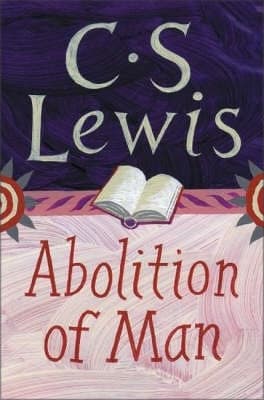
The Abolition of Man cover
Archivist's Choice

The Abolition of Man

C.S. Lewis (1943)

Genre

Spirituality / Philosophy

Reading Time

180 min

Key Themes

See below

Track Your Reading

Sign in to track this book

C.S. Lewis argues that modern education, by treating objective values as subjective feelings, risks 'abolishing' humanity by separating future generations from moral truth.

Core Idea

C.S. Lewis argues that modern education, especially through textbooks that make moral and aesthetic judgments relative, is systematically eroding humanity's ability to see and respond to objective value. This breakdown of the 'Tao' – the universal moral law recognized across cultures and times – creates 'men without chests,' people who have intellect and appetite but lack the emotional and spiritual core needed for virtue, honor, and true human well-being. Lewis believes this process, driven by a mistaken effort to 'conquer nature' that eventually includes human nature, will not lead to progress but to humanity's destruction, turning people into conditioned objects rather than free, rational, and morally responsible beings.
Reading time
180 min
Difficulty
Hard
✓ Read this if...
You are concerned about the philosophical underpinnings of modern education, the erosion of objective morality, or the long-term consequences of scientific reductionism on human nature and values. Also recommended for those interested in C.S. Lewis's philosophical arguments beyond his more famous apologetic works.
✗ Skip this if...
You are looking for a light read, a practical self-help guide, or a contemporary analysis of educational reform. This book is dense, philosophical, and rooted in mid-20th century thought, which may not appeal to those seeking easily digestible modern takes.

Core idea

The central argument and framework that powers the entire book.

C.S. Lewis argues that modern education, especially through textbooks that make moral and aesthetic judgments relative, is systematically eroding humanity's ability to see and respond to objective value. This breakdown of the 'Tao' – the universal moral law recognized across cultures and times – creates 'men without chests,' people who have intellect and appetite but lack the emotional and spiritual core needed for virtue, honor, and true human well-being. Lewis believes this process, driven by a mistaken effort to 'conquer nature' that eventually includes human nature, will not lead to progress but to humanity's destruction, turning people into conditioned objects rather than free, rational, and morally responsible beings.

At a glance

Reading time

180 min

Difficulty

Hard

Read this if...

You are concerned about the philosophical underpinnings of modern education, the erosion of objective morality, or the long-term consequences of scientific reductionism on human nature and values. Also recommended for those interested in C.S. Lewis's philosophical arguments beyond his more famous apologetic works.

Skip this if...

You are looking for a light read, a practical self-help guide, or a contemporary analysis of educational reform. This book is dense, philosophical, and rooted in mid-20th century thought, which may not appeal to those seeking easily digestible modern takes.

Key Takeaways

1

The Threat to Objective Value

Modern education risks eradicating the belief in inherent good and evil.

Quote

For the wise men of old the cardinal problem had been how to conform the soul to reality, and the solution had been knowledge, self-discipline, and virtue. For us, the cardinal problem is how to subdue reality to the human will, and the solution is a technique.

Lewis argues that modern education, particularly through textbooks like 'The Green Book' (which he criticizes), subtly undermines the idea of objective value. By presenting all statements of value as mere subjective feelings or cultural constructs, it inadvertently teaches children that there is no inherent good or evil, no universal moral law. This is not an explicit attack but a quiet erosion, leaving students unable to understand or explain why certain actions are truly noble or base. The risk is creating generations who see all mo...

Supporting evidence

Lewis's detailed analysis of 'The Green Book' (pseudonym for 'The Control of Language: A Handbook of English Usage' by Gaius and Titius), where a waterfall described as 'sublime' is analyzed not for its inherent sublimity but as an example of subjective emotion, thereby dismissing the objective quality of 'sublimity' itself.

Apply this

When evaluating educational materials or discussing moral issues, actively seek out and affirm the objective basis for value judgments. Challenge the automatic reduction of all moral statements to mere subjective feelings. Encourage critical thinking about the 'why' behind moral principles, not just the 'what.'

objective-valuesubjectivismhuman-will
2

The Tao: Universal Moral Law

All great civilizations recognized a foundational, objective moral order.

Quote

The Tao, which others may call Natural Law or Traditional Morality or the First Principles of Practical Reason or the First Platitudes, is not one among a series of possible systems of value. It is the source of all value judgements.

Lewis introduces 'The Tao' as a universal moral law, a common foundation of ethical principles found across diverse cultures and historical periods. He provides examples from ancient Egypt, Babylon, Norse mythology, Greek philosophy, Chinese wisdom, and Jewish and Christian scriptures to show that certain fundamental virtues—such as justice, kindness, respect for parents, and respect for life—are not arbitrary inventions but are deeply ingrained in human consciousness. The Tao is not a 'system' that can be chosen or discarded, but the...

Supporting evidence

Lewis provides an appendix listing parallel moral precepts from Egyptian, Babylonian, Norse, Greek, Roman, Jewish, Christian, and Indian traditions, demonstrating the universality of concepts like respect for elders, justice, mercy, and truthfulness.

Apply this

Study and appreciate the common moral threads across different cultures and religions. Use these universal principles as a foundation for discussing ethics, rather than starting from a purely relativistic or subjective viewpoint. Teach children about the shared human heritage of moral wisdom.

natural-lawuniversal-moralityethics-foundation
3

Men Without Chests

Undermining objective value creates individuals devoid of proper emotional and moral response.

Quote

In a sort of ghastly simplicity we remove the organ and demand the function. We make men without chests and expect of them virtue and enterprise. We laugh at honour and are shocked when we find traitors in our midst.

Lewis uses the metaphor of the 'chest' to represent the seat of generosity, sentiment, and emotion, which connects pure intellect (the head) and basic appetite (the belly). The 'chest' allows us to feel appropriate indignation at injustice, admiration for courage, and love for what is truly good. When modern education dismisses objective value, it 'abolishes' this chest, leaving individuals with only intellect (capable of calculating means) and appetite (driven by desires). Such 'men without chests' may be clever and skilled, but they...

Supporting evidence

The critique of 'The Green Book' leading students to view the 'sublime' as merely subjective emotion, thus dulling their capacity to feel awe or reverence for objective greatness. Lewis's observation that we 'laugh at honour' and then are surprised by a lack of integrity.

Apply this

Cultivate and encourage appropriate emotional responses to moral situations. Teach children to admire heroes, feel empathy for suffering, and recognize true nobility. Engage with literature and art that evokes these 'chest' responses, rather than dismissing them as mere sentimentality.

moral-educationemotional-intelligencevirtue-ethics
4

The Dangers of 'Conditioners'

Those who reject the Tao will inevitably seek to 'condition' humanity according to their own subjective values.

Quote

If the Tao is a product of irrationality, then reason itself must be irrational. If the Tao is not given, then it must be made. If it is made, it can be unmade.

If the Tao, the objective moral law, is rejected as a mere cultural construct or subjective preference, then no ultimate standard for human behavior remains. In this void, certain individuals or groups, whom Lewis calls 'Conditioners,' will inevitably step in to define what is 'good' for humanity. These Conditioners, operating from their own subjective values (which they may rationalize as scientific or progressive), will try to reshape human nature itself through various techniques – genetic engineering, psychological manipulation, p...

Supporting evidence

Lewis's hypothetical scenario of a future where scientific advancements allow for the complete control of human nature, and how those in power, having no objective moral framework, would be free to shape humanity to their arbitrary will.

Apply this

Be vigilant against ideologies that claim to possess the sole truth for human flourishing and seek to fundamentally alter human nature without reference to universal moral principles. Support education that fosters independent moral reasoning based on the Tao, rather than blind obedience to any authority.

moral-relativismtechnocracyhuman-engineering
5

The Illusion of Progress Without Principle

True progress must be guided by unchanging moral truth, not merely technological advancement.

Quote

What we call Man's power over Nature turns out to be a power exercised by some men over other men with Nature as its instrument.

Lewis argues that humanity often confuses technological or scientific advancement with moral progress. While we gain increasing power over nature, this power is always used by some humans over others. If the person using the power lacks a grounding in the Tao, this power becomes dangerous. The 'abolition of man' happens not just when we lose our moral compass, but when we use our new powers to redefine what it means to be human, removing intrinsic dignity and objective value. Progress, in Lewis's view, is not about discarding old trut...

Supporting evidence

Lewis's critique of Baconian science, which, while leading to technological mastery, also implies a mastery of man over man, as the 'scientific' pursuit of human betterment can become a tool for control.

Apply this

Critically evaluate claims of 'progress.' Ask whether new technologies or societal changes align with universal moral principles or merely serve the interests of a select few. Advocate for ethical frameworks to guide scientific and technological development.

technological-ethicsmoral-progresshuman-dignity
6

The False Neutrality of Modern Education

Education cannot be truly neutral regarding values; it inevitably teaches a worldview.

Quote

You cannot make a man by schooling. You must start with the raw material of a man, and that means a man who is already in some degree a part of the Tao.

Lewis challenges the idea that education can be value-neutral, especially in moral matters. By trying to avoid explicit moral instruction, modern educators inadvertently teach a relativistic worldview where all values are subjective. This 'neutrality' is a powerful form of conditioning that leaves students without a foundation for moral judgment. Education, by its nature, shapes the soul and intellect. If it fails to instill the principles of the Tao, it leaves a void that will be filled by unexamined desires or external influences. T...

Supporting evidence

The subtle messaging in 'The Green Book' that, by discrediting objective value, implicitly teaches students that all value is subjective, thus conditioning them without directly stating it.

Apply this

Recognize that all education, even seemingly neutral curricula, carries implicit values. Be intentional about the moral framework presented in educational settings. Engage in discussions about the values being implicitly taught, and actively work to align them with universal moral principles.

value-educationcurriculum-designmoral-relativism
7

The Inevitable Self-Contradiction

Rejecting the Tao leads to an illogical and ultimately unsustainable position.

Quote

If nothing is self-evident, nothing can be proved. Similarly, if nothing is of intrinsic value, then no value can be proved.

Lewis highlights the contradiction in rejecting the Tao. If all values are subjective, then the value judgment that 'all values are subjective' is itself merely a subjective preference. This leads to a logical trap: if you claim there's no objective truth, that claim itself cannot be objectively true. Those who try to abolish the Tao often do so in the name of some 'higher' value—like progress, freedom, or happiness—but these values themselves come from the very Tao they seek to dismantle. Ultimately, a world without the Tao is a worl...

Supporting evidence

The logical argument that if the premise 'all value is subjective' is true, then the premise itself is merely subjective, robbing it of any universal claim to truth.

Apply this

When confronted with arguments that reject objective morality, probe for the underlying values that motivate such claims. Point out the inherent contradictions and the impossibility of consistently living out a purely relativistic worldview. Encourage a return to foundational principles.

logical-fallacymoral-skepticismfoundational-principles
8

The Need for Objective Awe and Reverence

Cultivating proper responses to objective goodness is crucial for moral formation.

Quote

The task of the modern educator is not to cut down jungles but to irrigate deserts.

Lewis argues that education should not just provide information but cultivate the right responses to reality. Just as a desert needs irrigation to bring forth life, the human soul needs to be nurtured to appreciate and respond to objective goodness, beauty, and truth. This involves fostering a sense of awe, reverence, and admiration for things that are intrinsically worthy of it. When educators dismantle the idea of objective value, they strip students of the capacity for such responses, leaving them emotionally barren. Without the ab...

Supporting evidence

The example of the waterfall in 'The Green Book' where the sublime is reduced to a subjective feeling, thereby denying the objective quality of sublimity itself and preventing the student from experiencing genuine awe.

Apply this

Expose children and adults to great art, literature, music, and natural wonders that evoke a sense of awe and reverence. Encourage reflection on the objective qualities that make these things beautiful or sublime. Teach the importance of humility and respect for things greater than oneself.

aesthetic-educationmoral-emotionsreverence
9

The End of Humanity as We Know It

The abolition of objective value fundamentally alters what it means to be human.

Quote

We are not to do this in order to improve man, but to make man. For the first time we shall have the power to choose what sort of creature it is that shall come after man.

Lewis's ultimate warning is that the 'abolition of man' is not just a moral decline, but a radical transformation of humanity. By removing the Tao, we eliminate the very basis for human nature, dignity, and rights. If there is no objective standard for 'good' or 'human,' then humanity becomes a flexible concept, subject to the whims and designs of those with power. This is not just about bad people doing bad things; it is about losing the very definition of 'bad' and 'human.' The future generation, without the 'chest,' would be a new ...

Supporting evidence

The chilling conclusion of the book, where Lewis posits that the final stage of man's conquest of nature would be the conquest of human nature itself, leading to a post-human era.

Apply this

Defend the concept of inherent human dignity and intrinsic worth, independent of utility or subjective preference. Advocate for ethical limits on scientific and technological interventions that seek to fundamentally redefine human nature. Engage in robust philosophical discussions about the essence of humanity.

posthumanismhuman-essencebioethics
10

The Educator's Sacred Duty

Educators bear the profound responsibility of transmitting the Tao, not undermining it.

Quote

It is the business of the educator to make the pupil ready for the Tao. Without that, he is not fit for the world.

Lewis places a serious duty on educators. Their role is not merely to impart facts or vocational skills, but to cultivate the whole human being, preparing them to live virtuously within the framework of the Tao. This means fostering not just intellect, but also character, moral imagination, and the 'chest'—the appropriate emotional responses to good and evil. Educators who, knowingly or unknowingly, dismantle the belief in objective value are failing in this fundamental duty, leaving their students unprepared for life's moral complexi...

Supporting evidence

Lewis's direct address to the educators ('Gaius and Titius') of 'The Green Book,' holding them accountable for the subtle but profound moral conditioning they are imparting.

Apply this

As an educator, parent, or mentor, prioritize moral formation alongside intellectual development. Consciously seek to instill an understanding and appreciation of universal moral principles. Be a model of integrity and courage, demonstrating how to live in accordance with the Tao.

pedagogycharacter-educationmoral-responsibility

Critical analysis

Notable Quotes

The heart of the Abolition of Man is the abolition of the very idea of objective value.

Summarizing the central theme of the book.

What we call Man's power over Nature turns out to be a power exercised by some men over other men with Nature as its instrument.

Discussing the true nature of scientific and technological progress.

We make men without chests and expect of them virtue and enterprise. We laugh at honour and are shocked to find traitors in our midst.

Critiquing modern education's failure to cultivate 'the chest' – the seat of magnanimity and emotion.

It is the object to which the eye is directed, not the eye itself, which determines the nature of the vision.

Arguing against subjectivism in ethics and truth.

Unless you accept the Tao as an absolute, all your ethics are ultimately arbitrary.

Emphasizing the necessity of an objective moral law (the Tao) for any consistent ethical system.

For the wise men of old the cardinal problem had been how to conform the soul to reality, and the solution had been knowledge, self-discipline, and virtue. For the modern innovator the cardinal problem is how to conform reality to the wishes of man.

Contrasting ancient and modern approaches to the human condition.

The greatest evil is not now done in those sordid 'dens of crime' that Dickens loved to paint... but in clean, carpeted, warmed, well-lighted offices, by quiet men with white collars and cut fingernails who never raise their voices.

Illustrating how modern evil can be bureaucratic and impersonal.

A dogmatic belief in objective value is necessary to the very idea of a rule which is not a mere convention.

Arguing for objective morality as the basis for true rules.

The Tao, which others may call Natural Law or Traditional Morality or the First Principles of Practical Reason or the First Platitudes, is not one among a series of possible systems of value. It is the sole source of all value judgements.

Defining the Tao as the universal foundation of morality.

The task of the modern educator is not to cut down jungles but to irrigate deserts.

Suggesting that modern education needs to cultivate virtues rather than merely remove vices.

When we have mastered Nature to be slaves of Man, we are not rid of superstition but enslaved to a more dangerous one.

Highlighting the dangers of unchecked human power.

For the power of Man to make himself what he pleases means, as we have seen, the power of some men to make other men what they please.

Reiterating the theme of power dynamics in the 'abolition of man'.

The true point of view is the one which sees the object as it really is, not as we choose to see it.

Advocating for an objective understanding of reality and values.

You cannot go on 'seeing through' things for ever. The whole point of seeing through something is to see something through it. It is good that the window should be transparent, because the street or garden beyond it is opaque. How if you saw through the garden too?

Critiquing excessive skepticism and reductionism that leaves nothing sacred or real.

If nothing is self-evident, nothing can be proved. Similarly, if nothing is obligatory for its own sake, nothing else can be obligatory at all.

Arguing for the necessity of foundational, self-evident truths and moral obligations.

Quiz

Test Your Knowledge

Ready to see how well you understood this book? Take our interactive quiz with 10 questions.

10
Questions
~5
Minutes
?
Best Score

Key Questions (FAQ)

C.S. Lewis's 'The Abolition of Man' is a philosophical work that critiques modern education and its impact on objective morality. It argues that by dismissing universal values and the concept of 'Tao' (Natural Law), we risk dehumanizing future generations and undermining the very essence of what it means to be human.

About the author

C.S. Lewis

Clive Staples Lewis was a British writer, literary scholar, and Anglican lay theologian. He held academic positions in English literature at both Oxford University and Cambridge University. He is best known as the author of The Chronicles of Narnia, but he is also noted for his other works of fiction, such as The Screwtape Letters and The Space Trilogy, and for his non-fiction Christian apologetics, including Mere Christianity, Miracles, and The Problem of Pain.