“To see a World in a Grain of Sand / And a Heaven in a Wild Flower / Hold Infinity in the palm of your hand / And Eternity in an hour.”
— From 'Auguries of Innocence,' a poem often appended to the collection.

William Blake (1998)
Genre
Creativity
Reading Time
90 min
Key Themes
See below
Sign in to track this book
Blake's poems, with his own art, show how the joy of 'Innocence' meets the harsh truths of 'Experience'.
The collection begins with the 'Introduction' to *Songs of Innocence*. A happy piper, walking through wild valleys, meets a child on a cloud. The child asks the piper to play a song about a lamb, then to sing it, and finally to write it down. The piper, full of joy and inspiration, does so. He makes a pen from a reed and uses water for ink, carefully writing his songs of innocent joy and natural beauty. This scene sets the mood and main idea of the 'Innocence' section, showing simple joy, natural inspiration, and a childlike view of the world.
In 'The Lamb', a speaker talks to a lamb, asking if it knows who made it. The speaker then answers, saying the creator is also called a Lamb, referring to Jesus Christ. This creator is gentle and gave the lamb life, food, and soft, white wool. The poem connects the innocent lamb, the innocent child, and the divine 'Lamb of God'. It highlights purity, gentleness, and the kind parts of creation. It shows a world where God's presence is in the gentle and beautiful parts of nature and childhood.
This poem introduces a young chimney sweeper, whose mother died and father sold him into labor. He tells the story of Tom Dacre, another sweeper whose head was shaved to keep soot from his white hair. The speaker comforts Tom, who then dreams of thousands of sweepers in black coffins. An Angel arrives with a bright key, opening the coffins and letting them play in a green field and wash in a river, shining in the sun. The Angel tells Tom that if he is good, God will be his father and he will always have joy. The poem shows the harsh reality of child labor but offers comfort through faith and the promise of divine help.
'Holy Thursday' describes a line of poor orphan children, dressed in 'red & blue & green', walking to St. Paul's Cathedral on Ascension Day. 'Beadles with wands as white as snow' guide them. The speaker sees their innocent faces, 'shining with radiant faces', as they sit in the church, a 'multitude of lambs'. The poem shows an orderly and religious scene, with the children's voices rising like a 'mighty wind' in praise. It presents a seemingly perfect picture of charity and worship, focusing on the children's beauty and purity, seemingly untouched by their hard lives.
The 'Introduction' to *Songs of Experience* presents a prophet who hears the 'Holy Word' and calls the Earth to wake up. The prophet sees 'every Night & every Morn / Some to Misery are born' and 'every Morn & every Night / Some are born to sweet delight'. He regrets humanity's fallen state, comparing it to a lost time of innocence. The prophet questions the Earth, which is shown as a 'watry shore' wrapped in 'clouds of woe', suggesting suffering and spiritual darkness. This introduction sets a serious, critical tone, showing the widespread presence of suffering, injustice, and corruption of the human soul.
In 'The Tyger', the speaker is amazed by the tiger's terrifying beauty and asks about its creator. Unlike 'The Lamb', this poem deals with evil and destructive forces. The speaker asks what 'immortal hand or eye' could 'frame thy fearful symmetry', wondering if the same God who made the gentle lamb also made the fiery, fearsome tiger. The poem uses strong images of fire, hammer, chain, and furnace, suggesting a divine smith who made this creature in intense heat and power. It looks at the puzzle of creation, asking about a God capable of both innocence and experience, good and evil.
This poem sharply contrasts its 'Innocence' version. The speaker is a young chimney sweeper who is 'happy upon the hearth' only because he sings 'the notes of woe'. His parents taught him to praise God, the priest, and the king, who 'make up a heaven of our misery'. The poem exposes the fakery of society and religion, which use child laborers while offering false comfort and spiritual promises. There is no dream of angels or divine help here; only a bitter acceptance of a life of suffering, with powerful institutions directly blamed for their oppression. The 'soot' that covers them is both real and symbolic, representing their lost innocence and spiritual harm.
Unlike the 'Innocence' version, this 'Holy Thursday' criticizes the charity system. The speaker observes the 'wise guardians of the poor' who 'feed with a cold and usurous hand'. The children's 'trembling feet' and 'cold and usurous hand' are highlighted, showing their suffering. The poem questions a land where 'babes reduce to misery' and 'poverty and war' are allowed, while 'multitudes of lambs' are 'fed' in 'rich and fruitful land'. Blake condemns the social systems that create and keep poverty, exposing the fakery of a nation that claims to be Christian yet lets its children suffer.
'London' criticizes urban decay and human suffering. The speaker walks through the 'charter'd streets' and by the 'charter'd Thames', seeing 'marks of weakness, marks of woe' in every face. He hears the 'cry of every Man', the 'Infant's cry of fear', and the 'Chimney-sweeper's cry' that 'every black'ning Church appalls'. The 'harlot's curse' harms the 'new-born Infant's tear' and 'blights with plagues the Marriage hearse'. The poem shows a bleak city where freedom is limited, institutions are corrupt, and innocence is destroyed by social problems, connecting individual suffering to systemic injustice and moral decay.
The speaker revisits the 'Garden of Love', a place where he played as a child. He finds that a 'Chapel was built in the midst' where there was once an open field. The gates are shut, and above the door, he sees 'Thou shalt not' written in gold. He sees 'graves & tombstones where flowers should be' and priests in black gowns, 'walking their rounds', tying his 'joys & desires with briars'. The poem symbolizes how oppressive institutional religion and strict morality stop natural human desires, joy, and freedom. It turns a place of natural innocence and love into one of repression and death.
'A Little Boy Lost' tells of a child who questions God's presence, leading to him being 'burnt' by a 'priest' for 'reasoning upon such a dark thing'. This act shows how innocent questions and natural spirituality are stopped by rigid religious authority. The poem 'A Little Boy Found' describes how the boy's father searches for him, guided by an angel, and finds him 'sitting by a tree'. This pairing suggests a cycle of losing and finding innocence, or perhaps divine help that can fix what institutional religion has harmed. However, the burn mark remains, showing the lasting effect of harsh experience.
'The Human Abstract' offers a harsh view of human 'virtues'. It says that Pity would not exist without misery, and Mercy if everyone were happy. Peace is seen as a result of fear, not real goodwill. The poem suggests that these 'virtues' are not true goodness but responses to human suffering and social corruption. It shows a world where a 'creeping Sin' and a 'thickning shade' hide the 'Tree of Mystery', which grows in the human brain and is fed by 'Humility' and 'Cruelty'. This poem criticizes the basis of human morality, showing how suffering can continue and even be used to justify oppression.
'Infant Sorrow' describes the difficult experience of birth from the newborn's view. The infant is 'helpless, naked, piping loud', coming into a world of 'swaddling bands' and a 'dangerous world'. The speaker says he was 'bound and weary' and struggled from the 'swaddling bands', symbolizing the immediate limits placed on human life from birth. The poem contrasts sharply with the joyful innocence of 'Infant Joy', showing birth not as a blessing but as an entry into confinement and suffering, highlighting the 'sorrow' that comes with human experience.
'A Divine Image' (often compared with 'The Human Abstract') states that 'Cruelty has a Human Heart, / And Jealousy a Human Face, / Terror, the Human Form Divine, / And Secrecy, the Human Dress.' This poem, in some later editions of *Experience*, directly addresses the darker parts of humanity. It suggests that even these negative traits are part of the 'Human Form Divine'. It implies that the divine is not separate from human nature, but includes both its innocent and experienced, kind and cruel parts. It is a complex thought on the dual nature of humanity and its link to the divine.
The Narrator/Voice of Innocence and Experience
Transforms from a joyful, innocent creator to a disillusioned, critical prophet, reflecting the journey from innocence to experience.
The Symbol of Innocence and Christ
Remains a static symbol of uncorrupted innocence and divine love.
The Symbol of Experience and Fearsome Creation
Remains a static symbol, embodying the complex and fearsome aspects of existence.
The Victim of Exploitation, Hopeful Child
Maintains a hopeful outlook despite his circumstances, relying on faith for solace.
The Victim of Exploitation, Disillusioned Child
Has lost his innocence and gained a critical, albeit painful, understanding of his exploitation.
The Symbol of Vulnerability and Uncorrupted Potential
Represents humanity's potential for both pure joy and deep suffering, shaped by external forces.
The Benevolent and Fearsome Creator
Perceived differently through the lens of innocence (benevolent) and experience (complex, possibly terrifying).
The Antagonist/Symbol of Oppression
Consistently portrayed as an oppressive and corrupting force.
This is the main theme, looking at the 'two contrary states of the human soul'. Innocence shows childlike purity, spontaneous joy, trust, and simple faith, often linked to nature and divine kindness ('The Lamb', 'Introduction to Innocence'). Experience, on the other hand, shows the awareness that comes from seeing life's harsh realities, injustice, corrupt institutions, and human suffering ('The Tyger', 'London', 'The Garden of Love'). Blake does not see experience as entirely bad. Instead, he sees it as a needed, though sometimes painful, stage of human understanding. The poems show how these two states exist together and often conflict, revealing the complexities of moral and spiritual life. He suggests that true wisdom may come from combining both views.
“Without Contraries is no progression. Attraction and Repulsion, Reason and Energy, Love and Hate, are necessary to Human existence.”
Blake strongly criticizes the social structures and institutions that harm the vulnerable and keep suffering going. This is clearly shown in the 'Chimney Sweeper' poems, where children are sold into harsh labor while the Church and state offer false comfort. 'Holy Thursday' (Experience) exposes the fakery of charity that allows poverty to continue. 'London' shows a city where every institution, from the 'charter'd streets' to the 'black'ning Church', adds to human misery. Blake condemns the effects of the industrial revolution, the strictness of organized religion, and the oppressive power of the monarchy, showing how they corrupt natural human joy and potential.
“How the Chimney-sweeper's cry / Every black'ning Church appalls;”
Blake explores the many sides of the divine, moving past a simple view of a purely kind God. In 'Innocence', God is shown as the gentle 'Lamb', a loving creator. However, 'The Tyger' challenges this, asking what kind of God could make such a terrifying yet magnificent creature. This implies a creator capable of both good and evil, beauty and destruction. This theme suggests that the divine includes all parts of existence, including its darker aspects. Understanding God means recognizing the complexities and contradictions of the created world. Blake implies that both innocence and experience are parts of divine design.
“Did he who made the Lamb make thee?”
Many poems in *Experience* regret how human institutions, especially organized religion and strict morality, stop natural human desires, joy, and imagination. 'The Garden of Love' clearly shows this, changing a place of natural play into a chapel with 'Thou shalt not' written on its door, tying 'joys & desires with briars'. The 'Little Boy Lost' is burned for asking questions, showing how innocent inquiry is stopped. Blake believed that true spirituality and human thriving come from free imagination and feeling, and that social limits lead to spiritual death and psychological repression.
“And priests in black gowns were walking their rounds, / And binding with briars my joys & desires.”
The use of objects, characters, and animals to represent abstract ideas.
Blake's poems are rich with symbolism, making abstract concepts tangible. The Lamb symbolizes innocence, purity, and Christ, while the Tyger represents fearsome creation, experience, and the sublime. The Chimney Sweeper symbolizes exploited childhood and social injustice. Gardens represent natural freedom or, when corrupted, institutional repression ('Garden of Love'). These symbols often appear in pairs, highlighting the 'contrary states' and inviting readers to contemplate the deeper philosophical and moral implications of the imagery.
The placement of two contrasting elements side-by-side to highlight their differences.
Blake masterfully uses juxtaposition by presenting poems in 'contrary pairs' (e.g., 'The Lamb' vs. 'The Tyger', 'The Chimney Sweeper' (Innocence) vs. 'The Chimney Sweeper' (Experience), 'Holy Thursday' (Innocence) vs. 'Holy Thursday' (Experience)). This device is fundamental to the collection's structure and thematic exploration. By placing these contrasting perspectives side-by-side, Blake forces the reader to confront the complex duality of human experience, the corruption of innocence, and the paradoxical nature of the divine and society, rather than accepting a single, simplistic view.
Narration through the eyes of a child or a seemingly innocent voice.
In *Songs of Innocence*, many poems are narrated or feature a child's perspective, characterized by simple language, direct address, and an unquestioning faith. This device allows Blake to present a world of pure joy and benevolent creation without irony. The apparent simplicity of these voices often belies profound spiritual truths. Even in *Experience*, some poems feature childlike voices, but their innocence is tainted or they reveal a painful awareness of suffering, making the contrast with the earlier poems even more poignant and highlighting the loss of uncorrupted perception.
The use of words to convey a meaning that is the opposite of its literal meaning, or a situation that is contrary to what is expected.
Irony is a prominent device in *Songs of Experience*, exposing the hypocrisy and moral decay of society. For example, the 'black'ning Church' in 'London' is meant to be a place of spiritual light but is instead darkened by its complicity in social ills. The 'Holy Thursday' (Experience) poem describes 'wise guardians of the poor' who 'feed with a cold and usurous hand,' satirizing false charity. This device allows Blake to critique institutions and societal norms by highlighting the stark contrast between their stated ideals and their actual, often cruel, practices.
“To see a World in a Grain of Sand / And a Heaven in a Wild Flower / Hold Infinity in the palm of your hand / And Eternity in an hour.”
— From 'Auguries of Innocence,' a poem often appended to the collection.
“Tyger Tyger, burning bright, / In the forests of the night; / What immortal hand or eye, / Could frame thy fearful symmetry?”
— From 'The Tyger,' a central poem in 'Songs of Experience.'
“Little Lamb who made thee / Dost thou know who made thee”
— From 'The Lamb,' a counterpart to 'The Tyger' in 'Songs of Innocence.'
“How can the Bird that is born for joy / Sit in a cage and sing?”
— From 'The School Boy,' expressing a child's yearning for freedom.
“I love to rise in a summer morn, / To hear the birds sing on every tree;”
— Opening lines of 'The School Boy,' setting a scene of natural joy.
“A Robin Red breast in a Cage / Puts all Heaven in a Rage.”
— From 'Auguries of Innocence,' highlighting the importance of freedom for living beings.
“The mind forg'd manacles I hear.”
— From 'London,' describing the oppressive conditions and mental constraints of urban life.
“I was angry with my friend; / I told my wrath, my wrath did end. / I was angry with my foe: / I told it not, my wrath did grow.”
— From 'A Poison Tree,' exploring the destructive nature of suppressed anger.
“Can I see another's woe, / And not be in sorrow too?”
— From 'On Anothers Sorrow,' expressing profound empathy and connection to suffering.
“And the gates of perception were cleansed, everything would appear to man as it is, Infinite.”
— From 'The Marriage of Heaven and Hell,' a related work, but captures a core Blakean idea of perception.
“Unless the Eye is cleansed, how can it see?”
— From 'The Everlasting Gospel,' another related work, emphasizing the need for inner purification for true sight.
“He who binds to himself a joy / Does the winged life destroy; / But he who kisses the joy as it flies / Lives in eternity's sunrise.”
— From 'Eternity,' a poem often associated with Blake's philosophy of embracing transient beauty.
“A truth that's told with bad intent / Beats all the Lies you can invent.”
— From 'Auguries of Innocence,' highlighting the destructive power of malice, even with truth.
Ready to see how well you understood this book? Take our interactive quiz with 10 questions.
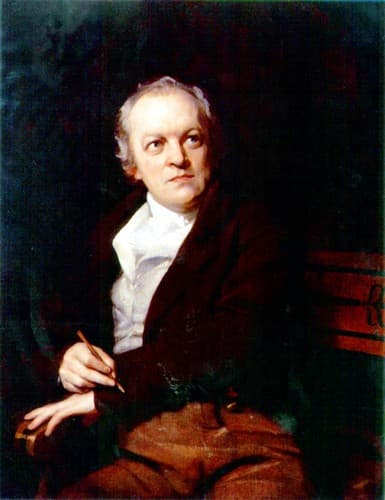
William Blake was an English poet, painter, and printmaker. Largely unrecognised during his life, Blake is now considered a seminal figure in the history of the poetry and visual art of the Romantic Age. What he called his "prophetic works" were said by 20th-century critic Northrop Frye to form "what is in proportion to its merits the least read body of poetry in the English language". His visual artistry led 21st-century critic Jonathan Jones to proclaim him "far and away the greatest artist Britain has ever produced". In 2002, Blake was placed at number 38 in the BBC's poll of the 100 Greatest Britons. While he lived in London his entire life, except for three years spent in Felpham, he produced a diverse and symbolically rich collection of works, which embraced the imagination as "the body of God" or "human existence itself".