“I celebrate myself, and sing myself, And what I assume you shall assume, For every atom belonging to me as good belongs to you.”
— Opening lines, establishing the poem's theme of individual and universal selfhood.


Walt Whitman (1924)
Genre
Creativity
Reading Time
80 min
Key Themes
See below
Sign in to track this book
Whitman's "Song of Myself" invites readers to embrace all existence, finding the divine, the democratic, and the individual within themselves and everything around them.
The poem begins with the speaker, Walt Whitman, stating that he celebrates himself, and what he believes, the reader will also believe. He stresses his individual identity, saying he is thirty-seven, healthy, and will continue his journey until death. He clearly connects his individual self to the universal, claiming that every atom belonging to him also belongs to the reader. He asks his soul to relax with him, watching a blade of summer grass, letting go of social rules and focusing on nature and his own thoughts. This prepares for a journey of self-discovery and a deep connection with the natural and human world, free from doctrines.
The speaker explores rich sensory experiences, describing the smell of grass, the feel of air, and the sounds of nature. He praises the 'perfume of the grass' and the 'sound of the belch'd words of my voice,' showing a deep appreciation for both subtle and raw parts of life. He dismisses traditional beliefs and institutions, finding truth in the immediate, tangible world. He feels a strong connection to the earth, calling it 'the great mother' and wanting to become one with its elements. This part shows the poem's basis in physical sensation and an almost spiritual respect for the natural world, seeing holiness in every particle.
Whitman moves beyond his individual self, imagining himself as part of everything and everyone. He states that he is 'of every hue and caste,' identifying with all races, social classes, and jobs. He describes seeing God in every man and woman, and in his own face in the mirror. He embraces both good and bad, beauty and ugliness, as essential parts of the whole. He feels empathy for the oppressed, the suffering, and the marginalized, living their experiences as his own. This section powerfully expresses the poem's main idea of interconnectedness, blurring the lines between the individual and the group, and stating that all life and experience are equally democratic.
The poem then celebrates the human body in detail and sensually, seeing it as sacred and holy, not something to be ashamed of. He praises all its parts and functions, from the most visible to the most private, stating that 'the body is as real as the soul.' He connects the physical body to the spiritual, suggesting that the soul shows itself through the body. He also explores death not as an end, but as a change, a 'birth' into another state. The soul, he suggests, is immortal and constantly journeys through different forms and experiences, gaining wisdom. This section highlights Whitman's complete view of life, where body and soul are linked and eternal.
Whitman acts as a cosmic observer, seeing a vast range of human life across America and beyond. He describes everyday scenes: farmers working, mothers rocking babies, mechanics toiling, enslaved people suffering, and lovers embracing. He does not just watch; he actively empathizes, feeling the joys and sorrows of those he sees. He stands with the 'runaway slave,' feels the 'agony of the wounded,' and shares the 'delight of the bridegroom.' This broad empathy allows him to embody the shared human experience, making him a vessel for humanity's collective consciousness. His view includes both the ordinary and the extraordinary, honoring all parts of life.
The speaker deals with the mysteries of life and death, seeing them not as opposites but as natural, continuous parts of an eternal cycle. He views death as a natural process, the self returning to the elements, from which new life emerges. He assures the reader that 'there is no death,' only a change of form, a constant flow of being. The grass, a repeated image, symbolizes this cycle, growing from the dust of the dead. He finds comfort and continuity in this idea, suggesting that even in apparent endings, there is a promise of renewal. This view offers a deep sense of hope about the ultimate fate of the individual and the universe.
Whitman states his unique role as a poet who speaks not only for himself but for all humanity and the cosmos. He sees his voice as a way for the unspoken cries of the world to be heard. He declares that he is 'the poet of the Body and the poet of the Soul,' covering all parts of existence. He rejects traditional poetic forms and rules, choosing free verse that reflects the fluidity and expansiveness of his thought. His words are meant to be direct, easy to understand, and inclusive, inviting the reader into a shared experience of consciousness. He aims to awaken the reader to their own inner divinity and connection to the universe.
Whitman consistently challenges established norms, beliefs, and intellectual systems. He dismisses the need for formal education or religious dogma to understand truth, instead supporting direct experience and intuitive understanding. He finds more wisdom in the 'loose drift of the air' and the 'whispers of the leaves' than in books or sermons. He encourages the reader to let go of their own assumptions and to trust their inner voice and senses. This section reinforces the poem's anti-establishment stance and its focus on individual freedom in seeking truth, promoting a radical self-reliance and learning through experience.
Throughout the poem, Whitman includes references to the American landscape, its people, and its growing democratic spirit. He sees America as a grand experiment, a mix of cultures and individuals, all united by a shared human experience. He celebrates the common man and woman, the workers, the pioneers, and the everyday citizens who show the nation's energy. He imagines a future where all people are treated with equality and respect, regardless of background. His poem itself embodies this democratic ideal, accessible to all and celebrating the inherent worth of every individual within the wide American society.
Whitman often touches on the spiritual parts of life that cannot be explained by reason. He speaks of 'currents of the air' and 'whispers of the soul' that reveal deeper truths than logic can grasp. He describes moments of deep mystical connection, where the individual self merges with universal consciousness. He acknowledges that some truths can only be felt, not spoken, and that language itself is often not enough to capture the full scope of reality. This section highlights the poem's spiritual depth, asking the reader to look beyond the surface and embrace the mysterious, transcendent parts of life that connect all beings.
The speaker often breaks the fourth wall, directly speaking to the reader and asking them to join in the poem's broad vision. He challenges the reader to question, to feel, and to embrace their own unique self. He promises that by following him, or rather, by following their own inner feelings, they too can reach a similar state of enlightened consciousness. He does not offer answers but a path to self-discovery, a way of seeing the world with new wonder and connection. This direct address creates a close bond between the poet and the audience, making the poem an interactive experience rather than a passive reading.
In the final sections, Whitman anticipates his own death and dispersal, not with fear, but with peace and a sense of continuity. He states that he will depart 'as the air, I shake my white locks at the runaway sun.' He imagines his body returning to the earth, becoming part of the grass, the soil, and the wind. He promises that he will always be present, waiting for the reader, embedded in the natural world. He encourages the reader to seek him in the grass beneath their boots, suggesting that his spirit, and the spirit of the poem, will always reside within existence, forever calling to those who listen. This ending reinforces life's cyclical nature and the self's lasting presence within the universe.
The Protagonist
The speaker begins by celebrating his individual self and expands his consciousness to encompass all beings and experiences, ultimately merging his individual identity with the universal.
The Supporting
The Soul is a constant, unchanging presence, serving as the eternal core of the speaker's journey and understanding.
The Supporting
The Body is consistently celebrated as a perfect, vital element, integral to the speaker's holistic vision of existence.
The Supporting/Symbolic
The Grass remains a constant symbol, reinforcing the poem's themes of continuity and interconnectedness.
The Mentioned/Collective
The Common Man/Woman serves as a diverse backdrop, illustrating the universal human experience that the speaker embraces.
This theme is central, stating that the individual self is not alone but deeply connected with all of life. Whitman constantly expands his 'I' to include the entire cosmos, blurring the lines between the individual, humanity, nature, and the divine. He declares, 'I celebrate myself, and sing myself, / And what I assume you shall assume, / For every atom belonging to me as good belongs to you.' This shows when he identifies with all people ('of every hue and caste'), with animals, and even with objects. The poem argues that true understanding comes from recognizing this basic unity, where differences are ultimately illusions, and all life comes from and returns to a single, universal source.
“I celebrate myself, and sing myself, / And what I assume you shall assume, / For every atom belonging to me as good belongs to you.”
Whitman greatly elevates the physical body and the material world to a sacred level, challenging traditional spiritual views that often devalued the flesh. He sees holiness in every part of physical life, from the 'perfume of the grass' to the 'body electric.' This theme appears in his detailed and sensual descriptions of the human form, which he calls 'perfect' and 'divine,' and his reverence for nature. He argues that the soul is not separate from the body but closely linked with it, and that true spiritual experience is found through engaging with the tangible world. This complete view celebrates life fully, embracing both the physical and the spiritual as equally holy.
“I sing the body electric, / The armies of those I love engirth me, and I engirth them, / They will not let me off till I go with them, respond to them, / And discorrupt them, and charge them full with the charge of the soul.”
A deep democratic spirit runs through "Song of Myself." Whitman champions the common person, seeing inherent worth and holiness in every individual regardless of their social status, job, race, or gender. He identifies with 'the runaway slave,' 'the prostitute,' 'the President,' and 'the farmer,' stating that all are equally valuable and connected. This theme shows in his inclusive language and his rejection of class structures. He sees America as a place where all can thrive and be celebrated, and his poem itself acts as a democratic text, open to all and speaking for humanity's collective voice. His free verse style reflects this democratic idea, breaking from traditional, aristocratic poetic forms.
“I am of old and young, of the foolish as much as the wise, / Regardless of others, ever regardful of others, / Maternal as well as paternal, a child as well as a man, / Stuff'd with the stuff that is coarse and stuff'd with the stuff that is fine, / One of the great American people, and one of the great people of the whole earth.”
Whitman presents death not as an end, but as a natural and continuous part of life's cycle, a transformation rather than destruction. The repeated image of the grass, growing from the graves of the dead, strongly symbolizes this idea of eternal return. He finds comfort in the idea that 'there is no death,' only a change of form, a return to the elements that will eventually form new life. This theme offers a deeply hopeful view of mortality, suggesting that individual existence adds to a larger, unending flow of being, where nothing is truly lost but merely changed.
“And to die is different from what any one supposed, and luckier.”
Throughout the poem, Whitman consistently prioritizes direct experience, sensory perception, and intuitive understanding over formal education, religious beliefs, or social customs. He dismisses 'creeds and schools,' finding truth in directly observing nature and the unfiltered impulses of his own soul. He encourages the reader to 'loaf and invite your soul,' to let go of intellectual constructs and embrace a more primal, instinctive way of knowing. This theme highlights a strong individualism and a deep trust in one's inner wisdom, suggesting that the deepest truths are found through personal engagement with the world rather than through established doctrines.
“You shall no longer take things at second or third hand, nor look through the eyes of the dead, nor feed on the spectres in books, / You shall not look through my eyes either, nor take things from me, / You shall listen to all sides and filter them from yourself.”
Unrhymed and unmetered lines, mimicking natural speech.
Whitman's pioneering use of free verse is perhaps the most defining plot device. It breaks from traditional poetic forms, allowing for a fluid, expansive, and democratic expression. The long, rambling lines and lack of strict meter or rhyme scheme mirror the speaker's boundless consciousness and his embrace of all aspects of life without artificial constraints. This device enables the poem to feel conversational, direct, and inclusive, reflecting the democratic ideals Whitman champions and inviting the reader into a more intimate, unmediated experience of the speaker's thoughts and observations.
Repetition of a word or phrase at the beginning of successive clauses.
Anaphora is frequently employed by Whitman to create a sense of incantation, build momentum, and emphasize the expansive nature of his vision. Phrases like 'I believe,' 'I am,' or 'And I know' are repeated to underscore the speaker's convictions and his identification with myriad experiences. This device creates a rhythmic, almost chant-like quality, drawing the reader into the speaker's sweeping affirmations and declarations. It reinforces the theme of interconnectedness by linking diverse elements under a common introductory phrase, creating a powerful cumulative effect.
Long lists of people, places, objects, or ideas.
Whitman's extensive use of catalogs is a key device for demonstrating his comprehensive embrace of life and his democratic vision. He lists countless professions, landscapes, human types, and natural phenomena, often without explicit connection beyond their inclusion in his vast panorama. This technique serves to illustrate the sheer diversity and richness of existence that the speaker absorbs and celebrates, reinforcing the idea that all things, no matter how disparate, are equally valuable and interconnected within the universal fabric. The catalogs create a sense of abundance and inclusivity, reflecting America's burgeoning diversity.
The speaker uses 'I' but embodies a universal consciousness.
While the poem is written in the first person ('I'), the speaker's 'I' quickly transcends individual identity to become a universal voice, embodying the collective human experience and even the consciousness of nature itself. This device allows Whitman to shift seamlessly between personal observation and cosmic identification, making his individual self a conduit for broader truths. The 'I' is both Walt Whitman and every man and woman, enabling the poem to be deeply personal yet universally resonant, inviting the reader to find their own 'I' within its expansive declarations.
Direct address to an absent person, abstract entity, or inanimate object.
Whitman frequently uses apostrophe to address his soul, the earth, death, or the reader directly. This device creates a sense of immediacy and intimacy, making the poem feel like a direct conversation or an urgent proclamation. By speaking to these entities as if they can respond, Whitman imbues them with a living presence and elevates their significance within his philosophical framework. It also helps to draw the reader into the poem's immersive experience, making them feel personally addressed and engaged in the speaker's journey of discovery.
“I celebrate myself, and sing myself, And what I assume you shall assume, For every atom belonging to me as good belongs to you.”
— Opening lines, establishing the poem's theme of individual and universal selfhood.
“Do I contradict myself? Very well then I contradict myself, (I am large, I contain multitudes.)”
— Acknowledging and embracing inconsistency and complexity within the self.
“A child said What is the grass? fetching it to me with full hands; How could I answer the child? I do not know what it is any more than he.”
— Reflecting on the simple, profound question of a child and the limits of adult knowledge.
“The past and present wilt—I have fill’d them, emptied them, And in endless content I identify myself with the future.”
— Expressing a forward-looking perspective and a connection to the unfolding future.
“And I know that the hand of God is the promise of my own, And I know that the spirit of God is the brother of my own, And that all the men ever born are also my brothers, and the women my sisters and lovers,”
— Emphasizing spiritual and human interconnectedness.
“Not words only—not words of the lips, not words of the voice only, But the voice of the body and of the soul, and of all that belongs to the body and soul.”
— Expanding the idea of communication beyond mere spoken words to include the entirety of one's being.
“I believe in you my soul, the other I am must not abase itself to you, And you must not abase yourself to the other.”
— Addressing the soul as a distinct yet equal part of the self, advocating for mutual respect.
“No array of terms can say how much I am at peace with myself, and with all I see and hear.”
— Expressing profound inner peace and harmony with the external world.
“My voice goes after what my eyes cannot reach, With the twirl of my tongue I encompass worlds and volumes of worlds.”
— Highlighting the imaginative and expansive power of the poet's voice and creativity.
“To me the converging objects of the universe perpetually flow, All are written to me, and I must get what the writing means.”
— Viewing the universe as a source of constant inspiration and meaning to be interpreted.
“I too am not a bit tamed, I too am untranslatable, I sound my barbaric yawp over the roofs of the world.”
— Asserting wildness, individuality, and a powerful, unrestrained voice.
“The runaway slave came to my house and stopp’d outside, I heard his motions crackling the twigs of the woodpile, Through the swung half-door of the kitchen I saw him pale and trembling.”
— A vivid, empathetic depiction of encountering a runaway slave, showing deep human connection.
“Failing to fetch me at first keep encouraged, Missing me one place search another, I stop somewhere waiting for you.”
— Concluding lines, offering reassurance and suggesting the enduring presence of the speaker's spirit.
“Only the lull I like, the hum of your valvèd voice.”
— A subtle, sensual line focusing on the intimate sound of a voice.
“And to feel the sky now, that is enough.”
— A simple statement of profound contentment and appreciation for the present moment.
Ready to see how well you understood this book? Take our interactive quiz with 10 questions.
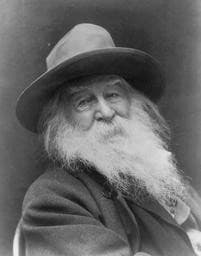
Walter Whitman Jr. was an American poet, essayist, and journalist. He is considered one of the most influential poets in American history. Whitman incorporated both transcendentalism and realism in his writings and is often called the father of free verse. His work was controversial in his time, particularly his 1855 poetry collection Leaves of Grass, which was described by some as obscene for its overt sensuality.