BookBrief
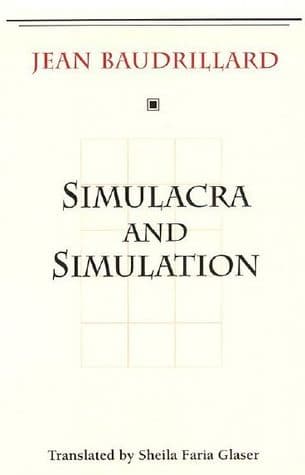
Simulacra and Simulation cover
Archivist's Choice

Simulacra and Simulation

Jean Baudrillard (1994)

Genre

Creativity / Philosophy

Reading Time

240 min

Key Themes

See below

Track Your Reading

Sign in to track this book

This book explores how copies now come before the original, and reality feels like a simulated echo, changing what we think about authenticity in a media-filled world.

Core Idea

Jean Baudrillard's "Simulacra and Simulation" says that modern society has replaced reality and meaning with signs and symbols. Human experience is a simulation of reality. He describes a "precession of simulacra" where images come first and shape reality, rather than just showing it. This has created a hyperreal state where the difference between real and imaginary disappears. The simulated becomes more real than the real. Baudrillard argues this change removes real meaning, value, and the chance for revolution. All parts of life are taken into an endless game of signs that do not refer to anything, which leads to the social world collapsing and the real disappearing. The book looks at how this appears in media, politics, art, and daily life. It shows that models and simulations do not represent reality anymore; they create their own reality. This system works as a way to prevent challenges. A simulated reality exists, and it stops any opposition by taking it in and neutralizing it within its hyperreal framework. Baudrillard thinks we live in a world where everything is clear but meaningless. The model's power makes it impossible to get back an authentic 'real.'
Reading time
240 min
Difficulty
Hard
✓ Read this if...
You are interested in critical theory, post-structuralism, media studies, or want to understand foundational concepts behind ideas like 'the matrix' and 'hyperreality'.
✗ Skip this if...
You prefer straightforward arguments, are averse to abstract and dense philosophical prose, or are looking for practical solutions rather than theoretical critiques of reality.

Core idea

The central argument and framework that powers the entire book.

Jean Baudrillard's "Simulacra and Simulation" says that modern society has replaced reality and meaning with signs and symbols. Human experience is a simulation of reality. He describes a "precession of simulacra" where images come first and shape reality, rather than just showing it. This has created a hyperreal state where the difference between real and imaginary disappears. The simulated becomes more real than the real. Baudrillard argues this change removes real meaning, value, and the chance for revolution. All parts of life are taken into an endless game of signs that do not refer to anything, which leads to the social world collapsing and the real disappearing.

The book looks at how this appears in media, politics, art, and daily life. It shows that models and simulations do not represent reality anymore; they create their own reality. This system works as a way to prevent challenges. A simulated reality exists, and it stops any opposition by taking it in and neutralizing it within its hyperreal framework. Baudrillard thinks we live in a world where everything is clear but meaningless. The model's power makes it impossible to get back an authentic 'real.'

At a glance

Reading time

240 min

Difficulty

Hard

Read this if...

You are interested in critical theory, post-structuralism, media studies, or want to understand foundational concepts behind ideas like 'the matrix' and 'hyperreality'.

Skip this if...

You prefer straightforward arguments, are averse to abstract and dense philosophical prose, or are looking for practical solutions rather than theoretical critiques of reality.

Key Takeaways

1

The Precession of Simulacra

When the map precedes the territory, reality dissolves into its own image.

Quote

The simulacrum is never that which conceals the truth—it is the truth which conceals that there is none. The simulacrum is true.

Baudrillard's main idea is that we no longer live in a world where images just show reality. Instead, images (simulacra) have become so widespread and strong that they come before and even create reality. This 'precession of simulacra' means the model or map comes before the actual place. Eventually, the place itself becomes hard to tell apart from, or is even replaced by, its model. We are in a hyperreality where the difference between the real and the simulated disappears. This leaves us with an enhanced experience, 'more real' than...

Supporting evidence

Baudrillard's famous example of the Borges fable, where the cartographers of the Empire draw a map so detailed it covers the entire territory, only for the map to eventually decay, leaving no trace of the original territory itself. He applies this to modern media and culture, where models become the reality.

Apply this

Question the 'authenticity' of experiences, images, and narratives presented through media. Recognize that 'realness' can be a carefully constructed effect, not an inherent quality. Seek out direct, unmediated experiences, understanding that even these are increasingly difficult to find.
hyperrealitysimulation
2

The Four Orders of Simulacra

Tracing the evolution from faithful copy to pure simulation without referent.

Quote

It is no longer a question of imitation, nor of reduplication, nor even of parody. It is rather a question of substituting signs of the real for the real itself.

Baudrillard describes four historical types of simulacra, showing a growing separation from reality. The first type is the 'good copy,' a true image of a deep reality. The second type involves distortion, where the image hides and changes a deep reality. The third type, the magic of simulation, is where the image hides that a deep reality is absent. Finally, the fourth type, pure simulation, is where the simulacrum has no connection to any reality; it is its own pure simulacrum. This framework shows how images change from being linked...

Supporting evidence

Baudrillard traces this evolution from pre-modern societies (where copies were clearly distinct from originals) through the Industrial Revolution (mass production blurring the lines) to the modern era of electronic media, where images and models create their own 'reality.'

Apply this

Analyze media and cultural phenomena through these four orders. Is what I'm seeing a direct representation, a distortion, a cover-up for an absence, or a self-contained system with no original? This helps deconstruct the layers of unreality in our daily lives.

simulationrepresentation
3

Hyperreality: More Real Than Real

When simulation is so perfect it surpasses and replaces the original.

Quote

The very definition of the real has become: that of which it is possible to give an equivalent reproduction.

Hyperreality is a state where the simulated experience feels more intense, more true, or more 'real' than any actual, direct reality. This is not just an illusion; it is a full immersion in a created reality that feels more compelling than the 'real world,' which is often messy and imperfect. Theme parks, reality TV, and immersive digital environments are good examples. The simulated environment is perfected, cleaned up, and intensified, giving a heightened sensory experience that the real world often cannot match. This leads to prefe...

Supporting evidence

Disneyland is Baudrillard's quintessential example. He argues it's presented as an 'imaginary world' to make us believe the rest of America is 'real,' when in fact, America itself is increasingly hyperreal. The perfection and idealized nature of Disneyland create a benchmark of 'realness' that actual reality often fails to meet.

Apply this

Be critical of experiences marketed as 'authentic' or 'immersive.' Understand that perfection often signals artifice. Seek out the imperfect, the spontaneous, and the uncurated, recognizing that true 'reality' often lacks the polished sheen of hyperreality.

simulacradisneyland
4

The Death of the Real

As simulations proliferate, the original referent vanishes, leaving only signs.

Quote

It is the generation by models of a real without origin or reality: hyperreal.

Baudrillard states the 'death of the real.' This is not a physical disappearance of objects. It is the end of the idea of an objective, verifiable reality that exists separate from its representations. In a world dominated by simulacra, the 'real' is not something to find or show. It is something made, created by models and signs. When signs only point to other signs and not to an outside reality, the whole system becomes self-referential. The original source is effectively 'killed off.' This leaves us lost in a sea of meaning where t...

Supporting evidence

Baudrillard discusses the Gulf War as a non-event, arguing that it was a 'simulation' unfolding primarily through media representation rather than as a tangible, verifiable conflict. The media spectacle became the 'reality' of the war, detached from its actual ground-level events.

Apply this

Cultivate skepticism towards media narratives, especially those presented with absolute certainty or overwhelming visual evidence. Recognize that even seemingly objective reports are often constructed realities. Practice critical analysis of sources and motives behind information dissemination.

hyperrealitysimulation
5

The End of Meaning and Value

In a world of pure simulation, meaning and value become arbitrary and interchangeable.

Quote

When the real is no longer what it used to be, nostalgia assumes its full meaning.

If models produce reality, and signs no longer refer to anything outside, then meaning itself becomes unstable and arbitrary. In a system of pure simulacra, everything can be exchanged. Value does not come from authenticity or usefulness but from its place within the simulated system. This causes a deep sense of meaninglessness. Historical events are replayed as shows, cultural objects lose their original importance, and even personal identity can feel like a planned performance. Nostalgia becomes a common cultural mode, not for a los...

Supporting evidence

The proliferation of themed restaurants, historical reenactments, and 'heritage' industries where the past is meticulously recreated, often sanitized and idealized, to be consumed as a commodity. The original historical context or meaning is secondary to the simulated experience.

Apply this

Challenge superficiality and the commodification of experience. Seek genuine engagement with history, art, and culture beyond their mediated forms. Recognize the seductive pull of nostalgia and question what 'past' is truly being evoked and why.

nostalgiacommodification
6

The Implosion of the Social

Mass media doesn't communicate; it absorbs and neutralizes, leading to an atomized public.

Quote

The masses are no longer subjects, but referentials of simulation.

Baudrillard says that mass media, instead of helping communication and social unity, actually causes the 'implosion of the social.' Instead of encouraging discussion or group action, media creates a continuous, undifferentiated flow of information that overloads and neutralizes. The 'masses' are not active but are a quiet, absorbing group that consumes signs without truly taking part. Public opinion becomes a simulated feedback loop. Real social interaction is replaced by the show of information. This leads to people being isolated, b...

Supporting evidence

The rise of 'reality television' where the 'real' is highly scripted and edited, presented as spontaneous life but designed for consumption. The audience is invited to observe, not participate, and their 'feedback' (ratings, comments) becomes part of the show's simulated reality.

Apply this

Limit passive consumption of mass media. Actively seek out diverse perspectives and engage in direct, face-to-face interactions. Be wary of echo chambers and algorithms that create a simulated consensus, and consciously seek to break out of them.

mass-mediaalienation
7

The Obscenity of Transparency

In a hyperreal world, everything is exposed, leaving no mystery or depth.

Quote

All that was once lived directly has become mere representation.

Baudrillard suggests that in the age of simulation, a new type of 'obscenity' appears: everything is absolutely transparent. There are no longer hidden depths, secret meanings, or private spaces. Everything is shown, revealed, and made clear for consumption. This is not freedom; it is a loss of mystery, allure, and the very possibility of meaning that comes from what is hidden. The constant demand for visibility, data, and immediate access removes the special quality of things, flattening experience into a surface-level show. The 'sec...

Supporting evidence

The pervasive surveillance culture, social media's demand for constant self-disclosure, and the 'reality' genre's insistence on showing every intimate detail of life. Nothing is left to the imagination; everything is rendered explicit.

Apply this

Cultivate personal privacy and resist the pressure to constantly self-disclose. Seek out experiences that retain a sense of mystery or require active interpretation. Value ambiguity and the unsaid, rather than demanding total transparency in all things.

surveillancepostmodernism
8

Simulation as Deterrence

The threat of the real is neutralized by its absorption into simulation.

Quote

It is always a question of proving the real by the imaginary, proving the truth by scandal, proving the law by transgression.

Baudrillard argues that simulation often deters, not just represents. By creating perfect, self-referential models, the 'real' threat or event is absorbed and neutralized. For example, the presence of nuclear deterrence, or the simulation of war games, can make actual warfare seem less likely or even unnecessary. The 'threat' is handled within the simulated system. Similarly, media portrayals of crime or social problems can create the appearance of addressing these issues, stopping real systemic change. The simulation prevents and a...

Supporting evidence

The example of the 'Panopticon' – the architecture of surveillance – where the *potential* for being watched is enough to regulate behavior, even if no one is actually watching. The simulation of surveillance deters transgression.

Apply this

Be skeptical of solutions or 'fixes' that exist solely within the realm of representation (e.g., public awareness campaigns that don't lead to action, symbolic gestures). Demand tangible, material changes rather than accepting simulated resolutions to real problems.

deterrencecontrol
9

The Strategic Primacy of the Model

Models don't describe reality; they actively produce and manage it.

Quote

The model is no longer an ideal form, but a generative formula.

Unlike the traditional view where models are simplified descriptions of reality, Baudrillard says that in the age of simulation, models become more important. They are no longer descriptive but create things. They do not just show reality; they produce it. Consider economic models that guide policy, or statistical models that categorize people, thereby shaping their behavior and chances. These models become self-fulfilling prophecies, creating the reality they claim to only describe. This shift in power from the 'real' to the 'model...

Supporting evidence

Algorithmic targeting and profiling, where models of consumer behavior or political leanings don't just predict but actively shape individual choices and societal trends by curating information and opportunities.

Apply this

Investigate the models and algorithms that shape your online experience, consumption habits, and political discourse. Understand that these are not neutral tools but powerful generative forces. Seek to understand their underlying assumptions and biases.

algorithmscontrol
10

The Impossibility of Revolution

When reality is absorbed by simulation, genuine opposition becomes impossible.

Quote

There is no longer any critical distance, any negativity, any subversion possible.

Baudrillard's work leads to a rather pessimistic conclusion about the chance for real societal change or 'revolution.' If reality is absorbed into simulation, and all forms of opposition or breaking rules are immediately re-absorbed and neutralized by the system (e.g., disagreement becomes a media show, counter-culture becomes a product), then there is no 'outside' from which to start a truly transformative critique. The system becomes self-referential and all-encompassing, able to simulate its own opposition and thus disarm it. This ...

Supporting evidence

Punk rock becoming a fashion trend, revolutionary symbols being commodified, or protest movements being framed and contained by mainstream media narratives, ultimately deflecting their original disruptive force.

Apply this

Recognize the seductive power of superficial 'rebellions' and 'disruptions' that ultimately serve to reinforce the existing system. Focus on creating genuine, tangible alternatives and resisting the urge to simply perform opposition for a simulated audience.

postmodernismresistance

Critical analysis

Notable Quotes

The simulacrum is never that which conceals the truth—it is the truth which conceals that there is none. The simulacrum is true.

Opening lines, introducing the core concept of simulacra as replacing reality.

Disneyland is presented as imaginary in order to make us believe that the rest is real, when in fact all of Los Angeles and the America surrounding it are no longer real, but of the order of the hyperreal and of simulation.

Analysis of Disneyland as a model of simulation masking the hyperreality of society.

It is no longer a question of imitation, nor of reduplication, nor even of parody. It is a question of substituting the signs of the real for the real.

Describing the shift from representation to simulation in postmodern society.

The territory no longer precedes the map, nor survives it. Henceforth, it is the map that precedes the territory—precession of simulacra—it is the map that engenders the territory.

Explaining the concept of the precession of simulacra, where models precede reality.

We live in a world where there is more and more information, and less and less meaning.

Commentary on the proliferation of information in media-saturated society.

The real is produced from miniaturized units, from matrices, memory banks and command models—and with these it can be reproduced an indefinite number of times.

Discussing how technology enables the production and reproduction of reality.

Simulation is no longer that of a territory, a referential being or a substance. It is the generation by models of a real without origin or reality: a hyperreal.

Defining hyperreality as a state where simulations create a reality beyond the real.

The very definition of the real becomes: that of which it is possible to give an equivalent reproduction.

Arguing that reality is now defined by its reproducibility in simulations.

Abstraction today is no longer that of the map, the double, the mirror or the concept. Simulation is no longer that of a territory, a referential being or a substance. It is the generation by models of a real without origin or reality: a hyperreal.

Contrasting traditional abstraction with the new abstraction of simulation.

The age of simulation thus begins with a liquidation of all referentials.

Stating that simulation erases traditional references to reality.

It is a question of substituting the signs of the real for the real, that is, of an operation of deterring every real process via its operational double.

Explaining how signs replace reality and disrupt real processes.

The simulacrum is true because it no longer has to be false, that is to say, because it no longer has to be rational.

Highlighting how simulacra operate beyond traditional truth/false dichotomies.

We are in a logic of simulation which has nothing to do with a logic of facts and an order of reasons.

Contrasting simulation logic with empirical or rational logic.

The simulacrum is not a degraded copy. It is a truth in its own right.

Asserting the autonomous reality of simulacra apart from original models.

Quiz

Test Your Knowledge

Ready to see how well you understood this book? Take our interactive quiz with 10 questions.

10
Questions
~5
Minutes
?
Best Score

Key Questions (FAQ)

Simulacra and Simulation is Jean Baudrillard's 1981 philosophical work that theorizes postmodern culture by introducing the concepts of simulacra (copies without originals) and simulation. It argues that in contemporary media-saturated society, representations have replaced reality, creating a hyperreal world where signs and images circulate independently of any referent.

About the author