BookBrief
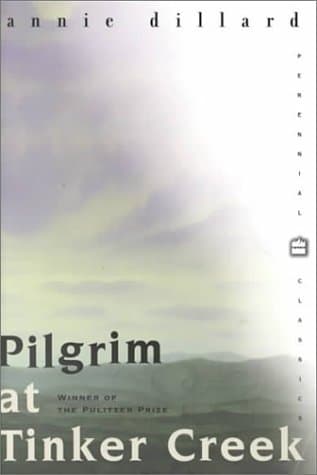
Pilgrim at Tinker Creek cover
Archivist's Choice

Pilgrim at Tinker Creek

Annie Dillard (1974)

Genre

Biography / Memoir / Spirituality / Science / Philosophy

Reading Time

12 Minutes

Key Themes

See below

Track Your Reading

Sign in to track this book

Core Idea

Annie Dillard's "Pilgrim at Tinker Creek" is a profound meditation on nature, spirituality, and the search for meaning within the intricate tapestry of the natural world. Through a year of observation at Tinker Creek in Virginia, Dillard explores the paradoxes of creation: its beauty and brutality, its order and chaos, and the ways in which the divine manifests in both the sublime and the grotesque. She argues that true understanding and spiritual awakening come from a relentless, often uncomfortable, engagement with the astonishing details of life and death unfolding around us, pushing readers to confront their perceptions of God, nature, and their own existence.
Difficulty
Medium

Core idea

The central argument and framework that powers the entire book.

Annie Dillard's "Pilgrim at Tinker Creek" is a profound meditation on nature, spirituality, and the search for meaning within the intricate tapestry of the natural world. Through a year of observation at Tinker Creek in Virginia, Dillard explores the paradoxes of creation: its beauty and brutality, its order and chaos, and the ways in which the divine manifests in both the sublime and the grotesque. She argues that true understanding and spiritual awakening come from a relentless, often uncomfortable, engagement with the astonishing details of life and death unfolding around us, pushing readers to confront their perceptions of God, nature, and their own existence.

At a glance

Difficulty

Medium

Key Takeaways

1

The Art of Seeing: Cultivating Deep Attention

Seeing is a deliberate, active practice that transforms the ordinary into the extraordinary.

Quote

The world is charged with the grandeur of God. It will flame out, like shining from shook foil.

Dillard's main point, and the book's core idea, is that true seeing needs intense, steady attention. We must deliberately shed our usual ways of looking. She argues we are often 'asleep to God's glory' because we don't truly observe. Her year at Tinker Creek shows this practice: she spends hours watching a muskrat, a spider's web, or light on water. This isn't passive; it's an active search for meaning and beauty, a 'piercing' of the obvious. This deep attention reveals the universe's complexity and connections, making a simple creek ...

Supporting evidence

Dillard's detailed descriptions of watching a frog being 'sucked dry' by a giant water bug, or her meticulous charting of the patterns of light on the creek's surface throughout the day and seasons. Her 'stalking' of muskrats.

Apply this

Dedicate specific, uninterrupted time each day to observe one natural object or phenomenon in detail, without judgment or distraction. Practice 'looking until you see' rather than merely glancing.


2

Nature's Brutal Beauty: The Paradox of Creation

The natural world is simultaneously magnificent and horrifying, a testament to life's relentless, often violent, cycle.

Quote

Nature is, above all, profligate. Don't believe them when they tell you that she is thrifty and cut to the bone. Nature is a big spender.

Dillard directly faces nature's cruelty and waste. She doesn't idealize the outdoors; instead, she shows the constant fight for survival, the hunting, and deaths that seem pointless. The clear description of a frog's painful death by a giant water bug is a shocking example. This brutality, however, isn't a flaw but a necessary part of creation's greatness. Life's extravagance, its 'profligate' use of individual lives for the species to continue, is part of its amazing design. This double nature challenges simple ideas of a kind nature...

Supporting evidence

The detailed account of the frog and the giant water bug. Her observations of parasitic wasps, starving fledglings, and the sheer volume of seeds produced by plants, most of which will never germinate.

Apply this

When observing nature, consciously acknowledge both its serene beauty and its inherent struggles and predation. Reflect on how these seemingly contradictory aspects coexist and contribute to the overall ecosystem.

3

The Sacred in the Mundane: Spirituality Beyond Dogma

Spiritual revelation is not confined to grand gestures but is woven into the fabric of everyday natural phenomena.

Quote

I had been my whole life a bell, and never knew it until at that moment I was rung.

Dillard's spirituality is personal and not tied to dogma. She finds God not in churches or books, but in a spider's web, the creek's flow, or migrating monarch butterflies. Her 'conversion' experiences are sudden, powerful moments of clarity and connection to something larger than herself, often from simple observations. This approach suggests the divine is present in the physical world and available through careful engagement with it. This is a strong alternative to organized religion, offering a path to spiritual fulfillment that is...

Supporting evidence

Her descriptions of moments of intense spiritual rapture while observing light or natural forms, such as the 'tree with the lights in it' or her feeling of being 'rung' by an unseen force.

Apply this

Seek moments of quiet contemplation in natural settings, allowing yourself to be fully present and open to unexpected insights or feelings of connection. Consider nature as a primary text for spiritual exploration.

4

Time's Elasticity: The Present Moment as Eternity

Deep engagement with the present moment can dissolve linear time, revealing an eternal, interconnected now.

Quote

The past and the future are not what they seem; they are what is always now.

Dillard's story, while covering a year, often compresses time. She puts ancient geological processes next to brief insect lives, cosmic time next to a single breath. This flexible sense of time comes from her deep attention; when fully absorbed in watching something, the lines between past, present, and future blur. The concept of 'now' grows to include all time, suggesting eternity isn't far off but always present, reachable through focused awareness. This challenges our usual, linear idea of time, proposing a more fluid, cyclical, a...

Supporting evidence

Her reflections on geological time while observing creek pebbles, her contemplation of evolutionary history in the development of a specific species, and her feeling that 'time is a kind of trick.'

Apply this

Practice activities that demand full presence, like deep observation, meditation, or creative pursuits. Notice how these activities can alter your perception of time, making moments feel both expanded and timeless.

5

The Interconnected Web: Everything is Related

The seemingly disparate elements of nature are intricately woven into a single, interdependent system.

Quote

The great world is to be seen in the small, and the small in the great.

Through her small observations and large reflections, Dillard consistently shows how all life connects. A drop of pond water under her microscope holds an entire ecosystem, mirroring the wider world. A monarch butterfly's flight links the local creek to distant Arctic caribou. This idea points to an ecological awareness that came before much mainstream environmentalism. She argues that understanding any single part of nature means understanding its relation to the whole. This view encourages humility and responsibility, recognizing th...

Supporting evidence

Her examination of pond water under a microscope, revealing a vibrant, self-contained world. Her tracing of the monarch butterfly migration and its connection to other wildlife cycles.

Apply this

When considering an environmental issue, trace its connections to other species, ecosystems, and even human activities, rather than viewing it in isolation. Look for the 'hidden threads' that link seemingly unrelated phenomena.

6

The Limits of Human Understanding: Embracing Mystery

Despite intense observation, much of the universe remains inscrutable, demanding an embrace of wonder and mystery.

Quote

The great world is to be seen in the small, and the small in the great.

Even with her constant search for understanding, Dillard often admits the limits of human perception and intelligence. There are moments of pure incomprehensibility, events that defy simple explanation. Nature's 'otherness,' its indifference to human concerns, and the vastness of its processes often leave her in awe mixed with confusion. This humility in the face of the unknown is important; it stops her from putting human interpretations on natural events. Instead, she advocates for open wonder, recognizing that mystery isn't a gap t...

Supporting evidence

Her musings on the 'empty' eyes of insects, the unknowable motivations of animals, and the sheer scale of geological time and cosmic events that dwarf human comprehension. Her repeated use of rhetorical questions that have no definitive answers.

Apply this

When encountering a phenomenon you don't understand, resist the urge to immediately explain it away. Instead, sit with the mystery, allowing yourself to feel wonder and acknowledge the limits of your current knowledge.

7

The Writer as Observer: Crafting Narrative from Nature

The act of writing becomes a means of processing, preserving, and sharing the deep observations of the natural world.

Quote

I am a fugitive from the law of averages. I am a witness.

Dillard's memoir is as much about the process of observing and reflecting as it is about the observations themselves. Her writing style—rich, poetic, and carefully made—reflects the intensity of her seeing. She uses vivid comparisons, scientific terms, and philosophical questions to turn her raw experiences into a meaningful story. The book itself is an extended act of attention, showing how a writer can change a personal meeting with nature into a universal insight. This point highlights literature's power to bridge individual experi...

Supporting evidence

The entire book serves as evidence, particularly her rich descriptive language and her frequent interjections of personal reflection on the act of observing and understanding.

Apply this

Keep a nature journal, regularly recording your observations, thoughts, and feelings about the natural world. Experiment with different descriptive techniques to articulate your experiences more vividly.

8

The Role of Suffering: A Lens for Spiritual Growth

Suffering, both observed in nature and experienced personally, can be a crucible for deeper understanding and spiritual awakening.

Quote

The world is an immense pain, which seems to have been created to be experienced by consciousness.

While not a main theme, Dillard sometimes addresses the problem of suffering, especially in natural predation and human pain. She doesn't avoid the harsh realities of existence, which she sees as part of the grand design. Her own moments of questioning, often from watching nature's indifference or brutality, spark deeper philosophical and spiritual inquiry. This suggests that facing pain and discomfort, rather than avoiding it, can lead to deep insights and a more nuanced understanding of life's complexities. This perspective is chall...

Supporting evidence

Her reflections on the suffering of animals, the 'waste' in nature, and her personal struggles with meaning and faith, particularly after witnessing disturbing natural events.

Apply this

When faced with personal or observed suffering, try to move beyond immediate emotional reactions to reflect on its broader implications, its place in the natural order, or its potential to deepen your empathy and understanding.

9

The Joy of Discovery: An Enduring Childlike Wonder

Maintaining a sense of childlike curiosity is essential for continuous learning and profound engagement with the world.

Quote

I am a child, I am a child, and I am here for a moment, and I am here for a moment.

Beneath the philosophical depth and scientific rigor, a clear sense of joy and wonder fills Dillard's narrative. She approaches the creek with an almost childlike enthusiasm, whether she's trying to 'con a coot' or playing 'King of the Meadow' with grasshoppers. This steady curiosity is not naive; it's a deliberate choice to remain open to new experiences, even seemingly small ones. This point highlights the importance of keeping a sense of wonder throughout life, recognizing that it drives exploration, deepens appreciation, and makes...

Supporting evidence

Her playful interactions with animals, her excitement over examining pond water, and her enthusiastic descriptions of natural phenomena like floods or migrations.

Apply this

Engage in activities that spark your curiosity and allow for playful exploration, even if they seem 'unimportant.' Revisit hobbies or places that once filled you with wonder and try to see them with fresh eyes.

10

The Creek as Metaphor: A Microcosm of Existence

Tinker Creek is not merely a location but a living metaphor for the universe, reflecting universal truths in its local rhythms.

Quote

The creek is the only book I have read for a year.

Tinker Creek goes beyond its physical reality to become a symbolic place. Dillard treats it as a 'text' to be read, a living laboratory where cosmic laws and spiritual truths constantly unfold. The seasonal changes, its life cycles, the play of light and shadow—all reflect larger universal patterns. By focusing intensely on this one small place, Dillard shows that deep insights can come from the immediate environment, proving that the universal is found in the particular. This is the book's main structural and thematic device, effecti...

Supporting evidence

The entire structure of the book, organized by seasons at the creek, and her constant drawing of philosophical and scientific parallels from specific observations at Tinker Creek.

Apply this

Choose a specific, small natural area near you (a park, a backyard, even a single tree) and dedicate time to observing it regularly. Reflect on how its rhythms and phenomena might reflect larger universal principles or personal experiences.

Critical analysis

Notable Quotes

Quiz

Test Your Knowledge

Ready to see how well you understood this book? Take our interactive quiz with 10 questions.

10
Questions
~5
Minutes
?
Best Score

Key Questions (FAQ)

Pilgrim at Tinker Creek is a non-fiction book by Annie Dillard that chronicles one year of her life spent observing nature in and around Tinker Creek, Virginia. It blends personal narrative with scientific observation, philosophical reflection, and spiritual inquiry.

About the author

Annie Dillard

Annie Dillard is a Pulitzer Prize-winning author celebrated for her lyrical prose and profound explorations of nature, faith, and the human condition. Her notable works include "Pilgrim at Tinker Creek," "An American Childhood," and "The Writing Life." Dillard's essays and books often blend personal reflection with philosophical inquiry, earning her a significant place in contemporary American non-fiction.