BookBrief
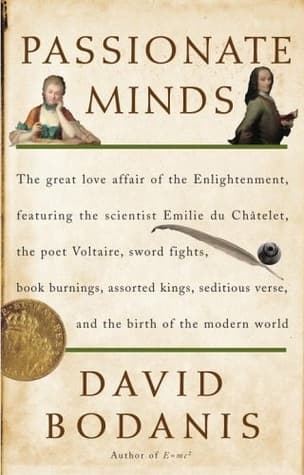
Passionate Minds cover
Archivist's Choice

Passionate Minds

David Bodanis (2006)

Genre

Biography / History / Science / Philosophy

Reading Time

9-10 hours

Key Themes

See below

Track Your Reading

Sign in to track this book

In an era of intellectual change, "Passionate Minds" tells the story of Voltaire and Émilie du Châtelet's romance and scientific work, showing how her genius helped lead to Einstein's E=mc².

Core Idea

David Bodanis's "Passionate Minds" argues that the Enlightenment, especially the scientific and philosophical progress of the mid-18th century, was shaped by the intellectual and romantic partnership between Émilie du Châtelet and Voltaire. The book suggests their private life together was where they developed and shared Newton's physics, Leibniz's philosophy, and critical thinking. It challenges the idea that history is only made by 'great men' by showing how important a woman's intellect, passion, and scholarship were in a time when men dominated. It shows how love, ambition, and curiosity drove scientific translation, philosophical debate, and the search for truth, highlighting du Châtelet's often overlooked contributions to the Enlightenment.
Reading time
9-10 hours
Difficulty
Medium
✓ Read this if...
You are fascinated by the untold stories of intellectual collaboration, want to understand the true origins of Enlightenment thought beyond popular figures, or are interested in the lives of brilliant women who defied societal norms to pursue science and philosophy.
✗ Skip this if...
You prefer a straightforward, chronological biography of a single individual, or are not interested in the detailed interplay between personal relationships and intellectual development in historical context.

Core idea

The central argument and framework that powers the entire book.

David Bodanis's "Passionate Minds" argues that the Enlightenment, especially the scientific and philosophical progress of the mid-18th century, was shaped by the intellectual and romantic partnership between Émilie du Châtelet and Voltaire. The book suggests their private life together was where they developed and shared Newton's physics, Leibniz's philosophy, and critical thinking. It challenges the idea that history is only made by 'great men' by showing how important a woman's intellect, passion, and scholarship were in a time when men dominated. It shows how love, ambition, and curiosity drove scientific translation, philosophical debate, and the search for truth, highlighting du Châtelet's often overlooked contributions to the Enlightenment.

At a glance

Reading time

9-10 hours

Difficulty

Medium

Read this if...

You are fascinated by the untold stories of intellectual collaboration, want to understand the true origins of Enlightenment thought beyond popular figures, or are interested in the lives of brilliant women who defied societal norms to pursue science and philosophy.

Skip this if...

You prefer a straightforward, chronological biography of a single individual, or are not interested in the detailed interplay between personal relationships and intellectual development in historical context.

Key Takeaways

1

The Enlightenment's Unsung Architect

Émilie du Châtelet's pivotal role in popularizing Newton and foreshadowing Einstein.

Quote

Why did you only reach me so late?

Émilie du Châtelet was more than Voltaire's lover; she was an important intellectual whose work helped shape the Enlightenment and modern science. At a time when women were often denied education, her intelligence allowed her to understand complex scientific theories and to translate and popularize Newton's Principia Mathematica for a French audience. Her work included critical notes and an early understanding of kinetic energy that helped form the concept behind Einstein's E=mc². Her intellectual rigor challenged the norms of her t...

Supporting evidence

Du Châtelet's translation and commentary on Newton's *Principia Mathematica*, which included her unique insights into kinetic energy (proportional to velocity squared), a concept that was not widely accepted at the time but later proved correct.

Apply this

Recognize and actively seek out the 'hidden figures' in historical narratives, especially those whose contributions were minimized due to societal biases. Support and amplify contemporary voices from underrepresented groups in STEM and academia.

enlightenment-figureswomen-in-sciencehistory-of-physics
2

Love as an Intellectual Catalyst

The passionate and tumultuous relationship between Voltaire and du Châtelet fueled their intellectual output.

Quote

Their time together was filled with far more than reading and intellectual conversation. There were frantic gallopings across France, sword fights... and intense affairs that bent but did not break their bond.

The fifteen-year relationship between Voltaire and Émilie du Châtelet was a mix of passion, intellectual teamwork, and personal drama. Their connection created a strong intellectual synergy. At Cirey, their château, they made a place for scientific experiments and philosophical discussions, attracting leading thinkers. Their shared pursuit of knowledge, along with a willingness to challenge societal and personal limits, allowed them to push intellectual boundaries. This shows how deep emotional bonds, when combined with shared purpose...

Supporting evidence

Their joint transformation of Cirey into a scientific and philosophical hub, where they conducted experiments and developed radical ideas, as well as their mutual support during periods of exile and persecution.

Apply this

Seek out relationships, both platonic and romantic, that foster intellectual growth and provide a safe space for challenging ideas. Prioritize environments where curiosity and critical thinking are celebrated and encouraged.

intellectual-collaborationromantic-partnershipsenlightenment-era
3

The Perilous Pursuit of Truth

Challenging authority during the Enlightenment came with severe personal and political risks.

Quote

A deadly burning of Voltaire’s books by the public executioner at the base of the grand stairwell of the Palais de Justice in Paris.

The Enlightenment was a difficult fight against established power. Voltaire and du Châtelet often faced trouble for their ideas about monarchy, church, and state. The burning of Voltaire's books and their narrow escapes from royal agents show the real dangers of free thought in 18th-century France. This constant threat highlights the bravery needed to support new ideas and the personal sacrifices made by those who questioned the existing order. Their story reminds us that intellectual freedom is often hard-won and requires strong conv...

Supporting evidence

Voltaire's multiple exiles, the public burning of his writings, and the constant surveillance and threats from agents of the king, which often forced him and du Châtelet to flee or operate covertly.

Apply this

Understand that progress often involves challenging comfortable norms and powerful institutions. Be prepared for resistance when advocating for change and support those who speak truth to power, even when it's unpopular.

censorshipfreedom-of-thoughtage-of-reasonpolitical-persecution
4

Mathematics as Liberation

Du Châtelet used her mathematical prowess to assert independence and navigate societal constraints.

Quote

Emilie put her mathematical acumen to lucrative use at the royal gambling tables.

For Émilie du Châtelet, mathematics was more than a study; it was a way to gain personal power and overcome the limits placed on women. Her ability to use mathematical principles went beyond theoretical physics to practical uses, such as her success at royal gambling tables. This gave her financial independence, rare for women then, and showed her sharp, practical mind. Her mathematical skills allowed her to engage with the world on her own terms, proving that intellectual abilities could lead to power and freedom, even in a restricti...

Supporting evidence

Her successful application of mathematical probability at gambling tables, which provided her with significant financial resources and autonomy.

Apply this

Cultivate practical skills and knowledge that can provide independence and leverage, especially in areas where traditional power structures might limit options. Recognize that 'soft' skills can be just as empowering as 'hard' skills.

financial-independencewomen-in-mathproblem-solving
5

The Private Sphere as a Crucible of Ideas

Isolated châteaux and private salons were vital for fostering radical thought.

Quote

Together the two lovers rebuilt a dilapidated and isolated rural chateau at Cirey where they conducted scientific experiments, entertained many of the leading thinkers...

In an era of strict censorship, private places like Cirey became important havens for intellectual freedom. Voltaire and du Châtelet's decision to rebuild and move to a rural château was a strategic move to create a 'think tank' away from the monarchy and the Church. These informal salons and private laboratories allowed for uncensored discussion, experimentation, and the development of ideas that would have been suppressed publicly. This shows how private, collaborative spaces are important for developing new ideas, especially when p...

Supporting evidence

The transformation of Cirey into a hub for scientific experiments and philosophical discussions, attracting figures like Maupertuis and others, allowing them to work and publish controversial material.

Apply this

Create or seek out 'safe spaces' for open dialogue and experimentation, whether in professional, academic, or personal contexts. Value privacy and intellectual freedom as essential components for innovation.

intellectual-salonssafe-spacesinnovation-hubsprivate-sphere
6

Beyond the 'Great Man' Narrative

The book re-evaluates history to give du Châtelet her rightful place alongside Voltaire.

Quote

Passionate Minds at last does justice to the supremely unconventional life and remarkable achievements of Emilie du Châtelet.

Historically, many accounts of the Enlightenment have focused mainly on men, often putting women in secondary roles. 'Passionate Minds' challenges this 'great man' view of history by highlighting Émilie du Châtelet's independent intellectual work. It shows that her work was not just an extension of Voltaire's but a distinct and equally important force in shaping scientific and philosophical thought. This re-evaluation is important for a more accurate and complete understanding of history, reminding us to question whose stories are tol...

Supporting evidence

The book's detailed exploration of du Châtelet's original scientific work, particularly her insights into kinetic energy and her independent translation and commentary on Newton, rather than merely focusing on her relationship with Voltaire.

Apply this

Actively deconstruct historical narratives, seeking out diverse perspectives and challenging dominant interpretations. Advocate for inclusive storytelling that recognizes contributions from all individuals, regardless of gender or background.

revisionist-historygender-biashistorical-narrativesfeminist-history
7

The Fluidity of Love and Intellect

Their unconventional relationship demonstrated that deep bonds can endure shifting personal dynamics.

Quote

Intense affairs that bent but did not break their bond.

Voltaire and du Châtelet's relationship went against common expectations, marked by periods of personal passion, intellectual collaboration, and even affairs. Yet, through all these changes, their basic bond of mutual respect and intellectual friendship lasted. This suggests that deep connections, especially those based on shared intellectual pursuits, can withstand personal complexities and changing emotions. It questions strict ideas of romantic fidelity, suggesting that the strongest partnerships might adapt and prioritize a deeper...

Supporting evidence

The narrative details their individual affairs and personal struggles, yet consistently shows them returning to Cirey and to each other for intellectual support and companionship, maintaining their collaborative projects.

Apply this

Consider the multifaceted nature of relationships and the various forms 'love' and 'partnership' can take. Prioritize shared values and intellectual connection over superficial expectations in long-term bonds.

unconventional-relationshipsintellectual-intimacyrelationship-dynamicsemotional-resilience
8

Science as a Revolutionary Force

Scientific inquiry was intrinsically linked to broader challenges against established power.

Quote

They developed radical ideas about the monarchy, the nature of free will, the subordination of women, and the separation of church and state.

For Voltaire and du Châtelet, scientific inquiry was not a neutral activity; it was deeply linked to their broader philosophical and political challenges to the old order. Their experiments on fire and light, their acceptance of Newtonian physics, and their discussions on the nature of reality directly influenced their views on government, human rights, and religious freedom. By seeking empirical truth and logical reasoning in the natural world, they implicitly questioned the authority of divine right and unquestioned dogma. This show...

Supporting evidence

Their work on fire and light, and du Châtelet's popularization of Newton, directly contrasted with the prevailing Aristotelian and church-sanctioned views, thereby providing an intellectual basis for questioning traditional authority.

Apply this

Recognize the political and social implications of scientific discovery and technological advancement. Understand that scientific literacy is crucial for informed citizenship and challenging misinformation.

science-and-politicsenlightenment-philosophyscientific-revolutionreason-vs-dogma

Critical analysis

Notable Quotes

The price of seeking to better oneself is that one has to accept that one's previous self was not as good.

Reflecting on the nature of intellectual progress and personal growth.

Science is a way of thinking much more than it is a body of knowledge.

Describing the fundamental essence of the scientific method and inquiry.

The greatest enemy of knowledge is not ignorance, it is the illusion of knowledge.

Highlighting the danger of intellectual complacency and overconfidence.

To understand is to perceive patterns, to see connections, to grasp the underlying structure.

Defining what true understanding entails beyond mere memorization.

Ideas are not born in a vacuum; they are products of their time, their culture, and the minds that conceive them.

Emphasizing the historical and social context of intellectual development.

The most beautiful thing we can experience is the mysterious. It is the source of all true art and science.

Exploring the role of wonder and mystery in driving human curiosity and creativity.

Doubt is not a pleasant condition, but certainty is an absurd one.

Discussing the philosophical stance on skepticism versus dogmatism.

True genius often lies not in having new ideas, but in seeing old problems in a new light.

Challenging the common perception of innovation and intellectual breakthroughs.

The universe is not only stranger than we imagine, it is stranger than we can imagine.

Reflecting on the limits of human comprehension when facing the vastness of the cosmos.

Every great advance in science has issued from a new audacity of imagination.

Attributing scientific progress to bold and imaginative thinking.

The history of science is the history of the gradual discovery of the fact that the world is not as it seems.

Summarizing the ongoing process of scientific revelation and paradigm shifts.

It is not enough to have a good mind; the main thing is to use it well.

Emphasizing the importance of applying one's intellectual capabilities effectively.

The greatest minds are those who can see the familiar with unfamiliar eyes.

Describing the unique perspective that characterizes profound thinkers.

To be truly free, one must be free to think, to question, and to challenge.

Connecting intellectual freedom with broader concepts of liberty and inquiry.

Quiz

Test Your Knowledge

Ready to see how well you understood this book? Take our interactive quiz with 10 questions.

10
Questions
~5
Minutes
?
Best Score

Key Questions (FAQ)

'Passionate Minds' tells the story of the tumultuous fifteen-year love affair between the philosopher Voltaire and the brilliant scientist Emilie du Châtelet in 18th-century France. Through their relationship, the book explores the birth of the Enlightenment, their scientific experiments, and their radical ideas that challenged the social order of the time.

About the author

David Bodanis

David Bodanis is a bestselling author of popular science books, including the critically acclaimed 'E=mc²: A Biography of the World's Most Famous Equation' and 'Passionate Minds: The Great Love Affair of Science.' His work is known for making complex scientific concepts accessible and engaging for a general audience.