BookBrief
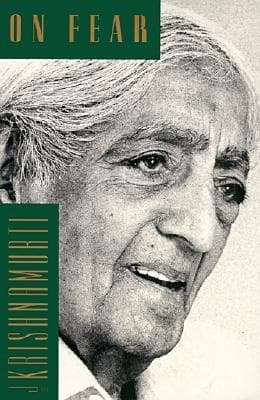
On Fear cover
Archivist's Choice

On Fear

Jiddu Krishnamurti (1994)

Genre

Spirituality / Philosophy

Reading Time

90 min

Key Themes

See below

Track Your Reading

Sign in to track this book

Krishnamurti shows how fear poisons love, joy, and clear thought, urging direct self-inquiry to find its root.

Core Idea

Jiddu Krishnamurti says fear, in its many forms, stops true freedom, love, and intelligence. He believes fear comes from the mind wanting security, holding onto the past, and worrying about the future. This creates a split between the observer and what is observed. This split, he argues, is the essence of time and thought that keeps fear alive. The book tells the reader to look beyond thinking, willpower, or outside solutions, which he sees as useless for ending fear. Krishnamurti suggests the only way to be free from fear is to watch fear itself directly, without judging, identifying with it, or letting a 'self' try to beat it. Through this direct, moment-by-moment awareness, the mind can go past the illusion of time and the habits that create fear. This leads to complete inner freedom and a growth of love and intelligence, untouched by any kind of psychological need or worry.
Reading time
90 min
Difficulty
Hard
✓ Read this if...
You are seeking a profound, non-dualistic approach to understanding and transcending fear, and are open to a challenging philosophical and spiritual inquiry that demands self-observation rather than external solutions.
✗ Skip this if...
You are looking for practical, step-by-step psychological techniques to manage anxiety, or prefer a more traditional, dualistic framework for spiritual growth.

Core idea

The central argument and framework that powers the entire book.

Jiddu Krishnamurti says fear, in its many forms, stops true freedom, love, and intelligence. He believes fear comes from the mind wanting security, holding onto the past, and worrying about the future. This creates a split between the observer and what is observed. This split, he argues, is the essence of time and thought that keeps fear alive. The book tells the reader to look beyond thinking, willpower, or outside solutions, which he sees as useless for ending fear.

Krishnamurti suggests the only way to be free from fear is to watch fear itself directly, without judging, identifying with it, or letting a 'self' try to beat it. Through this direct, moment-by-moment awareness, the mind can go past the illusion of time and the habits that create fear. This leads to complete inner freedom and a growth of love and intelligence, untouched by any kind of psychological need or worry.

At a glance

Reading time

90 min

Difficulty

Hard

Read this if...

You are seeking a profound, non-dualistic approach to understanding and transcending fear, and are open to a challenging philosophical and spiritual inquiry that demands self-observation rather than external solutions.

Skip this if...

You are looking for practical, step-by-step psychological techniques to manage anxiety, or prefer a more traditional, dualistic framework for spiritual growth.

Key Takeaways

1

Fear's Paralysis of Love

A mind gripped by fear is incapable of genuine love.

Quote

How can a mind that is afraid love?

Krishnamurti argues that fear and love cannot exist together. When the mind is controlled by fear—fear of losing, failing, not being enough, or the unknown—it shrinks and protects itself. This shrinking stops the open and vulnerable state needed for real love. Love, for Krishnamurti, is not an emotion but a state of being free from the self-focused worries that fear creates. A fearful mind always looks for security, control, and approval, which go against the selfless giving and openness of love. So, what often seems like love in a fe...

Supporting evidence

Krishnamurti consistently probes the nature of love in relation to fear, suggesting that our attachments and dependencies, born of fear, are not love but rather a form of self-preservation.

Apply this

Observe moments when you feel fear in relationships. Instead of reacting from that fear, pause and question its origin. Recognize that trying to control or possess another out of fear is not love, and actively work to release those self-protective mechanisms to allow genuine connection.

fearloveattachmentvulnerability
2

Dependence Corrodes Joy

Attachment and reliance on external factors diminish true inner joy.

Quote

What can a mind that depends on attachment know of joy?

Krishnamurti says true joy is an inner state, not based on outside things or desires. But people often seek joy by attaching themselves to people, things, beliefs, or experiences. This dependence always leads to suffering because everything outside changes. When what you are attached to is lost or changed, the 'joy' from it disappears, often replaced by sadness, worry, or anger. A dependent mind is always seeking and fearing loss, which stops it from finding the deep, light joy that comes from not being attached and having inner freed...

Supporting evidence

Krishnamurti frequently discusses how our pursuit of happiness through external means, be it relationships, status, or pleasure, ultimately leads to a cycle of dependence and suffering.

Apply this

Identify areas of your life where you feel a strong dependency for happiness (e.g., a specific person, job, or possession). Practice consciously releasing the mental grip on these attachments, not by abandoning them, but by observing your mind's reaction to the idea of their absence and finding inner peace independent of them.

joyattachmentdependencesufferingimpermanence
3

Fear's Dullness on the Mind

The constant presence of fear renders the mind insensitive and unresponsive.

Quote

The voice of fear makes the mind dull and insensitive.

Fear, when it lasts, limits the mind, reducing its ability for sharp perception, sensitivity, and intelligence. When the mind is busy protecting itself, worrying about the future, or regretting the past, it cannot respond freshly and fully to the present moment. This dullness is not just a lack of mental sharpness but a deeper lack of feeling for oneself, others, and the world. It stops real understanding, empathy, and creative ideas. A fearful mind always works from a limited, reactive place, unable to break free from old patterns an...

Supporting evidence

Krishnamurti repeatedly points out that a mind consumed by fear cannot be truly intelligent or observant, as its energy is diverted into self-protection.

Apply this

Notice how fear impacts your daily interactions and decision-making. When you feel fear, observe if your responses become automatic, defensive, or less compassionate. Consciously try to slow down, breathe, and bring a heightened awareness to your present experience, even if it feels uncomfortable, to break the cycle of dullness.

mindfulnessawarenessintelligencesensitivityconditioning
4

Analysis Cannot Uncover Fear

Intellectual analysis of past experiences fails to address the living root of fear.

Quote

The roots of hidden fears, which limit us and from which we constantly seek escape, cannot be discovered through analysis of the past.

Unlike many psychological approaches, Krishnamurti strongly argues that thinking about past hurts or experiences does not truly end fear. While analysis might give intellectual understanding or temporary relief, it does not touch the active, changing nature of fear as it appears now. The past is gone, and looking at it just reinforces the 'me' that experienced it, creating a new layer of psychological structure instead of dissolving the root of fear. Fear is a present thing, and its roots are not in past events but in the mind's curre...

Supporting evidence

Krishnamurti consistently critiques the analytical approach, suggesting it creates more fragmentation and does not lead to a fundamental transformation.

Apply this

When fear arises, resist the urge to immediately analyze its historical causes or intellectualize it. Instead, observe the raw sensation of fear in your body and mind without judgment or interpretation. Stay with the immediate experience of fear, allowing it to reveal itself in the present moment.

analysispastpresent-momentself-observationpsychology
5

Willpower is Futile

Exerting will to overcome fear only creates conflict, not freedom.

Quote

Questioning whether the exercise of will can eliminate the debilitating effects of fear...

Krishnamurti questions the common idea that willpower can defeat fear. He says 'will' comes from the ego, a part of the self that creates and keeps fear. When we try to 'will away' fear, we are creating a fight between two parts of the same broken mind: the part that fears and the part that wills to beat it. This inner struggle only makes the ego stronger and keeps the cycle of conflict and resistance going. True freedom from fear does not come from pushing it down or forcing it away, but from understanding. Using will against fear is...

Supporting evidence

Krishnamurti often discusses the futility of 'effort' and 'striving' in spiritual or psychological transformation, viewing them as extensions of the ego.

Apply this

Next time you feel fear, instead of trying to 'be brave' or 'push through' it with sheer willpower, simply observe the fear without trying to change it. Notice the subtle resistance you feel towards the fear itself. This observation without judgment is the beginning of understanding.

willpoweregoconflictresistanceunderstanding
6

The Root of All Fear

All forms of fear stem from the fundamental fear of non-existence or 'not being'.

Quote

Only a fundamental realization of the root of all fear can free our minds.

Krishnamurti's main idea is that all specific fears—fear of death, loss, failure, loneliness, public opinion—are just parts of one deeper root: the fear of 'not being.' This is not just fear of physical death, but fear of the psychological self, the 'me' and its identity, ending. This psychological 'me' is built from memory, experience, and conditioning, always trying to keep going and stay safe. Any threat to this, real or imagined, appears as fear. To be truly free, one must understand and directly face this basic fear of the self e...

Supporting evidence

Krishnamurti consistently returns to the idea that fear is ultimately about the self's survival, both physical and psychological.

Apply this

When a specific fear arises, trace it back. Ask yourself: What is this fear ultimately protecting? What aspect of 'me' is threatened? Keep peeling back the layers until you reach the underlying anxiety about the self's existence or its perceived importance.

selfegoexistenceidentitydissolution
7

Observation Without the Observer

True understanding of fear requires seeing it without the interpreting 'self'.

Quote

The observer is the observed.

A radical idea from Krishnamurti is that the 'observer'—the 'I' that watches, judges, and understands—is not separate from the 'observed'—the fear itself. When we say, 'I am afraid,' the 'I' that claims to be separate from fear is actually part of the fear. This separation creates two sides, conflict, and stops direct insight. To truly understand fear, one must let go of this false division and simply be the fear, without labeling, judging, or trying to escape it. In this state of awareness without choice, where no 'me' tries to get r...

Supporting evidence

This concept, 'the observer is the observed,' is a cornerstone of Krishnamurti's teachings, applied to all psychological phenomena, including fear.

Apply this

When you experience fear, instead of saying 'I am afraid,' try to observe the fear as a raw sensation, a pattern of thought, or an energy, without the 'I' that claims ownership or tries to analyze it. Just be with the fear, allowing the distinction between 'you' and 'fear' to dissolve, even for a moment.

observerobserveddualitychoiceless-awarenessself-inquiry
8

Freedom Through Awareness

Complete freedom from fear emerges from an immediate, total awareness of its presence.

Quote

Only a fundamental realization of the root of all fear can free our minds.

The way to freedom from fear, according to Krishnamurti, is not a slow process of winning over it but a sudden, complete insight. This insight comes from intense, choiceless awareness of fear exactly as it is, without trying to change, excuse, or escape it. When the mind fully, completely, and without breaking apart observes fear—its beginnings, its forms, its link to the 'self'—the energy that keeps fear going is no longer there. It is like bringing a bright light into a dark room; the darkness does not slowly go away, it vanishes in...

Supporting evidence

Krishnamurti consistently emphasizes the transformative power of 'total attention' and 'choiceless awareness' as the only means to fundamental change.

Apply this

The next time fear arises, dedicate your entire mental and emotional energy to observing it. Don't analyze, don't judge, don't try to get rid of it. Just be fully present with the sensation and thought of fear. See if, in that complete, undivided attention, the fear begins to lose its grip.

awarenessfreedominsighttransformationattention
9

The End of Time's Illusion

Fear is rooted in the psychological construct of time, the past and future.

Quote

Fear is always in relation to something that has been or will be.

Krishnamurti argues that fear is directly connected to the psychological idea of time. We fear what might happen in the future (loss, pain, death) or we carry fears based on past experiences and memories. The 'me' that thinks about the future or holds onto the past is what creates fear. In the actual present moment, without memories or expectations, fear cannot exist. It is the mind's constant movement from 'what was' to 'what will be' that creates the perfect conditions for worry and apprehension. To truly live in the present, free f...

Supporting evidence

Krishnamurti frequently deconstructs the concept of time, differentiating between chronological time and psychological time, and linking the latter directly to suffering and fear.

Apply this

Practice bringing your awareness fully to the present moment. When a fearful thought arises, ask yourself if the fear exists *right now* in this exact second, or if it's a projection into the future or a memory from the past. Consciously return to the sensory experience of the present.

timepresent-momentpastfuturepsychological-time
10

Fear and the Search for Security

The relentless human quest for security is the breeding ground of fear.

Quote

The desire for security creates fear.

Humanity's deep desire for security—whether emotional, financial, relational, or ideological—is, strangely, the very source of its fear. We seek security in attachments, beliefs, routines, and identities, hoping to create a stable, predictable life. However, life itself is not secure, it changes, and it does not last forever. Any attempt to tightly hold onto security is an attempt to control what cannot be controlled, leading to unavoidable worry, frustration, and fear of loss. A mind that constantly seeks security is never truly free...

Supporting evidence

Krishnamurti often points out how our societal structures, religious beliefs, and personal relationships are built on the foundation of seeking security, which he identifies as a root cause of psychological suffering.

Apply this

Reflect on where you seek security in your life. Observe how the attempt to create or maintain this security generates anxiety or fear. Experiment with consciously letting go of the need for absolute security in one small area, and notice what arises.

securityinsecuritycontrolattachmentimpermanence

Critical analysis

Notable Quotes

Freedom from fear is not the cultivation of courage.

Discussing the nature of fear and the inadequacy of conventional responses.

Fear is not an abstraction; it is always in relation to something.

Explaining that fear always has an object, whether perceived or imagined.

The mind that is afraid is a mind that is never free.

Highlighting the direct relationship between fear and the mind's state of being.

Can the mind observe fear without any movement of thought?

Posing a central question about observing fear without intellectualization or judgment.

To understand fear, you must live with it, not try to escape from it.

Advocating for direct confrontation and observation of fear rather than avoidance.

Fear is the product of thought, of time.

Tracing the origin of fear to the processes of thought and the projection into the future.

There is no end to fear if there is a perpetuation of the 'me'.

Linking the persistence of fear to the continued existence and emphasis on the self (ego).

The very desire to be secure breeds insecurity.

Paradoxically explaining how the pursuit of security often leads to its opposite.

When you are aware of fear, are you aware of it as an observer, or are you the fear?

Questioning the separation between the observer and the observed when experiencing fear.

Fear exists as long as there is the future.

Connecting fear directly to the concept of time and the unknown future.

Can the mind be totally quiet, not just outwardly but inwardly?

Exploring the possibility of profound inner stillness as a prerequisite for understanding.

The root of fear is attachment.

Identifying attachment to ideas, people, or possessions as a fundamental cause of fear.

To be free of fear is to die to everything known.

Suggesting that true freedom from fear involves letting go of all accumulated knowledge and experience.

Fear prevents you from seeing clearly.

Describing how fear distorts perception and hinders understanding.

Quiz

Test Your Knowledge

Ready to see how well you understood this book? Take our interactive quiz with 10 questions.

10
Questions
~5
Minutes
?
Best Score

Key Questions (FAQ)

"On Fear" explores how fear and dependence profoundly impact our lives, obscuring our true selves and hindering our capacity for love and joy. Krishnamurti argues that understanding the root of fear, rather than analyzing past events or exercising will, is essential for true liberation.

About the author