BookBrief
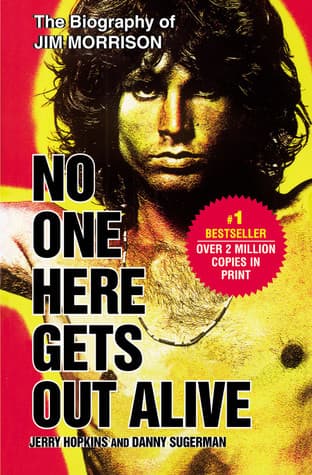
No One Here Gets Out Alive cover
Archivist's Choice

No One Here Gets Out Alive

Danny Sugerman (1981)

Genre

Biography / Memoir / History

Reading Time

8-10 hours

Key Themes

See below

Track Your Reading

Sign in to track this book

Explore Jim Morrison's complex life, the Doors' frontman, through the eyes of those closest to him, showing the poet, rebel, and self-destructive figure who challenged reality until his early death.

Core Idea

Danny Sugerman's "No One Here Gets Out Alive" offers a direct account of Jim Morrison's rise and fall. It suggests Morrison intentionally followed a tragic path, seeing his life and art as a ritual to push limits. The book argues that Morrison, a poet and trickster, created a public image that blended performance with his real self, eventually becoming an unwilling idol consumed by his own appeal. It examines how The Doors became a place for his talent, highlighting the way he controlled and attracted people, which led to his mysterious death in Paris.
Reading time
8-10 hours
Difficulty
Medium
✓ Read this if...
You are a fan of The Doors or Jim Morrison and want a deep, unflinching dive into his life, persona, and the band's history from an insider's perspective, or if you're interested in the psychology of self-destruction and the burdens of genius in rock and roll.
✗ Skip this if...
You are looking for a purely objective, academic biography, prefer a sanitized account of rock star lives, or are not interested in the darker, more chaotic aspects of artistic genius and fame.

Core idea

The central argument and framework that powers the entire book.

Danny Sugerman's "No One Here Gets Out Alive" offers a direct account of Jim Morrison's rise and fall. It suggests Morrison intentionally followed a tragic path, seeing his life and art as a ritual to push limits. The book argues that Morrison, a poet and trickster, created a public image that blended performance with his real self, eventually becoming an unwilling idol consumed by his own appeal. It examines how The Doors became a place for his talent, highlighting the way he controlled and attracted people, which led to his mysterious death in Paris.

At a glance

Reading time

8-10 hours

Difficulty

Medium

Read this if...

You are a fan of The Doors or Jim Morrison and want a deep, unflinching dive into his life, persona, and the band's history from an insider's perspective, or if you're interested in the psychology of self-destruction and the burdens of genius in rock and roll.

Skip this if...

You are looking for a purely objective, academic biography, prefer a sanitized account of rock star lives, or are not interested in the darker, more chaotic aspects of artistic genius and fame.

Key Takeaways

1

The Myth of Icarus: Morrison's Self-Destructive Ascent

Jim Morrison intentionally courted danger and excess, believing it essential for artistic and personal freedom.

Quote

He was an explorer, probing 'the bounds of reality to see what would happen...' and he didn't care if he crashed and burned in the process.

Morrison's life was a conscious, often self-destructive, effort to push boundaries. He did not simply fall victim to rock and roll excess; he actively pursued it as a core part of his philosophy and art. This drive appeared in his heavy use of drugs and alcohol, his confrontational stage presence, and his often chaotic personal life. He saw these experiences as necessary for his art, a way to shed societal norms and find deeper truths. This pursuit, while creating iconic art, eventually destroyed him, showing the tragic results of an ...

Supporting evidence

His repeated arrests, including the infamous Miami incident, and his escalating alcohol abuse were not deterrents but, in his mind, fuel for his artistic fire. The book details numerous instances of him purposefully escalating situations, both on and off stage, to provoke a reaction or to test his own limits.

Apply this

While not advocating self-destruction, Morrison's story prompts reflection on the balance between artistic pursuit, personal well-being, and the potential for creative expression to become a dangerous obsession. It highlights the importance of understanding the 'why' behind our most extreme impulses.

artistic-rebellionself-destructionexistentialismmyth-of-icarus
2

The Poet as Trickster: Performance and Persona

Morrison meticulously crafted his public image, blurring the lines between his true self and the 'Lizard King' persona.

Quote

He was always 'on,' even when he wasn't on stage. The performance was his reality.

Jim Morrison was more than a singer; he was an artist who embodied his work. He understood the power of creating myths and actively developed the 'Lizard King' persona, drawing from mythology, shamanism, and beat poetry. This was not just a stage act; it was part of his philosophical exploration of identity and reality. He intentionally blurred the lines between his true self and his created character, often using the persona to provoke, challenge, and examine the darker parts of the human mind. This constant performance made him myst...

Supporting evidence

His stage antics, from reciting poetry to confronting the audience, were often planned or at least semi-improvised manifestations of this persona. The book recounts how he would meticulously study philosophers and poets, then weave these influences into his lyrics and public image, demonstrating a deliberate construction of his intellectual and artistic identity.

Apply this

Recognize the power of persona in public life and creative endeavors. Consider how identity can be both an authentic expression and a curated performance, and the implications of each. It challenges us to look beyond the surface of public figures.

personaperformance-artmythologyidentity-construction
3

The Weight of Expectation: A Reluctant Idol

Despite his rebellious image, Morrison struggled with the burden of fame and the expectations placed upon him as a rock icon.

Quote

He wanted to be a poet, a filmmaker, an artist – not just 'Jim Morrison, the lead singer of The Doors.'

Morrison's early artistic goals were in poetry and filmmaking, not necessarily rock stardom. The huge fame and admiration that came with The Doors' success were a mixed blessing. While it gave him a platform for his art, it also trapped him in a commercial image he increasingly disliked. He felt misunderstood, reduced to a sex symbol or a wild man, rather than the serious artist and thinker he saw himself as. This disconnect fueled his frustration and contributed to his self-destructive habits, as he tried to dismantle the very image ...

Supporting evidence

His later poetry books, attempts at film projects, and his growing disdain for performing 'Light My Fire' are all cited as evidence of his desire to transcend his rock star identity. The book describes his increasing withdrawal from the band's business aspects and his preference for intellectual pursuits over typical rock star life.

Apply this

Consider the pressures of public life and the importance of maintaining one's authentic self amidst external expectations. It's a reminder that success can come with unforeseen burdens and the constant need to redefine one's purpose.

fame-burdenartistic-integritymisunderstandingcelebrity-culture
4

The Dark Side of Charisma: Manipulation and Magnetism

Morrison's intense charisma was often intertwined with manipulative tendencies, drawing people in while keeping them at arm's length.

Quote

He had this way of making you feel like you were the only person in the room, but then he'd just as easily discard you.

Jim Morrison had an undeniable, almost hypnotic appeal that captivated audiences and individuals. This magnetism was key to The Doors' success and his personal charm. However, the book shows that this charm often had a darker side. Morrison could be manipulative, using his intelligence and emotional intensity to control situations and people. He would draw others in, only to push them away when they got too close or no longer served his immediate needs. This pattern left a trail of devoted but often hurt individuals, from bandmates to...

Supporting evidence

Accounts from Pamela Courson, his bandmates, and various associates detail his erratic behavior, emotional games, and sudden shifts from profound connection to complete detachment. His ability to charm authorities one moment and provoke them the next showcases this duality.

Apply this

Develop a critical eye for charisma, understanding that it can be a powerful tool for both good and ill. Be aware of the difference between genuine connection and manipulative charm in personal and professional interactions.

charismamanipulationinterpersonal-dynamicsnarcissism
5

The Shamanic Impulse: Art as Ritual

Morrison viewed his performances and creative process as a modern form of shamanic ritual, aiming to transcend mundane reality.

Quote

He saw the stage as an altar, the audience as participants in a ritual, and himself as the shaman guiding them through an experience.

Influenced by anthropology, philosophy, and indigenous cultures, Morrison explicitly saw his role as an artist as similar to a shaman. He believed that music, poetry, and performance could be ways to achieve transcendence, to break through everyday illusions and connect with deeper, often primal, truths. His confrontational stage presence, his poetic chants, and his willingness to push limits were all part of this ritualistic approach. He aimed to tap into a collective unconscious, to remove inhibitions, and to create a shared, transf...

Supporting evidence

His fascination with Mircea Eliade's work on shamanism, his interest in Native American culture, and his use of repetitive, almost hypnotic lyrical patterns in songs like 'The End' illustrate this worldview. The book details his extensive reading and intellectual pursuits that informed his artistic philosophy.

Apply this

Explore the potential for art and creative expression to serve as a ritualistic or transformative experience, rather than just entertainment. Consider how artists can tap into deeper cultural or psychological currents.

shamanismritualtranscendenceart-philosophy
6

The Unbearable Weight of Genius: A Mind Unmoored

Morrison's brilliance was inseparable from his struggle with mental instability and a persistent sense of alienation.

Quote

His mind was a labyrinth, brilliant and beautiful, but also dark and disorienting.

Jim Morrison possessed significant intellectual and creative talent, clear in his lyrics, poetry, and philosophical insights. However, this brilliance was often linked with deep psychological struggles. The book hints at elements that might be seen as narcissism, borderline personality traits, or simply a deep sense of alienation he struggled to express or manage. His constant exploration of 'the bounds of reality' was not just an artistic choice but perhaps also a sign of an unstable mind seeking answers in chaotic experiences. This ...

Supporting evidence

Accounts of his unpredictable mood swings, his periods of intense creativity followed by deep depression, and his inability to maintain consistent personal or professional commitments point to underlying psychological complexities. His childhood experiences and strained relationship with his family are also presented as formative influences on his emotional landscape.

Apply this

Foster empathy and understanding for the complexities of the human mind, particularly in individuals who exhibit both extraordinary talent and significant personal struggles. It underscores the importance of mental health awareness, even for figures of immense creative power.

genius-strugglemental-healthalienationpsychological-complexity
7

The Doors: A Crucible of Creative Tension

The band's unique sound emerged from the intense, often volatile, creative friction between its distinct personalities.

Quote

Without the other three, Jim would have been just a poet. Without Jim, they would have been just a jazz band.

The Doors were more than just Jim Morrison and his backup band; they were a unique combination of four distinct musical and intellectual personalities. Ray Manzarek's classical and jazz influences, Robby Krieger's blues and flamenco guitar, and John Densmore's sophisticated drumming created a complex, often improvisational, musical foundation that both grounded and elevated Morrison's poetic vision. The creative process within the band often involved tension, with Morrison pushing for raw emotional expression and the others aiming for...

Supporting evidence

The book details the band members' individual musical backgrounds and how their differing approaches often led to arguments but ultimately resulted in groundbreaking music. Specific song compositions are analyzed to show how each member's contribution was vital.

Apply this

Recognize the value of diverse perspectives and creative tension in collaborative projects. Understand that friction, when managed constructively, can lead to innovative and powerful outcomes that surpass individual efforts.

creative-collaborationband-dynamicsartistic-tensionmusical-innovation
8

The Allure of the Abyss: Mortality and Legacy

Morrison's fascination with death and the forbidden shaped his art and ultimately contributed to his early demise, solidifying his mythic status.

Quote

He danced on the edge of the abyss, daring it to swallow him whole, and in doing so, he became immortal.

From his earliest writings, Jim Morrison focused on themes of death, decay, and the darker aspects of human existence. This interest was not merely morbid; it was a philosophical inquiry into mortality, the limits of experience, and the search for meaning in a finite life. This 'allure of the abyss' permeated his lyrics, his poetry, and his often reckless lifestyle. His self-destructive tendencies can be seen as a direct outcome of this focus, a deliberate embrace of danger to confront mortality directly. His early death in Paris, shr...

Supporting evidence

His lyrics, particularly in songs like 'The End' and 'When the Music's Over,' are rife with imagery of death and destruction. His frequent brushes with the law and his escalating substance abuse are presented as a slow, deliberate dance with the inevitable.

Apply this

Reflect on how an artist's personal philosophy and life choices can profoundly shape their creative output and enduring legacy. It encourages contemplation on the relationship between life, death, and artistic expression.

mortalitylegacymyth-makingexistential-themes
9

The Paris Enigma: A Final Act of Disappearance

Morrison's death in Paris remains shrouded in mystery, contributing to his enduring legend and the speculation surrounding his final days.

Quote

His final act was to disappear, leaving behind a void that fueled endless speculation and cemented his place in rock and roll mythology.

Jim Morrison's move to Paris was meant as a retreat, a chance to escape fame and focus solely on his poetry. However, his life there was still marked by excess and growing isolation. His death in July 1971, officially attributed to heart failure but without an autopsy, quickly became the subject of intense speculation and conspiracy theories. The lack of clear details, combined with the poetic nature of his life, allowed the myth around him to grow. This mysterious end was, in a way, the perfect final chapter for a man who constantly ...

Supporting evidence

The book meticulously recounts the events leading up to and immediately following his death, highlighting the inconsistencies and lack of definitive answers that have persisted for decades. The official reports are contrasted with the numerous alternative theories and eyewitness accounts.

Apply this

Analyze how ambiguity and unsolved mysteries can contribute to the enduring power of cultural figures and their narratives. It prompts critical thinking about historical accounts and the construction of legend.

mysteryconspiracy-theorylegendparis-death
10

Beyond the Rock Star: The Unfulfilled Poet

Beneath the 'Lizard King' façade lay a serious poet and intellectual who struggled to have his literary aspirations taken seriously.

Quote

He wanted to be Baudelaire, not Elvis.

While Jim Morrison is primarily remembered as a rock and roll icon, his deepest artistic goal was to be recognized as a serious poet. He read extensively in literature, philosophy, and mythology, and his notebooks were full of verses and prose he considered his true calling. The 'Lizard King' persona, while powerful on stage, often overshadowed his literary efforts, leading to frustration and a feeling of artistic misrecognition. He saw rock music as a means to an end, a platform to share his poetic ideas, but felt increasingly trappe...

Supporting evidence

The book frequently references his extensive reading habits, his academic background, and his dedication to writing poetry and screenplays, often at the expense of his musical career. His self-published poetry collections, 'The Lords and the New Creatures,' serve as a testament to this deeper ambition.

Apply this

Consider the multifaceted nature of artists and the importance of recognizing all their creative endeavors, not just the most commercially successful. It encourages a deeper look into the less-known aspects of celebrated figures.

poetic-ambitionliterary-legacyartistic-identityunfulfilled-dreams

Critical analysis

Notable Quotes

No one here gets out alive.

The book's title, a recurring phrase related to Jim Morrison's fatalistic outlook and the intensity of the Doors' journey.

He wasn't just a singer. He was a shaman, a poet, a force of nature.

Sugerman's description of Jim Morrison's stage presence and persona.

The Lizard King was dead. Long live the Lizard King.

Reflecting on Jim Morrison's death and the enduring legend.

We were all just trying to catch a piece of the lightning.

Describing the experience of being around The Doors during their peak.

Jim always said he wanted to be a great poet, not just a rock star.

Highlighting Morrison's artistic aspirations beyond music.

The darkness was part of his appeal, part of his genius.

Discussing Jim Morrison's darker aspects and their contribution to his artistry.

Every show was a ritual, a confrontation, a surrender.

Describing the intense and often unpredictable nature of The Doors' live performances.

He pushed the boundaries, and sometimes he went too far.

Referring to Jim Morrison's controversial behavior and boundary-pushing.

The music was the only thing that made sense sometimes.

Reflecting on the power and solace found in The Doors' music amidst chaos.

He burned so brightly, he had to burn out.

A common sentiment regarding Jim Morrison's intense life and early death.

It was a wild ride, and I wouldn't have missed it for anything.

Sugerman's personal reflection on his time with The Doors and Jim Morrison.

The myth grew even larger after he was gone.

Observing how Jim Morrison's legend continued to expand posthumously.

He lived as if every moment was his last, and in a way, it always was.

Commenting on Jim Morrison's intense approach to life and his fatalistic tendencies.

The camera loved him, but he often hated the camera.

Discussing Jim Morrison's complex relationship with fame and media attention.

Quiz

Test Your Knowledge

Ready to see how well you understood this book? Take our interactive quiz with 10 questions.

10
Questions
~5
Minutes
?
Best Score

Key Questions (FAQ)

'No One Here Gets Out Alive' is a definitive biography of Jim Morrison, the iconic lead singer of The Doors. It delves into his complex persona as a singer, philosopher, poet, and delinquent, exploring his rebellion against authority and his quest to push the boundaries of reality.

About the author

Danny Sugerman

Danny Sugerman was an American author and manager, best known for co-writing the definitive biography of Jim Morrison, 'No One Here Gets Out Alive.' His work provided deep insight into the life of the iconic rock star, drawing from his close personal relationship with Morrison and his time as Morrison's associate. Sugerman's writing offered a raw and unvarnished look at the excesses and complexities of rock and roll fame.