BookBrief
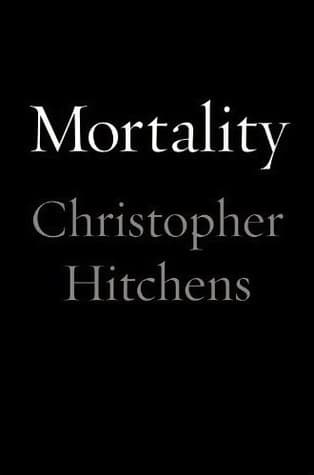
Mortality cover
Archivist's Choice

Mortality

Christopher Hitchens (2012)

Genre

Biography / Memoir / Spirituality / Philosophy

Reading Time

90 min

Key Themes

See below

Track Your Reading

Sign in to track this book

Facing esophageal cancer with sharp intellect and defiant wit, Christopher Hitchens gives a raw, brilliant, and unsparing account of confronting his own death without faith.

Core Idea

Mortality explores the difficult experience of terminal illness, specifically esophageal cancer, from the perspective of an atheist and intellectual. Hitchens examines the physical and mental effects of disease, society's discomfort with illness, and the struggle to keep one's identity and intellectual integrity while facing death. The book rejects religious comfort, instead finding meaning and dignity in humanism, literature, and the shared, limited experience of life itself, even as the body fails.
Reading time
90 min
Difficulty
Medium
✓ Read this if...
You are grappling with mortality, seeking a secular perspective on terminal illness, or appreciate Hitchens's intellectual rigor and defiant wit in the face of immense suffering.
✗ Skip this if...
You are looking for comfort in religious faith, prefer a less confrontational or more sentimental approach to death, or are sensitive to graphic descriptions of physical decline.

Core idea

The central argument and framework that powers the entire book.

Mortality explores the difficult experience of terminal illness, specifically esophageal cancer, from the perspective of an atheist and intellectual. Hitchens examines the physical and mental effects of disease, society's discomfort with illness, and the struggle to keep one's identity and intellectual integrity while facing death. The book rejects religious comfort, instead finding meaning and dignity in humanism, literature, and the shared, limited experience of life itself, even as the body fails.

At a glance

Reading time

90 min

Difficulty

Medium

Read this if...

You are grappling with mortality, seeking a secular perspective on terminal illness, or appreciate Hitchens's intellectual rigor and defiant wit in the face of immense suffering.

Skip this if...

You are looking for comfort in religious faith, prefer a less confrontational or more sentimental approach to death, or are sensitive to graphic descriptions of physical decline.

Key Takeaways

1

The Land of Malady

Illness as an involuntary deportation from the familiar 'country of the well.'

Quote

I was being deported, not just from the country of the well across the stark frontier that marks off the land of malady, but from the land of the living to the land of the dying.

Hitchens describes the sudden, disorienting change from health to severe illness not as a gradual decline, but as an abrupt, involuntary 'deportation.' This metaphor shows the deep psychological and physical break that chronic, life-threatening disease causes. It is a one-way trip across a 'stark frontier,' where the rules, expectations, and even the language of one's former life no longer apply. The experience is isolating, removing the comfort of normalcy and forcing a new relationship with one's body and the world. This immediate a...

Supporting evidence

Hitchens's opening essay details the moment of his collapse in a New York hotel room, marking the precise instant of this 'deportation' from a vibrant book tour to the onset of his esophageal cancer diagnosis.

Apply this

Cultivate a deeper appreciation for the 'country of the well' by practicing mindfulness and gratitude for moments of health. Recognize that our physical state is often a temporary privilege, not an inherent right. Engage with those experiencing illness with empathy, understanding the profound shift they've undergone.
illness-metaphorexistential-shiftfragility-of-health
2

The Tyranny of the Body

When the mind, once sovereign, becomes subservient to physical decay.

Quote

My mind, which was once my best friend, has become a cruel master, dictating terms I can no longer ignore.

Hitchens, a man known for his intellect and speaking skills, faces the harsh reality of his body's failure. He describes a significant shift in control, where his once-dominant mind is now controlled by the demands and limits of his failing physical form. This is more than just pain; it is a loss of self, as the very tools of his being—his voice, his ability to eat, his physical presence—are slowly taken away. The 'tyranny of the body' shows the humbling experience of illness, where intellectual strength and willpower cannot overcome ...

Supporting evidence

He details the agonizing loss of his voice, the inability to swallow solid food, and the constant physical discomfort that overshadows all other thoughts and activities, directly impacting his ability to write and speak.

Apply this

Practice radical acceptance of physical limitations, understanding that identity is more than just physical or intellectual capacity. Develop resilience in adapting to changing circumstances by finding new ways to engage with passions when old methods become impossible.

body-betrayalloss-of-agencymind-body-dichotomy
3

Refusal of Solace

Confronting mortality with reason, rejecting religious comfort.

Quote

To be told by the doctors that I was dying, and to have to face that fact without the false comfort of religion, was the greatest challenge of my life.

True to his lifelong atheism, Hitchens consistently refuses the 'solace of religion' when facing his terminal illness. This is not just a philosophical position but a deeply personal act of intellectual honesty. He sees religious belief as a 'celestial dictatorship,' a comforting illusion that ultimately cheapens the value of life and lessens human agency. His refusal to convert or seek spiritual comfort, even at the end, highlights his belief that facing death openly, with only reason and courage, is a more honest and dignified path....

Supporting evidence

His consistent essays and public statements throughout his illness reiterate his unwavering atheism, explicitly rejecting any 'deathbed conversion' or last-minute turn to faith, despite pressure from some quarters.

Apply this

Examine personal beliefs about mortality and the afterlife with intellectual honesty. Consider how one's worldview shapes the approach to suffering and death, and whether comfort or truth is prioritized.

atheism-in-deathintellectual-integritymortality-and-reason
4

The Language of Pain

The inadequacy of words to describe profound suffering.

Quote

There are some pains, like the ones I now experience, for which language itself seems to fail. They are beyond metaphor, beyond description.

Hitchens, a master of language, struggles with its limits when confronting his intense physical pain. He finds that even his extensive vocabulary and rhetorical skill are not enough to convey the agony he endures. This realization is especially poignant for a writer, showing a basic human challenge: how to express experiences that go beyond normal understanding. The 'language of pain' becomes a private, incommunicable realm, further isolating the sufferer. This struggle highlights the deep, subjective nature of suffering and the inher...

Supporting evidence

He describes his pain as 'excruciating' and 'beyond words,' lamenting the inadequacy of medical terminology or poetic metaphor to truly capture its essence, noting how it renders him speechless.

Apply this

When communicating with those in severe pain, acknowledge the limits of language and focus on active listening and empathetic presence rather than demanding detailed descriptions. Respect the incommunicable nature of their suffering.

incommunicable-painlimits-of-languagesubjectivity-of-suffering
5

Identity in Extremis

How illness strips away external definitions, revealing core self.

Quote

I am no longer a political commentator, a public speaker, or a writer in the same way. I am now primarily a patient, a body in decline.

Illness, especially a terminal one, acts as a test for identity. Hitchens observes how the external markers of his self—his public persona, his intellectual debates, his physical vigor—are systematically eroded. He is reduced to his most basic state: a body enduring suffering. This forced removal of external roles and achievements compels a confrontation with the core self. While devastating, this process also offers a unique, though harsh, chance for introspection, revealing what truly remains when all superficial layers are peeled a...

Supporting evidence

He reflects on the loss of his 'voice' in both literal and metaphorical senses, the inability to travel or engage in public discourse, and how these changes altered his self-perception from 'Hitchens the polemicist' to 'Hitchens the patient.'

Apply this

Regularly reflect on what constitutes your core identity beyond your job, relationships, or physical abilities. Cultivate a sense of self that is resilient to external changes and rooted in internal values and character.

self-redefinitionexistential-identityresilience-in-illness
6

The Privilege of the Well

The stark divide between those who know illness and those who don't.

Quote

The healthy cannot truly understand the experience of the sick. It is a frontier that divides us, and it is rarely crossed in the other direction.

Hitchens highlights the gap between the 'country of the well' and the 'land of malady.' He recognizes that healthy people cannot truly understand the daily reality of severe illness. This is not a judgment but an observation about the experiential divide. The healthy live with assumptions of continuity and control that the sick have lost. This creates an unintentional, yet deep, isolation for the ill. Hitchens's perspective encourages empathy and a recognition of the 'privilege' of good health, a privilege often unnoticed until it is ...

Supporting evidence

He describes how friends and family, despite their best intentions, struggle to grasp the extent of his suffering or the complete alteration of his daily life, often offering platitudes that miss the mark.

Apply this

Actively seek to bridge the empathy gap with those experiencing chronic illness by listening attentively and avoiding assumptions. Recognize and appreciate your own state of health as a fleeting privilege.

empathy-gaphealth-privilegeexperiential-divide
7

The Dignity of the Finite

Embracing a finite existence as the ultimate source of meaning.

Quote

The knowledge that one's life is finite, and that there is no afterlife, makes every moment more precious and every choice more meaningful.

For Hitchens, the absence of an afterlife does not lessen life's value; it increases it. He argues that the very limited nature of human existence gives every moment, every relationship, and every achievement deep meaning. Without the promise of eternal reward or punishment, our actions in this single life become most important. This perspective, consistent with his atheism, is not one of despair but of deep appreciation for the 'one shot' we are given. It is a call to live intensely, to seek truth, and to engage fully with the world,...

Supporting evidence

His continued dedication to writing and intellectual engagement, even in his final months, demonstrates his commitment to making every remaining moment count, not for a divine reward, but for the inherent value of the pursuit itself.

Apply this

Reflect on how the concept of a finite life can motivate you to pursue your passions, deepen your relationships, and contribute meaningfully to the world without relying on external promises of an afterlife.

finite-existencemeaning-without-godcarpe-diem
8

Solidarity of the Human Condition

Despite isolation, illness reveals a shared vulnerability.

Quote

To be ill is to be isolated, but it is also to be part of a vast, silent community of those who suffer.

While much of Hitchens's account emphasizes the isolating nature of illness, there is an underlying recognition of a shared human vulnerability. To be sick is to join an unwilling, silent community that crosses social, economic, and intellectual boundaries. It is a reminder that beneath all our individual achievements and distinctions, we are all ultimately fragile, susceptible to the same biological processes of decay and death. This shared fate, though often grim, offers a strange form of solidarity, a universal experience that conn...

Supporting evidence

He observes the shared experiences of fellow patients in hospitals and clinics, noticing the unspoken understanding and shared suffering that binds them, regardless of their backgrounds.

Apply this

Foster empathy and compassion for all individuals, recognizing that suffering is a universal aspect of the human experience. Seek out opportunities to support and connect with those facing hardship, understanding that shared vulnerability can be a powerful bond.

shared-sufferinghuman-vulnerabilityuniversal-experience
9

The Enduring Power of Intellect

Even in physical decline, the mind's capacity to observe and articulate persists.

Quote

Even when the body fails, the mind, if one is fortunate, can continue to observe, to reflect, to articulate, to make sense of the chaos.

Despite the constant physical pain and the 'tyranny of the body,' Hitchens's book itself shows the lasting power of the human intellect. Even as his physical form weakened, his mind remained sharp, analytical, and capable of deep expression. He continued to write, to observe his own decline with a detached, almost scientific curiosity, and to create essays that were as insightful and eloquent as any in his career. This demonstrates that while illness can devastate the body, the capacity for thought, reflection, and creative expression...

Supporting evidence

The very existence of 'Mortality,' composed during his final, agonizing months, is the strongest evidence. His ability to produce such lucid, profound essays while undergoing chemotherapy and radiation showcases his mental fortitude.

Apply this

Prioritize intellectual engagement and lifelong learning, understanding that a cultivated mind can be a source of strength and meaning even when other faculties diminish. Find ways to express yourself creatively or intellectually, regardless of physical limitations.

intellectual-resiliencemind-over-bodypower-of-writing
10

The Taboo of Illness

Society's discomfort with sickness and the dying.

Quote

We live in a culture that prefers to ignore illness, to push it to the margins, to pretend that it doesn't exist until it is undeniable.

Hitchens examines society's discomfort with illness and death, arguing that we often prefer to look away from suffering. This societal 'taboo' appears in various ways: awkward conversations, the isolation of the sick, and a general reluctance to face our own mortality. By openly discussing the realities of his cancer, Hitchens challenges this cultural avoidance. He suggests that this discomfort comes from a fear of vulnerability and a desire to maintain the illusion of control. His willingness to speak plainly about his physical and e...

Supporting evidence

He recounts instances of well-meaning but awkward interactions, the euphemisms used by others, and the general tendency to avoid direct discussion of his prognosis or physical decline.

Apply this

Actively challenge societal taboos around illness and death by engaging in open, honest conversations. Educate yourself and others about end-of-life care and grief. Be present and authentic with those who are sick or dying.

death-taboosocietal-discomfortopen-dialogue

Critical analysis

Notable Quotes

To the dumb question 'Why me?' the cosmos barely bothers to whisper, 'Why not you?'

Reflecting on the arbitrary nature of his cancer diagnosis.

The four last things are death, judgment, heaven and hell. I'm having a go at the first one.

A darkly humorous take on his impending death, referencing a theological concept.

What cannot be cured must be endured.

A stoic acceptance of his incurable illness.

The thing that I'm finding it hardest to live without is reading.

Lamenting the physical limitations, particularly the difficulty in reading, imposed by his illness.

I used to boast that I was a connoisseur of the hangover. Now I am a connoisseur of the headache.

Comparing the self-inflicted pain of his past with the inescapable pain of his illness.

I feel as if I have been condemned to some form of solitary confinement.

Describing the isolation and sensory deprivation caused by his illness.

You don't hear people saying, 'I'm dying of cancer, but at least I'm not dying of something else.'

Highlighting the absurdity of trying to find solace in relative suffering.

I wonder if I shall ever be able to write another sentence.

Expressing a poignant fear about losing his ability to write, central to his identity.

It has been a privilege to be alive and to be able to use the gift of words.

A reflection on his life's work and his appreciation for language.

I want to be able to think and write and live on my own terms until the last possible moment.

Articulating his desire for autonomy and dignity in the face of death.

The deathbed conversion is not a sign of belief, but of fear.

Reiterating his long-held atheist stance even as he faces his own mortality.

We are not given a good life or a bad life. We are given a life. It's up to us to make it good or bad.

A philosophical statement on personal responsibility and the nature of existence.

I am not a believer, but I am a seeker.

Distinguishing his intellectual curiosity and search for understanding from religious faith.

The body is a machine, and it's running down.

A stark, materialist view of his physical decline.

Quiz

Test Your Knowledge

Ready to see how well you understood this book? Take our interactive quiz with 10 questions.

10
Questions
~5
Minutes
?
Best Score

Key Questions (FAQ)

'Mortality' is Christopher Hitchens's powerful account of his eighteen-month battle with esophageal cancer, from his diagnosis to his death. It explores the physical and existential torments of illness, the taboos surrounding disease, and how it transforms one's relationship with the world.

About the author

Christopher Hitchens

Christopher Hitchens was a prolific and provocative essayist, critic, and journalist known for his sharp wit and uncompromising stance against religion and political dogma. His notable works include "Letters to a Young Contrarian" and "Mortality," a poignant exploration of his terminal cancer diagnosis. A recipient of numerous accolades, Hitchens was celebrated for his intellectual rigor and eloquent prose across a wide range of subjects.