BookBrief
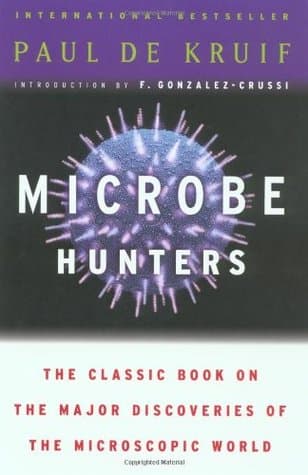
Microbe Hunters cover
Archivist's Choice

Microbe Hunters

Paul de Kruif (1926)

Genre

Biography / History / Health / Science

Reading Time

10-12 hours

Key Themes

See below

Track Your Reading

Sign in to track this book

Follow the scientists who, with early microscopes and strong curiosity, explored the unseen world of microbes, fighting disease and uncovering life's smallest secrets.

Core Idea

Paul de Kruif's "Microbe Hunters" tells the story of dramatic, often risky, and world-changing discoveries made by pioneering scientists. With little more than curiosity and a microscope, they revealed the invisible world of microbes. The book clearly shows the individual struggles, clever ideas, and teamwork that led to the germ theory of disease, the creation of vaccines, and a basic understanding of microbiology, changing medicine and public health. It shows that scientific progress is a human effort, driven by obsession, mistakes, and moments of brilliance.
Reading time
10-12 hours
Difficulty
Medium
✓ Read this if...
You are fascinated by the history of science and medicine, enjoy biographical narratives of groundbreaking discoveries, or want to understand the human stories behind major scientific breakthroughs like the germ theory and vaccine development.
✗ Skip this if...
You prefer modern scientific texts with a focus on contemporary research, dislike historical narratives, or are looking for a purely technical or clinical explanation of microbiology.

Core idea

The central argument and framework that powers the entire book.

Paul de Kruif's "Microbe Hunters" tells the story of dramatic, often risky, and world-changing discoveries made by pioneering scientists. With little more than curiosity and a microscope, they revealed the invisible world of microbes. The book clearly shows the individual struggles, clever ideas, and teamwork that led to the germ theory of disease, the creation of vaccines, and a basic understanding of microbiology, changing medicine and public health. It shows that scientific progress is a human effort, driven by obsession, mistakes, and moments of brilliance.

At a glance

Reading time

10-12 hours

Difficulty

Medium

Read this if...

You are fascinated by the history of science and medicine, enjoy biographical narratives of groundbreaking discoveries, or want to understand the human stories behind major scientific breakthroughs like the germ theory and vaccine development.

Skip this if...

You prefer modern scientific texts with a focus on contemporary research, dislike historical narratives, or are looking for a purely technical or clinical explanation of microbiology.

Key Takeaways

1

The Invisible Frontier

Before microscopes, disease was a mystery; after, a battleground.

Quote

For two hundred years after van Leeuwenhoek, men of science looked at the little beasts, and wondered what they were, and what they did.

De Kruif clearly shows the time before microscopes as one of ignorance. People blamed illnesses on divine anger, bad air, or unbalanced humors. The microscope's arrival, led by figures like Anton van Leeuwenhoek, did more than just show a new world; it changed how humanity understood itself and its place in biology. This new area, full of unseen life, was first a source of wonder, then fear, and finally, a goal for scientific conquest. The book stresses that this first look into the microbial world did not immediately lead to understa...

Supporting evidence

Anton van Leeuwenhoek's meticulous crafting of lenses and his detailed descriptions of 'animalcules' in pond water, saliva, and other samples, laying the groundwork for microbiology.

Apply this

Cultivate a curiosity for unseen forces influencing daily life, whether microscopic or systemic. Recognize that profound discoveries often begin with simple, persistent observation of phenomena that others overlook.


microscopypathogen-discoveryscientific-revolution
2

The Unsung Heroes of Observation

Genius often lies in the relentless, methodical pursuit of the obvious.

Quote

He was an obscure country doctor, a quiet, simple man, who loved children and flowers, and hated disease.

De Kruif points out that many important discoveries came not from showy geniuses, but from dedicated, often unusual, and sometimes overlooked people. They were driven by strong curiosity and an almost obsessive commitment to observation. These 'hunters' did not always start with grand theories but with a patient, almost childlike wonder at nature and a willingness to follow evidence wherever it led, no matter how strange or boring the path. Their persistent, often solitary, work built the factual basis for later, more famous scientifi...

Supporting evidence

Edward Jenner's meticulous observations of milkmaids' immunity to smallpox after contracting cowpox, leading to the development of vaccination.

Apply this

Embrace the power of persistent observation and detail-oriented work in your own field. Understand that significant contributions can come from quiet dedication rather than just groundbreaking theoretical leaps.

empirical-evidencescientific-methodobservation
3

The Germ Theory's Uphill Battle

Revolutionary ideas face fierce resistance, even with irrefutable proof.

Quote

Ignaz Semmelweis was a man who hated disease, and who was driven mad by his discovery.

The book powerfully shows the great resistance faced by early scientists who dared to question old medical beliefs. The germ theory of disease, now a foundation of modern medicine, was met with doubt, ridicule, and strong opposition. Doctors, set in traditional ways and often blinded by pride, refused to accept simple, life-saving actions like handwashing, even with clear statistical proof. This resistance often caused tragic outcomes for patients and deep personal suffering for the innovators. It is a sharp reminder that scientific p...

Supporting evidence

Ignaz Semmelweis's agonizing struggle to convince his colleagues of the importance of handwashing to prevent puerperal fever, despite dramatic reductions in mortality rates in his own clinic.

Apply this

Be prepared for resistance when introducing disruptive ideas, even those backed by strong evidence. Develop strategies for effective communication and advocacy, understanding that human psychology often trumps pure logic.

germ-theoryscientific-resistanceparadigm-shift
4

The Unforeseen Path of Discovery

Serendipity and perseverance often combine to forge breakthroughs.

Quote

Many a time he had found what he was not looking for, and many a time he had not found what he was looking for.

De Kruif repeatedly shows that scientific discovery is rarely a straight path. Many 'aha!' moments came from accidental observations, unexpected experiment results, or simply being in the right place at the right time. However, it was the scientist's readiness, sharp observation skills, and strong persistence that turned these 'accidents' into important discoveries. The book celebrates the messy, repeating nature of science, where failures are often steps forward and detours can lead to the deepest insights. It shows that genius is no...

Supporting evidence

Louis Pasteur's accidental discovery of attenuated chicken cholera vaccine when he used old cultures, observing that they protected chickens without causing full-blown disease.

Apply this

Foster an environment that allows for experimentation and 'failure' as learning opportunities. Remain open to unexpected results and be prepared to pivot your focus when new, intriguing data emerges.

serendipityscientific-processexperimentation
5

The Human Cost of Progress

Science is not sterile; it's fueled by passion, sacrifice, and sometimes madness.

Quote

These microbe hunters were not calm, cool, detached observers. They were men of passion, obsession, and sometimes, profound personal tragedy.

De Kruif skillfully makes these historical figures human, showing their strong passions, moments of despair, personal sacrifices, and sometimes, their descent into obsession or madness. The search for knowledge was not a detached intellectual task but a deeply personal, often all-consuming quest that affected their health, relationships, and mental state. The book highlights the great emotional and physical cost that groundbreaking scientific work can take, from self-experimentation to fighting professional isolation. It reminds us th...

Supporting evidence

Paul Ehrlich's relentless, almost destructive, pursuit of a 'magic bullet' cure for syphilis, involving thousands of experiments and immense personal strain.

Apply this

Recognize the human element in any field of endeavor. Support mental health and well-being within research and innovation communities, acknowledging the pressures involved in pushing boundaries.

scientific-ethicshuman-elementpassion-in-science
6

The Power of Collaboration (and Conflict)

Progress often emerges from both shared endeavors and fierce rivalries.

Quote

Pasteur and Koch, the two titans, never met, but their rivalry spurred an entire generation of bacteriologists.

While de Kruif often focuses on individual brilliance, he also subtly shows how teamwork, even if indirect, and rivalry deeply shaped microbiology's path. The competitive drive between major figures like Pasteur and Koch pushed research limits, making each side refine methods and prove theories with increasing strictness. Also, sharing techniques and discoveries, however unwillingly, built a growing body of knowledge. This dynamic mix of competition and cooperation shows that science is a group effort, where individual contributions a...

Supporting evidence

The intense, often acrimonious, rivalry between Louis Pasteur and Robert Koch, which, despite their personal animosity, led to significant advancements in understanding infectious diseases.

Apply this

Understand that both healthy competition and effective collaboration can be powerful drivers of innovation. Seek to learn from competitors while also actively building networks for shared learning.

scientific-rivalrycollaborationknowledge-sharing
7

From Curiosity to Cure

The journey from basic observation to life-saving intervention is long and arduous.

Quote

It was not enough to see the little beasts; it was necessary to conquer them.

The book traces the remarkable change from simply observing microbes to understanding their role in disease and, finally, developing ways to fight them. This journey was not instant but involved decades, sometimes centuries, of gradual progress. It required closing the gap between theory and practical use, often through dangerous and ethically tricky experiments. De Kruif stresses that the 'hunting' did not end once the microbe was identified; the real challenge began in developing vaccines, antitoxins, and treatments, turning microbi...

Supporting evidence

Emil von Behring's development of antitoxin therapy for diphtheria, building upon earlier discoveries of bacterial toxins and the body's immune response.

Apply this

Appreciate the entire innovation pipeline, from fundamental research to product development and implementation. Support initiatives that bridge the gap between discovery and practical solutions.

public-healthvaccine-developmentmedical-innovation
8

The Endless Hunt

Microbes constantly evolve; the battle for health is perpetual.

Quote

For every microbe conquered, another waited to challenge humanity.

De Kruif, writing in the early 20th century, already suggests that the fight against microbes is ongoing. While celebrating huge wins, the story implicitly recognizes that bacteria and viruses constantly evolve, adapt, and create new problems. The 'hunt' is not a limited war with a final victory, but a continuous, dynamic process needing constant research, alertness, and adaptation. This foresight is especially relevant today, as we face new pandemics and antibiotic-resistant strains, reminding us that scientific progress, though powe...

Supporting evidence

The continuous emergence of new diseases throughout history, even after major breakthroughs against established pathogens, implicitly suggesting the ongoing nature of the threat.

Apply this

Adopt a long-term perspective on challenges, understanding that solutions often require continuous adaptation and innovation. Invest in ongoing research and public health infrastructure to stay ahead of evolving threats.

microbial-evolutionpublic-health-preparednessantibiotic-resistance
9

The Power of the Simple Question

Breakthroughs often stem from asking 'why' or 'how' at a fundamental level.

Quote

He asked the question that nobody else had thought to ask: 'Why do some people get sick, and others don't?'

Many of the 'microbe hunters' in the book were not necessarily the smartest theorists of their time. However, they had an almost childlike ability to ask basic questions about things others took for granted. Why does cowpox protect against smallpox? Why do mothers in one ward die more often than in another? Why does this specific dye stain only certain bacteria? These seemingly simple questions, pursued with strictness and persistence, opened up entirely new areas of understanding and led directly to discoveries that changed thinking....

Supporting evidence

Robert Koch's methodical approach to isolating specific bacteria and linking them to specific diseases, establishing 'Koch's Postulates' by asking how to definitively prove a microbe causes a disease.

Apply this

Cultivate a habit of asking fundamental 'why' and 'how' questions, even about seemingly well-understood concepts. Challenge assumptions and encourage inquiry at all levels of an organization.

scientific-inquirycritical-thinkingfirst-principles
10

The Storytelling of Science

Science, when told as a human drama, can inspire and educate generations.

Quote

He made science live, not as a collection of facts, but as a thrilling adventure of human endeavor.

De Kruif's lasting impact is not just in recording scientific history, but in turning it into compelling human drama. By focusing on the scientists' personalities, struggles, successes, and failures, he made complex microbiology ideas understandable and interesting to many people. He showed that science is not a dry collection of facts but a real, often messy, human story full of suspense, bravery, and tragedy. This approach has inspired countless people to pursue science careers and created a greater appreciation for scientific disco...

Supporting evidence

The book's continued popularity and translation into eighteen languages, demonstrating its ability to captivate and educate a global audience for decades.

Apply this

When communicating complex information, prioritize storytelling and human connection. Frame challenges and solutions as narratives to increase engagement and understanding.

science-communicationnarrative-in-sciencepublic-engagement

Critical analysis

Notable Quotes

Science, my lad, is the only way out of the miseries of mankind.

Louis Pasteur's conviction about the power of science.

For the microbe hunter, the world was no longer a stage for heroes and villains, but for the invisible drama of life and death.

Describing the shift in perspective brought by microbiology.

Chance favors only the prepared mind.

Often attributed to Pasteur, reflecting on the nature of discovery.

He lived for the microbes, and he died for the microbes, and when he died, he left behind a world that would never be the same.

A tribute to Robert Koch's dedication and impact.

It is not the strongest of the species that survives, nor the most intelligent that survives. It is the one that is most adaptable to change.

While a common quote, the book illustrates this principle through the adaptability of microbes and the scientists' methods.

To be a scientist, one must be a poet, a dreamer, and a drudge.

Highlighting the multifaceted nature of scientific pursuit.

The fight was not against other men, but against the invisible, insidious enemies that lurked everywhere.

Emphasizing the true adversaries in the world of microbe hunting.

He saw the invisible, he believed the incredible, and he achieved the impossible.

Praising the visionary qualities of the early microbiologists.

There is no more wonderful thing than to observe the living things that are too small to be seen with the naked eye.

Reflecting on the wonder of early microscopic discoveries.

He was a man who dared to doubt, and in his doubt, he found truth.

Describing the critical and skeptical approach essential to scientific progress.

The greatest joy of all was to prove his enemies wrong, not with anger, but with irrefutable facts.

Illustrating the satisfaction of scientific validation.

Every drop of water, every grain of dust, every breath of air, teemed with life.

Evoking the omnipresence of microbes revealed by early research.

They were pioneers, exploring a world more alien and fantastic than any dreamed of by Columbus or Magellan.

Comparing the early microbe hunters to great explorers.

Quiz

Test Your Knowledge

Ready to see how well you understood this book? Take our interactive quiz with 10 questions.

10
Questions
~5
Minutes
?
Best Score

Key Questions (FAQ)

'Microbe Hunters' is a classic non-fiction book by Paul de Kruif that dramatizes the lives and discoveries of the pioneering scientists who first observed microbes and developed vaccines. It tells the fascinating stories of bacteriologists, doctors, and medical technicians who unveiled the microscopic world and its impact on human health.

About the author