BookBrief
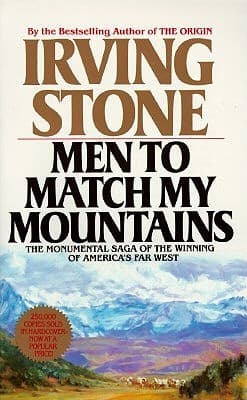
Men to Match My Mountains cover
Archivist's Choice

Men to Match My Mountains

Irving Stone (1956)

Genre

Biography / History

Reading Time

15-20 hours

Key Themes

See below

Track Your Reading

Sign in to track this book

Irving Stone's "Men to Match My Mountains" tells the story of pioneers, dreamers, and scoundrels who built fortunes, empires, and a nation in the American West.

Core Idea

Irving Stone's "Men to Match My Mountains" chronicles the settlement of the American West between 1840 and 1865. The book argues that the West attracted ambitious, resilient, and often ruthless individuals, drawn by the promise of wealth and new beginnings. Through the stories of prospectors, politicians, engineers, and outlaws, Stone shows how these people, despite an unforgiving landscape and the West's boom-and-bust cycles, created a new society and laid the groundwork for modern America. This often came at a cost to themselves and to indigenous populations. The central idea is that the West was not just a place, but a test that revealed both the best and worst of human character. Stone emphasizes how individual drive and group effort tamed the wilderness. He also shows the struggle against nature and the lasting impact of a frontier mentality shaped by grand visions and stark injustices. The book portrays the West as a place where American identity was redefined through constant effort, new ideas, exploitation, and the stories that came from these experiences.
Reading time
15-20 hours
Difficulty
Medium
✓ Read this if...
You are fascinated by the mid-19th century American West, enjoy epic historical narratives, or want to understand the motivations and struggles of the pioneers who shaped the region.
✗ Skip this if...
You prefer concise histories, are not interested in detailed biographical accounts of numerous historical figures, or find extensive descriptions of frontier hardship and exploitation difficult to read.

Core idea

The central argument and framework that powers the entire book.

Irving Stone's "Men to Match My Mountains" chronicles the settlement of the American West between 1840 and 1865. The book argues that the West attracted ambitious, resilient, and often ruthless individuals, drawn by the promise of wealth and new beginnings. Through the stories of prospectors, politicians, engineers, and outlaws, Stone shows how these people, despite an unforgiving landscape and the West's boom-and-bust cycles, created a new society and laid the groundwork for modern America. This often came at a cost to themselves and to indigenous populations.

The central idea is that the West was not just a place, but a test that revealed both the best and worst of human character. Stone emphasizes how individual drive and group effort tamed the wilderness. He also shows the struggle against nature and the lasting impact of a frontier mentality shaped by grand visions and stark injustices. The book portrays the West as a place where American identity was redefined through constant effort, new ideas, exploitation, and the stories that came from these experiences.

At a glance

Reading time

15-20 hours

Difficulty

Medium

Read this if...

You are fascinated by the mid-19th century American West, enjoy epic historical narratives, or want to understand the motivations and struggles of the pioneers who shaped the region.

Skip this if...

You prefer concise histories, are not interested in detailed biographical accounts of numerous historical figures, or find extensive descriptions of frontier hardship and exploitation difficult to read.

Key Takeaways

1

The Allure of the West: A Magnet for Extremes

The American West attracted a unique breed of individual, driven by both noble aspirations and base desires.

Quote

Bring me men to match my mountains.

Westward expansion was not one single movement, but a complex mix of different motivations. Stone shows that the 'men to match my mountains' included heroes, scoundrels, dreamers, and practical people. This wild land tested human nature, bringing out both the best and worst. It drew those seeking freedom, wealth, or a new start, but also those escaping their pasts, eager to exploit resources or dominate others. The vastness of the land seemed to demand equally grand characters, leading to people with great ambition and often, great fa...

Supporting evidence

The book's gallery of characters, from the utopian dreams of Sutter to the ruthless financial manipulations of Ralston's Ring, exemplifies the wide spectrum of human motivation drawn to the West.

Apply this

When evaluating grand historical movements, look beyond simplistic narratives of heroism or villainy. Recognize the complex interplay of individual desires and societal forces that shape collective action. Understand that transformative periods often attract a diverse, sometimes contradictory, cast of characters.

manifest-destinyfrontier-spirithuman-ambition
2

Fortune's Fickle Hand: The Boom-and-Bust Cycle

The promise of immense wealth in the West often led to spectacular rises and equally dramatic falls.

Quote

Men went West to fight, to make millions (or lose them), to die famous, infamous, or unknown.

The discovery of gold in California and silver in Nevada's Comstock Lode created an economic frenzy. Stone vividly portrays the appeal of instant riches, which drew many prospectors, business people, and investors. However, this 'golden chance' was often short-lived. Fortunes were made and lost quickly, leading to the boom-and-bust cycles typical of the Western economy. The book shows that while some became incredibly wealthy, many more faced ruin, their dreams broken by market changes, depleted resources, or bad luck. This era showed...

Supporting evidence

The story of Sutter, whose idyllic retreat was shattered and ultimately ruined by the Gold Rush, and the volatile careers of the Silver Kings in the Comstock Lode, illustrate the rapid accumulation and loss of wealth.

Apply this

Recognize the inherent risks in pursuing 'get-rich-quick' schemes. Understand that true, sustainable wealth often comes from consistent effort and strategic planning, rather than relying solely on sudden windfalls. Analyze the long-term impacts of resource-driven economies.

gold-rusheconomic-cyclesspeculation
3

Community and Cooperation: Taming the Wilderness

In the face of overwhelming hardship, collective effort and social cohesion proved essential for survival and settlement.

Quote

There were the Mormons who tamed the desert with Bible texts, polygamy and co-operation.

While individualism often defines the Western story, Stone shows that organized community and cooperation were just as important for creating lasting settlements. The challenges — harsh climates, long distances, and lack of infrastructure — required group action. The Mormons are a good example of how a close-knit community, united by faith and strong leadership, could turn a desert into a successful farming region. Their success came from a strategy of shared labor, resources, and support, proving that even in a land of individualists...

Supporting evidence

The detailed account of the Mormon settlement of Utah, emphasizing their cooperative farming, irrigation projects, and social organization, stands in stark contrast to the more individualistic, often chaotic, mining camps.

Apply this

When facing seemingly insurmountable challenges, consider the power of collective action and community building. Identify shared goals and leverage diverse skills within a group. Recognize that strong social bonds and organized effort can overcome obstacles that defeat individuals.

mormon-settlementcommunal-livingsocial-cohesion
4

The Unforgiving Land: Nature's Brutal Test

The majestic Western landscape was also a relentless adversary, demanding extreme resilience and often exacting a terrible price.

Quote

Exploration, sudden wealth, unspeakable hardship, the golden chance to build a new life in a new land - all these are present in this saga of human aspiration.

The romantic image of the American West often overlooks the harsh realities of the environment. Stone details the 'unspeakable hardship' faced by pioneers. The vast deserts, tall mountains, and extreme weather were not just backgrounds, but active forces that shaped lives. The book recounts many instances of starvation, dehydration, exposure, and disease, showing how quickly the dream of a new life could turn into a nightmare. The land itself became a character, a powerful opponent that tested human endurance, forcing settlers to face...

Supporting evidence

The tragic saga of the Donner Party, detailed in the book, serves as a stark reminder of the devastating consequences of underestimating the Western wilderness and the extreme sacrifices demanded by the journey.

Apply this

When embarking on ambitious endeavors, thoroughly assess and respect the environmental and logistical challenges. Prepare for worst-case scenarios and understand the limits of human resilience. Recognize that even with the greatest ambition, nature can be an insurmountable force.

donner-partywilderness-survivalenvironmental-challenges
5

Visionaries and Ventures: Building a New America

Beyond individual fortunes, the West was shaped by grand visions for infrastructure and economic empires.

Quote

Men who built colonies, railroads, cities, financial empires, or dreamed and struggled and failed.

The development of the West was not only driven by individual prospectors but by powerful people and groups with bigger plans. Stone highlights the rise of 'men who built colonies, railroads, cities, financial empires.' These were the entrepreneurs, bankers, and industrialists who saw the potential for large-scale development, connecting the continent and creating new centers of trade. Figures like the Big Four and Ralston's Ring understood that true wealth was not just in extracting resources, but in controlling transportation, finan...

Supporting evidence

The stories of the Big Four (Leland Stanford, Collis Huntington, Mark Hopkins, and Charles Crocker) and their role in building the transcontinental railroad, along with the financial machinations of William Ralston, exemplify the large-scale, visionary ventures.

Apply this

Study the interplay between individual initiative and large-scale corporate development in shaping economies. Understand how infrastructure projects can unlock vast economic potential. Recognize the power dynamics involved when capital and vision converge to transform a region.

transcontinental-railroadcorporate-developmenteconomic-expansion
6

The Human Cost of Progress: Exploitation and Injustice

The romanticized narrative of westward expansion often obscures the exploitation of land and people.

Quote

This book is a colorful gallery of characters: heroes and rascals...

While celebrating the pioneering spirit, Stone's story also reveals the darker side of westward expansion. The pursuit of wealth and power often came at a significant human cost. The displacement of indigenous populations, the exploitation of laborers (including Chinese immigrants on the railroads), and the ruthless business practices of powerful groups are underlying themes. The 'rascals' in Stone's book were not just colorful characters but often people who benefited from systemic injustices. This part of the story reminds us that p...

Supporting evidence

While not explicitly focused on injustice, the narrative of figures like Sutter losing his land to the gold rush chaos, or the 'gun-toting newspapermen and bankers' operating with little oversight, hints at a broader landscape of exploitation. (Note: Stone's 1956 perspective might not fully detail indigenous exploitation, but the mention of 'rascals' and the chaos of the gold rush implicitly points to this.)

Apply this

When examining historical progress, inquire about who benefited and who suffered. Analyze the ethical implications of rapid development and resource acquisition. Understand that 'progress' is often a subjective term, with different meanings for different groups.

indigenous-displacementlabor-exploitationhistorical-injustice
7

The Power of Narrative: Shaping Identity and Myth

Storytellers like Mark Twain played a crucial role in mythologizing the West and shaping American identity.

Quote

In the cast are Spaniards, Russians, Yankees, Southerners; Sutter, whose dream... John C. Fremont, Mark Twain, Brigham Young...

The American West was not just a physical place but a powerful idea, and its story was shaped by those who experienced and wrote about it. Stone includes figures like Mark Twain, whose writings turned his personal experiences into lasting myths and archetypes. Twain's humor, skepticism, and vivid descriptions captured the wildness and eccentricities of the frontier, making it accessible and engaging to a wider audience. This shows how literature and journalism not only reflected the West but actively helped shape its image, influencin...

Supporting evidence

The inclusion of Mark Twain in the 'colorful gallery of characters' underscores the importance of writers and chroniclers in shaping the public perception and historical record of the West.

Apply this

Recognize the profound impact of storytelling and media on historical interpretation and national identity. Critically analyze narratives to understand their origins, biases, and influence. Consider how contemporary events are being shaped by the stories we tell about them.

western-mythologyamerican-identityliterary-influence
8

Beyond the Gold: Diverse Paths to a New Life

While gold drew many, the West also offered unique opportunities for religious freedom, political escape, and social reinvention.

Quote

Exploration, sudden wealth, unspeakable hardship, the golden chance to build a new life in a new land...

The 'golden chance to build a new life' in the West went beyond the search for mineral wealth. Stone shows a broader range of reasons that drew people westward. For groups like the Mormons, it was the promise of religious freedom and the chance to build a society based on their own beliefs, free from persecution. For others, it was an opportunity to escape social restrictions, political unrest, or personal failures in the East, offering a fresh start. This variety of purposes highlights the West's role as a place for social experiment...

Supporting evidence

The detailed accounts of Brigham Young and the Mormon migration to Utah, driven by religious persecution and the desire for an independent community, exemplifies a non-economic primary motivation for westward settlement.

Apply this

Understand that migration and settlement are often driven by a complex interplay of economic, social, and ideological factors. Recognize that 'opportunity' can be defined in many ways beyond financial gain. Explore how new environments foster social innovation and different forms of community.

religious-freedomsocial-reinventionutopian-communities
9

The Enduring Legacy of the Frontier Mentality

The challenges and triumphs of the West forged a distinct American character that continues to influence the nation.

Quote

They were men who were larger than life size, who matched the mountains and shaped a pattern of American history.

The era of westward expansion, as Stone describes it, left a lasting mark on the American mind. The 'men to match my mountains' were not just historical figures but became symbols of self-reliance, resilience, new ideas, and boundless optimism tempered by hard-earned practicality. The constant struggle against nature, the pursuit of opportunity, and the need to adapt to new conditions created a 'frontier mentality' that emphasized individual liberty and a willingness to take risks. This spirit, while often romanticized, became a found...

Supporting evidence

The collective narrative of 'heroes and rascals, adventurers and plodders,' all facing immense challenges and striving for a new life, contributes to the overall impression of a distinctive character forged by the frontier experience.

Apply this

Reflect on how historical periods shape national character and values. Identify elements of the 'frontier mentality' in contemporary American culture and politics. Understand the long-term impact of foundational experiences on societal norms and individual aspirations.

frontier-thesisamerican-exceptionalismnational-character
10

Women of the West: Strength Beyond the Shadows

Despite a male-dominated narrative, women played crucial, often overlooked, roles in settling and shaping the Western frontier.

Quote

And some of the world’s most fascinating women.

While the book's title and much of its focus are on 'men,' Stone acknowledges 'some of the world’s most fascinating women.' These women were not just passive companions but active participants in the difficult journey and settlement of the West. They endured the same hardships as men, often managing households, raising families in extreme conditions, and contributing vital labor to establish communities. Figures like Eilley Orrum and Baby Doe Tabor, though perhaps known for their connections to powerful men, showed remarkable resilien...

Supporting evidence

The specific mention of 'the Rose of Sharon and Eilley Orrum' and 'Baby Doe Tabor' indicates Stone's recognition of individual women who made significant impacts, even if their stories are less central than the male figures.

Apply this

Seek out and highlight the contributions of often-marginalized groups in historical narratives. Recognize that history is often told from a dominant perspective and that a more complete understanding requires actively looking for diverse voices and experiences. Appreciate the resilience and agency of women in challenging historical contexts.

women-pioneersgender-roles-historyuntold-stories

Critical analysis

Notable Quotes

Go west, young man, and grow up with the country.

Horace Greeley's famous advice, though popularized by others, encapsulates the spirit of westward expansion.

The American pioneer was a man of indomitable courage, of tremendous physical and spiritual strength, and of an almost fanatical belief in the future of his country.

Stone's general characterization of the typical pioneer spirit.

They had come to a land where the mountains were indeed a challenge, but where the valleys promised a rich reward.

Describing the early settlers' perception of the western landscape.

Gold was not merely a metal; it was a fever, a madness, a siren song luring men to their destiny, or their doom.

Reflecting on the impact of the California Gold Rush.

The desert, harsh and unforgiving, was also a teacher, stripping men of their illusions and revealing their true selves.

Discussing the transformative power of the western desert on pioneers.

Every wagon wheel that turned westward carried not just goods, but dreams, hopes, and an unshakeable faith in a better tomorrow.

Illustrating the emotional cargo of the wagon trains heading west.

They were men who could build a city in a day, and tear down a mountain in a year.

Celebrating the industrious and ambitious nature of the western builders and miners.

The struggle for survival in the West was not just against nature, but against the very nature of man himself.

Highlighting the internal and external conflicts faced by pioneers.

In the vastness of the West, a man's word was his bond, and his rifle, his law.

Describing the informal legal and social structures of the frontier.

The lure of the unknown was a powerful magnet, drawing them ever onward, past the point of no return.

Explaining the relentless drive of explorers and settlers into uncharted territories.

They carved out an empire from wilderness, not with swords, but with plows, picks, and an unyielding will.

Emphasizing the tools and determination used to transform the West.

The true wealth of the West was not in its gold or silver, but in the spirit of its people.

Stone's reflection on the ultimate value of the western experience.

To conquer the mountains, they first had to conquer themselves.

A metaphorical insight into the personal growth and challenges faced by those who settled the West.

Quiz

Test Your Knowledge

Ready to see how well you understood this book? Take our interactive quiz with 10 questions.

10
Questions
~5
Minutes
?
Best Score

Key Questions (FAQ)

'Men to Match My Mountains' by Irving Stone is a sweeping historical narrative detailing the westward expansion of the United States, focusing on the settlement of California, Nevada, Utah, and Colorado. It chronicles the lives of various individuals—heroes, rascals, adventurers—who shaped this pivotal era of American history.

About the author