BookBrief
Memoirs of a Dutiful Daughter cover
Archivist's Choice

Memoirs of a Dutiful Daughter

Simone de Beauvoir (1959)

Genre

Biography / Memoir / Philosophy

Reading Time

10-12 hours

Key Themes

See below

Track Your Reading

Sign in to track this book

Simone de Beauvoir tells of her defiant break from a bourgeois Parisian upbringing, detailing her intellectual awakening and the start of her radical partnership with Jean-Paul Sartre during the turbulent interwar years.

Core Idea

Simone de Beauvoir's "Memoirs of a Dutiful Daughter" covers her early life, from childhood to young adulthood, within a conservative Parisian bourgeois family and society. It shows her intellectual awakening, her break from religious and social rules, and her search for an authentic self through education, literature, and intellectual friendships. The memoir sets the stage for her later philosophical work on freedom, responsibility, and the female condition, showing how her experiences of alienation and liberation shaped her existentialist ideas and her view of self-creation against societal expectations.
Reading time
10-12 hours
Difficulty
Medium
✓ Read this if...
You are interested in the intellectual and emotional development of one of the 20th century's most significant thinkers, the origins of existentialist thought, or the experience of a young woman breaking free from societal constraints in early 20th-century France.
✗ Skip this if...
You prefer fast-paced narratives, are not interested in detailed introspection and philosophical development, or find extensive descriptions of intellectual growth and academic life unengaging.

Core idea

The central argument and framework that powers the entire book.

Simone de Beauvoir's "Memoirs of a Dutiful Daughter" covers her early life, from childhood to young adulthood, within a conservative Parisian bourgeois family and society. It shows her intellectual awakening, her break from religious and social rules, and her search for an authentic self through education, literature, and intellectual friendships. The memoir sets the stage for her later philosophical work on freedom, responsibility, and the female condition, showing how her experiences of alienation and liberation shaped her existentialist ideas and her view of self-creation against societal expectations.

At a glance

Reading time

10-12 hours

Difficulty

Medium

Read this if...

You are interested in the intellectual and emotional development of one of the 20th century's most significant thinkers, the origins of existentialist thought, or the experience of a young woman breaking free from societal constraints in early 20th-century France.

Skip this if...

You prefer fast-paced narratives, are not interested in detailed introspection and philosophical development, or find extensive descriptions of intellectual growth and academic life unengaging.

Key Takeaways

1

The Burden of Bourgeois Belonging

Early life within a declining bourgeois family shaped Beauvoir's intellectual rebellion and search for authenticity.

Quote

My family was a typical bourgeois family of the kind that was beginning to decline. It was a world of tradition, convention, and a certain hypocrisy that I instinctively rebelled against.

Beauvoir's early life was shaped by her bourgeois family's rules and eventual decline. She began as a 'dutiful daughter,' adopting her class's values: order, respectability, and a set path for women. However, the family's financial problems and her father's intellectual snobbery, along with her mother's strong Catholicism, created a space for disillusionment. This environment, instead of holding her back, sparked a strong desire for intellectual and personal freedom. She saw the limits and often hypocritical nature of the bourgeois wo...

Supporting evidence

Beauvoir describes her father's intellectual arrogance and her mother's religious fervor, which she eventually rejects. The family's financial downturn after WWI forces them to move to a smaller apartment and forgo traditional dowries for the daughters, indirectly pushing Beauvoir towards a career.

Apply this

Reflect on the unspoken rules and expectations of your own upbringing. Identify which 'dutiful daughter' roles you might still be playing and consciously choose to shed those that no longer serve your authentic self.
bourgeoisie-declinesocial-conditioningexistential-rebellion
2

The Power of Intellectual Friendship

Intense intellectual friendships, particularly with Zaza, were crucial for Beauvoir's self-discovery and a precursor to her relationship with Sartre.

Quote

The friendship between women, when it is profound and sincere, is a source of strength and mutual understanding that no other relationship can replace.

Beauvoir's friendships, especially with Élisabeth Lacoin (Zaza), were crucial to her intellectual and emotional growth. Zaza was a kindred spirit, a fellow rebel against their class's restrictive norms. Through their intense talks and shared intellectual pursuits, Beauvoir began to form her own early ideas about freedom and individuality. Zaza's tragic death, a victim of the very societal pressures Beauvoir wanted to escape, deeply affected her, strengthening her resolve to live a life free from convention. These early friendships wer...

Supporting evidence

The detailed accounts of her friendship with Zaza, their shared intellectual explorations, and Zaza's eventual tragic demise due to societal pressures (her family's disapproval of her chosen partner).

Apply this

Actively seek out and cultivate friendships that challenge your thinking, support your personal growth, and provide a space for honest intellectual exchange. Prioritize depth over superficiality in your social connections.

female-friendshipintellectual-developmentexistential-influence
3

Education as Emancipation

Academic excellence and intellectual pursuit offered Beauvoir a pathway to escape traditional feminine roles and forge her own identity.

Quote

For me, studying was not a means to an end, but an end in itself; it was my way of becoming, of existing.

Education was Beauvoir's main tool for freedom. Unlike many women of her time, whose academic pursuits were often seen as a step towards marriage, Beauvoir embraced intellectual rigor for its own sake. Her dedication to philosophy, literature, and mathematics was not just about learning but about building her own identity outside of societal expectations. Her success in competitive exams, especially at the École Normale Supérieure, where she met Sartre, showed her exceptional intellectual abilities and solidified her path as an indepe...

Supporting evidence

Her detailed descriptions of her studies, her success in the 'agrégation' exam in philosophy (placing second to Sartre), and her eventual career as a teacher.

Apply this

View continuous learning not just as a career booster but as a fundamental aspect of personal freedom and identity formation. Actively pursue knowledge in areas that genuinely ignite your curiosity, regardless of immediate practical application.

intellectual-freedomfemale-educationself-actualization
4

The Genesis of an Intellectual Partnership

The meeting with Jean-Paul Sartre marked the beginning of an unconventional, lifelong intellectual and personal pact.

Quote

From the moment I met him, I knew that my life would be forever changed. He was my essential companion, my intellectual mirror.

The meeting with Jean-Paul Sartre at the Sorbonne was a turning point, shaping the rest of Beauvoir's life. Their relationship went beyond typical romantic norms, built on a new intellectual equality and mutual respect. They made a 'pact' that allowed for individual freedoms and multiple relationships, yet kept an 'essential' bond. Sartre recognized and encouraged Beauvoir's intellectual strength, and their shared philosophical explorations became the foundation of their partnership. This memoir shows the early stages of this legendar...

Supporting evidence

Her detailed recounting of meeting Sartre, their immediate intellectual connection, and the early discussions that led to their famous 'pact' of commitment without conventional marriage.

Apply this

Examine your own relationships for intellectual depth and mutual growth. Consider how you might challenge traditional relationship norms to better support your individual aspirations and shared intellectual pursuits.

sartre-beauvoir-pactintellectual-equalityunconventional-relationships
5

The Quest for Authenticity

Beauvoir's early life was a continuous struggle against inauthenticity, driven by a desire to live truthfully to her own values.

Quote

I wanted to live an authentic life, to be myself, to escape the roles and masks that society imposed upon me.

From a young age, Beauvoir showed a deep dislike for inauthenticity, a concept that would later become central to existentialist philosophy. She rejected her mother's performative piety, her father's intellectual posturing, and the societal pressure to fit a predefined role for women. Her rebellion was not just against external forces but an internal struggle to align her actions with her growing understanding of herself. This search for authenticity appeared in her career choice, her unconventional relationships, and her commitment t...

Supporting evidence

Her rejection of religious faith, her refusal to marry conventionally, and her pursuit of an intellectual career despite societal expectations.

Apply this

Regularly question your motivations and actions. Are you living in alignment with your deepest values, or are you performing a role for others? Take small, deliberate steps to shed 'masks' and embrace your authentic self.

authenticityexistentialism-preludeself-determination
6

The Disillusionment of Faith

Beauvoir's gradual abandonment of Catholicism was a crucial step in her intellectual and personal liberation.

Quote

I had believed for so long, but then the questions began, and the answers no longer satisfied me. The world became a different place, without God.

Beauvoir grew up in a devout Catholic home, and her early faith was strong. However, as her intellect grew and she encountered new ideas, particularly in philosophy, she began to question her religion's beliefs. This was not a sudden rejection but a gradual, difficult process of intellectual honesty. Losing faith in Catholicism was a deep liberation, as it freed her from a pre-set moral framework and allowed her to build her own ethical system. This loss of faith was a foundational moment for her existentialist view, where she recogni...

Supporting evidence

Her detailed accounts of her childhood piety, her later intellectual doubts, and the eventual, definitive break from religious belief, often linked to her expanding intellectual horizons.

Apply this

Challenge long-held beliefs, whether religious, political, or personal. Allow intellectual curiosity and critical thinking to guide your understanding of the world, even if it leads to uncomfortable conclusions.

religious-doubtexistential-atheismintellectual-liberation
7

The Female Condition in the 1920s

The memoir vividly portrays the limited opportunities and societal pressures faced by intelligent women in early 20th-century France.

Quote

For a girl, there were always limits, boundaries that were not imposed on boys. My only escape was through my mind.

Beauvoir's memoir is a valuable historical document, offering a detailed look at the female condition in post-WWI France. Despite her intellectual brilliance, she constantly struggled with societal expectations that pushed women towards marriage, domesticity, and a subordinate role. Her family's financial decline, ironically, helped her become independent, as it required her to pursue a career. The widespread sexism in academia and society meant she had to work twice as hard to prove herself. This early experience of gendered limitati...

Supporting evidence

Her discussions about the 'agrégation' exam and the rarity of women in higher education, the societal expectation that she would marry, and the limited career options for women.

Apply this

Reflect on how historical and societal gender roles continue to subtly influence your own choices and opportunities. Actively challenge internalized biases and support efforts to dismantle remaining gender-based barriers.

gender-roles-historyfemale-emancipationpatriarchal-society
8

The Weight of Choice and Freedom

Beauvoir's early life demonstrates the exhilarating yet terrifying responsibility that comes with embracing radical freedom.

Quote

I understood that I was condemned to be free; there was no one to blame but myself for my choices.

Even before formalizing her existentialist philosophy, Beauvoir lived its core principles. Her continuous rejection of predefined paths — from religious dogma to conventional marriage — was an act of radical freedom. This freedom, however, came with immense responsibility and often, a sense of isolation. The memoir captures the excitement of making her own choices, but also the 'anguish' that comes with realizing one is solely responsible for creating one's own meaning and values. Her experiences, especially breaking away from family ...

Supporting evidence

Her decisions to pursue an intellectual career, to live independently, and to enter an open relationship with Sartre, all against the backdrop of societal norms.

Apply this

Embrace the discomfort of choice. Recognize that true freedom comes with the responsibility of creating your own path and meaning, rather than passively accepting what is given. Make conscious, deliberate choices in all areas of your life.

existential-freedompersonal-responsibilitymeaning-making
9

Literature as a Realm of Being

Reading and writing were not merely hobbies but fundamental to Beauvoir's existence, a space for self-creation and understanding.

Quote

Books were my world, my refuge, my teachers. Through them, I discovered myself and the infinite possibilities of thought.

For Beauvoir, literature was more than an academic pursuit; it was an immersive world where she could explore ideas, experience different lives, and ultimately, build her own self. From her childhood love of novels to her rigorous philosophical studies, reading and writing were the main ways she engaged with the world and expressed her growing awareness. The memoir details her extensive reading habits and the deep impact specific authors had on her development. This dedication to the written word was not an escape but a form of active...

Supporting evidence

Her detailed descriptions of the books she read as a child and adolescent, the authors who influenced her (e.g., Dostoevsky, Gide), and her early attempts at writing.

Apply this

Cultivate a deep and diverse reading practice. Engage actively with texts, allowing them to shape your thinking and provide new perspectives. Consider journaling or writing to process your thoughts and develop your own voice.

literary-influenceintellectual-formationreading-as-creation
10

The Unfolding Self

The memoir illustrates that identity is not fixed but a continuous, evolving project shaped by experience and conscious choice.

Quote

I was always becoming, never fully formed. Each experience, each choice, added a new layer to who I was.

Beauvoir's 'Memoirs of a Dutiful Daughter' shows how identity changes. It tells of her shift from a compliant child to a rebellious adolescent, and finally, to an independent intellectual woman. Her story clearly shows that the self is not fixed but an ongoing project, shaped by interactions, intellectual discoveries, and deliberate choices. The 'dutiful daughter' gradually sheds her prescribed roles, actively building her own values and purpose. This autobiography, therefore, is not just a recounting of events but an exploration of h...

Supporting evidence

The entire arc of the memoir, from her early childhood conformity to her later intellectual and personal independence, marked by specific decisions and relationships.

Apply this

Embrace the idea that your identity is fluid and evolving. Regularly assess your values and aspirations, allowing yourself to grow and change without feeling bound by past versions of yourself. See life as a continuous process of self-discovery and creation.

identity-formationself-creationpersonal-evolution

Critical analysis

Notable Quotes

I was born into a good bourgeois family, into a society that seemed to me an eternal and natural order.

Reflecting on her early life and social standing.

My father's words had for me the weight of revealed truth.

Describing her early admiration and reliance on her father's intellect and opinions.

I was a good little girl, anxious to please, quick to obey.

Characterizing her behavior and personality during her early years.

Reading was for me a way of existing.

Highlighting the profound importance of books and literature in her formative years.

I desired to be a writer, a great woman, a free woman.

Expressing her early ambitions and aspirations for her future.

I was caught between two worlds, that of faith and that of reason.

Discussing her intellectual and spiritual struggles as she began to question her religious upbringing.

For the first time I felt the shock of being an individual, alone and responsible.

Describing a pivotal moment of self-awareness and the realization of personal autonomy.

I understood that if I wanted to escape, I must escape through knowledge.

Recognizing education and intellect as her path to liberation from societal constraints.

I had to find my own way, and that meant breaking with the past, with my family, with my class.

Reflecting on the necessary ruptures required to forge her own independent life.

I discovered that I could think for myself, that I could judge for myself.

Describing the empowering realization of her own intellectual capacity and critical thinking.

I did not want to be a wife or a mother; I wanted to be myself.

Articulating her rejection of traditional female roles in favor of personal self-realization.

My childhood had come to an end; my youth had begun.

Marking a clear transition from her protected early life to a period of greater independence and self-discovery.

I felt myself to be a stranger in the world, and yet at home in it.

A paradoxical feeling of alienation and belonging as she navigates her emerging identity.

Quiz

Test Your Knowledge

Ready to see how well you understood this book? Take our interactive quiz with 10 questions.

10
Questions
~5
Minutes
?
Best Score

Key Questions (FAQ)

The book primarily focuses on Simone de Beauvoir's early life, detailing her upbringing in a bourgeois French family, her intellectual awakening, and her rebellion against societal conventions, culminating in her formative years as a young woman in the 1920s.

About the author

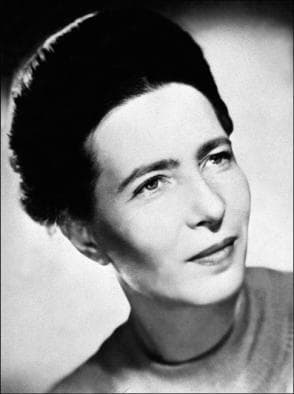
Simone de Beauvoir

Simone Lucie Ernestine Marie Bertrand de Beauvoir was a French existentialist philosopher, writer, social theorist, and feminist activist. Though she did not consider herself a philosopher, nor was she considered one at the time of her death, she had a significant influence on both feminist existentialism and feminist theory.