“The only way to love a woman is to love God first.”
— Dr. Thomas More reflects on his past relationships and his spiritual state.

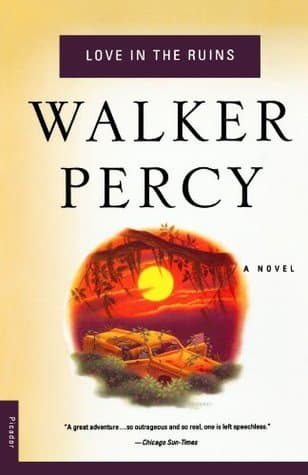
Walker Percy (1971)
Genre
Spirituality / Science Fiction
Reading Time
560 min
Key Themes
See below
Sign in to track this book
Dr. Tom More, using a miraculous stethoscope, diagnoses humanity's spiritual sickness, beginning a darkly comedic journey to heal souls before society collapses.
The novel starts on July 4th. Dr. Tom More, a psychiatrist and lapsed Catholic, sits in a water tower in a run-down part of Feliciana Parish, Louisiana. He believes the world is ending, a feeling matched by the decay around him. Tom has invented the 'Ontological Lapsometer,' a device he says can diagnose and cure mankind's spiritual sickness, which he calls 'angelism-bestialism.' He recalls past failures, including a failed attempt to save Lola from suicide and his daughter Samantha's death from a mysterious illness. He plans to use his Lapsometer to save a small community from the coming disaster, which he blames on a societal split between 'angelism' (pure intellect) and 'bestialism' (pure sensuality).
Tom lives in the remains of Paradise Estates, a former resort now split into a white Protestant section and a black Catholic section. He is in a relationship with three women: his former nurse, Kitty Vaught; a Jewish sculptor, Moira Schaffner; and a young, beautiful former Miss Alabama, Doris. His main patient is Art Immelmann, a former colleague who shows extreme symptoms of angelism-bestialism. Tom's Lapsometer, a helmet-like device with dials, claims to measure the 'ontological lapsus'—the fall from grace—in people. He thinks he can restore balance to the human mind, curing the spiritual illness that caused society's collapse. He tries to use the device on Art, but the results are unclear and frustrating.
Art Immelmann, a clever and nihilistic character, quickly gains power over Tom and the Lapsometer. He subtly changes Tom's ideas, suggesting the device can be used for control instead of healing. Art's own condition seems to worsen, or he pretends to improve to further his goals. He convinces Tom to use the Lapsometer on other residents, often with disturbing and unpredictable results. The device seems to strengthen existing traits rather than cure them, pushing the 'angelic' further into abstraction and the 'bestial' further into pleasure. Tom begins to suspect that Art is not just a patient but represents the spiritual decay he wants to fight, possibly even an evil agent.
The racial division in Paradise Estates reflects the larger societal breakdown. The white Protestants, led by Dr. Bob Comeaux, mostly ignore the black Catholics, who struggle with poverty and disease. Tom, though living among the white community, sees the black community's suffering and believes his Lapsometer could bridge the gap, restoring shared humanity. He watches Father Smith, a black Catholic priest, ministering to his flock, and feels a longing for his lost faith. However, his attempts to help are met with suspicion from both sides, showing the deep divisions that even technology cannot easily fix.
As Tom continues to experiment, he finds that the Lapsometer has an unexpected side effect: it can increase or decrease sexual desire. This discovery makes his ethical problem more complex. Art Immelmann, always manipulative, uses this feature to his advantage with the women, further blurring the lines between healing and control. Tom realizes that his invention, meant for spiritual salvation, could easily become a tool for pleasure or manipulation. This forces him to confront the moral implications of his scientific work and the dangers of trying to engineer human happiness or virtue. He questions if true healing can come from a machine or if it needs something deeper.
Tom's suspicions about Art Immelmann lead to a dramatic confrontation. He realizes that Art has been deliberately sabotaging his efforts and using the Lapsometer for selfish reasons, embodying the 'bestialism' Tom tried to cure. In a moment of clarity and desperation, Tom destroys the Lapsometer, seeing its potential for harm and the futility of trying to solve spiritual problems with a purely scientific device. This act shows Tom's rejection of a purely technological solution to human suffering and his acknowledgment of his own scientific pride. Destroying the Lapsometer is a turning point, forcing Tom to find a different path.
After destroying the Lapsometer, Tom changes deeply. He starts attending mass with the black Catholic community and finds comfort in the Church's rituals and community. He confesses his sins to Father Smith, a key moment in his spiritual journey. He rediscovers his lost Catholic faith, realizing that true healing and meaning are not in scientific invention but in spiritual connection and tradition. This return to faith marks a significant shift from his earlier reliance on technology and intellectual detachment. He begins to see the world not as a problem for science to solve, but as a place where grace and redemption are possible.
The predicted end of the world on July 4th passes without a dramatic catastrophe. Instead, life continues, though fractured and uncertain. Tom realizes that the apocalypse he expected was more of a spiritual and societal breakdown than a physical one. He accepts that a single invention will not 'cure' the world. He makes peace with his past, including his daughter's death, and starts to rebuild his life and relationships on a more traditional and spiritual basis. The immediate threat of global destruction lessens, replaced by the ongoing challenges of living in a fallen world.
Tom chooses to marry Kitty Vaught, his former nurse, recognizing her steady love and practical nature. He abandons his polygamous lifestyle, which he now sees as a sign of his previous spiritual confusion. He re-establishes a humble medical practice in the post-apocalyptic setting, focusing on traditional medicine and compassionate care rather than grand scientific plans. He finds quiet satisfaction in treating physical ailments and serving his community, embracing a more grounded and responsible life. This decision shows his rejection of intellectual abstraction and his commitment to the real parts of human life and relationships.
The novel ends with Tom living a relatively peaceful and meaningful life with Kitty. They have children, bringing hope and continuity to a broken world. Tom continues his medical practice, offering what help he can. He has found a way to live 'in the ruins'—both society's physical ruins and his own spiritual ruins—with a renewed sense of purpose, based on his Catholic faith and his love for his family. He has learned that true salvation is not in scientific breakthroughs but in faith, love, and the everyday acts of living a good life, even in a world that seems to be falling apart.
The Protagonist
Tom evolves from a detached, scientifically-driven intellectual to a man grounded in faith, love, and practical service, accepting the limitations of science in solving spiritual problems.
The Supporting
Kitty remains a constant, loving presence, eventually becoming Tom's chosen partner, symbolizing his return to a more grounded and traditional life.
The Antagonist
Art remains a static force of corruption, serving as a catalyst for Tom's eventual rejection of the Lapsometer and his return to faith.
The Supporting
Moira remains a symbol of intellectual engagement, but ultimately is not chosen by Tom as he seeks a more grounded life.
The Supporting
Doris remains a static symbol of sensuality, eventually being left by Tom as he embraces a more committed relationship.
The Supporting
Father Smith remains a consistent figure of spiritual wisdom, facilitating Tom's return to Catholicism.
The Supporting
Comeaux remains a static representation of secular authority and societal division, highlighting the challenges Tom faces in finding unity.
The Mentioned
Samantha's memory serves as a catalyst for Tom's initial ambition and later for his ultimate acceptance of life's mysteries and his return to faith.
The novel explores humanity's search for purpose in a decaying society. Dr. Tom More's Lapsometer is his attempt to scientifically fix this meaninglessness. However, he finds that technology is not enough; true meaning comes from faith, love, and traditional human relationships. This is clear when he rejects the Lapsometer and returns to the Catholic Church and marries Kitty, finding peace in a simple, faith-filled life.
“What does a man do when he is told that the best way to save himself and the world is to give up his search for himself and the world?”
Percy criticizes the modern reliance on science and intellect to solve deep problems, often ignoring spiritual and emotional truths. Tom More's Lapsometer, though well-intended, symbolizes this pride, trying to reduce complex human spiritual states to data. Art Immelmann's misuse of the device shows the ethical dangers of such an approach. Tom's journey shows that intellectual thinking can lead to detachment and moral confusion, as seen in his early relationships and his inability to connect until he gives up his scientific quest.
“The fact is that if a man is to live, he must be done with all that, all that abstract speculation, all that thinking about himself.”
A main theme is Percy's idea of 'angelism-bestialism,' a spiritual sickness where humans swing between pure intellect (angelism) and pure sensuality (bestialism), losing their whole humanity. Tom believes this split causes society's decay. Art Immelmann embodies extreme bestialism and nihilism, while Tom struggles with intellectual detachment. The novel suggests that true health means integrating these aspects through faith and love, and that the modern world worsens this split. Societal divisions, like the racial segregation in Paradise Estates, show this deeper spiritual problem.
“The great secret of the coming age is that the world is going to be saved, not by science, but by faith. Which is to say, by a new kind of science.”
The novel argues for redemption through a return to traditional Catholic faith and genuine human community. Tom's early attempts to 'cure' humanity are scientific and individualistic, but he finds salvation by reconnecting with his lost faith, confessing to Father Smith, and committing to Kitty. This highlights how spiritual tradition, sacraments, and community help counter modern alienation and despair. His final marriage and the birth of his children symbolize a hopeful future built on these foundations.
“One must love God and one's neighbor and not despair. The rest is all vanity.”
The novel contrasts Tom's initial relationships, driven by detachment and a search for fragmented satisfaction, with his commitment to Kitty Vaught. His relationships with Moira (intellectual) and Doris (sensual) represent the 'angelism' and 'bestialism' he struggles with. His choice of Kitty, who embodies stable love and practical care, shows his rejection of pleasure and intellectual detachment for real commitment. This shift emphasizes that true love and commitment are vital for human well-being and spiritual health, providing stability in a chaotic world.
“It is not a question of 'love' in the abstract, but of loving this man or this woman in this place at this time.”
A fictional device that diagnoses and attempts to cure spiritual illness.
The Lapsometer is Dr. Tom More's invention, a helmet-like machine designed to measure and correct the 'ontological lapsus' – the spiritual fall of humanity. It functions as a central plot device, driving Tom's actions and representing his scientific hubris. Initially presented as a potential savior, it quickly becomes a symbol of the limitations and dangers of relying on technology to solve spiritual problems. Its eventual destruction signifies Tom's rejection of a purely scientific worldview and his turn towards faith. It also serves as a vehicle for exploring Percy's 'angelism-bestialism' theory.
A decaying, racially segregated Louisiana parish symbolizing societal and spiritual collapse.
The setting of Feliciana Parish, Louisiana, in a near-future, post-apocalyptic state, serves as a microcosm of the larger societal and spiritual decay. The physical ruins, racial segregation between white Protestants and black Catholics, and general sense of malaise reflect the internal state of humanity. This setting provides a backdrop against which Tom's personal and spiritual struggles are played out, emphasizing the urgency of his quest for meaning. It highlights the fragility of civilization and the enduring human need for community and faith even in collapse.
The story is told from Tom More's subjective and often self-deprecating perspective.
The novel is narrated entirely from Dr. Tom More's first-person perspective, offering intimate access to his thoughts, theories, and personal struggles. This allows the reader to experience his intellectual journey, his anxieties about the world's impending doom, and his eventual spiritual awakening. His voice is often ironic, witty, and deeply introspective, providing both humor and profound philosophical insights. The subjectivity of his narration also underscores his initial detachment and the challenge of truly understanding reality when trapped in one's own head.
Character names carry historical and symbolic weight, enriching their roles.
The names of key characters hold symbolic significance. Dr. Tom More is a direct descendant of Sir Thomas More, the Catholic saint executed for refusing to acknowledge Henry VIII's supremacy, linking Tom to a legacy of faith, martyrdom, and resistance to secular power. This lineage foreshadows Tom's eventual return to Catholicism. Art Immelmann's name, while less direct, evokes a sense of artificiality and 'imitation man,' fitting his role as a manipulative and spiritually empty antagonist. This use of names adds depth and intertextual richness to the narrative.
“The only way to love a woman is to love God first.”
— Dr. Thomas More reflects on his past relationships and his spiritual state.
“I am a Catholic, but a bad one. I don't believe in God, but I believe in the Holy Catholic Church. What a fix.”
— Thomas More's internal struggle with faith and his intellectual skepticism.
“Why is it that the only people who know how to live are the ones who are dying?”
— More observes the behavior of people in the declining society around him.
“The world is going to hell, and I'm going to cure it.”
— More's ambitious, if somewhat deluded, goal for his 'lapsometer' invention.
“The great thing about the end of the world is that you don't have to worry about anything anymore.”
— A darkly humorous perspective on the societal collapse.
“The worst thing about the next world is that it will be just like this one, only more so.”
— More's cynical view of the future, even after the 'ruins'.
“Man is the only creature who refuses to be what he is.”
— A philosophical observation on human identity and self-denial.
“The trouble with people is not that they don't know, but that they know too much.”
— More's critique of the information overload and intellectualism of his time.
“What is life but a series of decisions, each one leading to the next, like dominoes falling?”
— More's reflection on the chain of events that led him to his current predicament.
“The true catastrophe is not the end of the world, but the end of meaning.”
— More grapples with the existential void underlying the societal decay.
“It is not enough to be a good man; one must also be a true man.”
— A moral distinction More considers in his personal quest for redemption.
“The world is full of signs, but no one knows how to read them.”
— More's lament about humanity's inability to understand its own predicament.
“Perhaps the only hope is to start over, to build something new from the ruins.”
— A glimmer of optimism amidst the general despair, hinting at renewal.
“We are all castaways on an island of our own making.”
— More's metaphorical description of human isolation and self-imposed predicaments.
Ready to see how well you understood this book? Take our interactive quiz with 10 questions.

Walker Percy, OblSB was an American writer whose interests included philosophy and semiotics. Percy is noted for his philosophical novels set in and around New Orleans; his first, The Moviegoer, won the National Book Award for Fiction.

Kenneth Thomas
4.9
Stormie Omartian
4.3
Jerry Bridges
4.3
Walter Brueggemann
4.3
Brother Lawrence
4.3

Unknown
4.3

Joseph Campbell
4.3

Dante Alighieri
4.2