BookBrief
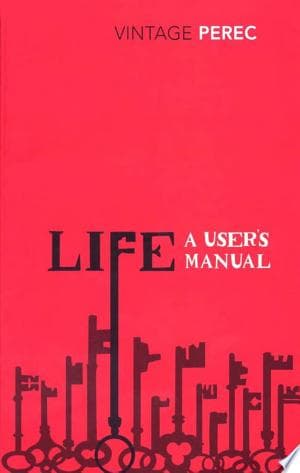
Life cover
Archivist's Choice

Life

Georges Perec (2012)

Genre

Biography / Memoir / History

Reading Time

15-20 hours (due to its length and complexity, but highly variable depending on reading style)

Key Themes

See below

Track Your Reading

Sign in to track this book

In a Paris apartment building, an artist's grand painting opens a window into the peculiar lives of its residents, revealing decades of intertwined fates, strange hobbies, and lingering secrets, all seen through the building's walls.

Core Idea

Georges Perec's "Life: A User's Manual" is a literary experiment that explores how lives connect within a single Parisian apartment building. Through immense detail and a complex system, the book suggests that human existence is a puzzle made from countless everyday moments, objects, memories, and choices. It shows memory as a complex and personal thing, and that our lives are shaped by what we collect and who we are, as well as the sad beauty of things changing. The book argues that people need to create stories to make sense of a world that is often random and out of their control. Its main idea is that to truly understand 'life,' one must look closely at and reconstruct ordinary things, showing how individual stories, even when they seem unrelated, are deeply linked and reflect common themes of loss, obsession, and the search for meaning in our chosen or inherited spaces. The book itself becomes a symbol of this process, inviting the reader to see life as a series of unfinished puzzles, where structure and close attention reveal much about the human condition.
Reading time
15-20 hours (due to its length and complexity, but highly variable depending on reading style)
Difficulty
Hard
✓ Read this if...
You are fascinated by experimental literature, complex narratives, the philosophy of everyday life, or enjoy books that meticulously interweave countless micro-stories to form a grander, unconventional mosaic. Ideal for readers who appreciate literary games, deep character studies through objects and environments, and a challenge to traditional storytelling.
✗ Skip this if...
You prefer straightforward, linear narratives, fast-paced plots, or traditional biographical/historical accounts. This book is dense, highly detailed, and demands patience; it is not for those seeking quick resolutions or an easy read.

Core idea

The central argument and framework that powers the entire book.

Georges Perec's "Life: A User's Manual" is a literary experiment that explores how lives connect within a single Parisian apartment building. Through immense detail and a complex system, the book suggests that human existence is a puzzle made from countless everyday moments, objects, memories, and choices. It shows memory as a complex and personal thing, and that our lives are shaped by what we collect and who we are, as well as the sad beauty of things changing. The book argues that people need to create stories to make sense of a world that is often random and out of their control.

Its main idea is that to truly understand 'life,' one must look closely at and reconstruct ordinary things, showing how individual stories, even when they seem unrelated, are deeply linked and reflect common themes of loss, obsession, and the search for meaning in our chosen or inherited spaces. The book itself becomes a symbol of this process, inviting the reader to see life as a series of unfinished puzzles, where structure and close attention reveal much about the human condition.

At a glance

Reading time

15-20 hours (due to its length and complexity, but highly variable depending on reading style)

Difficulty

Hard

Read this if...

You are fascinated by experimental literature, complex narratives, the philosophy of everyday life, or enjoy books that meticulously interweave countless micro-stories to form a grander, unconventional mosaic. Ideal for readers who appreciate literary games, deep character studies through objects and environments, and a challenge to traditional storytelling.

Skip this if...

You prefer straightforward, linear narratives, fast-paced plots, or traditional biographical/historical accounts. This book is dense, highly detailed, and demands patience; it is not for those seeking quick resolutions or an easy read.

Key Takeaways

1

The Infinite Interconnectedness of Lives

Every individual story, no matter how singular, is interwoven into a grander tapestry of human experience.

Quote

The entire building could be seen as a collection of isolated worlds, yet each one, in its own way, contributed to the overall fabric of existence within its walls.

Perec shows that no life exists alone. Through an apartment block, he reveals how the residents' seemingly separate lives are subtly, and sometimes openly, connected. A chance meeting, a shared wall, a distant memory – these things link them, forming a complex network of relationships, influences, and shared histories. This connection is not always obvious, often needing close observation and a willingness to explore the small details of each story. The book suggests that to truly understand a community, or even a person, one must app...

Supporting evidence

Serge Valene's ambition to paint the entire building serves as the central device, as his contemplation of each apartment and its inhabitants unlocks a cascade of interconnected stories and memories, revealing the historical and relational links between them.

Apply this

Actively seek out the unseen connections in your own community or workplace. Consider how the 'minor' characters in your life's narrative might be influencing your story, and vice-versa. Practice empathy by imagining the complex histories and relationships that define those around you.
interconnectedness-humannarrative-webcommunity-tapestry
2

The Power of the Mundane

Even the most ordinary spaces and routines hold extraordinary stories waiting to be unearthed.

Quote

It is often in the most unassuming corners that the most astonishing tales lie hidden, waiting for an observer patient enough to notice them.

Perec makes everyday things into an art form, showing that an ordinary Parisian apartment building can hold much human drama, eccentricity, and deep experience. He carefully details the objects, routines, and histories in each flat, showing that every scratch on a floorboard, every forgotten letter, every usual gesture holds a piece of a story. This approach challenges the reader to look beyond what is obvious and appreciate the rich life that unfolds daily. The book suggests that by paying close attention to the ordinary, we can find...

Supporting evidence

The detailed descriptions of specific apartments, their furnishings, and the daily rituals of their inhabitants, from the eccentric English millionaire's elaborate 'ultimate pastime' to the precise arrangement of objects in a scholar's study, transform the ordinary into the remarkable.

Apply this

Practice 'Perec-ian' observation in your own environment. Choose a single room, object, or daily routine and try to imagine all the stories, histories, and emotions that might be embedded within it. Document these observations in a journal to cultivate a deeper appreciation for the mundane.

mundane-extraordinaryeveryday-observationhidden-narratives
3

Memory as a Labyrinthine Construct

Memory is not a linear archive but a complex, often unreliable, and constantly reconfigured maze.

Quote

Memory is a strange thing; it can be as precise as a blueprint one moment and as shifting as sand the next, always subject to the currents of the present.

Perec explores memory's many sides, especially through Valene's attempt to recall the lives of the building's residents. The story often moves between different times, viewpoints, and levels of certainty, reflecting how human memory is always changing and can be wrong. Memories are not fixed facts but changing ideas, influenced by later experiences, emotions, and the act of remembering itself. The book shows how individual and group memories mix, sometimes disagreeing, sometimes agreeing, creating a rich but often unclear historical r...

Supporting evidence

Valene's own recollections are often fragmented, contradictory, or embellished, requiring him to piece together narratives from various sources, including other characters' memories and tangible artifacts, highlighting memory's reconstructive nature.

Apply this

Reflect on your own significant memories. How have your interpretations of past events changed over time? Engage in conversations with others about shared past experiences to understand how different perspectives shape collective memory. Be aware of the subjective nature of your own recollections.

memory-subjectivityrecollection-fluidityhistorical-reconstruction
4

The Art of Constraint and Obsession

Self-imposed limitations can paradoxically unleash boundless creativity and deep introspection.

Quote

It is often when one is confined by the strictest rules that the imagination finds its greatest freedom, pushing the boundaries of what is possible.

Perec, a key figure in the Oulipo movement, shows how much creativity can come from limits. The entire novel is structured around the apartment building's layout, with each chapter often matching a specific room or resident, and the story following a knight's tour pattern. This strict framework, far from limiting the storytelling, seems to free it, allowing for a surprising variety of stories, styles, and character types. The book suggests that close attention, whether it's Valene's goal to paint the building or the residents' unusual...

Supporting evidence

The novel's famous 'knight's tour' structure, which dictates the order of chapters and the movement through the building, is a prime example of Perec's use of formal constraint. The eccentric English millionaire's elaborate 'ultimate pastime' is another example of an obsessive, constrained pursuit.

Apply this

Experiment with self-imposed constraints in your own creative or problem-solving endeavors. For example, try writing a short story using only words that start with a specific letter, or solve a problem using only three resources. Observe how this limitation forces you to think more creatively.

oulipo-methodscreative-constraintsobsessive-creativity
5

Life as a Collection of Unfinished Puzzles

Human existence is often characterized by incomplete narratives, unresolved mysteries, and fragmented truths.

Quote

Every life, when examined closely enough, reveals itself to be a collection of fragments, some neatly placed, others forever lost or stubbornly out of reach.

Perec purposely leaves many stories unfinished, characters' fates unclear, and reasons ambiguous. This choice reflects how real life is incomplete, where we rarely know another's full history or inner world. The book suggests that our understanding of others, and even ourselves, is often based on partial information, guesses, and accepting unanswered questions. This can be unsettling but also mirrors human experience, where definite answers are rare. It encourages readers to accept uncertainty and the richness that comes from not havi...

Supporting evidence

Numerous character arcs are left without definitive conclusions, details about their pasts are hinted at but never fully revealed, and certain mysteries within the building remain unsolved, forcing the reader to piece together possibilities.

Apply this

Practice comfortable uncertainty. When faced with an incomplete story or ambiguous situation, resist the urge for immediate closure. Instead, explore the multiple possibilities and accept the inherent mystery. Apply this to personal relationships, understanding that you'll never fully know another person's entire story.

unresolved-narrativesambiguity-lifefragmented-truths
6

The Arbitrariness of Existence

Life's events, both grand and trivial, often unfold through chance encounters and seemingly random circumstances.

Quote

One might spend a lifetime seeking meaning, only to discover that much of what happens is simply a matter of chance, a roll of the cosmic dice.

Through the many stories of the apartment block, Perec highlights how chance and randomness shape human lives. Lucky meetings, accidental discoveries, and unexpected turns often decide characters' paths, leading to outcomes that cannot be logically predicted. This view questions the idea of strict fate or a grand plan, suggesting instead that life is often a series of unpredictable events that, looking back, form a coherent but often random story. It encourages appreciating the chance moments that define our paths and recognizing how ...

Supporting evidence

Many characters' lives are profoundly altered by chance encounters, miscommunications, or seemingly insignificant coincidences, such as a random inheritance or a mistaken identity, which propel their stories in unexpected directions.

Apply this

Cultivate an awareness of serendipity in your daily life. Keep a journal of 'lucky breaks' or unexpected events that have influenced your path. Be open to unplanned detours and appreciate the role of chance in shaping your experiences, rather than solely focusing on rigid planning.

contingency-lifeserendipity-existencerandomness-fate
7

The Illusion of Control

Despite our elaborate plans, life often unfolds beyond our complete command, revealing the limits of human agency.

Quote

Man plans, but the world, in its infinite indifference, often has other designs, or no designs at all.

Many characters in the book carefully plan their lives, pursue big goals, or try to control their surroundings, only to find their efforts stopped by unforeseen events, others' wishes, or life's sheer unpredictability. From detailed plans that fail to carefully built identities that fall apart, Perec quietly questions the human tendency to believe in complete control. The book suggests that while planning is necessary, relying too much on control can lead to disappointment. Instead, it supports being adaptable and accepting life's inh...

Supporting evidence

The eccentric millionaire's highly structured 'ultimate pastime' is an extreme example of an attempt to control every variable, yet even within this system, unforeseen elements and the passage of time introduce complications and ultimately lead to a form of futility.

Apply this

Practice letting go of the need for absolute control in certain areas of your life. Identify one area where you tend to over-plan and intentionally allow for more spontaneity or external influence. Observe the outcomes and your emotional response.

agency-limitscontrol-illusionunpredictability-life
8

The Accumulation of Things and Selves

Our identities are shaped by the objects we collect and the layers of experiences we accumulate over time.

Quote

Every object, every room, every life, is a palimpsest, bearing the traces of all that has come before, a silent testament to time and existence.

Perec places great importance on objects and their ability to hold history, memory, and identity. Each apartment is a small world of its residents' lives, filled with collected possessions that tell unspoken stories of passions, losses, and hopes. The book suggests that we are, in part, defined by the 'things' we gather around us, and these objects become parts of ourselves, silent witnesses to our journeys. Furthermore, our identities are not fixed but are layers built over years through experiences, relationships, and the roles we p...

Supporting evidence

The meticulous inventories of objects within various apartments – from a collection of rare books to a room filled with tools for an obscure hobby – are not mere descriptions but profound insights into the characters' inner lives and histories.

Apply this

Conduct a 'Perec-ian' inventory of a significant room or object in your home. What stories do these items tell about you, your past, and your aspirations? Consider decluttering not just for minimalism, but also for understanding what stories you truly want to carry forward.

object-biographyidentity-layersmaterial-culture
9

The Human Need for Narrative

We constantly strive to impose order and meaning on the chaos of life through storytelling.

Quote

To live is to tell stories, to weave a coherent thread through the disparate beads of experience, even if that coherence is ultimately an illusion.

At its heart, 'Life' shows the human need to create stories. Serge Valene's painting project is itself an act of storytelling, an attempt to combine countless individual lives into one vision. The book's structure, though complex, aims to present a unified, though many-sided, picture of the apartment block. Even when facts are hard to find or disagree, characters (and the author) build stories to make sense of their world, to remember, to entertain, or to simply exist. This shows how storytelling is not just art but a basic way we thi...

Supporting evidence

Valene's entire project is driven by the desire to create a single, overarching narrative through his painting, connecting the disparate lives. The sheer volume of individual stories, even those with loose ends, demonstrates the human drive to narrate and find meaning.

Apply this

Reflect on a significant life event. How do you tell the story of that event? How has that narrative evolved over time? Practice intentional storytelling in your own life to create meaning and connect with others, recognizing the power of your personal narratives.

storytelling-meaningnarrative-compulsioncoherence-chaos
10

The Melancholy Beauty of Transience

All lives, like all buildings, are ultimately fleeting, leaving behind echoes and traces for those who remain.

Quote

Everything passes, everything fades, but the echoes, the imprints, remain, whispering their tales to those who listen closely enough.

Beneath the many lives, there is a strong sense of sadness and change. Characters come and go, fortunes rise and fall, and even the building itself, while seeming permanent, is subject to time. Perec quietly reminds us that all human efforts, all relationships, and all individual lives are ultimately limited. Yet, this change is not shown as purely sad, but rather as a beautiful and touching part of life. The echoes of past residents, the stories they leave behind, and their lasting impact on others create a rich legacy that continues...

Supporting evidence

The constant shift of inhabitants, the deaths of several characters, and Valene's own aging process throughout the narrative underscore the transient nature of life within the seemingly unchanging structure of the building.

Apply this

Embrace the impermanence of life by fully engaging with present experiences and relationships. Consider how you want to leave your own 'echoes' and traces for future generations, and actively work to create meaningful legacies in your personal and professional life.

transience-lifemelancholy-beautylegacy-memory

Critical analysis

Notable Quotes

The greatest difficulty, the thing that is most truly a puzzle, is that of the puzzle itself. For the puzzle is not just a collection of objects, but a process, a series of operations, a chain of deductions and inductions, a sequence of choices and eliminations.

Reflecting on the nature of puzzles and their construction, a central theme of the book.

To live is to pass from one space to another trying to make it as not to be crushed.

A poignant reflection on the human condition and the constant negotiation of existence.

I often think that the only thing that makes life possible is the fact that we can forget things.

Exploring the role of memory and forgetting in shaping our perception of life.

We do not know what the world is, we only know what we perceive of it.

A philosophical statement about perception and the limits of human understanding.

The past is not a story we recount, it is a story we invent.

Discussing the subjective and reconstructive nature of memory and history.

To write is to try to understand. To understand is to try to be.

A personal reflection on the act of writing as a means of self-discovery and existence.

The truth is not out there, it is within us.

A statement emphasizing internal truth over external, objective reality.

One does not discover new lands without consenting to lose sight of the shore for a very long time.

An evocative metaphor for exploration, risk-taking, and venturing into the unknown.

The world is a vast collection of tiny things that make no sense until you put them together.

Reflecting on the fragmented nature of reality and the human drive to create meaning.

We are all made of stories. Some we tell, some we live, some we hide.

Highlighting the narrative quality of human identity and experience.

There is nothing more difficult than to be simple.

A paradoxical statement on the challenge of achieving clarity and unadorned expression.

The real voyage of discovery consists not in seeking new landscapes, but in having new eyes.

A profound insight into the power of perspective and internal transformation over external change.

Life is a crossword puzzle. Its words are written in the ink of time.

A metaphorical description of life as a complex, interconnected challenge to be solved.

What is important is not to know everything, but to know what one does not know.

A statement on the value of self-awareness and acknowledging the limits of one's knowledge.

Quiz

Test Your Knowledge

Ready to see how well you understood this book? Take our interactive quiz with 10 questions.

10
Questions
~5
Minutes
?
Best Score

Key Questions (FAQ)

'Life A User's Manual' by Georges Perec centers on Serge Valene, an artist living in a Parisian apartment block, who plans to paint an elaborate depiction of the building. The narrative unfolds chapter by chapter, exploring the diverse lives, histories, and interconnected stories of the residents he has known over sixty years.

About the author

Georges Perec

Georges Perec was a French novelist, filmmaker, documentalist, and essayist. He was a member of the Oulipo group. His father died as a soldier early in the Second World War and his mother was killed in the Holocaust. Many of his works deal with absence, loss, and identity, often through word play.