BookBrief
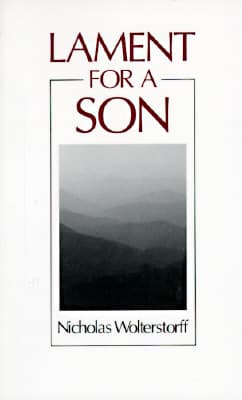
Lament for a Son cover
Archivist's Choice

Lament for a Son

Nicholas Wolterstorff (1987)

Genre

Biography / Memoir / Spirituality / Philosophy

Reading Time

90 min

Key Themes

See below

Track Your Reading

Sign in to track this book

After his son Eric's sudden death, a philosopher turns his grief into a personal and moving lament, giving voice to the pain of loss and the strength of love.

Core Idea

Wolterstorff's "Lament for a Son" is a deeply personal reflection on grief after his 25-year-old son's sudden death. It argues that grief is not just an emotion to overcome, but a lasting part of love itself, a 'love-song' for the person lost. The book challenges common ideas of 'getting over' grief, stating that true healing involves accepting the permanence of loss, the shattering of life's expectations, and the lasting weight of memory, even while struggling with faith and the limits of philosophy or theology. Through short reflections, letters, and poetic writing, Wolterstorff shows how grief makes the general human experience of loss specific, appearing differently in each relationship. He explores the physical, intellectual, and spiritual disruption caused by such a tragedy, ultimately suggesting that we honor the deceased by honestly facing the pain, rather than seeking quick closure or easy comfort. The book presents grief as proof of deep love, an ongoing connection with the absent loved one.
Reading time
90 min
Difficulty
Medium
✓ Read this if...
You are experiencing profound grief, seeking a raw, honest, and philosophically rich exploration of loss, or wish to understand the enduring nature of sorrow and love after bereavement. It is particularly insightful for those grappling with faith during suffering.
✗ Skip this if...
You are looking for practical grief recovery steps, a self-help guide to 'moving on,' or prefer a linear, narrative-driven memoir over fragmented, reflective prose.

Core idea

The central argument and framework that powers the entire book.

Wolterstorff's "Lament for a Son" is a deeply personal reflection on grief after his 25-year-old son's sudden death. It argues that grief is not just an emotion to overcome, but a lasting part of love itself, a 'love-song' for the person lost. The book challenges common ideas of 'getting over' grief, stating that true healing involves accepting the permanence of loss, the shattering of life's expectations, and the lasting weight of memory, even while struggling with faith and the limits of philosophy or theology.

Through short reflections, letters, and poetic writing, Wolterstorff shows how grief makes the general human experience of loss specific, appearing differently in each relationship. He explores the physical, intellectual, and spiritual disruption caused by such a tragedy, ultimately suggesting that we honor the deceased by honestly facing the pain, rather than seeking quick closure or easy comfort. The book presents grief as proof of deep love, an ongoing connection with the absent loved one.

At a glance

Reading time

90 min

Difficulty

Medium

Read this if...

You are experiencing profound grief, seeking a raw, honest, and philosophically rich exploration of loss, or wish to understand the enduring nature of sorrow and love after bereavement. It is particularly insightful for those grappling with faith during suffering.

Skip this if...

You are looking for practical grief recovery steps, a self-help guide to 'moving on,' or prefer a linear, narrative-driven memoir over fragmented, reflective prose.

Key Takeaways

1

Grief as a Love-Song

Lament is not the opposite of love, but its profound expression in the face of loss.

Quote

Every lament, after all, is a love-song.

Wolterstorff reframes grief not as a problem to be fixed, but as a natural, though painful, part of love itself. The act of lamenting—the crying, the empty feeling, the constant memory—shows the depth of the past connection. To suppress grief is, in a way, to deny the love that was. His open sorrow for Eric is not a weakness but proof of the strong bond he shared with his son. This view challenges the societal tendency to see grief as something to 'get over,' instead inviting us to see it as an ongoing expression of lasting love that ...

Supporting evidence

Wolterstorff's entire narrative is a sustained lament for Eric, demonstrating through his own experience how his grief is inextricably linked to his deep love and remembrance of his son.

Apply this

When facing loss, consciously acknowledge that your pain is a manifestation of love. Instead of trying to suppress or 'move past' the grief, allow yourself to feel it as a continuing connection to the one you've lost, reframing sorrow as a 'love-song' rather than a burden.


grief-as-loveenduring-lovereframing-grief
2

The Particularity of Grief's Universality

Deeply personal sorrow resonates universally, giving voice to shared human experiences of loss.

Quote

What he learned, to his surprise, is that in its particularity there is universality.

Wolterstorff wrote 'Lament for a Son' as a personal expression of grief for his son Eric. Yet, he found that its specific details—the recounting of his unique pain, memories, and questions—deeply resonated with many readers experiencing their own forms of loss. This shows a key truth: while each grief is unique in its origin, the underlying human experience of deep absence, longing, and shattered expectations is widely shared. By bravely expressing his distinct sorrow, Wolterstorff created a universal language for pain, showing that t...

Supporting evidence

Wolterstorff's own account of receiving letters from many readers who had lost children, other relatives, or experienced different forms of loss, all finding their own pain voiced in his specific narrative.

Apply this

When experiencing or supporting someone through grief, don't shy away from the specific details of the loss. Recognize that sharing the unique aspects of sorrow can create deeper connection and understanding, offering solace through shared humanity rather than generic platitudes.

universal-griefshared-humanityempathy-through-narrative
3

The Shattering of Expectations

Grief isn't just loss of a person, but the violent demolition of a future that was anticipated.

Quote

What does a parent do with a child's future, when the child is gone?

Wolterstorff describes a part of parental grief beyond the immediate pain of absence: the shattering of a future that was expected. Parents invest not only in their child's present but also in their imagined future—milestones, achievements, relationships, and even their own eventual role as grandparents. Eric's death did not just end his life; it destroyed a lifetime of shared expectations, dreams, and stories Wolterstorff had subconsciously woven. This 'loss of future' is a distinct and agonizing part of grief, leaving a void where v...

Supporting evidence

Wolterstorff's reflections on Eric's unfulfilled potential, the life he would never live, and the future interactions and joys that would never materialize between them.

Apply this

When processing grief, allow yourself to mourn not just the person, but also the future you had envisioned with them. Acknowledge the 'shattered expectations' as a valid and significant part of your loss, giving yourself permission to grieve for what will never be.

anticipatory-griefunfulfilled-futureshattered-dreams
4

The Impossibility of 'Getting Over' Grief

Grief is not a temporary affliction to be overcome, but an enduring landscape to be navigated.

Quote

I shall never forget Eric. I shall never get over it.

Wolterstorff rejects the idea that grief is something one 'gets over.' Instead, he describes it as an ongoing process, a changed state of being that permanently alters the individual. His sorrow for Eric is not a wound that heals completely and vanishes, but a deep change to his inner world. He understands that while the sharpest pain may lessen, the absence, the memory, and the love will persist. This view challenges the common societal pressure to quickly 'recover' from loss, advocating instead for grief as a lifelong companion that...

Supporting evidence

Wolterstorff's consistent language throughout the book, emphasizing his continued lament and the permanent mark Eric's death has left on him, rather than suggesting any endpoint to his grief.

Apply this

Release the pressure to 'get over' grief. Understand that it is a permanent change, and your task is to learn how to live with the loss, integrate it into your life, and allow your love and memories to endure, even if they are accompanied by sorrow.

enduring-griefgrief-journeyliving-with-loss
5

Questioning God in the Midst of Pain

Authentic faith allows for honest anger and profound questioning in the face of tragedy.

Quote

Why, God, why?

As a theologian, Wolterstorff openly expresses his anger and confusion towards God after Eric's death. His faith is not a shield against questioning, but a framework within which he struggles with the incomprehensible. He offers no easy theological answers or platitudes; instead, he models an honest dialogue with the divine. This shows that true faith can include doubt, anger, and unanswerable questions, rather than demanding blind acceptance. His lament is, in part, a lament to God, a desperate cry for understanding that acknowledges...

Supporting evidence

Wolterstorff's direct addresses to God throughout the book, questioning His justice, His presence, and the meaning behind Eric's premature death, without abandoning his faith.

Apply this

If you are a person of faith experiencing loss, give yourself permission to question, to be angry, and to lament to God. Recognize that this honest wrestling can be a profound act of faith, rather than a sign of its absence, and can deepen your spiritual understanding.

faith-and-doubttheodicyspiritual-wrestling
6

The Weight of Memory's Persistence

Memories, while precious, can also be a source of persistent pain in grief.

Quote

The memory of Eric is not just a comfort; it is also a constant reminder of what is lost.

While memories of a loved one are often cherished for comfort, Wolterstorff shows their dual nature in deep grief. For him, every cherished memory of Eric—his laugh, his adventures, his aspirations—is also a sharp reminder of his absence. These memories do not just bring joy; they highlight the stark reality of what is no longer. The persistence of memory ensures that the pain of loss is continually refreshed, preventing any easy escape. It is a bittersweet paradox: the very things that connect him to Eric also emphasize the gaping vo...

Supporting evidence

Wolterstorff recounts specific memories of Eric's life, explaining how each memory, while beautiful, also brings with it the renewed sting of loss and the realization that new memories will never be made.

Apply this

Acknowledge the complex role of memories in grief. Allow yourself to feel both the comfort and the pain they bring. Understand that it's okay for memories to be bittersweet, and that this duality is a natural part of the grieving process.

bittersweet-memoriesmemory-and-griefremembrance-pain
7

The Body's Grief and the Mind's Unbelief

Grief manifests as a visceral, physical experience, often preceding mental acceptance.

Quote

My body knows he is gone, even when my mind tries to argue otherwise.

Wolterstorff vividly describes grief not just as an emotional or intellectual experience but as a deep physical affliction. He speaks of a bodily ache, a visceral emptiness, and a sense of physical disorientation. His body reacts to Eric's absence even before his mind fully processes the finality of death. This emphasizes that grief is a holistic experience, affecting every part of being. The body's intuitive, primal response to loss often moves faster than the mind's ability to understand, leading to a disorienting disconnect where o...

Supporting evidence

Wolterstorff's descriptions of his physical sensations of grief, the 'emptiness' he feels, and the way his body seems to 'search' for Eric even when his mind understands the reality of death.

Apply this

Pay attention to the physical manifestations of your grief. Allow yourself to rest, nourish your body, and acknowledge its role in processing loss. Don't dismiss physical symptoms as merely psychological; they are a valid part of your grieving experience.

embodied-griefsomatic-griefphysical-toll-of-loss
8

The Inadequacy of Explanations

In profound grief, intellectual explanations and theological justifications often fall flat.

Quote

There are no explanations that can make this right.

As a philosopher and theologian, Wolterstorff is well-suited to examine the inadequacy of various explanations or theological frameworks often offered to those in grief. He finds little comfort in arguments about God's mysterious plan, the idea of 'everything happening for a reason,' or even the promise of reunion. These intellectual ideas, while perhaps comforting in other contexts, fail to address the raw, immediate pain of Eric's absence. His experience shows that deep grief is not a problem to be solved with logic or doctrine, but...

Supporting evidence

Wolterstorff's internal struggle with his own theological training and philosophical understanding, finding them insufficient to assuage his immediate, overwhelming sorrow for Eric.

Apply this

When comforting someone in grief, prioritize presence and empathy over offering explanations or platitudes. Understand that intellectual solutions rarely ease emotional pain, and simply being there to witness their suffering is often the most profound support you can offer.

grief-and-logicempty-platitudesempathetic-presence
9

Honoring Through Acknowledgment

To truly honor the lost, one must fully acknowledge and voice their absence.

Quote

To honor Eric, I must voice my grief.

Wolterstorff's act of writing 'Lament for a Son' is itself an act of honoring. He does not avoid the pain, but leans into it, understanding that to truly honor Eric is to acknowledge the immense void his death created. This suggests that avoiding grief or pretending it does not exist diminishes the person lost. By openly lamenting, Wolterstorff keeps Eric's memory alive, not just as a static image, but as a dynamic presence whose absence continues to shape him. This view encourages mourners to embrace their grief as an active form of ...

Supporting evidence

The entire book serves as evidence, being a sustained act of lament and remembrance, explicitly written to honor Eric's life and the depth of the author's love and loss.

Apply this

Allow yourself to openly grieve and speak of your lost loved one. Understand that expressing your sorrow and acknowledging their absence is a powerful way to honor their memory and the impact they had on your life.

active-remembrancegrief-as-honorvoicing-loss
10

The Uniqueness of Each Loss

While grief is universal, the specific contours of each individual's loss are profoundly unique.

Quote

Though many have lost children, no one has lost Eric but me.

Despite the universality of grief that 'Lament for a Son' reveals, Wolterstorff never loses sight of the unique nature of his loss. He acknowledges that while others may experience losing a child, no one else lost his Eric, with his specific personality, memories, and future. This highlights a critical nuance in understanding grief: while empathy can bridge divides, the individual experience of loss remains deeply personal. It cautions against comparing griefs or assuming perfect understanding of another's pain. Each relationship is...

Supporting evidence

Wolterstorff's detailed descriptions of Eric's distinct character, his specific dreams, and the unique bond they shared, emphasizing that while others mourn, their grief is not identical to his own.

Apply this

When encountering someone grieving, avoid minimizing their pain by comparing it to others' experiences. Instead, validate the unique nature of their loss and the specific relationship they had, offering support that respects their individual journey.

individual-griefunique-lossnon-comparative-grief

Critical analysis

Notable Quotes

I shall not cease to love him. I shall not cease to be his father. Nor shall he cease to be my son.

Wolterstorff's unwavering parental love and identity after his son's death.

Death is not merely the end of life; it is the end of *this* life, this particular, unrepeatable life.

Reflecting on the unique and irreplaceable nature of the individual life lost.

Expressing a profound connection to his grief, almost a refusal to let go of the pain.

Describing the visceral and existential impact of bereavement.

Challenging the societal perception of grief and tears as a weakness.

What is it like to lose a child? It is to lose the future.

Highlighting the devastating impact of a child's death on a parent's hopes and future.

I find myself wanting to scream, to pound on the table, to rage against the injustice of it all.

Expressing raw anger and frustration at the unfairness of his son's death.

The memory of him is not a substitute for his presence.

Distinguishing between cherished memories and the painful absence of his son.

We live in the present, but we remember the past, and we hope for the future.

A broader reflection on human existence, touched by the interplay of time.

Grief is not a problem to be solved, but a reality to be lived through.

A crucial insight into the nature of grief, advocating for acceptance rather than eradication.

He was not just a son; he was a person, a unique and irreplaceable person.

Emphasizing the individuality and irreplaceability of his son, beyond his role as a family member.

And the world goes on, heedless. That is what hurts.

The painful contrast between his personal tragedy and the indifferent continuation of the world.

The wound of loss is not a scar that heals completely, but a part of who one becomes.

Suggesting that profound loss permanently alters one's identity rather than just leaving a healed mark.

Expressing his profound struggle with faith and the problem of evil in the face of his son's death.

Quiz

Test Your Knowledge

Ready to see how well you understood this book? Take our interactive quiz with 10 questions.

10
Questions
~5
Minutes
?
Best Score

Key Questions (FAQ)

'Lament for a Son' is Nicholas Wolterstorff's deeply personal memoir chronicling his grief after the sudden death of his son, Eric, in a mountain-climbing accident. It explores themes of loss, faith, and the enduring nature of love amidst profound sorrow.

About the author