BookBrief
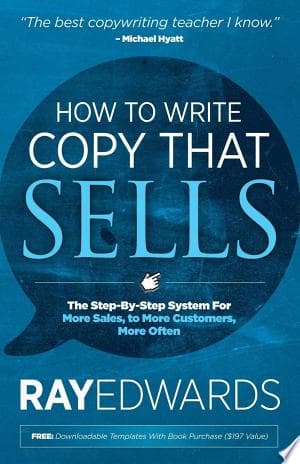
How to Write Copy That Sells cover
Archivist's Choice

How to Write Copy That Sells

Ray Edwards (2016)

Genre

Marketing

Reading Time

180 min

Key Themes

See below

Track Your Reading

Sign in to track this book

Learn to write persuasive copy that sells without sounding like a salesperson, turning your words into an effective tool across all platforms.

Core Idea

Good sales copy is not about manipulation; it is about clear, empathetic communication that helps your ideal customer. It shows how your product or service solves their problems and helps them reach their goals. By using a structured method, understanding customer needs, and presenting a strong solution with benefits, stories, and proof, anyone can write copy that drives action and builds trust. The key is understanding human behavior, writing to one person, and making a clear, appealing offer.
Reading time
180 min
Difficulty
Easy
✓ Read this if...
You want a practical, step-by-step framework for writing persuasive sales copy that connects with customers and drives conversions, without resorting to manipulative tactics.
✗ Skip this if...
You are looking for advanced psychological deep dives into consumer behavior or already have a robust, proven copywriting system in place.

Core idea

The central argument and framework that powers the entire book.

Good sales copy is not about manipulation; it is about clear, empathetic communication that helps your ideal customer. It shows how your product or service solves their problems and helps them reach their goals. By using a structured method, understanding customer needs, and presenting a strong solution with benefits, stories, and proof, anyone can write copy that drives action and builds trust. The key is understanding human behavior, writing to one person, and making a clear, appealing offer.

At a glance

Reading time

180 min

Difficulty

Easy

Read this if...

You want a practical, step-by-step framework for writing persuasive sales copy that connects with customers and drives conversions, without resorting to manipulative tactics.

Skip this if...

You are looking for advanced psychological deep dives into consumer behavior or already have a robust, proven copywriting system in place.

Key Takeaways

1

The P.A.S.T.O.R. Framework

A structured approach to persuasive copywriting.

Quote

The PASTORS framework is a simple, yet powerful way to ensure your copy addresses all the key elements of persuasion.

Edwards presents the P.A.S.T.O.R. framework as a complete plan for writing strong sales copy. This stands for Problem, Amplify, Story/Solution, Transformation, Offer, and Response. It guides copywriters through the entire persuasion process, from finding a customer's problem to getting them to act. By addressing each part, copywriters can build a logical and emotional argument that directly speaks to the reader's needs and desires. This removes the 'salesy' feel and replaces it with a helpful, guiding tone. This framework is a strateg...

Supporting evidence

The entire book is structured around this framework, with each chapter often dedicated to explaining one component. Edwards provides numerous examples of how each step plays out in real-world copy.

Apply this

Before writing any sales copy, outline your content using the P.A.S.T.O.R. framework. Start by clearly defining the 'Problem' your audience faces, then 'Amplify' it with vivid descriptions. Next, share a 'Story' or present your 'Solution,' detailing the 'Transformation' it brings. Finally, present your 'Offer' and guide them to a clear 'Response.'
copywriting-frameworkspersuasion-techniquessales-funnel
2

Speak to One Person

Tailor your message to an ideal customer avatar.

Quote

When you try to speak to everyone, you speak to no one.

A main idea Edwards stresses is the importance of writing to one ideal customer. Instead of talking to a large group, copy becomes much better when written for a specific person, your 'customer avatar.' This means understanding their background, beliefs, problems, desires, goals, and even their daily life. By imagining this one person, their struggles, and their hopes, the copywriter can use words that connect deeply and personally. This makes the reader feel seen, understood, and that the message was written just for them, cutting th...

Supporting evidence

Edwards frequently advises creating a detailed customer avatar, going beyond basic demographics to include their emotional landscape and specific pain points. He contrasts this with vague, ineffective copy that tries to appeal to everyone.

Apply this

Before writing, create a detailed customer avatar. Give them a name, age, profession, hobbies, and most importantly, document their core problems and desires related to your product. Write your copy as if you're having a one-on-one conversation with this specific person.

customer-avatartarget-audiencepersonalization
3

Headlines are 80% of the Battle

The critical role of compelling headlines in attracting attention.

Quote

On average, five times as many people read the headline as read the body copy. When you have written your headline, you have spent eighty cents out of your dollar.

Edwards agrees with David Ogilvy that the headline is the most important part of any copy. In today's world where attention is scarce, a headline's main job is to stop someone from scrolling, get their immediate interest, and make them want to read the rest of the message. A weak or general headline means even the best body copy will not be read. Edwards gives various headline formulas and psychological triggers, such as curiosity, benefit-focused statements, and urgent calls, to make them more effective. He argues that spending signi...

Supporting evidence

Edwards dedicates significant space to headline writing techniques, providing specific examples of effective headlines and discussing their underlying psychological principles, such as 'How-to,' 'Benefit-driven,' and 'Question' headlines.

Apply this

Brainstorm at least 10-20 headlines for every piece of copy. Experiment with different angles: benefit-driven, curiosity-inducing, problem-solution, and direct. Test which headlines perform best using A/B testing where possible.

headline-formulasattention-grabbingcopywriting-elements
4

Benefits, Not Features

Translate product features into tangible customer advantages.

Quote

People don't buy products; they buy solutions to their problems and the feelings those solutions create.

A common mistake in copywriting is listing features without explaining how they directly help the customer. Edwards states that customers care less about the 'what' (features) and more about 'what's in it for me?' (benefits). A feature describes a product's characteristic, while a benefit explains how that feature improves the customer's life, solves a problem, or fulfills a desire. Good copy turns technical details into real results, emotional gains, and practical advantages. For example, instead of saying 'our camera has 50 megapixe...

Supporting evidence

Edwards provides numerous examples comparing feature-focused copy with benefit-focused copy, clearly demonstrating how the latter resonates more powerfully with potential buyers by addressing their underlying needs and desires.

Apply this

For every feature of your product or service, ask 'So what?' or 'What does this mean for the customer?' several times until you arrive at a clear, emotional, or practical benefit. Focus your copy on these benefits.

value-propositioncustomer-centricmarketing-messaging
5

The Power of Story

Engage emotions and build trust through narrative.

Quote

Stories bypass the logical, analytical mind and go straight to the emotional core, where decisions are often made.

Edwards supports storytelling as a necessary tool in persuasive copywriting. People are naturally drawn to stories; stories get attention, make information memorable, and create empathy in ways that facts alone cannot. By sharing a relatable struggle, a journey of change, or a success story (your own, a customer's, or a metaphor), copywriters can build a deep emotional connection with their audience. Stories build trust, make the 'sales' feel less pushy, and help potential customers imagine themselves getting similar good results. The...

Supporting evidence

Edwards integrates storytelling into the 'S' (Story/Solution) component of his P.A.S.T.O.R. framework, highlighting its role in building rapport and illustrating the effectiveness of a solution. He shares anecdotes and examples of how stories resonate.

Apply this

Incorporate personal anecdotes, customer testimonials formatted as mini-stories, or relatable metaphors into your copy. Structure your stories with a clear character, conflict, and resolution that aligns with the transformation your product offers.

narrative-marketingemotional-connectionpersuasive-writing
6

The Irresistible Offer

Crafting a value proposition that's impossible to refuse.

Quote

Your offer isn't just your product; it's the entire package of value, bonuses, guarantees, and scarcity that makes it a no-brainer.

An effective offer is more than just stating a product's price. Edwards teaches that an 'irresistible offer' is a carefully put-together package of perceived value that seems much greater than the cost to the customer. This involves adding extra bonuses, offering strong guarantees to reduce risk, creating urgency or scarcity to encourage immediate action, and clearly explaining the value of everything included. The goal is to make buying feel like a clear, logical choice rather than a risky gamble. By increasing perceived value and lo...

Supporting evidence

Edwards dedicates a section to 'The Offer' within his P.A.S.T.O.R. framework, detailing elements like bonuses, guarantees, and urgency/scarcity. He provides examples of how to stack value.

Apply this

Beyond your core product, brainstorm valuable bonuses that complement it. Develop a strong, risk-reversing guarantee. Consider adding time-sensitive urgency or limited-quantity scarcity to encourage immediate action. Clearly articulate the total value of the entire package.

value-stackingsales-psychologyconversion-optimization
7

Call to Action: Be Specific

Guide your audience to a clear, singular next step.

Quote

Don't make your reader guess what you want them to do next. Tell them precisely, and tell them often enough.

The 'Response' (or Call to Action) is the result of all your persuasive efforts, and Edwards insists it must be completely clear and specific. Vague calls to action ('Learn More,' 'Click Here') leave the reader unsure and often lead to no action. Instead, copywriters should use strong, benefit-focused verbs that tell the reader a single, obvious next step ('Get Your Free Guide Now,' 'Enroll in the Course Today,' 'Schedule Your Consultation'). Also, the CTA should be placed throughout the copy, not just at the end, and be easy to see. ...

Supporting evidence

The 'R' in P.A.S.T.O.R. stands for Response, where Edwards emphasizes the need for a clear, singular call to action. He compares vague CTAs with specific, benefit-driven ones, showing the impact on conversion.

Apply this

Ensure every piece of copy has one primary, clear call to action. Use active, benefit-oriented language (e.g., 'Claim Your Discount' instead of 'Submit'). Make it visually distinct and repeat it strategically at key points in your copy.

call-to-actionconversion-rate-optimizationuser-experience
8

Embrace the 'Why' Behind the Buy

Understand the deep emotional motivators of your customers.

Quote

Logic makes people think, but emotion makes people act.

Edwards often repeats that buying decisions are rarely purely logical. While features and facts provide reasons, the main drive to buy is almost always emotional. Copywriters must understand the 'why' behind a purchase, what deep desires, fears, goals, or problems the customer is trying to address. Is it status, security, love, freedom, comfort, or belonging? By understanding and directly speaking to these core emotional drivers, copy can create a much stronger connection and get a more powerful response. This involves empathy and psy...

Supporting evidence

Throughout the book, Edwards connects copy techniques to underlying psychological principles. His emphasis on amplifying the 'Problem' and presenting the 'Transformation' in the P.A.S.T.O.R. framework directly addresses emotional motivators.

Apply this

When defining your customer avatar, spend significant time identifying their core emotional drivers. Ask 'why' multiple times to uncover the deeper reasons they seek a solution. Weave these emotional appeals into your headlines, stories, and benefit statements.

consumer-psychologyemotional-marketinghuman-desires
9

The Importance of Proof and Credibility

Build trust and reduce skepticism with undeniable evidence.

Quote

In a world full of hype, proof is your most powerful ally.

In a market that is increasingly doubtful, Edwards highlights the important role of proof and credibility in overcoming objections and building trust. Simply making claims, no matter how strong, is often not enough. Copy needs to be supported by real evidence that shows the product works and the seller is trustworthy. This includes testimonials, case studies, statistics, social proof (e.g., number of happy customers), endorsements, and guarantees. By providing verifiable proof, copywriters can remove doubts, reduce perceived risk, and...

Supporting evidence

Edwards consistently refers to the need for evidence to support claims, especially when discussing the 'Story/Solution' and 'Offer' components. He advocates for using testimonials, case studies, and statistics to build credibility.

Apply this

Integrate specific testimonials (with names and photos if possible), relevant statistics, case study snippets, and strong guarantees into your sales copy. Highlight any awards, certifications, or media mentions your product or company has received.

social-proofcredibility-buildingtrust-marketing
10

Practice and Persistence

Copywriting is a skill developed through consistent effort.

Quote

The more you write, the better you get. There are no shortcuts to becoming a master copywriter.

While Edwards provides frameworks and techniques, he always emphasizes that good copywriting is a skill built through dedicated practice and effort. It is not about finding a 'magic solution' but about continuous learning, trying new things, and improving. He encourages aspiring copywriters to write daily, study successful copy, and not be afraid of failure or rewriting. Becoming a master copywriter involves many hours of writing, testing, and making changes. This reminder grounds the reader, showing that while the book offers valuabl...

Supporting evidence

Edwards' overall tone throughout the book implies that these are skills to be developed. He often encourages readers to 'do the work' and apply the frameworks rather than just passively consume them.

Apply this

Commit to a regular writing schedule, even if it's just 15-30 minutes daily. Analyze successful ads and sales pages, trying to reverse-engineer their strategies. Don't be afraid to write multiple drafts and continually refine your copy based on results and feedback.

skill-developmentdeliberate-practicecopywriting-mastery

Critical analysis

Notable Quotes

People don't buy products or services. They buy solutions to their problems, and they buy good feelings.

Explaining the fundamental driver of purchasing decisions.

Your job as a copywriter is to enter the conversation already happening in your prospect's mind.

Emphasizing the importance of understanding the customer's internal monologue.

The purpose of a headline is to get the first sentence read. The purpose of the first sentence is to get the second sentence read.

Illustrating the sequential goal of compelling copy.

Features tell, benefits sell.

A classic copywriting principle distinguishing between product attributes and their value.

The more you tell, the more you sell.

Advocating for detailed and comprehensive copy, especially for complex or high-ticket items.

People will do anything for those who encourage their dreams, justify their failures, allay their fears, confirm their suspicions, and help them throw rocks at their enemies.

A powerful summary of human motivation and how to connect with it emotionally.

Always write to one person, your ideal customer.

Highlighting the importance of a clear target audience for effective messaging.

Clarity trumps persuasion. If people don't understand what you're offering, they can't buy it.

Prioritizing clear communication above clever rhetoric.

Every word you write should either build desire or remove resistance.

A concise framework for evaluating the effectiveness of each piece of copy.

The greatest danger in marketing is to be boring.

Warning against bland or unengaging content that fails to capture attention.

Your offer is more important than your copy.

Stressing that a compelling product/service is foundational, even for great copy.

Sell the destination, not the plane ride.

Focusing on the end result or transformation the customer will experience, rather than the process.

People buy with emotion and justify with logic.

Explaining the dual role of emotion and reason in the buying process.

Proof is the most powerful weapon in your copy arsenal.

Emphasizing the critical role of evidence and testimonials in building trust.

Quiz

Test Your Knowledge

Ready to see how well you understood this book? Take our interactive quiz with 10 questions.

10
Questions
~5
Minutes
?
Best Score

Key Questions (FAQ)

Copywriting is the art and science of strategically delivering words that get people to take some form of action. It's crucial for selling because it directly persuades potential customers to buy products or services, driving revenue and business growth.

About the author