BookBrief
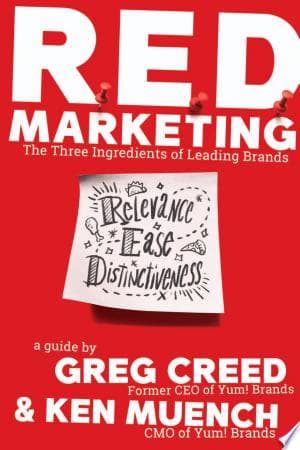
R.E.D. Marketing cover
Archivist's Choice

R.E.D. Marketing

Greg Creed (2021)

Genre

Business / Marketing

Reading Time

240 min

Key Themes

See below

Track Your Reading

Sign in to track this book

Learn the secrets behind Taco Bell and KFC's growth with 'R.E.D. Marketing,' a guide from Yum! Brands' former CEO that breaks down successful campaigns into three clear ideas: Relevance, Ease, and Distinctiveness.

Core Idea

R.E.D. Marketing says that lasting brand success today depends on combining Relevance, Ease, and Distinctiveness. The book argues that brands must connect with current culture to stay relevant, remove problems from every customer step to ensure ease, and create unique features that make them stand out. Ignoring any of these three weakens the entire marketing effort, leading to less impact and growth.
Reading time
240 min
Difficulty
Medium
✓ Read this if...
You are a marketing professional, business leader, or entrepreneur looking for a practical, actionable framework to enhance your brand's market effectiveness and drive sustainable growth.
✗ Skip this if...
You are looking for a deep dive into highly technical marketing analytics or a purely academic exploration of marketing theory without practical application.

Core idea

The central argument and framework that powers the entire book.

R.E.D. Marketing says that lasting brand success today depends on combining Relevance, Ease, and Distinctiveness. The book argues that brands must connect with current culture to stay relevant, remove problems from every customer step to ensure ease, and create unique features that make them stand out. Ignoring any of these three weakens the entire marketing effort, leading to less impact and growth.

At a glance

Reading time

240 min

Difficulty

Medium

Read this if...

You are a marketing professional, business leader, or entrepreneur looking for a practical, actionable framework to enhance your brand's market effectiveness and drive sustainable growth.

Skip this if...

You are looking for a deep dive into highly technical marketing analytics or a purely academic exploration of marketing theory without practical application.

Key Takeaways

1

The R.E.D. Marketing Trinity

Achieve breakthrough growth by mastering Relevance, Ease, and Distinctiveness.

Quote

Marketing works in three very different ways: Relevance—Is it relevant to the marketplace? Ease—Is it easy to access and use? Distinction—Does it stand out from competition?

Creed's R.E.D. framework is a simple yet effective way to grow a brand, avoiding complex terms for practical ideas. It states that successful marketing campaigns must address three main points: Relevance, Ease, and Distinctiveness. Relevance means your product meets current market needs and customer desires. Ease means customers can find, buy, and use your product or service without trouble. Distinctiveness means creating a unique identity and offering that stands out. Ignoring any of these points can hurt a campaign, wasting money an...

Supporting evidence

Creed applied the R.E.D. method to lead Taco Bell and KFC to double-digit growth during his tenure as CEO and CMO respectively, demonstrating its real-world efficacy in challenging market conditions.

Apply this

Before launching any new product or campaign, rigorously evaluate it against the R.E.D. criteria. Ask: 'Is this truly relevant to my target audience right now? How can I make it even easier for them to engage? What makes this distinctly different from every other option out there?' Prioritize improvements in the weakest area.

marketing-frameworksbrand-strategycustomer-centricity
2

Relevance: Tapping into the Zeitgeist

Connect with consumers by understanding their current needs, culture, and context.

Quote

Is it relevant to the marketplace?

Relevance is the base of R.E.D. Marketing. It means brands must match current customer desires, cultural trends, and market conditions. A product must be good for now. This requires understanding target customers, their changing lives, problems, goals, and even wider social talks. A brand that isn't relevant risks becoming old, no matter its past successes. Relevance is not fixed; it needs constant attention and change to ensure the brand's message and products truly connect with the present.

Supporting evidence

Taco Bell's turnaround under Creed involved re-establishing relevance by understanding the evolving tastes and lifestyles of its target demographic, moving beyond just 'fast food' to 'food as experience' and late-night cravings.

Apply this

Conduct regular ethnographic research, social listening, and trend analysis to identify shifts in consumer behavior and cultural currents. Adapt messaging, product features, and even distribution channels to align with these insights, ensuring your brand always feels timely and essential.

market-researchconsumer-insightscultural-trends
3

Ease: Frictionless Customer Journeys

Remove obstacles to make interaction and consumption effortless.

Quote

Is it easy to access and use?

Ease means making every step of the customer's journey simple, from first seeing a product to getting help after buying it. Today, customers don't have patience for things that are complicated or inconvenient. A product, even if it's relevant or unique, will struggle if it's hard to find, buy, or use. Creed stresses making processes smooth, choices simple, and access easy. This applies to the product itself and the whole brand experience — website navigation, ordering, customer service, and clear communication. Brands that prioritize ...

Supporting evidence

The proliferation of drive-thrus, mobile ordering apps, and simplified menus across fast-food chains like Taco Bell and KFC directly addresses the need for ease, making it quicker and simpler for customers to get their food.

Apply this

Map out your entire customer journey and identify every potential point of friction. Implement A/B testing on website flows, simplify ordering processes, improve delivery logistics, and ensure customer support is easily accessible and efficient.

customer-experienceuser-experienceoperational-efficiency
4

Distinctiveness: Standing Out from the Crowd

Forge a unique identity that captivates and differentiates.

Quote

Does it stand out from competition?

Distinctiveness is a brand's unique mark, its ability to get noticed and remembered among competitors. It's not just about being different, but about creating a memorable identity, a unique voice, and a clear value that sets you apart. This can show up in new product features, a strong brand story, a unique look, or even a specific way of handling customer service. Without distinctiveness, even relevant and easy products risk blending in, becoming common and forgettable. Creed argues that true distinctiveness creates an emotional bond...

Supporting evidence

Taco Bell's 'Live Más' campaign and its adventurous menu items (e.g., Doritos Locos Tacos) are prime examples of creating distinctiveness that resonated deeply with its target demographic, moving it beyond a generic fast-food chain.

Apply this

Identify your brand's core strengths and unique selling propositions. Develop a consistent brand voice, visual identity, and messaging that clearly communicates what makes you different and why it matters. Don't be afraid to take bold creative risks that align with your brand's essence.

brand-identitydifferentiationunique-selling-proposition
5

The Synergy of R.E.D.

Optimize all three pillars for exponential marketing impact.

Quote

By combining actual examples from Yum! and other recognizable brands... your brand can set and achieve a truly breakthrough marketing campaign utilizing R.E.D Marketing.

The real power of R.E.D. Marketing comes from using all three points together, not just mastering one. A relevant product that is hard to get will fail. An easy-to-use product that looks like others will struggle for sales. A unique product that no one needs will be ignored. Creed shows that when relevance, ease, and distinctiveness all work well, they create a strong loop that drives brand growth. This complete approach ensures marketing efforts are not separate but work together for a single, effective goal, leading to lasting advan...

Supporting evidence

The combined success of Taco Bell and KFC under Creed's leadership, achieving double-digit growth, is attributed to the integrated application of the R.E.D. framework across all aspects of their marketing and operations.

Apply this

Instead of siloed teams focusing on individual aspects, foster cross-functional collaboration. For instance, product development should work closely with marketing on relevance and distinctiveness, while operations and digital teams focus on ease. Regularly audit how all three elements interact and reinforce each other.

integrated-marketingholistic-strategycompetitive-advantage
6

Beyond Product: Marketing the Experience

R.E.D. applies to the entire customer journey, not just the offering.

Quote

This book... will help everyone in your company understand what really works for driving sustainable brand growth and business success.

Creed's R.E.D. method goes beyond just product features to include the entire customer experience. It highlights that every customer interaction with a brand — from an ad to a store visit, from using an app to getting customer service — must show relevance, ease, and distinctiveness. This means everyone in the company must understand and commit to these ideas. When every department, from product development to operations, sales, and support, uses R.E.D., the brand gives a consistent, appealing, and smooth experience. This full approac...

Supporting evidence

The book's assertion that 'everyone in your company' should understand R.E.D. implies its application across all business functions, not just the marketing department, for a truly integrated brand experience.

Apply this

Train all employees, regardless of their role, on the R.E.D. principles and how their daily tasks contribute to relevance, ease, and distinctiveness for the customer. Empower teams to identify and resolve friction points or enhance unique brand elements within their areas of responsibility.

brand-experiencecustomer-journey-mappingorganizational-culture
7

Simplicity as a Strategic Advantage

Complex problems demand simple, actionable frameworks.

Quote

It’s simple methodology does not require complicated terms and a PhD to understand, it’s actually quite simple.

A main idea of Creed's R.E.D. Marketing is the power of simplicity. In a business world often filled with complicated ideas, a clear, easy-to-understand framework like R.E.D. is a major advantage. Its simplicity means anyone in an organization, from staff to leaders, can understand and use it. This widespread understanding helps everyone work together and allows for quick, firm action. The simplicity also encourages clear thinking, making marketers focus on the basic reasons for growth, rather than getting stuck in overly complex plan...

Supporting evidence

Creed explicitly states that the R.E.D. methodology 'does not require complicated terms and a PhD to understand,' underscoring its inherent simplicity and broad applicability.

Apply this

Always strive for clarity and conciseness in your marketing strategies and internal communications. When presenting ideas, distill them down to their core R.E.D. components. Encourage a culture where complex problems are broken down into simple, actionable steps.

strategic-simplicityactionable-insightsorganizational-alignment
8

Data, Neuroscience, and Behavioral Economics

Leverage scientific insights to refine R.E.D. execution.

Quote

By combining actual examples... with the latest findings in marketing, neuroscience, and behavioral economics...

While R.E.D. provides the main framework, Creed stresses that its use must be based on modern science. Recent findings in marketing science, neuroscience, and behavioral economics offer strong tools to improve how relevance is found, ease is designed, and distinctiveness is shared. Data analysis can show changing customer behaviors (relevance). Behavioral economics can guide design choices that reduce problems (ease). Neuroscience can help with creative decisions that make a brand more memorable and effective (distinctiveness). This s...

Supporting evidence

The book explicitly mentions integrating 'the latest findings in marketing, neuroscience, and behavioral economics' with the R.E.D. framework, indicating a scientific approach to its application.

Apply this

Invest in data analytics capabilities to track consumer behavior and campaign performance. Incorporate principles from behavioral economics (e.g., choice architecture, framing effects) into your product design and marketing messages. Use A/B testing and experimentation to scientifically validate R.E.D.-driven initiatives.

marketing-sciencebehavioral-economicsdata-driven-marketing
9

The Power of Storytelling and Examples

Learn from real-world successes and failures to apply R.E.D.

Quote

This book, filled with simple frameworks and engaging stories, will help everyone in your company understand what really works...

Creed's method is not just theory; it is shown with practical examples and stories from his time at Yum! Brands and other global companies. This focus on real-world use is important for understanding how R.E.D. works in different situations. Learning from actual successes and failures, like Taco Bell's comeback or KFC's global reach, gives valuable insights that theoretical talks often miss. These stories make the R.E.D. ideas real and memorable, helping readers understand the concepts and imagine how they can use them for their own m...

Supporting evidence

The book is described as 'filled with simple frameworks and engaging stories,' and uses 'actual examples from Yum! and other recognizable brands' to demonstrate the R.E.D. method.

Apply this

When developing your R.E.D. strategies, look for case studies or examples (both internal and external) that illustrate successful application of relevance, ease, and distinctiveness. Use storytelling within your organization to communicate marketing goals and inspire teams, making the R.E.D. principles more resonant and actionable.

case-studiesmarketing-narrativesexperiential-learning
10

Sustainable Growth Through Adaptability

R.E.D. is a flexible methodology for an ever-changing market.

Quote

a transparent and flexible methodology straight from marketing powerhouse Yum! Brands.

The R.E.D. framework is flexible, designed to change with modern markets. It's not a strict rule but a set of guiding ideas that can be used across different industries, places, and customer groups. This ability to adapt is key to lasting growth, as it allows brands to constantly change, innovate, and respond to new challenges and chances without losing their main plan. By always checking relevance, improving ease, and refining distinctiveness, brands can ensure they last and continue to connect with customers, even as markets quickly...

Supporting evidence

The description of R.E.D. as a 'transparent and flexible methodology' highlights its inherent adaptability, crucial for brands operating in a constantly changing global market, as Yum! Brands does across 120 countries.

Apply this

Regularly review and update your R.E.D. assessments to reflect market changes. Foster an organizational culture that embraces experimentation and learning from both successes and failures. Use the R.E.D. framework as a consistent lens through which to evaluate new trends and competitive moves, guiding your adaptive responses.

market-adaptabilitycontinuous-improvementstrategic-agility

Critical analysis

Notable Quotes

The single biggest competitive advantage any business can have is happy customers who come back again and again.

Emphasizing the core philosophy behind R.E.D. Marketing.

Routine. Excitement. Discipline. That's the R.E.D. of marketing.

Introducing the acronym and its meaning.

You can't just be good; you have to be memorable. And you can't be memorable if you're not consistent.

Discussing the interplay of consistency and distinctiveness.

The best marketing doesn't feel like marketing. It feels like a valuable experience.

Highlighting the importance of customer experience over overt sales tactics.

Discipline isn't about being rigid; it's about being focused on what truly matters to your customer.

Redefining 'Discipline' in the R.E.D. framework.

If you don't know who your customer is, you don't have a business, you have a hobby.

Stressing the fundamental need for customer understanding.

Excitement isn't just about big campaigns; it's about delighting customers in small, unexpected ways every day.

Broadening the definition of 'Excitement' beyond traditional advertising.

Your brand isn't what you say it is; it's what your customers say it is.

A classic marketing adage emphasizing customer perception.

Marketing is not a department; it's the entire company's job.

Advocating for a holistic, company-wide approach to marketing.

The greatest enemy of good marketing is the belief that 'we've always done it this way.'

Challenging complacency and encouraging innovation.

Routine builds trust. Excitement builds desire. Discipline ensures both are sustained.

Summarizing the synergistic relationship between the three R.E.D. pillars.

Don't just sell products; sell solutions to problems and experiences that enrich lives.

Shifting focus from product features to customer benefits and value.

The best data isn't just about what happened, but why it happened, and what you can do about it.

Emphasizing actionable insights over mere data collection.

Under-promising and over-delivering is not just a nice slogan; it's a strategic imperative for long-term growth.

Highlighting the importance of exceeding customer expectations.

Quiz

Test Your Knowledge

Ready to see how well you understood this book? Take our interactive quiz with 10 questions.

10
Questions
~5
Minutes
?
Best Score

Key Questions (FAQ)

R.E.D. Marketing is a proven, systematic methodology developed by Greg Creed and Ken Muench, focusing on Relevance, Ease, and Distinctiveness to create breakthrough marketing campaigns and drive sustainable brand growth. It was successfully applied at Yum! Brands to lead Taco Bell and KFC to double-digit growth.

About the author