BookBrief
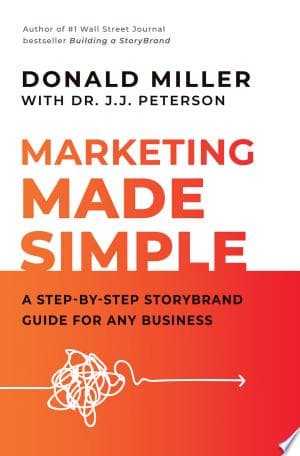
Marketing Made Simple cover
Archivist's Choice

Marketing Made Simple

Donald Miller (2020)

Genre

Business / Marketing

Reading Time

180 min

Key Themes

See below

Track Your Reading

Sign in to track this book

Learn how to create a customer pipeline with a five-part checklist that turns your brand's story into a sales funnel, helping your business grow.

Core Idea

Marketing Made Simple breaks down marketing strategies into a clear, actionable 5-part sales funnel for businesses of all sizes. It helps them clarify their message and increase revenue. It argues that effective marketing is not about elaborate campaigns but about a simple, repeatable system. This system guides potential customers through awareness, engagement, and purchase. The book provides a practical framework, emphasizing a clear 'one-liner,' an optimized website, compelling lead generators, nurturing email campaigns, and direct sales sequences. All of these focus on solving customer problems and building lasting relationships. By simplifying marketing, businesses can stop wasting money and see measurable results.
Reading time
180 min
Difficulty
Easy
✓ Read this if...
You are a small business owner, entrepreneur, or marketing professional feeling overwhelmed by marketing and need a clear, actionable, step-by-step system to generate leads and sales.
✗ Skip this if...
You are looking for advanced, experimental, or highly theoretical marketing concepts, or you already have a well-defined, effective sales funnel in place.

Core idea

The central argument and framework that powers the entire book.

Marketing Made Simple breaks down marketing strategies into a clear, actionable 5-part sales funnel for businesses of all sizes. It helps them clarify their message and increase revenue. It argues that effective marketing is not about elaborate campaigns but about a simple, repeatable system. This system guides potential customers through awareness, engagement, and purchase. The book provides a practical framework, emphasizing a clear 'one-liner,' an optimized website, compelling lead generators, nurturing email campaigns, and direct sales sequences. All of these focus on solving customer problems and building lasting relationships. By simplifying marketing, businesses can stop wasting money and see measurable results.

At a glance

Reading time

180 min

Difficulty

Easy

Read this if...

You are a small business owner, entrepreneur, or marketing professional feeling overwhelmed by marketing and need a clear, actionable, step-by-step system to generate leads and sales.

Skip this if...

You are looking for advanced, experimental, or highly theoretical marketing concepts, or you already have a well-defined, effective sales funnel in place.

Key Takeaways

1

The Simple Sales Funnel

A five-part marketing roadmap to guide customers from awareness to purchase.

Quote

If you confuse, you lose. The simpler your marketing message, the more likely customers are to engage and buy.

Donald Miller says businesses often overcomplicate their marketing, leading to customer confusion and lost sales. The solution is a simple, repeatable five-part sales funnel: the One-Liner, Website, Lead Generator, Email Campaigns, and Sales Campaign. This funnel attracts customers and guides them through a clear journey, building trust and showing value at each stage. By simplifying the customer's path, businesses can reduce friction, increase conversions, and build a loyal customer base. It is a pragmatic approach that prioritizes c...

Supporting evidence

Miller references the 'StoryBrand' framework's principle of clarity and the human brain's preference for simple narratives. He implies that businesses that fail to simplify their message often see lower engagement and conversion rates.

Apply this

Map out your current customer journey. Identify where customers drop off due to confusion or lack of clear next steps. Then, design your marketing assets (website, emails, offers) to fit cleanly into each of the five funnel stages, ensuring a seamless progression.


sales-funnelstorybrandcustomer-journey
2

The Power of the One-Liner

Craft a concise statement that instantly communicates your value proposition.

Quote

Your One-Liner is the ultimate filter. It should instantly answer, 'What do you do?' and 'How does it make my life better?'

The One-Liner is the foundation of the entire marketing funnel, acting as an elevator pitch that can be delivered in a single breath. It is not a slogan; it is a strategic tool designed to immediately engage potential customers by clearly stating what your business offers and the problem it solves. Miller stresses that a good One-Liner positions the customer as the hero, not the business. It has three parts: the problem you solve, the solution you offer, and the success the customer will achieve. Mastering this brevity forces business...

Supporting evidence

Miller provides examples of well-crafted One-Liners that quickly resonate with audiences, contrasting them with vague or self-promotional statements that fail to capture attention.

Apply this

Develop your One-Liner by identifying the primary problem your target customer faces, how your product/service uniquely addresses it, and the positive outcome they will experience. Practice delivering it concisely until it feels natural.

value-propositionelevator-pitchclarity
3

Website as Your Digital Storefront

Your website must be clear, conversion-focused, and easy to navigate.

Quote

Your website isn't an art project; it's a sales tool. Every page should guide the customer toward a clear call to action.

Many businesses see their website as a digital brochure or a place to show creativity, but Miller says it must work as a sales machine. He emphasizes that a website's main goal is to turn visitors into leads or customers, not just to inform. This means avoiding jargon, prioritizing clear calls to action (CTAs), and structuring content to answer customer questions and overcome objections. The website should guide visitors through the sales funnel with easy navigation and compelling copy that focuses on the customer's needs and aspirati...

Supporting evidence

Miller critiques common website mistakes, such as ambiguous navigation, too much text, and lack of clear CTAs, illustrating how these design flaws lead to high bounce rates and low conversions.

Apply this

Audit your website for clarity, calls to action, and navigation. Ensure your hero section immediately communicates your One-Liner. Place clear CTAs prominently 'above the fold' and throughout the site. Simplify menus and remove any information that doesn't directly serve to move a customer down the funnel.

website-designcall-to-actionconversion-rate-optimization
4

The Irresistible Lead Generator

Offer valuable content in exchange for contact information to build your email list.

Quote

People don't give up their email for nothing. You need to offer them something of immense value, something that solves a real problem for them.

The Lead Generator bridges a casual website visitor and a potential customer. Miller says businesses must offer something valuable and relevant to their audience in exchange for their email address. This is not just about collecting emails; it is about starting a relationship and showing your expertise. Effective lead generators, such as checklists, guides, templates, or mini-courses, provide immediate use and solve a specific problem for the customer, positioning your business as a helpful authority. Without a compelling lead magnet,...

Supporting evidence

Miller highlights successful lead magnets that directly address common customer pain points, contrasting them with generic 'newsletter sign-ups' that rarely convert.

Apply this

Identify a common, urgent problem your target customer faces. Create a high-value, downloadable resource (e.g., a '5-Step Checklist to [Achieve Desired Outcome]') that solves this problem. Promote it prominently on your website and social media.

lead-magnetemail-list-buildingcontent-marketing
5

Nurturing with Email Campaigns

Segmented, value-driven email sequences build trust and move leads toward purchase.

Quote

Email is where you build genuine relationships. Don't just sell; serve. Educate, inspire, and solve problems.

Once you have an email address, the work of nurturing begins. Miller emphasizes that email campaigns are not just for sending sales pitches, but for building trust and showing ongoing value. He advocates for automated email sequences that deliver helpful content, answer common questions, and subtly introduce your offerings over time. These campaigns should be segmented based on customer interests or where they are in the buying journey, ensuring relevance. The goal is to move subscribers from interest to desire, positioning your busin...

Supporting evidence

Miller outlines a typical 'nurture sequence' of 3-5 emails, explaining the purpose of each email (e.g., welcome, value delivery, soft pitch) and how they collectively build rapport.

Apply this

Design an automated email sequence for new subscribers that delivers 3-5 pieces of valuable content over a week or two. Include a mix of educational material and customer success stories, subtly integrating a call to action for your main product/service in later emails.

email-marketingdrip-campaignscustomer-nurturing
6

The Direct Sales Campaign

Clearly articulate your offer, its benefits, and the consequences of inaction.

Quote

When it's time to sell, sell. Don't be shy. Clearly state your offer and why your customer needs it now.

After nurturing leads through valuable content, the sales campaign is where businesses make a direct request. Miller insists on clarity and confidence at this stage. A sales campaign should clearly present the offer, restate the value and benefits, address potential objections, and create a sense of urgency or scarcity when appropriate. This is not about being pushy, but about providing a clear path to purchase for customers who are now informed and trusting. Effective sales campaigns use the goodwill built in previous stages of the f...

Supporting evidence

Miller details the components of an effective sales letter or pitch, including problem-solution, testimonials, risk reversal, and a clear call to action with a deadline.

Apply this

When launching a product or service, craft a dedicated sales email or landing page that clearly outlines what you're selling, who it's for, the specific benefits, testimonials, and a strong, time-bound call to action. Ensure it directly addresses common customer hesitations.

sales-copycall-to-actionurgency
7

The Three Stages of Customer Relationship

Understand that customers progress from curiosity to commitment to evangelism.

Quote

Your relationship with a customer isn't static. It evolves from simply knowing you exist to actively advocating for your brand.

Miller identifies three stages of customer relationships that businesses must understand: Curiosity, Enlightenment, and Commitment. In the Curiosity stage, customers are just becoming aware of your brand and need compelling reasons to learn more. Enlightenment is when they are actively seeking information and evaluating your solutions. Finally, Commitment is when they make a purchase and ideally become loyal advocates. Each stage requires a different marketing approach. Misunderstanding which stage a customer is in leads to misaligned...

Supporting evidence

Miller implicitly links these stages to the parts of his sales funnel, showing how the One-Liner generates curiosity, the website and lead magnet provide enlightenment, and email/sales campaigns drive commitment.

Apply this

Segment your audience based on their stage in the customer relationship. Tailor your marketing messages: for curious prospects, focus on intriguing questions; for enlightened leads, provide detailed solutions; for committed customers, offer loyalty programs or ask for referrals.

customer-lifecyclecustomer-segmentationbrand-advocacy
8

Marketing is About Solving Problems

Frame your offerings as solutions to your customers' real-world challenges.

Quote

Your customer doesn't care about your product; they care about their problems. Position your product as the solution to their problems.

A main theme in Miller's philosophy, rooted in StoryBrand, is that effective marketing always centers on the customer's problems, not the business's features or accolades. Customers are self-interested; they look for solutions to their pain points, desires, and frustrations. Businesses that clearly state these problems and then position their products or services as the guide to overcoming them will connect more deeply. This 'problem-solution' framing makes marketing immediately relevant and compelling, cutting through the noise of se...

Supporting evidence

Miller consistently uses the 'StoryBrand' framework, where the customer is the 'hero' with a 'problem,' and the business is the 'guide' offering a 'solution.'

Apply this

Before writing any marketing copy, identify the top three problems your ideal customer faces that your product/service can solve. Start your marketing messages by articulating one of these problems, then introduce your offering as the clear solution.

problem-solutioncustomer-centricstorytelling
9

The One Marketing Plan You Won't Regret

Focus your efforts on a single, integrated plan rather than scattered tactics.

Quote

Stop chasing shiny objects. Create one overarching marketing plan that integrates all your efforts and stick to it.

Miller addresses the common problem of businesses jumping from one marketing tactic to another without a cohesive strategy. This 'shiny object syndrome' leads to wasted resources, inconsistent messaging, and poor results. The 'one marketing plan' he advocates for is the entire sales funnel outlined in the book: a unified, sequential approach that ensures all marketing efforts work together. By committing to this single, integrated plan, businesses can achieve clarity, consistency, and compounding results. It forces discipline and prev...

Supporting evidence

Miller contrasts the effectiveness of a structured, sequential marketing plan with the chaos and inefficiency of ad-hoc marketing tactics that lack integration.

Apply this

Instead of trying every new social media trend or ad platform, commit to building out each stage of the five-part sales funnel. Ensure your One-Liner, website, lead magnet, email campaigns, and sales campaigns are all aligned and flow seamlessly into one another.

marketing-strategyintegrated-marketingfocus
10

Measure What Matters, Not What's Easy

Track metrics that directly correlate with sales funnel progression and revenue.

Quote

Many businesses track vanity metrics. Focus on the numbers that tell you if your funnel is actually working and generating revenue.

A critical, often overlooked aspect of marketing is effective measurement. Miller warns against 'vanity metrics' – numbers that look good but do not directly impact the bottom line (e.g., social media likes without engagement). Instead, businesses should focus on metrics that show progress through the sales funnel: website traffic, lead magnet downloads, email open/click rates, conversion rates at each stage, and ultimately, sales and customer lifetime value. By understanding which parts of the funnel are performing well and which nee...

Supporting evidence

Miller implicitly refers to the need for analytics at each stage of the funnel, from website traffic tools to email marketing platform reports, to gauge effectiveness.

Apply this

For each stage of your sales funnel, identify 1-2 key metrics to track (e.g., website traffic for awareness, lead magnet downloads for lead generation, conversion rate for sales). Set up tracking tools and review these metrics weekly or monthly to identify bottlenecks and areas for improvement.

marketing-analyticskey-performance-indicatorsroi

Critical analysis

Notable Quotes

Confusion is the enemy of good marketing.

A foundational principle for effective marketing communication.

People don't buy the best products; they buy the products they can understand the fastest.

Explaining the importance of clear messaging over product superiority in consumer decisions.

If you confuse, you lose.

A concise summary of the danger of unclear marketing messages.

Every hero is on a journey, and they're looking for a guide.

Introducing the StoryBrand framework's concept of positioning the customer as the hero and the business as the guide.

Your customer is the hero, not your brand.

A crucial distinction for effective marketing, shifting focus from the business to the customer' s needs and desires.

The only reason people buy from you is because they perceive that you will solve a problem for them.

Highlighting the problem/solution dynamic as the core driver of purchasing decisions.

When you clarify your message, you clarify your brand.

Emphasizing the direct link between clear communication and a strong brand identity.

Marketing is just inviting people into a story.

A simple yet profound definition of marketing through the lens of the StoryBrand framework.

People are looking for an external solution to an internal problem.

Explaining that customers often seek tangible products or services to address deeper, emotional needs.

You've got to make it easy for people to buy.

Stressing the importance of a clear call to action and a frictionless sales process.

The more simple you make your marketing, the more money you'll make.

A direct correlation drawn between simplicity in marketing and business success.

Every piece of marketing material should serve a purpose: to invite the customer into a story.

Guidance on aligning all marketing efforts with the overarching narrative and customer journey.

When we stop talking about ourselves and start talking about our customers, that's when our businesses grow.

A powerful shift in perspective that leads to increased engagement and sales.

A confused mind always says no.

Reinforcing the idea that any ambiguity in messaging will result in lost opportunities.

Quiz

Test Your Knowledge

Ready to see how well you understood this book? Take our interactive quiz with 10 questions.

10
Questions
~5
Minutes
?
Best Score

Key Questions (FAQ)

Marketing Made Simple is a guide by Donald Miller that teaches businesses how to create and implement a sales funnel to attract new customers and drive sales. It provides a 5-part checklist based on the StoryBrand framework to clarify your marketing message and strategy.

About the author

Donald Miller is a New York Times bestselling author known for his unique blend of memoir and practical advice. His notable works include "Blue Like Jazz: Nonreligious Thoughts on Christian Spirituality," a seminal book in the modern Christian literary landscape, and "Building a StoryBrand," which applies narrative principles to business. Miller's writing often explores themes of faith, doubt, and personal growth with honesty and humor.