BookBrief
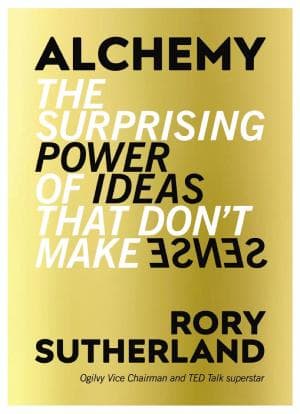
Alchemy cover
Archivist's Choice

Alchemy

Rory Sutherland (2019)

Genre

Psychology / Marketing / Self-Help

Reading Time

240 min

Key Themes

See below

Track Your Reading

Sign in to track this book

Rory Sutherland's 'Alchemy' shows how advertising ideas, behavioral science, and funny stories prove that the best solutions come from ignoring logic and trying irrational approaches.

Core Idea

In "Alchemy," Rory Sutherland says that human decision-making, which classical economics calls 'irrational,' is logical when seen through evolutionary psychology, context, and perceived value. He thinks that real innovation and good problem-solving often come from using unexpected solutions, understanding how things are presented, and knowing that value is often subjective, not objective. The book supports a different, psychological way to approach business and life. It shows how 'illogical' choices and 'wasteful' spending can signal things or create more perceived value, leading to better and more satisfying results than just using logical optimization.
Reading time
240 min
Difficulty
Medium
✓ Read this if...
You are a marketer, entrepreneur, psychologist, or anyone interested in understanding the hidden logic behind seemingly irrational human behavior and how to leverage it for innovative problem-solving and value creation.
✗ Skip this if...
You prefer traditional, data-driven business strategy guides that strictly adhere to rational economic principles and measurable outcomes, or if you are looking for a step-by-step self-help manual.

Core idea

The central argument and framework that powers the entire book.

In "Alchemy," Rory Sutherland says that human decision-making, which classical economics calls 'irrational,' is logical when seen through evolutionary psychology, context, and perceived value. He thinks that real innovation and good problem-solving often come from using unexpected solutions, understanding how things are presented, and knowing that value is often subjective, not objective. The book supports a different, psychological way to approach business and life. It shows how 'illogical' choices and 'wasteful' spending can signal things or create more perceived value, leading to better and more satisfying results than just using logical optimization.

At a glance

Reading time

240 min

Difficulty

Medium

Read this if...

You are a marketer, entrepreneur, psychologist, or anyone interested in understanding the hidden logic behind seemingly irrational human behavior and how to leverage it for innovative problem-solving and value creation.

Skip this if...

You prefer traditional, data-driven business strategy guides that strictly adhere to rational economic principles and measurable outcomes, or if you are looking for a step-by-step self-help manual.

Key Takeaways

1

The Power of Perceived Value

Value is subjective and can be engineered through perception, not just objective utility.

Quote

The problem with logic is that it kills off too many good ideas.

Sutherland says that focusing on rational decisions often stops us from finding new solutions. He thinks value is not fixed but comes from how we see things. Instead of making objective improvements, businesses and people can create value by changing how something is seen. This 'alchemy' means understanding the psychological biases and emotions that guide choices. This often leads to unexpected but effective strategies. For example, people might prefer a product that is objectively 'worse' in some ways if it seems more valuable becaus...

Supporting evidence

Red Bull's success, despite its objectively 'bad' taste, is attributed to its positioning as a 'deviant' drink that provides a psychological boost beyond mere caffeine. The high price and distinct branding contribute to its perceived efficacy as a performance enhancer and a status symbol, rather than just a beverage.

Apply this

Instead of trying to make a product objectively 'better' (e.g., cheaper, faster), explore ways to make it *feel* better. Can you change its name, packaging, or the context in which it's consumed? Consider what emotional need your product fulfills beyond its functional purpose.


perceived-valuebehavioral-economicsirrationality
2

The Magic of Context and Framing

How we present information and the environment in which choices are made profoundly impact decisions.

Quote

Almost all human decisions are made with context as a critical input.

Context matters a lot. Sutherland says that the same choice, presented differently or in a different setting, can lead to very different results. Our brains respond to how things are framed, what anchors we use, and social cues. Knowing this lets us 'pre-suade'—influence decisions before people even think about them. This is not about tricking people, but about making the environment right for desired outcomes by using human biases. For example, making a product feel special or rare can make people want it more, even if its actual use...

Supporting evidence

The example of countdown boards at train stations. The boards don't make trains run faster, but by providing information, they reduce the perceived pain of waiting. The context of knowing *how long* you'll wait is psychologically preferable to waiting in uncertainty, even if the actual delay is identical.

Apply this

Before launching a product or initiative, meticulously analyze the context in which it will be encountered. How can you frame the choice to highlight its benefits? Consider the language, visual cues, and surrounding environment. For example, instead of '20% off,' try 'Save $20' if the original price is high enough to make $20 sound significant.

framing-effectcontextual-designchoice-architecture
3

Solve the Problem Behind the Problem

Often, the stated problem isn't the real problem; addressing deeper psychological needs yields better solutions.

Quote

The opposite of a good idea can also be a good idea.

Sutherland says we often misunderstand problems by looking at their surface signs instead of the real human needs or psychological discomforts behind them. Real 'alchemy' means looking deeper to find the unspoken desires, fears, or irrationalities that drive behavior. By finding the 'problem behind the problem,' we can create solutions that are more effective, and often simpler and cheaper, than those from a purely logical analysis. This needs empathy, observation, and a willingness to question common ideas about what people 'should' ...

Supporting evidence

The example of the Eurostar train from London to Paris. Logically, the problem was that the journey felt too long. The 'logical' solution would be to make the train faster. However, the 'alchemical' solution was to improve the onboard experience (better food, nicer interiors, Wi-Fi) and make the journey *feel* shorter and more pleasant, rather than actually shortening the travel time. The problem wasn't the duration, but the boredom and discomfort during that duration.

Apply this

When faced with a problem, ask 'why?' five times to uncover the root cause. Don't just accept the first logical solution. Consider the emotional or psychological discomfort people are experiencing. Can you solve that discomfort, even if it doesn't directly address the 'logical' problem?

root-cause-analysisdesign-thinkinguser-psychology
4

The Unsung Value of 'Waste'

What appears wasteful from a logical perspective can be highly valuable psychologically or strategically.

Quote

Waste is only waste if you don't understand the hidden value it creates.

In a world focused on efficiency, Sutherland supports the value of what seems like 'waste.' What looks like unnecessary spending or an inefficient process from a logical view can actually serve important psychological or strategic purposes. This 'waste' can build trust, show quality, create desire, or stop competitors. It questions the idea of lean manufacturing and pure economic rationality, suggesting that some inefficiencies are not only acceptable but necessary for a better overall experience or competitive edge. The key is to tel...

Supporting evidence

The inclusion of 'free' breadsticks or olives at restaurants. From a logical perspective, this is a cost to the business. However, psychologically, it creates a feeling of generosity, enhances the dining experience, and can anchor perceptions of quality and value, making customers more satisfied and likely to return or spend more.

Apply this

Re-evaluate areas of your business or life that seem 'wasteful.' Is there a hidden psychological benefit to that inefficiency? Could it be a signal of trust, quality, or care? Don't cut costs blindly; understand the full impact of seemingly 'inefficient' elements.

signaling-theoryperceived-generositystrategic-inefficiency
5

Embrace Counter-Intuition and Lateral Thinking

The best solutions often come from deliberately challenging assumptions and exploring illogical paths.

Quote

Evolutionary psychology suggests that we are not rational at all, but simply rationalizers.

Sutherland strongly supports thinking differently and using unexpected approaches. He says that if a problem has a logical solution, it has probably already been found. The truly hard and rewarding problems need us to move away from usual logic, accept irrationality, and explore ideas that seem strange at first. This means questioning old ideas, trying out seemingly 'bad' ideas, and actively looking for different viewpoints. It is about breaking free from the biases that make us repeat familiar, but often not the best, ways of thinkin...

Supporting evidence

His own advertising career, where seemingly illogical campaigns yielded massive success. For instance, the 'Taste the Rainbow' campaign for Skittles, which is entirely abstract and makes no logical claims about the product, yet is iconic and highly effective because it taps into a playful, non-rational aspect of consumer desire.

Apply this

When stuck on a problem, try the opposite of what seems logical. Brainstorm 'bad' ideas. Ask 'what if we did nothing?' or 'what if we made it worse?' Actively seek out perspectives from people completely outside your field or expertise, as they are less constrained by conventional wisdom.

lateral-thinkingcognitive-biasesdisruptive-innovation
6

The Power of Defaults and Nudges

Subtle changes in choice architecture can guide behavior more effectively than direct mandates.

Quote

Small things that make a big difference, without people noticing.

Sutherland points out how much 'nudges' and default settings affect human behavior. Knowing that people are often lazy, have too many choices, or stick to what is familiar, system designers can gently guide people toward desired outcomes without limiting their freedom. This approach, from behavioral economics, recognizes that humans do not always make perfectly rational decisions. By understanding our biases, like loss aversion or the status quo bias, we can create situations where the 'right' choice is the easiest or most obvious one...

Supporting evidence

The success of opt-out organ donation systems compared to opt-in systems. Countries with opt-out defaults have significantly higher organ donation rates, demonstrating that most people will stick with the default option, even for a decision as profound as this.

Apply this

Review processes where you want to encourage a specific behavior. Can you make that behavior the default option? Can you simplify the choice or make the desired action the path of least resistance? For example, pre-ticking a box for environmentally friendly options on a form.

nudgetheorychoice-architecturedefault-bias
7

Marketing as a Source of Value, Not Just Information

Effective marketing doesn't just communicate value; it creates it by shaping perception and desire.

Quote

The greatest form of marketing is to create something that people want to talk about.

Sutherland changes how we see marketing, making it more than just a communication tool; it is a way to create value. He says marketing is not just about telling people about a product's features; it is about shaping their desire, creating a story, and investing in a brand's 'psychological space.' By influencing how people see things, marketing can make an objectively identical product much more valuable to the consumer. This goes beyond logical arguments and uses emotional connection, social signals, and the joy of newness or belongin...

Supporting evidence

Luxury brands are a prime example. A designer handbag, while functionally similar to a cheaper alternative, commands a vastly higher price due to its brand story, exclusivity, and the social status it confers. The marketing creates the aspirational value, which then becomes a tangible asset.

Apply this

Don't view marketing as an afterthought or a necessary evil. See it as an integral part of your product or service. Invest in crafting a compelling story, a unique brand identity, and an experience that evokes emotion and desire, rather than just listing features. How can your marketing itself become part of the product's value?

brand-storytellingemotional-brandingaspirational-marketing
8

The Power of Signaling and Costly Signals

Demonstrating genuine commitment or quality often requires signals that are expensive or seemingly irrational.

Quote

The problem with being rational is that it means you can be copied.

Sutherland talks about signaling theory, suggesting that people (and businesses) often use signals to figure out trustworthiness, quality, or commitment. For a signal to be believable, it often needs to be 'costly'—meaning it involves an investment that a less committed or lower-quality entity would not or could not make. From a purely logical view, these costly signals might seem inefficient or wasteful. However, in an alchemical sense, they work very well because they give believable proof of underlying value. This explains why peop...

Supporting evidence

The existence of a warranty. Offering a long warranty is a costly signal that the manufacturer believes in the durability of their product. A company selling an inferior product would be less likely to offer such a warranty, as it would incur too many costs from claims. The warranty itself, even if never used, increases perceived quality.

Apply this

Consider how you can credibly signal your value, commitment, or quality. What 'costly' actions can you take that a competitor or less dedicated individual wouldn't? This could be exceptional customer service, a generous return policy, or even just investing in beautiful packaging that signals care and attention to detail.

signaling-theorycredibilitytrust-building
9

The Evolutionary Roots of 'Irrationality'

Many human 'irrationalities' are actually adaptive behaviors honed by evolution for survival.

Quote

We are not rational creatures who make logical decisions based on evidence. Instead, we are bundles of instincts and heuristics, often operating on an unconscious level.

Sutherland explores the evolutionary psychology behind many of our behaviors that seem irrational. He says that what looks illogical in a modern, data-driven world often made sense for our ancestors. These deep-seated ways of thinking, while sometimes causing mistakes in complex modern situations, were good for survival and reproduction. Understanding these evolutionary roots helps us see why people act the way they do, instead of just calling it 'stupid.' This view allows for more empathy and helps create solutions that work with...

Supporting evidence

Our strong preference for loss aversion (the pain of losing something is greater than the pleasure of gaining an equivalent amount). This is an evolutionary adaptation to avoid threats and preserve resources, which was crucial for survival in precarious environments.

Apply this

When trying to understand a behavior, ask how it might have been adaptive in an ancestral environment. Are you trying to overcome an ancient human instinct? If so, can you reframe your offering to appeal to that instinct, rather than fight it? For example, appealing to a sense of belonging or status.

evolutionary-psychologyheuristicsloss-aversionancestral-environment
10

Don't Be Afraid to Be Different

In a world obsessed with best practices, true innovation often comes from being deliberately unique.

Quote

If everyone is doing something, there's often an opportunity to do the opposite.

Sutherland strongly supports being different instead of conforming, especially in business and marketing. When everyone tries for 'best practice,' the result is often sameness and competition on price. Real 'alchemy' is finding unique differences, even if they seem unusual or go against current trends. Being different makes people remember you, allows for higher prices, and often appeals to market segments tired of the usual. This needs courage to go against the crowd and trust in one's own insights into human psychology. It is about ...

Supporting evidence

The example of Innocent Smoothies. At a time when most soft drinks were highly processed and artificially flavored, Innocent stood out by emphasizing natural ingredients, quirky branding, and a playful tone, creating a distinct niche that allowed them to thrive.

Apply this

Identify areas where your industry or competitors are all doing the same thing. How can you deliberately do the opposite or create a unique experience? Don't just follow trends; consider how you can start one or carve out a truly distinct identity that resonates with a specific audience.

differentiation-strategyniche-marketinguniqueness-advantage

Critical analysis

Notable Quotes

The opposite of a good idea can also be a good idea.

Sutherland argues against binary thinking in problem-solving, suggesting that unconventional approaches often yield better results.

We don't value things; we value their meaning.

Discussing how perceived value is often psychological rather than functional, using examples from marketing and economics.

The most powerful tool in marketing is not logic but magic.

Emphasizing the importance of emotional and irrational elements in influencing consumer behavior over rational appeals.

A change in perceived value can be achieved without a change in actual value.

Explaining how psychological framing and context can alter how people assess worth, often at low cost.

The best way to get a good idea is to get a lot of ideas.

Advocating for creative abundance and experimentation as keys to innovation in business and life.

Price is often a story, not a number.

Illustrating how pricing strategies rely on narrative and perception rather than just cost-based calculations.

In a world of abundance, the scarce resource is attention.

Highlighting the shift in marketing focus from product scarcity to capturing consumer attention in modern economies.

The most expensive part of any product is the meaning we attach to it.

Using luxury goods as examples to show how symbolic value drives pricing and desire.

Don't solve problems; dissolve them.

Encouraging reframing or eliminating problems altogether rather than tackling them head-on with conventional solutions.

A brand is a story that never stops telling itself.

Describing how successful brands continuously reinforce their narrative through consistent experiences and messaging.

The best ideas often seem ridiculous at first.

Arguing for the value of counterintuitive thinking and embracing initial skepticism in creative processes.

Happiness is not about having what you want, but wanting what you have.

Tying psychological insights to personal well-being, suggesting contentment stems from perception.

Marketing is applied psychology with a budget.

Defining marketing as the practical use of psychological principles to influence behavior on a large scale.

The real competition is not between products, but between perceptions.

Stating that market success often depends on how products are perceived rather than their objective features.

Quiz

Test Your Knowledge

Ready to see how well you understood this book? Take our interactive quiz with 10 questions.

10
Questions
~5
Minutes
?
Best Score

Key Questions (FAQ)

'Alchemy' explores how irrational thinking and psychological insights can solve problems more effectively than pure logic. It blends behavioral science, marketing stories, and branding principles to show why human decisions are often driven by perception and emotion rather than rationality.

About the author