“Sing, Muses, and Apollo, you who strike the lyre, and Artemis, who delights in arrows!”
— Opening invocation of the 'Hymn to Apollo', setting the divine stage.

Sign in to track this book
Explore ancient Greek foundational myths as gods and goddesses reveal themselves to mortals, showing the interaction between divine and human realms.
The hymn tells of Apollo's birth on Delos and his search for a place to build his oracle. He travels across Greece, considering several sites before choosing Crisa, near Mount Parnassus. There, he kills the dragoness Python, who guarded the spring, earning him the name 'Pythian Apollo.' He then gathers priests for his temple, turning into a dolphin to lead a ship of Cretan sailors to Crisa. He shows his divine form and tells them to serve as guardians of his sacred place and interpreters of his prophecies at Delphi, promising them a prosperous life.
The hymn describes the abduction of Persephone, Demeter's daughter, by Hades, lord of the underworld, with Zeus's help. Demeter, heartbroken, searches for her daughter across the earth, neglecting her divine duties. Her grief causes a terrible famine, as no crops grow, threatening humanity. Disguised as an old woman, Demeter arrives in Eleusis and is taken in by King Celeus and Queen Metaneira. She tries to make their son, Demophoon, immortal, but is interrupted, revealing her divine identity and demanding a temple built in her honor.
As the famine worsens and the gods worry, Zeus sends Hermes to the underworld to demand Persephone's release. Hades agrees but cleverly offers Persephone a pomegranate seed, which she eats, binding her to the underworld for part of the year. A compromise is reached: Persephone will spend two-thirds of the year with her mother and one-third with Hades. Demeter, satisfied, restores fertility to the earth. The cycle of Persephone's descent and return establishes the rhythm of the seasons, explaining periods of agricultural abundance and scarcity.
Born to Maia in a cave on Mount Cyllene, the infant Hermes shows his cunning nature immediately. On his first day, he invents the lyre from a tortoise shell and then, at night, steals fifty of Apollo's sacred cattle. He cleverly hides their tracks and the cattle, sacrificing two. Apollo, angry at the theft, eventually tracks Hermes to his cave, but Hermes pretends to be a helpless baby in swaddling clothes. The dispute goes before Zeus for judgment.
Before Zeus, Hermes continues to deny his actions, but Zeus, amused by his son's cleverness, orders him to return the cattle. Hermes, however, charms Apollo with the beautiful music of his new lyre. Apollo is so captivated that he trades his cattle for the instrument. This exchange solidifies their relationship: Hermes gives Apollo the lyre and later invents the panpipes, while Apollo grants Hermes the caduceus and control over flocks, trade, and messages. Zeus makes Hermes his personal messenger and the guide of souls to the underworld.
The hymn describes Aphrodite's power over gods and mortals, even making Zeus fall in love. However, Zeus, tired of her boasts, causes Aphrodite herself to desire a mortal man, Anchises, a Trojan prince. Disguised as a mortal maiden, Aphrodite approaches Anchises as he tends his cattle on Mount Ida. She invents a story of being a princess abducted by Hermes and brought to him, claiming to be destined to be his wife. Anchises, captivated, falls in love and sleeps with her.
After their union, Aphrodite reveals her true divine form to a terrified Anchises. She scolds him for his fear but comforts him by predicting the birth of their son, Aeneas, who will be a great hero. She warns Anchises never to boast of having slept with a goddess, fearing the gods' wrath, especially Zeus. She recounts stories of other mortals who consorted with immortals, like Tithonus, who gained immortality but not eternal youth. She leaves, leaving Anchises both in awe and fearful, yet proud of their divine child.
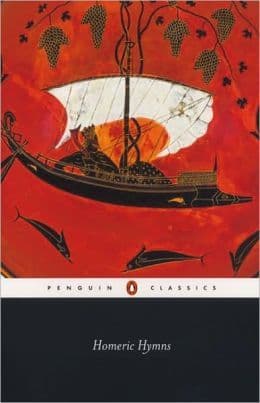
The hymn tells of an event where Dionysus, appearing as a young man, is captured by Tyrrhenian pirates who mistake him for a wealthy prince. Only the helmsman recognizes his divine presence and warns his crew, but they ignore him, planning to sell Dionysus into slavery. Dionysus then shows his power. Miracles begin on the ship: wine flows, vines entwine the mast, and ivy covers the sails. The terrified pirates jump overboard and turn into dolphins, except for the wise helmsman, whom Dionysus spares and blesses.
This hymn addresses Ares directly, portraying him as a mighty, golden-helmeted god of war, strong and tireless in battle. He is described as a force that brings both terror and courage, a slayer of men, yet also a protector of cities. The hymnist asks Ares to temper his fierce nature, to send away 'mad rage' and 'bitter strife,' and instead to inspire peace and courage. He is asked to grant the supplicant strength to avoid cowardice and to live a just life, showing his power to both destroy and uphold order through strength.
Hecate is praised as a powerful goddess honored by Zeus above all others, with dominion over earth, sea, and sky. She is described as a benevolent deity who grants success in various efforts: in battle, assemblies, contests, and in fishing and animal husbandry. She nurtures the young and bestows wealth. The hymn emphasizes her ancient origins and continued reverence, especially concerning Demeter and Persephone, highlighting her role in the underworld and her ability to grant or withhold blessings, making her a universal and influential goddess.
This hymn celebrates Artemis, the virgin goddess of the hunt, wilderness, wild animals, and childbirth. She is depicted as a majestic figure, delighting in her silver bow and swift arrows, ranging across mountains and forests with her hunting dogs. She is often with nymphs and is revered for her purity and independence. The hymn also mentions her role in helping women in childbirth, despite her own virginity, and her connection to her twin brother, Apollo. She is a formidable goddess, swift and true, both a bringer of death to animals and a fierce protector of the innocent.
This hymn exalts Zeus, the king of the gods and ruler of Olympus. He is praised as the most powerful deity, the father of gods and men, and the wielder of the lightning bolt. His control over the cosmos is absolute, and he maintains order and justice. The hymn emphasizes his wisdom and his role as the ultimate authority, to whom all other gods defer. He is invoked as a protector and a giver of blessings, ensuring the balance of the world and the fate of both mortals and immortals. His presence is felt throughout the universe, a constant force.
The hymn honors Poseidon, the mighty god of the sea, earthquakes, and horses. He is depicted as a powerful deity whose trident can stir the oceans into storms or calm them. He is the shaker of the earth, causing tremors and creating new lands. His connection to horses is also noted, as he is often associated with their creation and mastery. He is invoked as a protector of sailors and a provider of safe passage, yet also a force to be feared for his destructive potential, embodying the dual nature of the sea.
This hymn celebrates Athena, the powerful and wise goddess who sprang fully armed from Zeus's head. She is revered as the patron of heroes, strategy in warfare, and various crafts, especially weaving and pottery. Her intelligence and strategic skill are emphasized, making her a formidable ally and a terrifying opponent. She is a virgin goddess, known for her stern demeanor and commitment to justice and order. The hymn highlights her role in protecting cities and inspiring innovation, embodying both fierce martial skill and intellectual wisdom.
The hymn glorifies Helios, the Titan god of the sun, who drives his fiery chariot across the sky each day, bringing light to gods and mortals. He is depicted as a radiant and all-seeing deity whose golden rays illuminate the entire world. His journey from east to west marks the passage of day, and he is a vital force for life and growth. The hymn emphasizes his unwavering course and his importance in maintaining cosmic order, making him a central figure in the daily experience of the ancient Greeks and a symbol of constant, life-giving energy.
The Olympian God
Establishes his divine domain and authority through the slaying of Python and the founding of his oracle.
The Olympian Goddess
Experiences profound grief and anger, leading her to withdraw her blessings from the earth, before eventually restoring fertility and establishing the cycles of seasons and the Eleusinian Mysteries.
The Olympian Goddess
Transitions from an innocent maiden to the queen of the underworld, accepting her dual role and establishing the cycle of seasons.
The Olympian God
Establishes his divine portfolio through his inventive acts and cunning negotiations, becoming a crucial messenger and psychopomp.
The Olympian Goddess
Is humbled by Zeus into experiencing mortal love, leading to the birth of Aeneas and a cautionary tale about divine-mortal interaction.
The Olympian God
Secures Persephone as his queen, establishing the balance between the living and the dead through her cyclical presence.
The Olympian God
Consistently upholds his authority as king of the gods, arbitrating disputes and enforcing cosmic order, even through controversial means.
The Mortal
Experiences a profound and dangerous encounter with a goddess, leading to the birth of a heroic son and a life marked by divine favor and fear.
The Olympian God
Reveals his divine power to mortals, punishing the impious and demonstrating the awe-inspiring nature of his worship.
The Olympian Goddess
Maintains her powerful, independent, and chaste identity, affirming her dominion over the wild and her role as a protector.
The Olympian God
Maintains his dominion over the sea and earth, a constant force of both creation and destruction.
The Olympian Goddess
Consistently embodies wisdom, strategic power, and patronage of civilization, reinforcing her vital role in both divine and mortal affairs.
A central theme in the Homeric Hymns is the great power of the Olympian gods. Each hymn praises a deity, showing their domain and influence over the cosmos and human life. From Zeus's authority to Demeter's control over harvest, Apollo's insight, and Poseidon's command of the sea, the hymns show deities shaping destiny, causing disasters, or giving blessings. Mortals depend on their favor and are vulnerable to their anger, emphasizing the vast difference between divine and human realms. This is clear when Dionysus turns pirates into dolphins (Hymn to Dionysus) or when Aphrodite, made by Zeus, experiences human love (Hymn to Aphrodite), showing even a goddess's submission to a higher power.
“For easy it is for the immortals to bring all things to pass, according to their will.”
The hymns often explore the difficult and sometimes dangerous relationship between gods and mortals. While gods can give gifts and protection, direct interaction often leads to big consequences for humans, from awe and favor to terror, punishment, or death. Mortals are rarely ready for the full display of divine power, and even willing unions, like Aphrodite and Anchises, come with warnings and risks. The stories serve as warnings, reminding mortals of their place and the importance of respect. The transformation of the pirates in the Hymn to Dionysus shows the danger of not recognizing a god, while Anchises's fear after Aphrodite reveals herself (Hymn to Aphrodite) highlights the overwhelming nature of divine presence.
“But Anchises was seized with terror, and covered his face with his robe, and said: 'Goddess, I pray you by all that is holy, have mercy on me! For no man lives in strength who lies with immortal goddesses.'”
Many hymns explain the origins of natural events, religious rituals, or cultural practices. The Hymn to Demeter, for instance, explains the changing seasons through Persephone's yearly descent to the underworld and her return. The Hymn to Apollo details the founding of the oracle at Delphi and its priesthood. The Hymn to Hermes tells of the invention of the lyre and panpipes, as well as Hermes's role as a messenger and patron of trade. These stories not only entertain but also provide a way to understand the world and its sacred traditions, placing the divine directly into daily life and natural cycles.
“And so, when Persephone came up from the darkness, the earth bore fruit in abundance, and the broad ways of the world were full of flowers and leaves.”
A recurring theme is how gods establish or solidify their unique domains, powers, and places of worship within the Olympian pantheon. Each hymn often focuses on a deity's important achievement or defining moment. Apollo's journey to establish Delphi and kill Python marks his claim over prophecy and sacred sites. Demeter's grief and actions establish the agricultural cycle and the Eleusinian Mysteries. Hermes's youthful actions and cleverness secure his roles as messenger, guide, and patron of human endeavors. These stories show the dynamic process of divine self-assertion and the structuring of cosmic order, defining the roles and relationships among the gods.
“Here first you shall build a rich temple for me, and all men shall always bring perfect hecatombs to this place.”
A story that explains the origin of a natural phenomenon, custom, or ritual.
Many Homeric Hymns serve as etiological myths, providing mythical explanations for aspects of the natural world or human culture. For example, the Hymn to Demeter explains the changing seasons through Persephone's abduction and return, while the Hymn to Apollo recounts the founding of the Delphic oracle and the origin of the Pythian games. These myths ground the divine within the observable world, offering a sacred narrative for phenomena and practices that would otherwise be unexplained, thus reinforcing the relevance and presence of the gods in daily life.
The direct involvement of gods in the affairs of mortals or other deities.
Divine intervention is a pervasive plot device. Gods frequently interfere in the lives of mortals, often with profound and transformative consequences. Zeus's orchestration of Persephone's abduction, his compelling of Aphrodite to fall in love with Anchises, or Dionysus's direct transformation of the pirates are prime examples. This device highlights the immense power of the gods and their often unpredictable will, emphasizing the limited agency of mortals and the constant presence of the divine in the ancient Greek worldview. It drives much of the narrative conflict and resolution.
The physical alteration of a character, often from divine to mortal, or mortal to animal/plant.
Transformation is used to demonstrate divine power, enact punishment, or facilitate a god's interaction with the mortal world. In the Hymn to Dionysus, the god transforms the impious pirates into dolphins as punishment for their hubris. In the Hymn to Apollo, Apollo transforms himself into a dolphin to lure the Cretan sailors to Crisa. Aphrodite disguises herself as a mortal maiden to approach Anchises. These transformations underscore the fluid boundaries between divine and mortal, and the gods' ability to manipulate form and reality to achieve their ends, often with awe-inspiring or terrifying results.
The visible manifestation of a deity to a human.
Theophany is a crucial device for illustrating the power and awe of the gods. When a god reveals their true divine form to a mortal, it is often an overwhelming and terrifying experience. Anchises's terror upon Aphrodite's revelation (Hymn to Aphrodite) and the helmsman's recognition of Dionysus (Hymn to Dionysus) are clear examples. These moments emphasize the vast difference between divine and human nature, the danger of encountering the sacred directly, and the profound impact such encounters have on mortal perception and understanding of the cosmos.
A character, often a god, who uses cunning, deception, and mischief to achieve their goals.
The 'Divine Trickster' archetype is most prominently embodied by Hermes in his hymn. From his birth, Hermes uses cunning and deception to steal Apollo's cattle, invent the lyre, and charm the other gods, including Zeus, with his wit and music. This device introduces an element of playful subversion within the divine order, showcasing intelligence and cleverness as powerful forces. The trickster's actions often lead to unexpected outcomes, the establishment of new traditions, or the acquisition of new powers, adding complexity and humor to the divine narratives.
“Sing, Muses, and Apollo, you who strike the lyre, and Artemis, who delights in arrows!”
— Opening invocation of the 'Hymn to Apollo', setting the divine stage.
“For from Zeus are kings, and from Zeus are singers.”
— From the 'Hymn to Demeter', emphasizing divine origin of power and art.
“Happy is he among men upon earth who has seen these things.”
— Referring to the Eleusinian Mysteries in the 'Hymn to Demeter', highlighting the blessedness of initiates.
“But when the earth blossomed with fragrant spring flowers, the wide-wayed earth, with crocuses and hyacinths and roses and lilies, and with narcissus, which Gaia grew as a snare for the maiden.”
— Description of Persephone's abduction in the 'Hymn to Demeter', focusing on the deceptive beauty of nature.
“For there is no way for mortals to escape the mind of Zeus.”
— A general statement about divine will, present in several hymns, implying inevitability.
“And the goddess, greatly angered, sat apart from the blessed gods, pining with desire for her deep-girdled daughter.”
— Demeter's grief and withdrawal after Persephone's abduction, leading to famine.
“Sing to me, Muse, of Hermes, the son of Zeus and Maia, the slayer of Argus, the lord of Cyllene and Arcadia rich in flocks, the ingenious, thievish, cattle-raiding, dream-interpreting, night-watching, gate-door-stealing god.”
— Opening invocation of the 'Hymn to Hermes', detailing his mischievous and clever attributes.
“For from me comes both song and lyre.”
— Apollo's declaration of his dominion over music and poetry in the 'Hymn to Apollo'.
“So he spoke, and the goddess, bright-eyed Athena, smiled.”
— A common descriptive phrase in the hymns, often indicating divine approval or amusement.
“Farewell, daughter of Zeus, and grant me victory in this contest, and I will remember you in another song.”
— A common concluding formula in the hymns, where the poet bids farewell to the deity and promises future praise.
“And the sweet sound of the lyre filled the house, and the gods were delighted.”
— Description of Apollo's music in Olympus, showcasing the joy it brings to the gods.
“For all things are from Zeus, and all things return to Zeus.”
— A philosophical statement about the omnipresence and ultimate authority of Zeus, often implied throughout the hymns.
“And from that time forth, the mysteries were established, holy and awesome, which no one may transgress or speak of.”
— Conclusion of the 'Hymn to Demeter', establishing the sacred and secret nature of the Eleusinian Mysteries.
“But when she had drunk the kykeon, she took it from the hand of Iambe, and her spirit was eased.”
— Demeter's breaking of her fast with the sacred drink kykeon in the 'Hymn to Demeter', marking a turning point in her grief.
Ready to see how well you understood this book? Take our interactive quiz with 10 questions.

Biography coming soon.

Kay Lynn Mangum
4.3

Stormie Omartian
4.3
Jerry Bridges
4.3

Walter Brueggemann
4.3
Rhonda Byrne
4.3

Brother Lawrence
4.3
Joseph Campbell
4.3
Unknown
4.3