“I think it's okay to be a little bit of a heretic. It means you're thinking for yourself.”
— Michael says this to Lucy, encouraging her to question her beliefs.

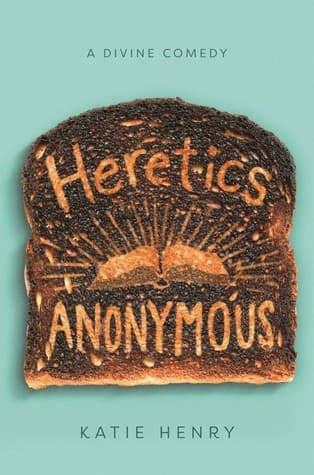
Katie Henry (2018)
Genre
Spirituality / Young Adult / Romance
Reading Time
6-8 hours
Key Themes
See below
Sign in to track this book
An atheist new to a strict Catholic school finds unexpected camaraderie and a fight for freedom among a secret society of religious rebels, led by a girl who dreams of becoming a priest.
Michael, a seventeen-year-old atheist, is once again the new kid, this time at St. Clare's, a strict Catholic high school in a new town. His father's job requires frequent relocation, making it difficult for Michael to form lasting friendships. On his first day, Michael immediately notices the school's religious atmosphere, from the crucifixes in every classroom to the mandatory theology lessons. During his first theology class, a spirited girl named Lucy challenges the teacher's interpretation of a religious text, catching Michael's attention. He initially assumes she's a fellow non-believer due to her questioning nature, hoping he might have found an ally in this unfamiliar environment. However, he soon learns that Lucy is not only Catholic but deeply committed to her faith, aspiring to become a priest, a role not permitted for women in the Catholic Church.
Intrigued by Lucy's outspokenness, Michael seeks her out. Lucy, in turn, introduces him to her secret group, 'Heretics Anonymous,' a club for students who feel marginalized or misunderstood by St. Clare's conservative environment. The group meets in a hidden room within the school library, providing a safe space for its members to express their true beliefs and identities without fear of judgment or reprisal. Michael learns that the group consists of diverse individuals: Lucy, the aspiring female priest; Avi, who is Jewish and gay; Max, a gender-nonconforming student who prefers to wear skirts; and Eden, who practices paganism. Michael, as an atheist, fits right in with their shared sense of being outsiders, finding a sense of belonging he's long wanted.
Inspired by their shared frustrations with St. Clare's restrictive policies, Michael encourages the Heretics to move beyond secret meetings and take active steps to challenge the school's hypocrisies. Their first mission targets the school's strictly enforced gendered dress code, which Max finds particularly oppressive. The group plans a coordinated act of defiance: Max wears a skirt, Avi wears a dress, and Michael wears Max's typical 'boy' clothes, and Eden wears a suit, while Lucy wears a tie. Their goal is to show the absurdity and unfairness of the rules. The protest causes a stir among students and faculty, drawing the attention of Father Michael, the school's principal, and setting the stage for future confrontations.
The Heretics continue their acts of subtle rebellion, but Michael's enthusiasm sometimes pushes the boundaries further than the others intend. During a theology class discussion about faith and reason, Michael, trying to provoke thought and expose what he perceives as dogmatism, makes a highly controversial and disrespectful comment about religious belief. His actions lead to immediate disciplinary action from the teacher and result in a suspension. This incident not only puts Michael in trouble but also draws unwanted attention to the entire Heretics Anonymous group. Father Michael and other school authorities begin to suspect the existence of an organized dissident group, increasing the pressure on the Heretics to be more cautious.
Determined to expose more of St. Clare's perceived hypocrisies, the Heretics turn their attention to the mandatory abstinence pledge that all students are required to sign. They decide to anonymously distribute a survey among the student body, asking about students' actual experiences with the pledge and their sexual activity. The results, when compiled, show a significant discrepancy between the signed pledges and the reality of student behavior, showing widespread non-compliance and the ineffectiveness of the policy. The Heretics then anonymously post these findings, causing a major scandal within the school and forcing the administration to confront the issue. This mission further solidifies their reputation as rebellious agents of change.
The school's annual play, a production of 'Romeo and Juliet,' is the next target for the Heretics' activism. Lucy is cast as Juliet, and the group discovers that the school administration intends to censor certain lines and themes deemed inappropriate for a Catholic school audience, particularly those related to suicide and premarital intimacy. The Heretics see this as another instance of the school's hypocrisy and control over artistic expression. They devise a plan to subtly reinsert the censored lines during the live performance, drawing attention to the censorship in a public forum. This act of defiance during a major school event further escalates the conflict between the Heretics and the St. Clare's leadership.
As the Heretics' missions become more daring, Michael's determination to challenge St. Clare's grows, often pushing the group into riskier territory. He becomes increasingly focused on 'winning' against the administration, sometimes losing sight of the group's original goal of creating a safe space for diverse beliefs. Lucy, while supportive of their cause, begins to express concern over Michael's escalating tactics. She worries that his actions are becoming too reckless and could jeopardize the entire group, potentially leading to expulsions or more severe consequences. This creates a growing tension between Michael and Lucy, as their approaches to activism diverge, with Lucy advocating for more strategic and less confrontational methods.
Driven by a desire for a definitive victory, Michael takes his most extreme and unauthorized step yet. He secretly compiles the Heretics' various grievances, manifestos, and personal stories into a document intended to expose St. Clare's hypocrisies to a wider audience. Without consulting the others, he uploads this 'Heretics Anonymous Manifesto' to a public online forum, hoping to gain external support and force the school's hand. This act, however, backfires dramatically. The manifesto is quickly traced back to the school, and the administration, now fully aware of the Heretics' existence, launches a full investigation. The group's anonymity is shattered, and all its members face severe disciplinary action, including possible expulsion.
The fallout from the manifesto's publication is swift and severe. Father Michael calls each of the Heretics in for questioning, threatening expulsion for their actions. The group is thrown into disarray, with members feeling betrayed and terrified of the consequences. Avi's parents are particularly upset, concerned about the impact on his college applications. Max faces renewed bullying. Eden retreats, and Lucy confronts Michael, furious that his recklessness has endangered everyone. The once-united front of Heretics Anonymous crumbles under the pressure, and Michael is forced to confront the negative repercussions of his solo, impulsive decision. He realizes he prioritized his own agenda over the safety and well-being of his friends.
Facing the anger and disappointment of his friends, Michael is forced to confront the consequences of his actions. He deeply regrets betraying their trust and endangering their futures. He makes a heartfelt apology to each member of the Heretics, acknowledging his mistakes and taking full responsibility for the manifesto. This act of humility and sincerity begins to mend the fractured relationships. Lucy, while still hurt, sees his genuine remorse. The group, despite their fear, slowly starts to come together again, realizing that their bond and shared values are stronger than the immediate crisis. Michael's journey of self-reflection allows him to understand the true meaning of friendship and collective action.
The Heretics are summoned to a formal expulsion hearing, where Father Michael and other school officials will decide their fate. Despite the earlier internal conflicts, the group decides to face the hearing together, presenting a united front. They argue for their right to freedom of expression and belief, pointing out the school's own stated values of compassion and community. Unexpectedly, some teachers and even a few students who were initially critical come forward to offer support, testifying to the Heretics' character and the importance of open dialogue. This show of solidarity, both from within and outside the group, demonstrates the impact they've had and the wider conversation their actions have sparked within St. Clare's.
After intense deliberations, the St. Clare's administration decides against expelling the Heretics. Instead, they receive a milder punishment, such as probation or community service, acknowledging the complexity of the situation and the students' intentions. More importantly, the school agrees to review some of its more restrictive policies, particularly the dress code and the approach to theology classes, showing a willingness to create a more inclusive environment. The Heretics, though no longer a secret society, continue to advocate for change, now with some official recognition. Michael learns that true faith is not necessarily in a deity, but in the power of friendship, standing up for what's right, and believing in oneself and others. The ending suggests a hopeful future for both the students and the school.
The Protagonist
Michael learns to balance his desire for justice with empathy for his friends, understanding that collective action and trust are more powerful than individual rebellion.
The Supporting
Lucy learns to navigate the complexities of her faith and her desire for change, finding a balance between challenging institutions and maintaining her personal beliefs.
The Supporting
Avi finds confidence in his identity and learns to stand up for himself and his beliefs within a challenging environment.
The Supporting
Max gains confidence in their self-expression and finds a community that celebrates their unique identity.
The Supporting
Eden learns to voice her beliefs and find strength in her unique spiritual path, supported by her friends.
The Antagonist
Father Michael reluctantly begins to acknowledge the need for change and dialogue within the school, moving slightly away from absolute rigidity.
The Supporting
Mr. Sullivan maintains his role as a teacher, subtly influenced by the Heretics' challenges to encourage more open discussion in his classroom.
The Supporting
Michael's Dad begins to understand the importance of his son's friendships and identity, beyond just academic success and fitting in.
The novel explores how young people navigate and assert their identities, especially when they differ from societal or institutional norms. Each member of Heretics Anonymous is on a journey of self-discovery, whether it's Michael embracing his atheism, Lucy reconciling her faith with feminism, Avi accepting his sexuality, Max expressing their gender identity, or Eden practicing paganism. The secret club provides a safe space for them to explore and affirm who they are, away from the judgment of St. Clare's. Their collective rebellion is as much about finding their individual voices as it is about challenging the school.
“"We were Heretics Anonymous. And we weren't just a secret club. We were a promise to each other, a promise to be ourselves, no matter what."”
A central theme is the tension between religious faith and rational inquiry, personified by Michael's atheism and Lucy's devout but questioning Catholicism. The book challenges the idea that these two concepts are mutually exclusive, suggesting that critical thinking can coexist with, and even strengthen, personal belief. The Heretics' discussions in theology class and their broader protests force characters to examine their own beliefs and the reasons behind them. Ultimately, the novel suggests that 'faith' can extend beyond religion to include faith in oneself, in friends, and in the power of collective action, bridging the gap between purely secular and purely religious perspectives.
“"Maybe faith wasn't about believing in something you couldn't see. Maybe it was about believing in the people right in front of you."”
The conflict between conforming to established rules and rebelling against perceived injustices is a driving force of the plot. St. Clare's represents the forces of conformity, with its strict dress codes, mandatory religious practices, and traditional doctrines. The Heretics, by contrast, embody rebellion, actively seeking to challenge these norms. The novel explores the motivations behind rebellion, the risks involved, and the impact it can have on both individuals and institutions. It also explores the nuances of rebellion, from quiet dissent to overt protest, and the moral dilemmas that arise when challenging authority, particularly when individual actions affect a collective.
“"Being a Heretic wasn't about tearing things down. It was about making space for something new to grow."”
Despite Michael's initial focus on individual rebellion, the overarching theme is the transformative power of community and friendship. The Heretics Anonymous group provides a vital support system for its members, offering a place where they can be authentic, understood, and accepted. It's within this community that Michael, Lucy, Avi, Max, and Eden find the courage to stand up for their beliefs. Michael's journey involves learning to prioritize the well-being of his friends over his personal agenda, realizing that true strength is in solidarity and mutual support. The book celebrates how shared experiences and a common purpose can create strong bonds and drive meaningful change.
“"I'd spent my whole life looking for a place to belong, and it turned out, belonging wasn't a place at all. It was these people."”
The novel frequently shows instances of hypocrisy within St. Clare's, contrasting the school's stated values with its actual practices. Examples include the abstinence pledge, the censorship of the school play, and the gendered dress code. The Heretics' missions are often designed to expose these hypocrisies, advocating for greater authenticity and integrity from the institution. This theme extends to the characters' personal journeys, as they strive to live authentically in a world that often pressures them to conform or hide parts of themselves. The conflict between the school's outward image and its internal realities drives much of the plot.
“"It was easy to preach about love and acceptance when you were the one in charge. It was harder to live it when you were the one being judged."”
A clandestine student group providing a safe space for diverse identities and a platform for rebellion.
The Heretics Anonymous club serves as the central plot device. It's a physical space (the hidden library room) and a conceptual space for the protagonists to gather, share their true selves, and plan their acts of defiance against St. Clare's. This device creates immediate conflict with the school's strict rules and fosters a strong sense of camaraderie and shared purpose among the diverse members. It allows for the exploration of various marginalized identities and beliefs, channeling individual frustrations into collective action. The secrecy itself adds tension and stakes to their missions.
Narrative told through the eyes of an atheist outsider, offering a critical lens on the Catholic school.
The story is narrated from Michael's first-person point of view. This perspective is crucial because Michael, as an atheist and the new kid, offers an objective, often critical, lens through which to view the traditions and rules of St. Clare's. His initial skepticism and outsider status allow the author to introduce and question the Catholic school environment for the reader. His internal monologues reveal his evolving understanding of faith, friendship, and his own identity, making his personal growth a central part of the narrative arc and allowing readers to experience the events through his developing perspective.
St. Clare's Catholic school functions as a smaller reflection of broader societal conflicts.
St. Clare's, with its rigid rules, diverse student body, and institutional authority, functions as a microcosm of larger societal conflicts between tradition and progress, conformity and individuality, and different belief systems. The struggles faced by the Heretics within the school – challenging gender norms, advocating for LGBTQ+ rights, questioning religious dogma, and fighting for freedom of expression – mirror real-world issues. This device allows the author to explore complex themes in a contained, relatable setting, making the characters' personal battles resonate with broader social discussions.
A document compiled by Michael that serves as a catalyst for the climax and resolution.
The 'Heretics Anonymous Manifesto' is a pivotal plot device. It represents Michael's most impulsive and far-reaching act of rebellion. Its anonymous publication initially seems like a victory but quickly leads to the exposure of the group and the core conflict of the climax. The manifesto forces the Heretics to confront the consequences of their actions, leading to internal conflict, apologies, and ultimately, a stronger, more honest form of solidarity. It acts as a turning point, pushing the narrative from covert operations to overt confrontation and resolution.
“I think it's okay to be a little bit of a heretic. It means you're thinking for yourself.”
— Michael says this to Lucy, encouraging her to question her beliefs.
“Faith isn't about having all the answers. It's about asking the right questions.”
— Lucy reflects on her evolving understanding of religion.
“Sometimes the most rebellious thing you can do is be kind.”
— A member of Heretics Anonymous discusses activism.
“You don't have to believe in God to believe in something bigger than yourself.”
— Michael explains his atheist perspective to Lucy.
“Rules are made by people, and people are flawed. So why should we follow them blindly?”
— A debate in Heretics Anonymous about institutional rules.
“Love isn't a sin. It's the most human thing there is.”
— Lucy defends her feelings in a conversation about romance.
“Being different isn't a curse. It's a superpower.”
— Michael encourages Lucy to embrace her uniqueness.
“The point of faith is to make you a better person, not to make you feel guilty.”
— Lucy challenges a strict religious teaching.
“If you're not making someone uncomfortable, you're not doing it right.”
— A humorous take on activism within Heretics Anonymous.
“Sometimes the bravest thing you can do is admit you don't know.”
— Lucy realizes the value of uncertainty in her journey.
“Tradition is just peer pressure from dead people.”
— A witty remark during a group discussion about customs.
“You can't find yourself if you're always trying to be someone else.”
— Michael advises Lucy on authenticity.
“Religion should be about love, not fear.”
— Lucy expresses her ideal view of spirituality.
“The world needs more questions and fewer answers.”
— Reflecting on the group's purpose of inquiry.
Ready to see how well you understood this book? Take our interactive quiz with 10 questions.

Biography coming soon.
Kay Lynn Mangum
4.3
Stormie Omartian
4.3
Jerry Bridges
4.3
Walter Brueggemann
4.3
Rhonda Byrne
4.3
Brother Lawrence
4.3
Joseph Campbell
4.3
Unknown
4.3