BookBrief
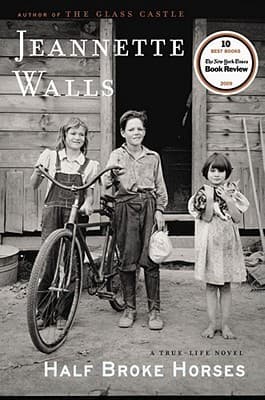
Half Broke Horses cover
Archivist's Choice

Half Broke Horses

Jeannette Walls (2009)

Genre

Biography / Memoir / History

Reading Time

270 min

Key Themes

See below

Track Your Reading

Sign in to track this book

At six, Lily Casey Smith broke wild horses; later, she piloted planes and managed a large Arizona ranch. Her life showed grit, resourcefulness, and a spirit that met every frontier challenge and personal tragedy.

Core Idea

"Half Broke Horses" tells the story of Lily Casey Smith, Jeannette Walls' grandmother, a woman who showed the independence and determination of the American frontier. The book suggests that real strength and self-reliance come from direct experience, hard work, and a commitment to one's own values, often against social norms. Walls uses many stories to show how Lily handled great personal loss, money problems, and the difficulties of pioneering life. She always chose practical solutions and an authentic life over sentiment or fitting in. The book highlights the effect of an education based on observation and hands-on learning, and the lasting power of a life lived fully, leaving a legacy richer than any money.
Reading time
270 min
Difficulty
Easy
✓ Read this if...
You are fascinated by stories of remarkable women, frontier life, resilience in the face of adversity, and unconventional approaches to education and living.
✗ Skip this if...
You prefer narratives with a strong emotional focus on introspection and vulnerability, or if you dislike stories where practicality often trumps sentiment.

Core idea

The central argument and framework that powers the entire book.

"Half Broke Horses" tells the story of Lily Casey Smith, Jeannette Walls' grandmother, a woman who showed the independence and determination of the American frontier. The book suggests that real strength and self-reliance come from direct experience, hard work, and a commitment to one's own values, often against social norms. Walls uses many stories to show how Lily handled great personal loss, money problems, and the difficulties of pioneering life. She always chose practical solutions and an authentic life over sentiment or fitting in. The book highlights the effect of an education based on observation and hands-on learning, and the lasting power of a life lived fully, leaving a legacy richer than any money.

At a glance

Reading time

270 min

Difficulty

Easy

Read this if...

You are fascinated by stories of remarkable women, frontier life, resilience in the face of adversity, and unconventional approaches to education and living.

Skip this if...

You prefer narratives with a strong emotional focus on introspection and vulnerability, or if you dislike stories where practicality often trumps sentiment.

Key Takeaways

1

Frontier Spirit: Self-Reliance as Survival

Embracing hardship and resourcefulness as a way of life in the untamed West.

Quote

Those old cows knew trouble was coming before we did.

Lily Casey Smith's life shows a deep self-reliance that came from the American frontier's harsh conditions. From a young age, she did demanding tasks like breaking horses. This skill taught her strength and an understanding of nature. This was not a philosophy but a practical need to survive where things were scarce and dangers common. Her ability to change, create, and stay determined when facing constant challenges — like natural disasters, economic problems, or personal losses — shows a basic idea of the frontier: that one's own sk...

Supporting evidence

By age six, Lily was helping her father break horses. Her journey alone on a pony for five hundred miles at fifteen to teach in a frontier town demonstrates extreme self-reliance.

Apply this

Cultivate practical skills and problem-solving abilities. Instead of immediately seeking external solutions, first assess what resources and ingenuity you possess to tackle challenges independently.

self-reliancefrontier-liferesilienceresourcefulness
2

Unconventional Education: Learning Beyond the Classroom

Life's lessons, often harsh, provide a more profound and practical education than formal schooling.

Quote

I loved cars even more than I loved horses. They didn't need to be fed if they weren't working, and they didn't leave big piles of manure all over the place.

Lily's education came mostly from experience, from directly engaging with the world rather than from school. She valued reading and became a teacher, but her most important learning came from doing things and from necessity. She learned to drive a car and fly a plane not from books, but by trying things and having a natural interest in how things worked. This way of learning gave her practical intelligence and an ability to adapt that formal education often misses. Her life shows that real understanding comes from doing, from solving ...

Supporting evidence

Lily learned to drive a car and fly a plane through personal initiative and hands-on experience, not through formal lessons. Her teaching career itself was in a frontier setting, demanding practical, adaptive methods.

Apply this

Seek out opportunities for hands-on learning and skill acquisition. Don't limit your education to traditional paths; embrace self-teaching and practical experience as valid, often superior, forms of knowledge.

experiential-learningpractical-intelligenceself-taughtadaptability
3

Defying Convention: Gender Roles on the Frontier

The demands of frontier life often blurred traditional gender lines, empowering women to break free.

Quote

She bristled at prejudice of all kinds -- against women, Native Americans, and anyone else who didn't fit the mold.

Lily Casey Smith's life is a strong example of how the frontier's harsh realities could accidentally break down strict gender expectations. In a world where survival depended on everyone contributing, the idea of 'women's work' often became unimportant. Lily's involvement in breaking horses, running a ranch, teaching in remote towns, and even flying a plane were not acts of rebellion against social rules, but simply what needed to be done. This environment created a deep rejection of bias, especially against women, because it showed t...

Supporting evidence

Lily helped break horses from a young age, rode alone for hundreds of miles to take a teaching job, and ran a vast ranch alongside her husband. Her disdain for prejudice is explicitly stated.

Apply this

Challenge societal expectations and stereotypes, especially those related to gender. Focus on competence and capability rather than conforming to predefined roles, and advocate for equality based on merit.

gender-rolesfeminismfrontier-womenequalityprejudice
4

Enduring Tragedy: Resilience in the Face of Loss

Personal heartbreak, while devastating, can forge an unbreakable spirit rather than defeat it.

Quote

Lily survived tornadoes, droughts, floods, the Great Depression, and the most heartbreaking personal tragedy.

Lily's life included not only adventures but also great personal loss. The book mentions a 'most heartbreaking personal tragedy,' which, along with the constant fight against natural disasters and money problems, would defeat many. Yet, Lily's spirit stayed strong. This ability to recover from devastating loss is a main idea, showing that while pain is certain, giving up is a choice. Her ability to keep going, to find purpose and joy despite deep sadness, shows great inner strength. It suggests that real strength is not about avoiding...

Supporting evidence

The narrative explicitly mentions Lily surviving 'the most heartbreaking personal tragedy,' alongside numerous natural disasters and the Great Depression.

Apply this

Develop coping mechanisms for grief and loss. Recognize that resilience is not the absence of pain, but the ability to persist and find meaning even after devastating experiences. Seek support but cultivate inner strength.

griefresiliencecoping-mechanismspersonal-tragedyendurance
5

Practicality Over Sentimentality: A Hard-Nosed Approach to Life

Survival often requires a pragmatic, unsentimental perspective on animals, possessions, and even relationships.

Quote

They didn't need to be fed if they weren't working, and they didn't leave big piles of manure all over the place.

Lily's preference for cars over horses, said with dry humor, perfectly shows her practical way of thinking. Her choices were often based on usefulness and efficiency rather than feelings. This does not mean she had no feelings, but that sentiment was a luxury she could not always afford in her difficult life. Whether managing animals, dealing with hard people, or making tough choices during economic downturns, Lily put first what worked, what was lasting, and what ensured survival. This practical, unsentimental approach let her handle...

Supporting evidence

Her statement about cars vs. horses, and her overall approach to ranching and survival, where animals are both companions and resources.

Apply this

When facing difficult decisions, prioritize practical outcomes and long-term sustainability over immediate emotional comfort or sentimentality. Learn to detach emotionally when necessary to make objective choices.

pragmatismpracticalitydecision-makingsurvival-skillsefficiency
6

The Power of Storytelling: Legacy Through Narrative

Passing down personal histories preserves a unique heritage and offers profound life lessons.

Quote

Rosemary Smith Walls always told Jeannette that she was like her grandmother, and in this true-life novel, Jeannette Walls channels that kindred spirit.

Jeannette Walls' choice to tell her grandmother's story in a 'first-person voice that is authentic, irresistible, and triumphant' shows the power of oral history and family stories. Through Lily's voice, Walls not only honors her grandmother's life but also keeps a vital part of American history — the story of the wild West and the people who lived there. This storytelling is more than just entertainment; it passes on values, strength, and wisdom through generations. It shows how personal stories, especially those of strong, unusual p...

Supporting evidence

Jeannette Walls explicitly states she is channeling her grandmother's spirit and voice, transforming family stories into a 'true-life novel.'

Apply this

Document and share your own family histories and personal experiences. Recognize the value of oral traditions and written memoirs in transmitting wisdom, values, and a sense of identity across generations.

storytellingoral-historyfamily-legacymemoirintergenerational-wisdom
7

Embracing Change: From Horses to Airplanes

A willingness to adapt to new technologies and evolving circumstances is key to thriving.

Quote

I loved cars even more than I loved horses. They didn't need to be fed if they weren't working, and they didn't leave big piles of manure all over the place.

Lily Casey Smith's excitement for cars and later, flying planes, despite her long connection to horses, shows a remarkable openness to new things and change. Her ability to not only accept but actively use new technologies says a lot about her forward-thinking mind. In a world that was quickly changing, she did not hold onto the past out of longing or fear; instead, she saw the practical benefits and chances that new inventions offered. This ability to adapt was important for her survival and success, letting her stay current and effe...

Supporting evidence

Her preference for cars over horses and her subsequent learning to fly a plane demonstrate a clear embrace of modern technology and a willingness to move beyond traditional methods.

Apply this

Actively seek out and learn about new technologies or methods relevant to your field or interests. Don't resist change out of habit; instead, evaluate its potential benefits and adapt your skills accordingly.

innovationadaptabilitytechnological-advancementprogressgrowth-mindset
8

Character Over Conformity: Living an Authentic Life

True strength comes from living by one's own principles, even if they defy societal expectations.

Quote

She bristled at prejudice of all kinds -- against women, Native Americans, and anyone else who didn't fit the mold.

Lily Casey Smith was a woman who always lived by her own rules, guided by an inner sense of fairness, hard work, and independence, rather than outside pressure to conform. Her 'bristling' at prejudice was not just quiet disapproval; it was an active rejection of narrow-mindedness and arbitrary social structures. This strong authenticity allowed her to create a unique path, whether teaching in a remote town, running a ranch, or simply saying her opinions openly. Her life shows that real character is built not by fitting in, but by stan...

Supporting evidence

Her independent decisions throughout her life (e.g., leaving home to teach, running a ranch) and her explicit rejection of various forms of prejudice.

Apply this

Identify your core values and strive to live in alignment with them, even if it means going against popular opinion or societal norms. Advocate for fairness and challenge prejudice when you encounter it.

authenticityintegritynonconformitypersonal-valuesindividualism
9

The Interconnectedness of Life: Man, Animal, and Land

Survival and prosperity on the frontier depend on a deep understanding and respect for the natural world.

Quote

Those old cows knew trouble was coming before we did.

Lily's first line immediately creates a deep connection between humans, animals, and nature. Her life on the ranch and her experiences breaking horses gave her an understanding of the land and its creatures. This was not just a romantic idea, but a practical need for survival. Knowing the subtle signs from animals, understanding weather patterns, and respecting nature's power were important skills. This deep connection meant that her fate was tied to the health of her animals, the land's fertility, and the weather's whims. It created ...

Supporting evidence

Her statement about the cows' foresight regarding trouble, and her life running a ranch, which demands constant interaction with and understanding of animals and the environment.

Apply this

Cultivate an awareness of your natural surroundings and the subtle cues from animals or the environment. Recognize your place within a larger ecosystem and strive for practices that promote balance and respect for nature.

ecosystemnature-connectionanimal-instinctenvironmental-awarenesssustainability

Critical analysis

Notable Quotes

You can't cling to the past, because no matter how much you try, it's already gone.

Lily's philosophy on life and moving forward.

I never had a plan. I just did what needed doing.

Lily reflecting on her pragmatic approach to life's challenges.

If you want to get ahead in life, you have to be willing to get your hands dirty.

Lily teaching her children about hard work and determination.

There's no point in crying over spilled milk, unless it's the last milk you got.

Lily's tough-love advice on dealing with minor setbacks.

A man should be able to do anything a woman can do, and vice versa.

Lily's belief in gender equality and self-sufficiency.

I was never afraid of anything. I just did what I had to do.

Lily describing her fearless approach to difficult situations.

The only way to keep your word is to never give it lightly.

Lily emphasizing the importance of integrity and promises.

You can't control what other people do, but you can control how you react to it.

Lily's wisdom about personal responsibility and emotional control.

Life is like a wild horse. You can either let it throw you, or you can ride it.

A central metaphor of the book, reflecting Lily's spirit.

Some folks are born with silver spoons, and some are born with a shovel. I got a shovel.

Lily acknowledging her humble beginnings and her work ethic.

I always figured if I could ride a horse, I could do anything.

Lily's confidence stemming from her skill and comfort with horses.

You gotta make your own luck.

Lily's belief in creating opportunities through effort, not waiting for them.

The world ain't always fair, but that don't mean you gotta give up.

Lily's pragmatic view on injustice and her enduring spirit.

Being a woman don't mean you can't be strong.

Lily's demonstration of female strength and challenging gender norms.

Quiz

Test Your Knowledge

Ready to see how well you understood this book? Take our interactive quiz with 10 questions.

10
Questions
~5
Minutes
?
Best Score

Key Questions (FAQ)

Half Broke Horses is a memoir by Jeannette Walls, chronicling the extraordinary life of her grandmother, Lily Casey Smith. It tells the story of a resilient woman who broke horses, taught in frontier towns, ran a vast Arizona ranch, and faced numerous challenges with an indomitable spirit.

About the author