“Thou hast made me endless, such is thy pleasure. This frail vessel thou emptiest again and again, and fillest it ever with fresh life.”
— The speaker reflects on the divine's continuous renewal of life.


Rabindranath Tagore (1910)
Genre
Spirituality / Philosophy
Reading Time
90 min
Key Themes
See below
Sign in to track this book
In "Gitanjali," Tagore's poems celebrate the divine, weaving together themes of devotion, nature, and the soul's search for the infinite.
“Thou hast made me endless, such is thy pleasure. This frail vessel thou emptiest again and again, and fillest it ever with fresh life.”
— The speaker reflects on the divine's continuous renewal of life.
“The song that I came to sing remains unsung to this day. I have spent my days in stringing and unstringing my instrument.”
— A poignant reflection on unfulfilled potential and the struggle of creation.
“Let all my senses burn in a flame of worship, and all my thoughts fly in a song of praise.”
— An expression of complete devotion and spiritual surrender.
“Where the mind is without fear and the head is held high, where knowledge is free...”
— A vision of an ideal, free society.
“My Lord, I know that I can never find You in the market-place, nor in the temple of the rich, nor in the solitary cell of the hermit.”
— Searching for the divine in everyday life rather than specific places.
“Death, thy servant, is at my door. He has crossed the unknown sea and brought thy call to my home.”
— Facing the inevitability of death with a sense of acceptance.
“I came to your shore as a stranger, I lived in your house as a guest, I leave your door as a friend, for I have known you, my world.”
— A metaphor for one's journey through life and relationship with the world.
“The child who is born in the house is not a stranger, but a familiar guest.”
— Reflecting on the innate connection between humans and the divine/universe.
“The morning will come, the darkness will vanish, and thy voice will pour down in golden streams.”
— A hopeful anticipation of divine revelation and the end of suffering.
“Deliverance is not for me in renunciation. I feel the embrace of freedom in a thousand bonds of delight.”
— Finding freedom and joy within worldly experiences, not by abandoning them.
“I have no sleep tonight. The time has come for my voyage, and I am to launch my boat.”
— A sense of readiness and anticipation for a new journey, possibly spiritual or literal.
“He whom I enclose with my name is weeping in this dungeon. I am ever busy building this wall all around myself.”
— A critique of ego and self-imposed limitations that separate one from the divine or others.
“My heart, the bird of the wilderness, has found its sky in your eyes.”
— A romantic or devotional expression of finding belonging and purpose in another.
“Light, oh where is the light? Kindle it with the burning fire of desire!”
— A passionate plea for enlightenment or divine guidance, driven by intense longing.
Ready to see how well you understood this book? Take our interactive quiz with 10 questions.
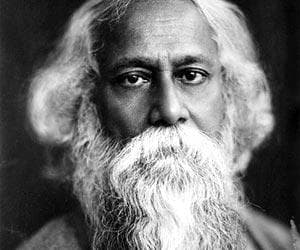
Rabindranath Tagore was a Bengali poet, writer, playwright, composer, philosopher, social reformer and painter. He reshaped Bengali literature and music as well as Indian art with Contextual Modernism in the late 19th and early 20th centuries. Author of the "profoundly sensitive, fresh and beautiful" poetry of Gitanjali, he became in 1913 the first non-European and the first lyricist to win the Nobel Prize in Literature. Tagore's poetic songs were viewed as spiritual and mercurial; however, his "elegant prose and magical poetry" remain largely unknown outside Bengal. He was a fellow of the Royal Asiatic Society. Referred to as "the Bard of Bengal", Tagore was known by sobriquets: Gurudeb, Kobiguru, Biswokobi.

Kay Lynn Mangum
4.3
Stormie Omartian
4.3
Jerry Bridges
4.3
Walter Brueggemann
4.3
Rhonda Byrne
4.3
Brother Lawrence
4.3
Joseph Campbell
4.3

Unknown
4.3