BookBrief
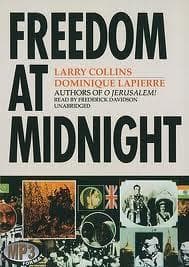
Freedom at Midnight cover
Archivist's Choice

Freedom at Midnight

Larry Collins (1975)

Genre

Politics / Biography / History

Reading Time

1200 min

Key Themes

See below

Track Your Reading

Sign in to track this book

This is the dramatic, bloody birth of India and Pakistan from the British Empire, as told through the final months of Lord Mountbatten's viceroyalty and the assassination of Mahatma Gandhi.

Core Idea

"Freedom at Midnight" chronicles the final year of British rule in India, ending with the country's independence and the devastating partition. The book argues that the hasty transfer of power, primarily by Lord Mountbatten under pressure and a tight deadline, worsened existing communal tensions and directly led to a humanitarian catastrophe. Through detailed accounts of political figures, ordinary citizens, and events, Collins and Lapierre show the human cost of political expediency and the scars left by the hurried redrawing of borders. The book asserts that while independence was inevitable, its execution was flawed and violent.
Reading time
1200 min
Difficulty
Medium
✓ Read this if...
You want a gripping, detailed, and human-centered account of India's independence and partition, exploring the political machinations and immense human tragedy.
✗ Skip this if...
You prefer a purely academic or dispassionate analysis of the events, or are looking for a concise overview rather than an immersive narrative.

Core idea

The central argument and framework that powers the entire book.

"Freedom at Midnight" chronicles the final year of British rule in India, ending with the country's independence and the devastating partition. The book argues that the hasty transfer of power, primarily by Lord Mountbatten under pressure and a tight deadline, worsened existing communal tensions and directly led to a humanitarian catastrophe. Through detailed accounts of political figures, ordinary citizens, and events, Collins and Lapierre show the human cost of political expediency and the scars left by the hurried redrawing of borders. The book asserts that while independence was inevitable, its execution was flawed and violent.

At a glance

Reading time

1200 min

Difficulty

Medium

Read this if...

You want a gripping, detailed, and human-centered account of India's independence and partition, exploring the political machinations and immense human tragedy.

Skip this if...

You prefer a purely academic or dispassionate analysis of the events, or are looking for a concise overview rather than an immersive narrative.

Key Takeaways

1

The Burden of Empire's End

The British departure from India was less a grand gesture and more a desperate scramble to escape an unsustainable dominion.

Quote

The British Empire, once a source of immense pride and power, had become an economic and moral albatross, its jewel in the crown now a burning ember they were desperate to drop.

The book portrays the pressure on Britain after WWII to give up India. The decision to grant independence was driven by a depleted treasury, a war-weary populace, and the impossibility of maintaining control over a restive subcontinent. The narrative shows the ironic twist where the 'jewel in the crown' had become a financial and administrative burden. The British, once masters of manipulation, found themselves outmaneuvered by Indian nationalism, leading to a hasty retreat that prioritized British interests over the stability of the ...

Supporting evidence

The authors detail the financial strain on post-war Britain, unable to sustain the administrative and military costs of governing India, and the political will in London for a rapid exit, exemplified by Prime Minister Clement Attlee's directive for a swift transfer of power.

Apply this

Leaders must recognize when an endeavor, no matter how historically significant, becomes an unsustainable drain on resources and adjust strategy for a timely and responsible exit, rather than prolonging an inevitable decline.


decolonizationpost-colonialismgeopolitics
2

Mountbatten's Hasty Handoff

Lord Mountbatten's accelerated timetable for independence exacerbated the chaos and violence of partition.

Quote

Mountbatten's 'surgical' approach to partition proved to be anything but, leaving a gaping wound that bled for decades.

The book critiques Lord Mountbatten's role as the last Viceroy, particularly his decision to move the date of independence from June 1948 to August 1947. While intended to minimize unrest, this acceleration had the opposite effect, compressing political negotiation into an impossible timeframe. The hurried demarcation of borders by Cyril Radcliffe, who had never visited India, and the lack of preparation for the mass migration, directly contributed to the scale of communal violence. Mountbatten appears as a figure driven by ambition, ...

Supporting evidence

Collins and Lapierre extensively document Mountbatten's unilateral decision to bring forward the independence date and the subsequent scramble to complete the partition process, including the Radcliffe Line's creation in just five weeks, without local consultation or proper demographic data.

Apply this

When managing complex transitions, especially those involving diverse populations, a rapid timetable without adequate planning and stakeholder involvement can lead to catastrophic unintended consequences. Prioritize thoroughness over speed.

partition-of-indialord-mountbattencommunal-violence
3

The Price of Freedom: Human Cost

The joy of independence was tragically overshadowed by an explosion of communal violence, displacement, and death.

Quote

The midnight hour of freedom was also the dawn of an unimaginable nightmare, as millions paid for independence with their lives and their homes.

Beyond the political events, 'Freedom at Midnight' shows the human toll of partition. The book details the massacres, rapes, forced conversions, and displacement that came with the creation of India and Pakistan. It paints a grim picture of trains arriving filled with corpses, of refugees trekking for hundreds of miles, and of families torn apart. This account is a powerful reminder that political decisions often have devastating consequences for ordinary people, transforming concepts of 'nation' and 'border' into experiences of terro...

Supporting evidence

The authors recount numerous eyewitness testimonies, stories of refugee trains, the systematic violence in Punjab and Bengal, and the overwhelmed administrative machinery trying to cope with the exodus.

Apply this

Policymakers must prioritize human security and well-being above political expediency, especially during periods of significant societal change. Anticipate worst-case scenarios and plan for humanitarian aid and conflict resolution.

human-rightsrefugee-crisisethnic-cleansing
4

Gandhi's Lonely Battle

Mahatma Gandhi, the architect of non-violence, found himself a tragic, isolated figure amidst the partition's bloodbath.

Quote

The apostle of non-violence, who had led India to freedom, found himself a prophet without honor in his own land, unable to quell the fires of hatred he had inadvertently helped to ignite.

The book presents a portrayal of Mahatma Gandhi in his final years. Having led India to independence through non-violent resistance, he was marginalized during the negotiations for partition. His pleas for unity and his attempts to bridge the Hindu-Muslim divide were largely ignored by the political leadership, who were more concerned with power and state-building. Gandhi's desperate fasts and visits to riot-torn areas were noble, but insufficient to stop the communal hatred. His assassination, detailed, is a tragic end to a life dedi...

Supporting evidence

The book describes Gandhi's diminishing influence in the Congress Party, his solitary efforts to bring peace to Calcutta and Delhi during the riots, and the details leading up to his assassination by Nathuram Godse.

Apply this

Even the most powerful moral leaders can be sidelined by political pragmatism and popular fervor. True leadership requires not only vision but also the ability to adapt strategies to prevent the subversion of core values.

mahatma-gandhinon-violencepolitical-marginalization
5

The Princely States: A Legacy of Anomaly

The integration of India's 565 princely states presented a unique and perilous challenge to the nascent nation.

Quote

The maharajas, once absolute rulers of their fantastical kingdoms, found their opulent worlds crumbling under the relentless march of modern nation-building.

A subplot of 'Freedom at Midnight' is the position of India's princely states. These semi-autonomous entities, from vast kingdoms to tiny enclaves, enjoyed extravagant lifestyles under British paramountcy but faced a crisis with independence. The book details the varied characters of the maharajas and their attempts to maintain their privileges or declare independence. Sardar Patel, with his diplomacy and coercion, played a role in integrating these states into the Indian Union. This process shows the arbitrary nature of colonial rule...

Supporting evidence

The authors provide colorful anecdotes about various maharajas, such as the Maharaja of Patiala's lavish lifestyle, and the political maneuvering involved in integrating states like Hyderabad and Junagadh.

Apply this

Nation-building requires decisive leadership and strategic integration of diverse elements, often necessitating a delicate balance of negotiation and firm action to overcome entrenched interests and historical anomalies.

princely-statessardar-patelindian-union
6

The Blame Game: Who's Responsible?

The book implicitly argues that responsibility for the partition's horrors lies with a confluence of British haste, Indian political ambition, and communal intransigence.

Quote

The seeds of partition were sown by British 'divide and rule,' nurtured by communal leaders, and harvested in a frenzy of political ambition and fear.

While not explicitly assigning blame, the narrative suggests a shared responsibility for the catastrophic outcomes of partition. The British are faulted for their 'divide and rule' policies and their hasty, unprepared exit. Indian leaders, particularly Nehru and Jinnah, are depicted as being too entrenched in their positions and too eager for power to prioritize a unified India over their political aspirations. The deep communal prejudices, inflamed by political rhetoric, are also highlighted as a driver of the violence. The book avoi...

Supporting evidence

The detailed accounts of Jinnah's unwavering demand for Pakistan, Nehru's desire for a strong central government, and Mountbatten's accelerated timetable all contribute to this complex picture of shared responsibility.

Apply this

Historical events, especially those with tragic outcomes, rarely have a single cause or culprit. Understanding the multiple contributing factors – political, social, and individual – is crucial for informed analysis and preventing future mistakes.

jinnahnehrudivide-and-rule
7

The Power of Individual Stories

The book's strength lies in its ability to humanize history through countless personal anecdotes and vivid character sketches.

Quote

History is not just about dates and treaties; it is the sum of countless human experiences, both grand and agonizingly personal.

Collins and Lapierre excel at bringing history to life through their research and focus on individual stories. From the maharajas to the experiences of refugees, the book grounds the events of independence in the lived realities of people from all parts of society. This approach makes the political narrative accessible and emotionally resonant. It shows that understanding history requires looking beyond grand narratives and appreciating the impact of events on ordinary individuals, whose voices often get lost in broader historical acc...

Supporting evidence

The inclusion of specific stories like the Maharaja of Nawanagar's passion for cricket, the plight of a Muslim family fleeing to Pakistan, or the British soldiers' emotional departure, enriches the historical account.

Apply this

When communicating complex information, integrate personal narratives and specific examples to make the content relatable, memorable, and impactful. Human stories are powerful tools for understanding and empathy.

oral-historyhistoriographynarrative-history
8

The Enduring Scars of Partition

The partition of India and Pakistan left deep, lasting wounds that continue to shape the geopolitics of the subcontinent.

Quote

The lines drawn in haste on a map became the fault lines of future conflicts, forever altering the destiny of a subcontinent.

Even decades after the events, 'Freedom at Midnight' shows that the consequences of partition are not just historical footnotes but living realities. The book implicitly connects the hurried and violent division to the ongoing tensions between India and Pakistan, particularly over Kashmir. The mass displacement created refugee populations that struggled for generations, and the communal hatreds during that period continue. This takeaway emphasizes that political decisions made under duress, especially those involving territorial and i...

Supporting evidence

While the book concludes with Gandhi's assassination in 1948, the detailed description of the creation of the borders and the subsequent migrations implicitly sets the stage for future conflicts like the Kashmir dispute and the enduring animosity between the two nations.

Apply this

When making decisions with far-reaching implications, especially those involving borders and ethnic groups, consider the long-term, intergenerational consequences and prioritize sustainable solutions over temporary fixes.

kashmir-conflictindo-pakistan-relationshistorical-trauma
9

The Spectacle of Power and Poverty

The narrative vividly contrasts the obscene wealth and privilege of the British Raj and Indian royalty with the widespread poverty of the masses.

Quote

Beneath the gilded surface of imperial grandeur and princely extravagance lay the undeniable bedrock of a nation's destitution.

The authors show the stark dichotomy that defined colonial India: the wealth and opulent lifestyles of the British administrators and the Indian maharajas, set against the backdrop of poverty, disease, and illiteracy among the majority of the Indian population. The book describes lavish banquets, extravagant palaces, and eccentric royal customs, juxtaposed with scenes of famine, overcrowded cities, and the struggles of ordinary people. This contrast is not just descriptive; it is a commentary on the injustices of the colonial system a...

Supporting evidence

The book details the extravagant ceremonies of the Raj, the maharajas' wealth (e.g., the jewels of the Nizam of Hyderabad), and the widespread poverty that Gandhi encountered on his travels.

Apply this

Understanding historical contexts requires acknowledging the power dynamics and economic disparities that often underpin societal structures, as these factors significantly influence political outcomes and social change.

colonialismsocioeconomic-inequalitybritish-raj

Critical analysis

Notable Quotes

The partition of India is not a settlement; it is a sentence of death.

Gandhi's reaction to the partition plan.

I am not a saint who has strayed into politics; I am a politician trying to be a saint.

Gandhi reflecting on his dual role.

The British are leaving India in a state of chaos and bloodshed.

Comment on the rushed British withdrawal.

We have a Muslim nation and a Hindu nation, but where is the Indian nation?

Critique of the two-nation theory.

Mountbatten's deadline was a ticking time bomb for millions.

On the rushed partition timeline.

The trains arrived full of corpses, a macabre exchange of populations.

Description of refugee trains during partition.

Jinnah's Pakistan was born in a hospital bed, not on the battlefield.

On Jinnah's ill health during independence.

Nehru's 'tryst with destiny' speech masked the bloodshed outside.

Contrasting Nehru's speech with partition violence.

The British divided and left; we are left to divide ourselves.

Criticism of colonial legacy.

Gandhi's fast was a moral weapon against a tide of hatred.

On Gandhi's fasts to stop violence.

The Radcliffe Line was drawn with a ruler, ignoring villages and hearts.

On the arbitrary partition boundaries.

Independence came at midnight, but freedom was delayed by bloodshed.

Reflecting on the title's irony.

Mountbatten's vanity cost more time than it saved.

Critique of Mountbatten's rushed approach.

The last Viceroy presided over the dissolution of an empire.

On Mountbatten's role in British withdrawal.

Quiz

Test Your Knowledge

Ready to see how well you understood this book? Take our interactive quiz with 10 questions.

10
Questions
~5
Minutes
?
Best Score

Key Questions (FAQ)

'Freedom at Midnight' is a historical narrative detailing the events surrounding Indian independence in 1947, focusing on the transition from British rule to the partition into India and Pakistan. It covers key figures like Lord Mountbatten and Mahatma Gandhi, and the violent aftermath of partition.

About the author