BookBrief
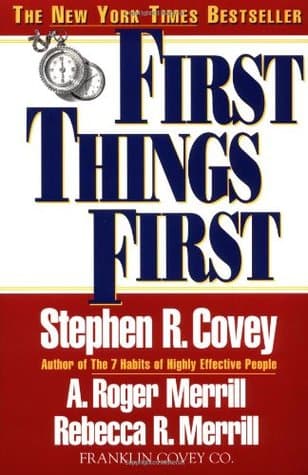
First Things First cover
Archivist's Choice

First Things First

Stephen R. Covey (2016)

Genre

Spirituality

Reading Time

10-12 hours

Key Themes

See below

Track Your Reading

Sign in to track this book

Move beyond daily tasks to align actions with values and prioritize what truly matters over what is merely urgent.

Core Idea

Stephen R. Covey's "First Things First" explains that good time management is really about managing oneself. It means putting principles ahead of schedules and focusing on important tasks instead of just urgent ones. The book suggests that typical time management systems often trap people in a cycle of urgency, causing them to neglect important but not urgent tasks (Quadrant II). It proposes a 'Principle-Centered Paradigm' where people match their daily activities with their core values and long-term goals. This creates a complete approach to productivity, blending personal, work, and spiritual aspects through weekly planning, delegation, and teamwork.
Reading time
10-12 hours
Difficulty
Medium
✓ Read this if...
You feel overwhelmed by urgent tasks, struggle to make time for important long-term goals, or want to align your daily actions with your core values and principles.
✗ Skip this if...
You are looking for a quick-fix productivity hack, prefer purely secular and tactical time management approaches, or dislike self-help books with a strong emphasis on spiritual and principle-based living.

Core idea

The central argument and framework that powers the entire book.

Stephen R. Covey's "First Things First" explains that good time management is really about managing oneself. It means putting principles ahead of schedules and focusing on important tasks instead of just urgent ones. The book suggests that typical time management systems often trap people in a cycle of urgency, causing them to neglect important but not urgent tasks (Quadrant II). It proposes a 'Principle-Centered Paradigm' where people match their daily activities with their core values and long-term goals. This creates a complete approach to productivity, blending personal, work, and spiritual aspects through weekly planning, delegation, and teamwork.

At a glance

Reading time

10-12 hours

Difficulty

Medium

Read this if...

You feel overwhelmed by urgent tasks, struggle to make time for important long-term goals, or want to align your daily actions with your core values and principles.

Skip this if...

You are looking for a quick-fix productivity hack, prefer purely secular and tactical time management approaches, or dislike self-help books with a strong emphasis on spiritual and principle-based living.

Key Takeaways

1

The Urgency Trap

Prioritizing the urgent over the important leads to a life of crisis management.

Quote

The key is not to prioritize what's on your schedule, but to schedule your priorities.

Covey states that many people fall into the 'urgency trap,' constantly reacting to immediate needs instead of working on what truly matters. This leads to a cycle of managing crises, where people feel busy but not fulfilled, because their actions do not match their core values and long-term goals. Urgent tasks often seem important, but real importance lies in activities that help our mission and well-being, even without immediate deadlines. Escaping this trap requires changing from a reactive to a proactive mindset, purposefully choos...

Supporting evidence

The time management matrix, which divides activities into four quadrants: Urgent/Important, Not Urgent/Important, Urgent/Not Important, and Not Urgent/Not Important. Covey emphasizes that most people spend too much time in Quadrants I and III.

Apply this

Regularly review your calendar and to-do list, identifying activities that are urgent but not important, and those that are important but not urgent. Deliberately block out time for Quadrant II activities like planning, relationship building, and self-renewal, even if there's no immediate pressure to do so.


time-management-matrixquadrant-iiproactive-livingcrisis-management
2

The Importance of Quadrant II

Focusing on not urgent, but important tasks is the cornerstone of effective personal management.

Quote

Quadrant II is the heart of effective personal management. It deals with things that are not urgent, but are important.

Quadrant II activities are those that help us reach long-term goals, personal growth, and well-being. These often get put off because they are not urgent. They include planning, prevention, building relationships, finding new opportunities, and self-care. Covey believes that consistently spending time on Quadrant II is the best way to improve life quality, lower stress, and achieve meaningful results. It is about investing in our future rather than just reacting to problems. Ignoring Quadrant II leads to many Quadrant I crises, as pre...

Supporting evidence

Covey's 'big rocks' analogy, where if you don't put the big rocks (important tasks) into the jar first, the sand (urgent tasks) and pebbles (trivial tasks) will fill it up, leaving no room for what truly matters.

Apply this

Identify your 'big rocks' for the week (1-3 key Quadrant II activities). Schedule these into your calendar first, treating them as non-negotiable appointments. Protect this time fiercely from interruptions and less important tasks.

quadrant-iiproactive-planningpersonal-missionlong-term-goals
3

Beyond the Clock: The Compass

True effectiveness comes from aligning actions with a personal mission, not just managing time.

Quote

The challenge is not to manage time, but to manage ourselves.

Covey challenges the usual idea of time management, saying that just organizing tasks on a schedule (the 'clock') is not enough. True effectiveness needs a 'compass' – a clear sense of direction from our deepest values and personal mission. The compass makes sure our clock-driven activities are meaningful and help our ultimate purpose. Without a compass, we might efficiently climb a ladder only to find it is leaning against the wrong wall. This idea highlights that self-management means aligning daily choices with our core beliefs and...

Supporting evidence

The contrast between the 'clock' (representing schedules, appointments, efficiency) and the 'compass' (representing vision, values, direction, effectiveness). Covey argues for the primacy of the compass.

Apply this

Develop a personal mission statement that clearly articulates your values, vision, and roles. Regularly review this statement (weekly or monthly) and use it as a filter for your daily and weekly planning, ensuring your actions are aligned with your 'compass.'

personal-mission-statementvalues-alignmenteffectiveness-vs-efficiencyprinciple-centered-living
4

The Power of the 'No'

Saying 'no' to the unimportant is essential for saying 'yes' to the important.

Quote

You have to decide what your highest priorities are and have the courage — pleasantly, smilingly, unapologetically — to say 'no' to other things. And the way to do that is to have a bigger 'yes' burning inside.

This idea stresses the importance of making choices and setting boundaries. In a world of constant demands and chances, being able to politely but firmly decline requests that do not match our Quadrant II priorities is essential. Covey emphasizes that saying 'no' is not about being unhelpful; it is about protecting the time and energy needed for our most important work. This courage comes from clearly understanding our 'bigger yes' – our personal mission and values. Without this clarity, we can easily get caught up in others' urgent n...

Supporting evidence

Covey's emphasis on the need for 'courage' to live by one's own priorities, often requiring one to 'sacrifice' popular or urgent requests for the sake of long-term effectiveness.

Apply this

Before committing to a new request or task, ask yourself: 'Does this align with my personal mission and Quadrant II priorities?' If not, practice politely declining, perhaps suggesting an alternative or explaining your current commitments to important projects.

boundary-settingprioritizationdiscernmentself-discipline
5

Interdependence: The Win-Win Synergy

Effective living extends beyond personal management to synergistic relationships.

Quote

The highest and best way to live is interdependently.

Covey extends the idea of 'first things first' to relationships, promoting a cooperative, 'win-win' approach. Real effectiveness is not just about individual productivity; it is about creating supportive relationships where everyone benefits. This means understanding others' needs and views, communicating well, and finding solutions that work for everyone. Ignoring relationships, even when pursuing personal goals, eventually harms long-term success, as most big achievements come from working together. Interdependence means valuing dif...

Supporting evidence

The 'win-win' paradigm, contrasted with 'win-lose,' 'lose-win,' and 'lose-lose' scenarios, as a principle for effective human interaction and collaboration.

Apply this

In team projects or personal relationships, actively seek to understand the other person's 'win.' Brainstorm solutions that address both your needs and theirs, aiming for outcomes where everyone feels respected and benefits. Invest time in 'relationship Quadrant II' activities like active listening and genuine appreciation.

interdependencewin-winsynergyempathic-communicationemotional-bank-account
6

The Weekly Planning Process

Regular, principle-centered weekly planning is crucial for living 'first things first.'

Quote

The best way to manage yourself is to start with the end in mind and then organize your life around your highest priorities.

Covey suggests a weekly planning process as the practical way to apply 'first things first.' This is more than a to-do list; it is a strategic review where you connect your personal mission and roles to your weekly activities. It involves identifying your main roles (e.g., spouse, parent, manager, community member), choosing 1-3 Quadrant II goals for each role, and then scheduling these 'big rocks' into your week before adding other tasks. This ensures your week is proactive, balanced, and aligned with your values, instead of just rea...

Supporting evidence

Covey's detailed explanation of the weekly planning process, which includes reviewing your mission, identifying roles, selecting Quadrant II goals, scheduling, and adapting daily.

Apply this

Dedicate 30-60 minutes at the start of each week (e.g., Sunday evening) to this planning process. Review your personal mission, identify your key roles, set 1-3 important (Quadrant II) goals for each role, and then schedule specific time blocks in your calendar to work on these goals.

weekly-reviewrole-identificationgoal-settingproactive-scheduling
7

Integrity and the Inner Scorecard

True success is measured by living in alignment with one's principles, not external validation.

Quote

If you live with integrity, you are free. You are not bound by the need to conform to others' expectations.

Covey emphasizes that integrity – matching our intentions and actions with our deepest values – is key to living effectively. It is about having an 'inner scorecard' where self-worth comes from living by our principles, rather than an 'outer scorecard' based on external approval or comparison. When we live with integrity, we build self-trust and inner peace. This helps us make tough choices and stay committed to our 'first things.' This internal consistency provides a strong base for all other parts of personal management and leadersh...

Supporting evidence

The concept of the 'inner scorecard' versus the 'outer scorecard,' illustrating that sustainable self-esteem comes from living congruent with one's conscience and principles.

Apply this

Regularly reflect on whether your daily actions align with your stated values and mission. If there's a disconnect, identify the cause and make a conscious effort to adjust your behavior. Practice keeping commitments to yourself, however small, to build self-trust.

integrityauthenticityself-trustprinciple-centered
8

The Four Human Needs

Holistic effectiveness requires addressing our physical, social, mental, and spiritual needs.

Quote

The greatest battles of life are fought daily in the chambers of the heart, and the arena of the mind.

Covey states that true effectiveness and well-being are not just about productivity. They are about fully nurturing our four basic human needs: physical (survival, health), social (love, belonging), mental (learning, growth), and spiritual (meaning, contribution). Ignoring any of these areas leads to imbalance and less ability. 'First Things First' is not just about scheduling tasks; it is about scheduling self-renewal activities that address all four dimensions, ensuring we are always improving. This balanced approach prevents burnou...

Supporting evidence

Covey's emphasis on the need for balance across four dimensions: physical, social/emotional, mental, and spiritual, as essential for 'sharpening the saw' and sustained effectiveness.

Apply this

In your weekly planning, ensure you schedule specific activities that address each of your four needs. For example, physical (exercise), social (quality time with loved ones), mental (reading, learning), spiritual (meditation, nature).

holistic-wellnessself-renewalsharpen-the-sawpersonal-growthbalance
9

Empowerment Through Delegation

Effective leaders delegate responsibility, not just tasks, to foster growth and trust.

Quote

Empowerment is not giving people power; people already have power. Empowerment is removing obstacles.

This idea covers leadership and team effectiveness. Covey distinguishes between 'gofer' delegation (telling someone exactly what to do) and 'stewardship' delegation (giving someone a desired result, guidelines, resources, accountability, and consequences). Stewardship delegation empowers people because it trusts them with responsibility and lets them use their creativity and judgment. It is a Quadrant II activity for leaders, as it builds skills in others, frees up the leader for higher-level work, and creates a culture of trust and i...

Supporting evidence

Covey's concept of 'stewardship delegation' compared to 'gofer delegation,' highlighting its role in empowering individuals and creating synergistic teams.

Apply this

When delegating, focus on the desired outcome rather than the exact steps. Clearly define the 'what' (desired result), 'how' (guidelines), 'resources,' 'accountability,' and 'consequences.' Provide support and be available for questions, but allow the individual autonomy in execution.

delegationempowermentstewardshipleadershiptrust
10

The Principle-Centered Paradigm

Living by timeless principles provides a stable foundation amidst change.

Quote

Principles are like lighthouses. They are natural laws that cannot be broken.

At the heart of 'First Things First' is the concept of principle-centered living. Covey argues that while practices and techniques change, universal principles (like fairness, integrity, human dignity, service, quality, potential, growth) are timeless. Building our lives and decisions on these principles gives us a firm foundation, a 'true north' in a constantly changing world. This shift moves beyond personality ethics or quick fixes to an ethic based on character, rooted in lasting truths. It ensures that our 'first things' are not ...

Supporting evidence

Covey's consistent reference to 'natural laws' or 'principles' (e.g., fairness, integrity, honesty, human dignity) as immutable foundations for effective living, contrasting them with transient techniques or personality traits.

Apply this

Identify the core principles that resonate most deeply with you. Regularly review your actions and decisions against these principles, ensuring they serve as your guiding light, especially when facing difficult choices or uncertainties.

principlescharacter-ethicnatural-lawsparadigm-shifttimeless-truths

Critical analysis

Notable Quotes

The key is not to prioritize what's on your schedule, but to schedule your priorities.

A central theme of the book, emphasizing proactive scheduling.

Most people spend their lives in Quadrants III and IV, putting out 'urgent' fires and escaping from them.

Referring to the Time Management Matrix, highlighting common pitfalls.

Effectiveness is doing the right things. Efficiency is doing things right.

Distinguishing between effectiveness and efficiency, prioritizing the former.

The main thing is to keep the main thing the main thing.

A concise summary of the importance of focusing on core priorities.

Quadrant II is the heart of effective personal management. It deals with things that are not urgent, but are important.

Highlighting the strategic importance of activities in the 'Quadrant II' of the Time Management Matrix.

Many people climb the ladder of success only to find it's leaning against the wrong wall.

Emphasizing the importance of vision and purpose before action.

To say 'yes' to important Quadrant II priorities, you have to learn to say 'no' to other activities, sometimes even good activities.

Discussing the necessity of sacrifice and clear boundaries for effective prioritization.

Unless you are clear about your mission and vision, you will be distracted by the many 'good' things that come your way.

Stressing the foundational role of personal mission statements.

A life of meaning and contribution is a life of Quadrant II.

Connecting the focus on important, non-urgent tasks to a fulfilling life.

The greatest battles of life are fought daily in the silent chambers of the soul.

Highlighting the internal, personal struggle for alignment and integrity.

You can't manage time; you can only manage yourself.

A fundamental reframing of time management as self-management.

The more you are driven by the urgent, the more you are driven by the things that are not important.

Warning against the trap of constant urgency and its impact on important goals.

Our challenge is not to manage time, but to manage ourselves from the inside out.

Emphasizing the internal locus of control and character-based approach.

The essence of Quadrant II management is to organize and execute around priorities.

A concise definition of the core principle of effective planning.

Quiz

Test Your Knowledge

Ready to see how well you understood this book? Take our interactive quiz with 10 questions.

10
Questions
~5
Minutes
?
Best Score

Key Questions (FAQ)

'First Things First' emphasizes a paradigm shift from time management to prioritizing what's truly important based on personal values and mission. It introduces the 'Urgent/Important Matrix' as a tool for effective self-management.

About the author