BookBrief
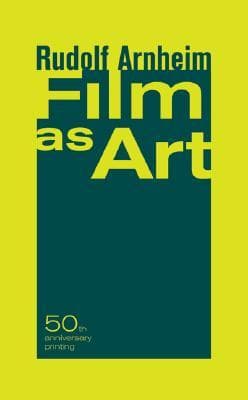
Film as Art cover
Archivist's Choice

Film as Art

Rudolf Arnheim (1957)

Genre

Creativity

Reading Time

240 min

Key Themes

See below

Track Your Reading

Sign in to track this book

Rudolf Arnheim's "Film as Art" argues that cinema's true artistry came from using its early limitations—silence, black-and-white, and flat images—creatively.

Core Idea

Arnheim states that film's artistic core comes not from perfectly copying reality, but from its unique qualities that make it change and simplify reality. He believes that the 'flaws' of film—like being two-dimensional, lacking natural color and sound (in early film), and framing a continuous world—force filmmakers to make specific artistic choices. This raises film beyond simple recording to a form capable of deep visual and emotional simplification. A true artist uses these medium-specific traits to create a new, aesthetically important reality.
Reading time
240 min
Difficulty
Hard
✓ Read this if...
You are a film student, filmmaker, or film theorist interested in the foundational aesthetic principles of cinema, particularly the early theories on film's unique artistic potential and its relationship to other art forms.
✗ Skip this if...
You are looking for a contemporary analysis of modern filmmaking techniques, an overview of film history, or a casual read on popular movies.

Core idea

The central argument and framework that powers the entire book.

Arnheim states that film's artistic core comes not from perfectly copying reality, but from its unique qualities that make it change and simplify reality. He believes that the 'flaws' of film—like being two-dimensional, lacking natural color and sound (in early film), and framing a continuous world—force filmmakers to make specific artistic choices. This raises film beyond simple recording to a form capable of deep visual and emotional simplification. A true artist uses these medium-specific traits to create a new, aesthetically important reality.

At a glance

Reading time

240 min

Difficulty

Hard

Read this if...

You are a film student, filmmaker, or film theorist interested in the foundational aesthetic principles of cinema, particularly the early theories on film's unique artistic potential and its relationship to other art forms.

Skip this if...

You are looking for a contemporary analysis of modern filmmaking techniques, an overview of film history, or a casual read on popular movies.

Key Takeaways

1

The Power of Imperfection

Art thrives not despite, but because of, its inherent limitations.

Quote

The very properties that make photography and film imperfect as copies of reality are the ones that make them perfect as media of art.

Arnheim's main point is that film's artistic nature developed from its early technical limits. The lack of sound, color, and true 3D in early cinema did not hinder but pushed filmmakers to innovate and simplify. This turned film from mere copying into real artistic expression. This idea challenges today's focus on hyperrealism, suggesting that the pursuit of perfect technology can lessen artistic potential by removing the very friction that sparks creativity. The limitations made filmmakers focus on composition, movement, light, and s...

Supporting evidence

Arnheim frequently references the early silent films, where the lack of dialogue necessitated exaggerated gestures, expressive cinematography, and innovative use of montage to convey narrative and emotion. He points out how the monochrome palette forced a heightened awareness of tonal contrasts and light manipulation.

Apply this

When approaching a creative project, instead of immediately seeking the most advanced tools or limitless resources, consider imposing deliberate limitations. How can constraints on budget, time, or available technology force more inventive solutions? Embrace the 'imperfections' of a medium as opportunities for unique artistic expression.
artistic-limitationmedium-specificitycreative-constraint
2

Perceptual Abstraction

Film's artistic value lies in its departure from literal reality, guiding our perception.

Quote

The film image is not a copy of reality, but a transformation of reality.

Arnheim says film is naturally an art of simplification because it cannot perfectly copy reality. This 'visual simplification' is not a flaw but its greatest strength. By flattening 3D space onto a 2D screen, removing color, and initially sound, film naturally distorts and simplifies reality. This simplification makes the viewer actively involved, filling in gaps and interpreting images. The filmmaker then guides, directing the viewer's attention and shaping their view of the world, instead of just recording it. This process shows how...

Supporting evidence

He discusses how the two-dimensional screen inherently flattens perspective and depth, making the viewer interpret spatial relationships rather than simply observe them. The absence of color forces the viewer to focus on form, line, and light values, enhancing the abstract quality of the image.

Apply this

When creating visual content, don't just aim to show reality as it is. Think about how you can manipulate perspective, color, or sound to guide the audience's attention and evoke specific emotions or interpretations. Consider what you *omit* as much as what you include, allowing the audience to actively participate in constructing meaning.

perceptual-psychologyvisual-abstractionviewer-engagement
3

The Silent Language of Form

Before words, film communicated through the universal grammar of visual composition.

Quote

The pure film is silent film. And the pure film is a medium for the presentation of events that take place in silence.

Arnheim favors silent cinema as the purest film art. He argues that sound, while adding realism, also lessened film's unique visual language. In silent films, meaning came only from visual composition, movement, rhythm, and the expressive power of the human face and body. This made filmmakers masters of visual storytelling, creating a universal language of forms that crossed language barriers. The lack of dialogue made every visual choice very important, leading to a deeper focus on the image's formal qualities. Sound, in this view, r...

Supporting evidence

He analyzes specific scenes from silent films, detailing how camera angles, framing, editing rhythm, and actor's gestures collectively built narrative and emotional impact without a single spoken word. The emphasis on the 'visual field' and its manipulation is central.

Apply this

When designing presentations, websites, or any visual communication, try to convey your core message without relying on text or spoken words. Focus on the power of imagery, layout, and visual flow. How much can you communicate through composition and visual metaphors alone?

visual-storytellingsilent-cinemaformal-composition
4

Depth on a Flat Screen

The illusion of three-dimensionality is a triumph of visual intelligence, not technological mimicry.

Quote

The two-dimensional surface of the screen is not a defect, but a condition of its art.

Arnheim carefully explains how film creates the illusion of depth from a flat medium. This is not a technical trick but a visual event, where the brain uses cues like perspective, overlapping objects, relative size, and atmospheric perspective to build a sense of 3D. The filmmaker purposely changes these visual cues, guiding the viewer's perception of space. This active building of depth by the viewer, rather than passively receiving existing depth, is what Arnheim finds artistically deep. It shows the creative interaction between the...

Supporting evidence

He details various 'depth cues' used in painting and early cinema: linear perspective, the diminishing size of distant objects, the obscuring of far objects by near ones, and the use of light and shadow to model form. He argues that these are not inherent properties of reality but artistic conventions employed to create an illusion.

Apply this

In photography or video, instead of relying solely on wide-angle lenses for a sense of depth, consciously compose your shots using foreground, midground, and background elements. Utilize overlapping, scale differences, and selective focus to guide the viewer's eye and create a compelling illusion of space.

depth-perceptionvisual-illusioncompositional-depth
5

The Frame as a World

The film frame is not a window to reality, but a self-contained, carefully composed visual universe.

Quote

The frame isolates a section of reality and thereby gives it a new significance.

For Arnheim, the film frame is more than a simple boundary; it is a deliberate act of choosing and highlighting. By cropping reality, the frame turns the ordinary into the important. What is included, and importantly, what is left out, becomes a strong artistic choice. This framing creates a self-contained visual world, where every element in the frame gains more importance and adds to the overall meaning. It rejects the idea that film just records; instead, it actively builds a new reality within its rectangular borders, making the v...

Supporting evidence

He discusses how close-ups isolate details, making them monumental, and how carefully composed wide shots can create a sense of balance or tension within the frame. The 'edge' of the frame is not arbitrary but a crucial artistic boundary.

Apply this

When taking a photograph or shooting a video, don't just point and shoot. Actively consider your frame. What do you *want* the viewer to see, and what do you *want* to exclude? How does the boundary of your frame enhance or change the meaning of your subject?

framing-compositionmise-en-scènevisual-selection
6

The Rhythm of Montage

Editing is not just cutting; it's the creation of a new, synthetic reality through sequence.

Quote

Montage is the art of combining separate shots in such a way that they create a new meaning that is not present in any of the individual shots.

Arnheim saw montage as one of film's most powerful artistic tools, an idea much influenced by Soviet filmmakers like Eisenstein. Montage, or editing, is putting individual shots together to create a new reality and meanings that go beyond the content of single shots. It involves rhythm, contrast, and intellectual connection. This creative sequencing lets filmmakers change time, space, and emotion, creating ideas and feelings impossible to show in a single, still frame. It turns film from a series of photos into a dynamic, flowing stor...

Supporting evidence

He cites examples of how rapid cutting can create tension or excitement, while slow, deliberate cuts can evoke contemplation. The Kuleshov Effect, where the same shot of an actor's face gains different meanings when juxtaposed with different images, is a prime example of montage's power.

Apply this

When telling a story through visuals, think beyond individual images. How can the sequence and pacing of your visuals create a specific emotional arc or intellectual argument? Experiment with different rhythms of cutting – fast, slow, abrupt, smooth – to achieve desired effects.

montage-theoryediting-techniqueskuleshov-effect
7

Expression Through Deformation

Art distorts reality to reveal deeper truths and emotions.

Quote

To be able to express, art must deform.

Arnheim states that art, including film, gets its expressive power not from exact reproduction but from purposely changing or styling reality. This 'change' is not a mistake but a conscious act that lets the artist emphasize certain aspects, distill emotions, and show hidden truths that might be obscured in a perfectly realistic depiction. It is the artist's personal view shaping the objective world, making the unseen visible. This idea applies to everything from exaggerated acting in silent films to the use of chiaroscuro lighting, w...

Supporting evidence

He points to expressionist painting and early German expressionist cinema (e.g., 'The Cabinet of Dr. Caligari') as prime examples where distorted sets, lighting, and acting convey psychological states and abstract ideas more powerfully than realism ever could.

Apply this

In your creative work, don't shy away from stylization or abstraction. Consider how you can intentionally distort or simplify elements to highlight a specific emotion, idea, or theme. What aspects of reality can you exaggerate or minimize to make your point more impactful?

expressionismstylizationartistic-distortion
8

The Spectator's Active Role

Viewing film is an act of co-creation, not passive reception.

Quote

The spectator is not a passive recipient but an active participant in the creation of the film's meaning.

A key part of Arnheim's theory is that the film viewer is not a passive receiver of images but an active participant in building meaning. Because film naturally simplifies reality and relies on visual cues and montage, the audience must actively use their visual and thinking skills to interpret what they see. They fill in missing sounds, guess depth, connect different shots, and project emotions onto characters. This active involvement makes the film experience so deep and personal. It is a joint effort between the filmmaker's intent ...

Supporting evidence

His entire framework of 'perceptual psychology' applied to film implies an active viewer. The way the brain constructs depth from 2D images, or meaning from juxtaposed shots (like the Kuleshov Effect), are examples of this active interpretation.

Apply this

When designing experiences or content, consider how you can empower your audience to be active participants. What elements can you leave open to interpretation? How can you encourage them to connect the dots, rather than simply spoon-feeding them information? Foster curiosity and engagement.

active-receptioncognitive-engagementinterpretive-viewer
9

Medium-Specific Art

True art arises from embracing and exploiting a medium's unique properties.

Quote

Art begins when the properties of the medium are understood and fully exploited.

Arnheim's work strongly argues for 'medium-specificity'—the idea that each art form has unique qualities that, when understood and used, define its artistic potential. For film, these unique qualities were initially its flatness, lack of color, and silence. He argues that when film tries to just copy reality or other art forms (like theater), it loses its artistic essence. True film art happens when filmmakers recognize and use what only film can do: change visual perception, create rhythmic montage, and simplify reality through the f...

Supporting evidence

He contrasts early film, which embraced its unique visual capabilities, with the 'talkies' that followed, which he felt often regressed by simply filming stage plays, thus neglecting film's unique strengths for a more mimetic approach.

Apply this

Whatever your creative pursuit, take time to deeply understand the fundamental characteristics of your medium. What can it do that no other medium can? How can you push its unique boundaries and exploit its inherent 'limitations' to create something truly distinctive and powerful?

medium-theoryart-philosophycreative-exploitation
10

Beyond Mimicry: The Essence of Art

Art's purpose is not to duplicate reality, but to transform and interpret it.

Quote

The artistic value of a picture does not depend on its closeness to reality, but on the power of its transformation of reality.

Ultimately, Arnheim's 'Film as Art' is a deep look at the nature of art itself. He argues against the simple view that art's main job is to copy reality. Instead, he sees art as a transformative act—a process of choosing, simplifying, and interpreting that reshapes reality to show deeper insights, bring out specific emotions, or explore universal ideas. For film, this transformation happens through its inherent visual limits and the filmmaker's deliberate choices in composition, lighting, and editing. This view frees art from the need...

Supporting evidence

His entire book serves as evidence, consistently demonstrating how film's 'imperfections' (2D, no color, no sound) are not defects but the very mechanisms through which it transforms reality into art, forcing interpretation and expression.

Apply this

When evaluating or creating art, shift your focus from 'how realistic is it?' to 'how does it transform reality?' or 'what new perspective does it offer?'. Embrace the idea that art's power lies in its ability to interpret and re-present the world, rather than simply reproduce it.

art-theoryaesthetic-philosophytransformation-art

Critical analysis

Notable Quotes

The true work of art is a challenge to the intellect, a stimulus to the imagination, and a delight to the senses.

General statement on the purpose and impact of art.

Film is an art precisely because it is not life, but an interpretation of life.

Distinguishing film as an artistic medium separate from mere reproduction of reality.

The camera does not merely record; it transforms.

Emphasizing the active role of the camera and filmmaker in shaping perception.

Art is not a mirror held up to reality, but a hammer with which to shape it.

Arguing for art's active, formative power rather than passive reflection.

Perception is not a passive reception of stimuli, but an active process of organization and interpretation.

Fundamental principle of Gestalt psychology applied to visual perception.

The essence of visual art is the creation of significant form.

Defining the core objective of visual arts, including film.

Creativity is the ability to connect the unconnected, to make new combinations of existing elements.

Explaining the mechanism behind creative thought and production.

The limitation of the medium is often the stimulus for creativity.

Highlighting how constraints can foster inventive solutions in art.

To see is to think.

Connecting visual perception directly with cognitive processes.

The artist does not reproduce what he sees, but makes us see.

Distinguishing artistic creation from mere imitation, focusing on guiding the viewer's experience.

A good film does not simply tell a story; it creates a world.

Emphasizing the immersive and comprehensive nature of effective filmmaking.

The medium itself has expressive qualities that the artist must master and exploit.

Stressing the importance of understanding and utilizing the inherent characteristics of a chosen artistic medium.

Art is not merely imitation, but a transformation of reality into a structured, meaningful experience.

Reiterating the transformative power of art and its ability to imbue reality with deeper meaning.

The spectator is not a passive recipient but an active participant in the creation of meaning.

Acknowledging the role of the audience in interpreting and completing the artistic work.

Quiz

Test Your Knowledge

Ready to see how well you understood this book? Take our interactive quiz with 10 questions.

10
Questions
~5
Minutes
?
Best Score

Key Questions (FAQ)

Arnheim argues that the artistic potential of film is rooted in its inherent limitations, particularly those present in early cinema such as the absence of sound, color, and three-dimensional depth. He posits that these very constraints forced creative solutions that defined film as an art form.

About the author