BookBrief
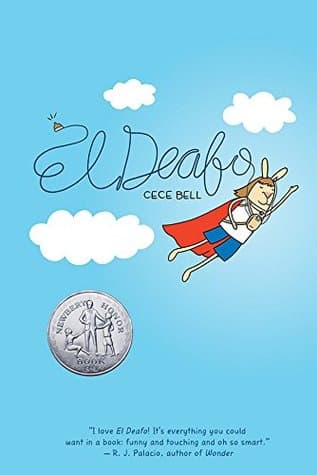
El Deafo cover
Archivist's Choice

El Deafo

Cece Bell (2014)

Genre

Biography / Memoir / Children's

Reading Time

120 min

Key Themes

See below

Track Your Reading

Sign in to track this book

Armed with a powerful hearing aid that grants her unexpected 'superpowers,' a young Cece navigates the isolating and often hilarious journey of finding friendship while embracing her deafness in a new school.

Core Idea

Cece Bell's "El Deafo" is a graphic memoir about her childhood experience with hearing loss, which began at age four after meningitis. The book shows her struggles with fitting in, understanding social cues, and using a large hearing aid called the Phonic Ear. Bell explains that while the device made her feel different and isolated at times, it also connected her to others in unique ways and became a symbol of her self-acceptance. In the story, she looks for friendship, deals with communication problems when she experiences the world differently, and turns a perceived disability into a strength and identity, using her superhero alter-ego, El Deafo. The main point is that accepting one's differences, instead of hiding them, helps with self-acceptance and making real friends. Bell shows how she learned that true friendship means understanding and valuing each other's unique perspectives, even when those perspectives come from different ways of experiencing the world.
Reading time
120 min
Difficulty
Easy
✓ Read this if...
You are a child or adult interested in a heartwarming, insightful, and often humorous graphic novel about growing up with a disability, the search for friendship, and self-acceptance. It's particularly good for understanding the experience of hearing loss.
✗ Skip this if...
You are not interested in graphic novels or memoirs, or prefer more adult-oriented themes and complex prose over a childhood perspective.

Core idea

The central argument and framework that powers the entire book.

Cece Bell's "El Deafo" is a graphic memoir about her childhood experience with hearing loss, which began at age four after meningitis. The book shows her struggles with fitting in, understanding social cues, and using a large hearing aid called the Phonic Ear. Bell explains that while the device made her feel different and isolated at times, it also connected her to others in unique ways and became a symbol of her self-acceptance. In the story, she looks for friendship, deals with communication problems when she experiences the world differently, and turns a perceived disability into a strength and identity, using her superhero alter-ego, El Deafo.

The main point is that accepting one's differences, instead of hiding them, helps with self-acceptance and making real friends. Bell shows how she learned that true friendship means understanding and valuing each other's unique perspectives, even when those perspectives come from different ways of experiencing the world.

At a glance

Reading time

120 min

Difficulty

Easy

Read this if...

You are a child or adult interested in a heartwarming, insightful, and often humorous graphic novel about growing up with a disability, the search for friendship, and self-acceptance. It's particularly good for understanding the experience of hearing loss.

Skip this if...

You are not interested in graphic novels or memoirs, or prefer more adult-oriented themes and complex prose over a childhood perspective.

Key Takeaways

1

The Phonic Ear: A Double-Edged Sword

A powerful hearing aid becomes both a source of connection and alienation.

Quote

The Phonic Ear was big. It connected to a giant battery pack that I had to wear in a special harness on my chest. I called it my 'chest pack.' It was heavy and clunky, and it made me feel like an alien.

Cece's Phonic Ear is the main technological item that shapes her early school experience. It helps her hear her teacher, but its size and visibility make her feel noticeably different. The device amplifies sound and sends it to her hearing aids, giving her a unique advantage by letting her hear her teacher from anywhere. This 'superpower' initially makes her feel in control and even mischievous. However, it also highlights her difference, making her an object of curiosity or pity, which hinders her desire for normalcy and real connect...

Supporting evidence

Cece's initial excitement about being able to hear her teacher's private conversations from a distance, such as when her teacher is in the staff room or bathroom, contrasts sharply with her self-consciousness about wearing the device and explaining it to new friends.

Apply this

When considering assistive technology, prioritize not only its functional benefits but also its social and emotional impact. Design should aim for integration and subtlety to minimize feelings of 'otherness,' while also empowering users to embrace their unique abilities.

assistive-technologysocial-stigmaidentity-formation
2

The Quest for True Friendship

Navigating the complexities of childhood friendships with a disability.

Quote

All I wanted was a friend. A real friend. Someone who wouldn't just be nice to me because I was deaf, but because they liked *me*.

Cece's journey is a search for real friendship. Her deafness and the visible Phonic Ear often make others see her primarily through that lens, leading to well-meaning but ultimately unsatisfying interactions. She meets different kinds of friends: the overly helpful, the bossy, and those who struggle to understand her experience. She wants not just companionship, but someone who sees past her disability to her true self, someone who can communicate honestly without pity or excessive accommodation. This shows the universal childhood des...

Supporting evidence

Cece's experiences with various friends, like Laura who is overly protective, Ginny who is bossy and dismissive of her hearing needs, and Mike who tries to 'fix' her hearing, all illustrate the struggle to find a balanced, respectful friendship. Her eventual connection with Martha, who accepts her for who she is, marks a turning point.

Apply this

Encourage open dialogue about differences in friendships. Teach children (and adults) to look beyond superficial traits or disabilities and strive for understanding and empathy, fostering relationships based on mutual respect rather than pity or obligation.

childhood-friendshipsocial-acceptancedisability-awareness
3

Embracing 'El Deafo' as a Superpower

Reclaiming a perceived weakness as a source of strength and identity.

Quote

I was El Deafo! Listener for All! I could hear things no one else could hear. It was a superpower.

At first, Cece sees her Phonic Ear as a burden, but she slowly rethinks her deafness and the device as a source of unique power. The 'El Deafo' persona is her way of coping, turning feelings of isolation and difference into a secret strength. This superhero alter ego lets her explore the advantages her hearing aid gives her, such as overhearing teacher conversations, and gives her a sense of control over her condition. This change from victim to hero is important for her self-esteem and identity. It shows how powerful it is to reframe...

Supporting evidence

Cece's internal monologues and fantasies where she imagines herself as 'El Deafo,' complete with a cape and a powerful 'listening' ability, especially when she uses the Phonic Ear to her advantage or when she feels misunderstood by others.

Apply this

Encourage creative self-expression and imaginative play in children facing challenges. Help them find ways to reframe their 'differences' as unique strengths or 'superpowers,' fostering resilience and a positive self-image.

self-empowermentidentity-reclamationcoping-mechanisms
4

The Burden of Communication

The constant effort required to bridge the communication gap.

Quote

It was exhausting. Always trying to figure out what people were saying, always trying to make sure they understood me. Sometimes I just wanted to give up.

The memoir clearly shows how tiring it is to be deaf in a hearing world. Cece's daily life is a continuous effort to interpret sounds, read lips, and make sure others understand her. This is not just about hearing; it is about the mental effort of constant attention, the frustration of miscommunication, and the emotional toll of feeling left out or misunderstood. The book shows how hearing people often take communication for granted, while for someone like Cece, it is a huge task requiring great concentration and resilience. This ongo...

Supporting evidence

Multiple instances where Cece struggles to understand conversations in noisy environments, at parties, or when people speak too quickly. Her frustration when friends forget to face her or speak clearly, or when she has to repeatedly ask for clarification, underscores this burden.

Apply this

Practice active listening and clear communication. When interacting with individuals with hearing impairments, remember to face them, speak clearly (not shouting), and be patient. Encourage empathy by recognizing the effort involved in bridging communication gaps.

communication-barrierscognitive-loadempathy-building
5

The Invisibility of Internal Struggle

The disconnect between outward appearance and inner emotional turmoil.

Quote

On the outside, I probably looked okay. But on the inside, I felt like a big, messy knot of worries and questions.

Cece's graphic novel format effectively shows the gap between her outward appearance and her inner emotional world. While she may seem like a 'normal' child, her internal world is full of anxiety, self-consciousness, and longing. The visual medium lets readers see her thoughts, fears, and fantasies (like El Deafo) that others around her do not see. This shows a universal truth: many struggles, especially those about identity and difference, are internal and often go unnoticed by others. It shows why it is important to look beyond surf...

Supporting evidence

The contrast between Cece's seemingly calm facial expressions in certain panels and the accompanying thought bubbles filled with anxieties about her Phonic Ear, misunderstandings, or fears of not fitting in. Her 'El Deafo' fantasies are a key visual representation of her internal world.

Apply this

Cultivate a culture of empathy and curiosity. Encourage children to ask questions and listen attentively to peers, rather than making assumptions. For adults, remember that a person's outward presentation may not reflect their inner state, especially when dealing with invisible disabilities or challenges.

emotional-literacyinvisible-disabilityself-perception
6

The Unintentional Gaffes of Well-Meaning People

Even attempts at kindness can be hurtful when lacking understanding.

Quote

They meant well, I knew they did. But sometimes 'meaning well' just made things worse.

The memoir has many examples where well-meaning friends or adults unintentionally make Cece feel more isolated or 'othered.' From friends who speak too loudly or too slowly, to those who treat her with too much pity, or even teachers who single her out, these actions, though not malicious, often reinforce her feeling of being different. This shows an important point: empathy requires not just good intentions but also real understanding and sensitivity to individual experiences. Without this deeper insight, even kind acts can be clumsy...

Supporting evidence

Examples include Laura's overly protective behavior, Ginny's impatience when Cece can't hear, Mike trying to 'fix' her hearing by speaking into the Phonic Ear, and teachers asking her to demonstrate her hearing aid to the class without her consent.

Apply this

Educate oneself and others on disability etiquette and inclusive communication. Before acting, consider whether your 'help' is truly helpful and desired, or if it inadvertently reinforces stereotypes or disempowers the individual. Prioritize listening and asking rather than assuming.

disability-etiquettemicroaggressionsunconscious-bias
7

Finding Your Tribe: The Power of Shared Experience

The comfort and validation found in connecting with others who understand.

Quote

It was so nice to be with other kids who understood. Who didn't need me to explain everything. Who just *knew*.

Despite her initial wish to fit into the hearing world, Cece also finds comfort and validation in connecting with other deaf children. Her time at her old deaf school, and later moments of shared understanding with others who are hard of hearing, show the power of 'finding your tribe.' In these interactions, the need for explanation lessens, and there is an inherent understanding that goes beyond words. This shows why affinity groups and communities are important, where individuals with shared experiences can feel truly seen, heard, a...

Supporting evidence

Cece's nostalgic reflections on her deaf school, where communication was effortless and everyone understood the challenges of hearing loss. Later, her brief but powerful connection with another hard-of-hearing child, Martha, who truly 'gets' her experience.

Apply this

Support and create spaces for affinity groups and communities based on shared experiences, especially for marginalized groups. Recognize that while inclusion in the mainstream is vital, so is the opportunity to connect with others who share a similar journey for validation and support.

community-buildingshared-identitybelonging
8

The Universal Experience of Childhood Difference

While specific, Cece's story resonates with anyone who has felt 'other.'

Quote

Being different wasn't always easy. But maybe everyone felt different sometimes. Maybe that was just part of growing up.

While 'El Deafo' is a memoir about growing up deaf, its main themes are universally relatable. Cece's struggles with fitting in, finding her identity, navigating friendships, and dealing with self-consciousness are common experiences for many children, especially during formative years. Her deafness is a metaphor for any perceived difference—whether it is wearing glasses, having a unique hobby, or coming from a different background. The book uses a specific disability to explore the broader human experience of wanting to belong while ...

Supporting evidence

The narrative arc of Cece's journey, from initial self-consciousness about her Phonic Ear to her eventual acceptance and embrace of her 'El Deafo' identity, mirrors the broader developmental process of self-acceptance many children undergo regarding their own perceived differences.

Apply this

Use this book as a tool to foster empathy and discuss the universal aspects of feeling different. Encourage children to share their own experiences of feeling unique and to recognize that everyone has their own 'Phonic Ear' moments, promoting understanding and inclusivity.

universal-themesidentity-developmentchildhood-experiences
9

The Visual Language of a Graphic Memoir

How the medium itself amplifies the emotional and sensory experience.

Quote

The pictures helped me tell my story in a way that words alone never could. You could *see* what it felt like.

The graphic novel format is not just for looks; it is important to the story's impact. The visual medium lets Bell show the nuances of her experience in ways that text alone cannot. Readers can 'see' the fragmented sounds, the isolation of not understanding, the overwhelming nature of noise, and the internal world of her imagination. The use of rabbit characters makes the story approachable and universal, while visual cues for sound (or lack of it), thought bubbles, and character expressions powerfully communicate Cece's emotional sta...

Supporting evidence

The visual representation of sound waves (or their absence), the Phonic Ear's 'superpower' range extending through walls, the exaggerated facial expressions of characters, and the thought bubbles that reveal Cece's inner monologues and anxieties.

Apply this

Recognize the power of diverse storytelling formats. When exploring complex or sensory experiences, consider how visual narratives, comics, or multimedia can enhance understanding and empathy for audiences, especially children.

graphic-memoirvisual-storytellingsensory-representation

Critical analysis

Notable Quotes

MY EARS DON'T WORK!

Young Cece realizing her hearing loss after meningitis.

I was a superhero, and my Phonic Ear was my superpower.

Cece describing how she reimagined her hearing aid.

The Phonic Ear made me different, but it also made me special.

Cece reflecting on her unique experience with the device.

I just want to be normal.

Cece's internal struggle with wanting to fit in.

Being deaf is not a problem. It's just... different.

Cece's growing understanding of her condition.

I couldn't hear, but I could still see everything.

Cece observing social dynamics, often from a distance.

Maybe being different isn't so bad after all.

Cece's evolving thoughts on her uniqueness.

It was like having a secret superpower, but also a secret weakness.

Cece on the dual nature of her Phonic Ear.

The world was full of sounds I couldn't hear, but also full of people I wanted to connect with.

Cece's desire for connection despite her hearing loss.

I just wanted someone to understand.

Cece's longing for empathy and understanding from peers.

Sometimes it was hard to tell if people were being nice because they genuinely liked me, or because they felt sorry for me.

Cece's anxieties about social interactions and motives.

It was just me, El Deafo, ready for anything.

Cece fully embracing her superhero alter ego.

Friendship is a two-way street. Sometimes you have to take the first step.

Cece learning about the effort required in building friendships.

What if I never find a true friend?

Cece's fear and worry about making genuine connections.

Quiz

Test Your Knowledge

Ready to see how well you understood this book? Take our interactive quiz with 10 questions.

10
Questions
~5
Minutes
?
Best Score

Key Questions (FAQ)

'El Deafo' is a graphic novel memoir by Cece Bell that chronicles her experiences growing up deaf after contracting meningitis, navigating a new school, making friends, and learning to embrace her hearing aid, which she imagines as a superpower.

About the author

Cece Bell

Cece Bell is a critically acclaimed author and illustrator known for her poignant and humorous graphic novels for young readers. Her most famous work, 'El Deafo,' is a New York Times bestseller and a recipient of a Newbery Honor, celebrated for its honest portrayal of childhood, hearing loss, and finding one's place. Bell's work often draws from her own experiences, making it relatable and inspiring.